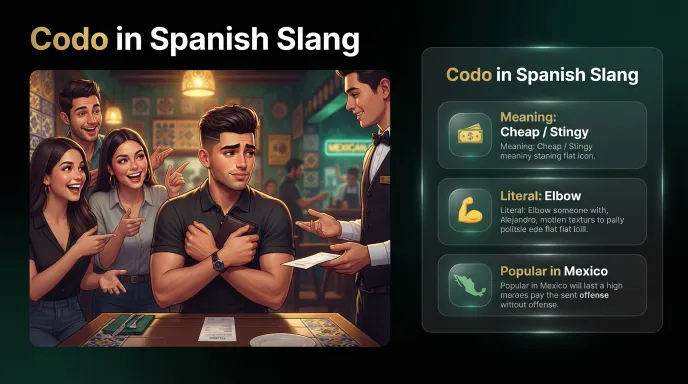
Codo in Spanish slang means a cheap or stingy person who does not like spending money or sharing expenses.
It is one of the most common slang words in Mexican Spanish and is usually used in casual conversations with friends and family.
If you’ve seen someone say “No seas codo” or wondered what codo in Spanish slang means, you’re in the right place.
In this guide, you’ll learn its meaning, where it’s commonly used, if it’s rude, real-life examples, and when you should avoid using it.
Quick Answer
Codo is a Spanish slang word that describes someone who is cheap, stingy, or unwilling to spend money. Although the literal meaning of codo is “elbow,” its slang meaning refers to a person who avoids paying or sharing expenses. It is especially common in Mexico and is usually used in informal conversations.
What Does Codo in Spanish Slang Mean?
The slang meaning of codo is a person who is reluctant to spend money, share costs, or treat others. In English, the closest words are cheap, stingy, miserly, or tight with money.
Unlike many internet slang terms, codo is a traditional regional slang word that has been part of everyday Spanish conversations for many years.
Literal Meaning
In standard Spanish, codo simply means “elbow.”
Example:
- Me golpeé el codo.
- Translation: I bumped my elbow.
When talking about the human body, there is no slang involved.
Slang Meaning
When used informally, codo describes someone’s attitude toward money rather than a body part.
Examples:
- No seas codo.
- Translation: Don’t be so cheap.
- Mi hermano es muy codo.
- Translation: My brother is very stingy.
The meaning is usually clear from the conversation.
Does Codo Have a Full Form?
No. Codo is not an acronym or abbreviation.
It is a complete Spanish word with two different meanings:
| Word | Meaning |
| Codo | Elbow (literal meaning) |
| Codo (slang) | Cheap or stingy person |
Unlike abbreviations such as LOL, BRB, or WFH, codo does not stand for anything else.
Different Meanings of Codo
Depending on the context, codo can have more than one meaning.
1. Body Part
The original meaning is the elbow.
Example:
- Me duele el codo.
- Translation: My elbow hurts.
This meaning is standard Spanish and is understood everywhere.
2. Cheap or Stingy Person
The slang meaning refers to someone who dislikes spending money.
Example:
- Pedro nunca invita el café. Es muy codo.
- Translation: Pedro never buys coffee. He’s very cheap.
This is the meaning most people are referring to when they search for codo in Spanish slang.
3. Playful Teasing
Among friends and family, codo is often used jokingly rather than seriously.
Example:
- ¡Qué codo eres! Siempre esperas que los demás paguen.
- Translation: You’re so cheap! You always wait for everyone else to pay. If it sounds funny or insulting depends on your tone of voice and relationship with the other person.
Where Is Codo Commonly Used?
Codo is most closely associated with Mexican Spanish, although many Spanish speakers in other countries also understand it.
You may hear it in:
- Conversations between friends
- Family gatherings
- School or college
- Restaurants
- Shopping trips
- Casual text messages
- Facebook comments
- Instagram posts
- WhatsApp chats
- Spanish-language memes
Unlike modern internet slang, codo did not originate on social media. However, people frequently use it online when chatting in Spanish.
Is It Used on TikTok or Instagram?
Yes, but only because Spanish speakers naturally use it in their posts, comments, and videos.
It is not a TikTok-specific slang word or a trending internet abbreviation.
Is It Used in Text Messages?
Yes.
Spanish speakers often send short messages like:
- No seas codo
- Qué codo eres.
- Invita algo, codo.
These messages are usually playful when sent between close friends.
Is Codo Rude, Offensive, or Harmless?
Codo is generally considered mild slang rather than a serious insult. Most people use it jokingly with friends or family, but it can sound rude if said in an argument or to someone you don’t know well.
The tone depends more on how you say it than the word itself.
| Situation | How It Sounds |
| Friends joking together | Harmless and playful |
| Family teasing | Usually friendly |
| Speaking to a stranger | Can sound rude |
| During an argument | Insulting |
| Workplace or business | Better avoided |
When It Sounds Friendly
Friends often call each other codo after someone refuses to buy snacks, coffee, or lunch.
Example:
No seas codo. Compra unas papas para todos.
Translation: Don’t be so cheap. Buy some chips for everyone.
When It Can Be Offensive
If you use codo to criticize someone in front of others, it may embarrass them.
For example:
Siempre eres tan codo.
Translation: You’re always so cheap.
In this situation, the comment may feel more like an insult than a joke.
Real-Life Examples of Codo in Spanish Slang
The easiest way to understand codo is by seeing it used in everyday conversations.
Friends Splitting a Bill
Luis: Quién paga la pizza?
Carlos: Mejor pagamos cada uno.
Luis: ¡Qué codo eres!
Translation:
Luis: Who’s paying for the pizza?
Carlos: Let’s each pay for our own.
Luis: You’re so cheap!
Family Conversation
Mom: Compra helado para todos.
Son: Mejor otro día.
Mom: No seas codo.
Translation:
Mom: Buy ice cream for everyone.
Son: Maybe another day.
Mom: Don’t be stingy.
Text Message
Ana: Compraste los boletos?
Sara: No todavía.
Ana: No seas coda.
Translation:
Ana: Did you buy the tickets?
Sara: Not yet.
Ana: Don’t be cheap.
Note: Coda is the feminine form used for a woman or girl.
Social Media Example
Mi amigo nunca invita el café. Es bien codo.
Translation: My friend never buys coffee. He’s really cheap.
This type of light-hearted joke is common in Spanish-language posts and memes.
Origin and History
The exact origin of the slang meaning of codo is uncertain, so there is no single confirmed explanation.
What linguists and Spanish language references agree on is that codo has been used in Mexican Spanish for many decades to describe someone who is unwilling to spend money.
Unlike newer slang that spreads through social media, codo became popular through everyday spoken language. Over time, it also appeared in television shows, movies, and comedy, making it familiar to many Spanish speakers.
Is It Still Popular Today?
Yes.
Although some regions use different words, codo remains a common slang term in Mexico and continues to appear in daily conversations, text messages, and social media posts.
Similar Slang and Related Terms
Several Spanish words have meanings close to codo, but each has a slightly different tone.
| Word | Meaning | Common Use |
| Tacaño | Stingy | Standard Spanish |
| Agarrado | Cheap | Common in Latin America |
| Cicatero | Miserly | Used in some regions |
| Miserable | Extremely stingy | Strong criticism |
| Ahorrador | Good saver | Positive meaning |
Codo vs. Tacaño
These two words are similar but not identical.
| Codo | Tacaño |
| Informal slang | Standard Spanish |
| Especially common in Mexico | Used across the Spanish-speaking world |
| Often playful | More neutral |
| Best for casual conversations | Suitable in both spoken and written Spanish |
If you’re learning Spanish, tacaño is usually safer in formal situations, while codo sounds more natural among Mexican friends.
Why Do People Use Codo?
People use codo because it is a quick and familiar way to describe someone who doesn’t like spending money.
It is commonly used to:
- Joke with friends
- Tease family members
- Describe someone’s personality
- Comment on group expenses
- Make conversations more natural
In many cases, the speaker is not trying to insult anyone. Instead, the word adds humor to the conversation.
Why Context Matters
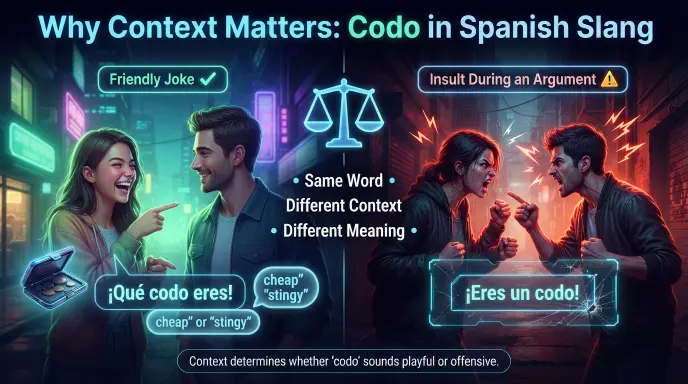
The same word can sound completely different depending on your tone.
For example:
- Smiling: “No seas codo.”
- Angry: “Eres muy codo.”
The first usually feels playful, while the second sounds like criticism.
Common Misunderstandings
Many Spanish learners misunderstand codo because they only know its literal meaning.
It Always Means “Elbow”
No.
The word codo can mean either elbow or a stingy person, depending on the context.
It Is Used Everywhere
Not exactly.
While many Spanish speakers understand it, the slang meaning is most strongly associated with Mexico. Other countries may prefer different words.
It Is a Serious Insult
Usually not.
Most of the time, it is light teasing between people who know each other well.
It Is Internet Slang
No.
Although people use it on social media and in text messages, codo existed long before the internet and is considered regional Spanish slang rather than online slang.
When Should You Avoid Using It?
Although codo is usually a mild slang term, it is not appropriate in every situation. Because it describes someone negatively, it’s best to use it only when you’re sure the other person will take it as a joke.
Avoid using codo in these situations:
- Speaking to your boss or manager
- Talking to teachers or professors
- Addressing customers or clients
- Meeting someone for the first time
- Formal business conversations
- Serious arguments where it could make the situation worse
Better Choices in Formal Situations
Instead of calling someone codo, you can use more neutral expressions such as:
- Careful with money
- Budget-conscious
- Financially cautious
- Frugal
- Good at saving money
These phrases sound more respectful and are less likely to offend someone.
Polite Alternatives
If you want to express the same idea without sounding negative, here are some better options.
| Word or Phrase | Meaning | Tone |
| Frugal | Spends money carefully | Positive |
| Budget-conscious | Watches spending | Neutral |
| Careful with money | Doesn’t overspend | Neutral |
| Financially responsible | Manages money wisely | Positive |
| Ahorrador (Spanish) | Good saver | Positive |
Notice that being frugal is not the same as being codo. A frugal person saves money wisely, while a codo is often seen as unwilling to spend money even when it’s reasonable.
Why Do People Search for “Codo in Spanish Slang”?
Many English speakers encounter the word while:
- Watching Mexican TV shows or movies
- Listening to Spanish-language music
- Reading comments on Facebook or Instagram
- Chatting with Spanish-speaking friends
- Learning Spanish
- Traveling in Mexico
Since codo has both a literal and a slang meaning, it can be confusing without context. That’s why many learners search online to understand what someone really meant.
Frequently Asked Questions
Q1. What does codo mean in Spanish slang?
Codo means a cheap, stingy, or miserly person. It describes someone who doesn’t like spending money or sharing expenses.
Q2. Does codo literally mean elbow?
Yes. In standard Spanish, codo means elbow. However, in informal conversations, it can also describe someone who is cheap with money.
Q3. Is codo considered rude?
Not usually. Among friends and family, it is often playful. However, using it with strangers, coworkers, or during an argument may sound insulting.
Q4. Is codo mainly used in Mexico?
Yes. The slang meaning is most common in Mexican Spanish, although many Spanish speakers in other countries understand it.
Q5. Is codo an internet slang word?
No. Codo is a traditional regional Spanish slang word. People use it online, but it did not originate on social media or as a texting abbreviation.
Q6. Can I use codo at work?
It’s better not to. Since the word criticizes someone’s behavior, avoid using it in professional or formal sett
Q7. Does codo mean cheap in Spanish?
Yes. In Spanish slang, codo means someone who is cheap, stingy, or unwilling to spend money, especially in Mexican Spanish.
Q8. Why does codo mean cheap?
The exact origin is uncertain, but codo has long been used in Mexican Spanish as slang for a person who doesn’t like spending money.
Q9. What is the meaning of Codo?
Codo literally means “elbow” in Spanish, but as slang it means a cheap or stingy person.
Q10. How do Mexicans say “okay”?
Mexicans commonly say “órale,” “va,” “sale,” or simply “ok”, depending on the situation and level of formality.
ings.
Q11. Is there a feminine form of codo?
Yes. When referring to a woman or girl, Spanish speakers often say coda.
Example:
No seas coda.
Translation: Don’t be so cheap.
Conclusion
Codo in Spanish slang refers to someone who is cheap, stingy, or unwilling to spend money, especially in Mexican Spanish.
While the word literally means “elbow,” its slang meaning is widely recognized in casual conversations among friends and family.
In most situations, codo is used as playful teasing rather than a harsh insult. However, context matters. It can sound rude if used with strangers, in the workplace, or during an argument.
If you’re learning Spanish or traveling in Mexico, understanding this common slang term will help you better follow everyday conversations and avoid misunderstandings.
Explore More Articles:

Hi, I’m Tyler Brooks, a writer specializing in Gen Z culture and internet slang. I track trending terms across TikTok and social media to explain their real-world meanings. My goal is to provide clear, accurate, and up-to-date definitions that help readers understand modern online language.