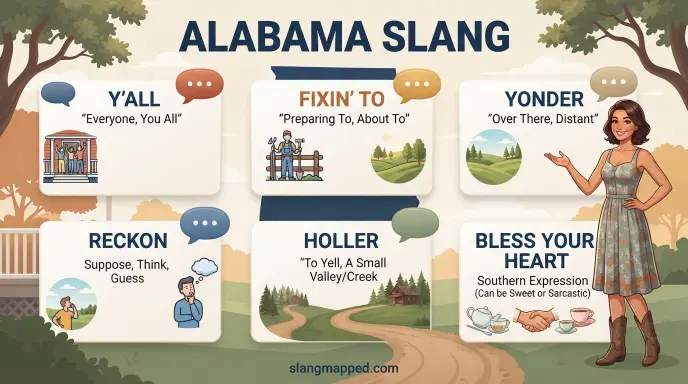
Alabama slang includes informal Southern words and phrases that you may hear in everyday conversations, family gatherings, country communities, and online posts.
Some terms are strongly associated with the South, while others are common across much of the United States.
Words like y’all, fixin’ to, reckon, and holler can sound unusual if you did not grow up around Southern speech. Their meanings are often simple, but their tone can depend on the speaker and situation.
Alabama speech also reflects the wider Southern American English tradition. That means not every expression listed here is unique to Alabama. Some are shared with neighboring Southern states.
This guide explains common Alabama slang in plain English, shows how people use it, and points out phrases that can change meaning depending on context.
Quick Answer: Alabama Slang at a Glance
| Question | Answer |
| Meaning | Informal words and expressions associated with Alabama and Southern speech |
| Tone | Usually casual, friendly, humorous, or regional |
| Used By | Alabama residents and other Southern speakers |
| Common Places | Conversation, texting, social media, family settings |
| Offensive? | Usually no, but some phrases can sound rude or sarcastic depending on context |
The important point is that “Alabama slang” is not one fixed dictionary of words. Alabama has different communities and speech styles, so vocabulary can vary by age, location, family, and social setting.
Common Alabama Slang Words and Phrases
Here are some expressions you are likely to encounter in Alabama or the broader South.
| Alabama/Southern Term | Meaning | Example |
| Y’all | You all / you people | “Are y’all coming over?” |
| Fixin’ to | About to do something | “I’m fixin’ to leave.” |
| Yonder | Over there, usually at some distance | “The barn is over yonder.” |
| Holler | Small valley; also to shout | “They live down in the holler.” |
| Reckon | Think, suppose, or believe | “I reckon we should go.” |
| Howdy | Hello | “Howdy! How are you?” |
| Bless your heart | Can express sympathy, affection, or criticism | “Bless your heart, you tried.” |
| Ain’t | Informal form used for several negative constructions | “I ain’t going.” |
| Might could | Might be able to | “I might could help tomorrow.” |
| Over yonder | Over there | “Your shoes are over yonder.” |
| All get-out | Extremely or very | “It was hot as all get-out.” |
| Tump | Tip or knock something over | “Don’t tump that cup.” |
| Cut the light off | Turn the light off | “Can you cut the light off?” |
| Carry on | Continue behaving or making noise | “The kids were carrying on.” |
| Mess | A large amount or group of something | “We picked a mess of beans.” |
Some of these expressions are not exclusive to Alabama. They are better understood as part of Southern American English, with some being especially familiar in Alabama.
What Does “Y’all” Mean in Alabama?
Y’all is the informal plural form of “you.” It can mean you all or simply address more than one person.
For example:
“Are y’all ready to eat?”
Here, the speaker is talking to a group.
One reason y’all stands out is that it is useful in everyday conversation. English does not have a widely used standard plural form of “you,” so y’all fills that gap naturally.
It can also appear in texting:
“Are y’all coming tonight?”
Today, y’all is used far beyond Alabama and the South. You can see it in social media posts, messages, advertising, and casual conversation across the United States.
What Does “Fixin’ to” Mean?
Fixin’ to means about to do something or getting ready to do something.
For example:
“I’m fixin’ to head home.”
This means:
“I’m about to go home.”
The phrase is strongly associated with Southern American speech. It does not mean someone is repairing something in this context.
Another example
“We’re fixin’ to start dinner.”
The speaker means dinner will begin soon.
It is casual, so it is better suited to conversation and informal writing than formal business communication.
What Does “Yonder” Mean?
Yonder means over there, often referring to a place that is some distance away.
You might hear:
“The truck is parked over yonder.”
The word gives the sentence a distinctly Southern or rural feel.
It does not always identify an exact distance. The meaning depends on the speaker and the situation.
What Is a “Holler”?
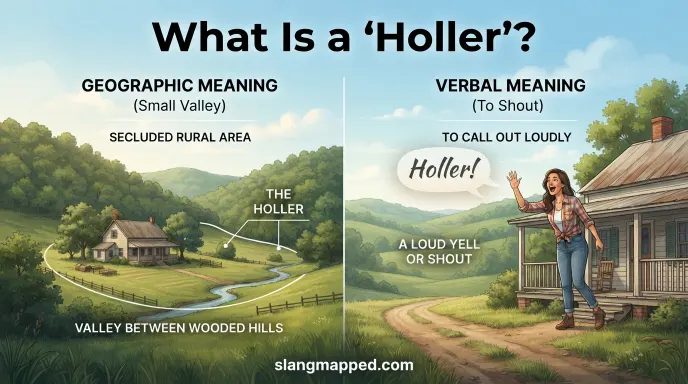
In Southern speech, holler can refer to a small valley, especially in a rural or mountainous area.
It can also be an informal pronunciation of holler, meaning shout or call out loudly.
For example:
“He lives down in the holler.”
Here, holler refers to a geographic place.
But:
“Holler if you need me.”
Here, it means call out or shout.
Context tells you which meaning is intended.
What Does “Reckon” Mean?
Reckon can mean think, suppose, or believe.
For example:
“I reckon it’s going to rain.”
This means:
“I think it’s going to rain.”
It often sounds relaxed and conversational. It is not limited to Alabama, but it is familiar in Southern speech.
“Bless Your Heart”: Friendly or Insulting?
Bless your heart is one of the most misunderstood Southern expressions.
It can be sincere.
“You lost your wallet? Bless your heart. I hope you find it.”
In that situation, the phrase can show sympathy.
But it can also be sarcastic:
“He thinks he knows everything. Bless his heart.”
Here, the speaker may be gently criticizing the person.
The tone matters
The words alone do not tell you the full meaning. Voice, facial expression, relationship, and context can change the message.
That is why assuming “bless your heart” always means something nice can lead to confusion.
Why Does Alabama Slang Sound Different?
Alabama is part of the broader Southern United States, where regional speech has developed over many generations.
Southern American English includes differences in:
- Vocabulary
- Pronunciation
- Grammar
- Sentence patterns
- Expressions
- Informal speech
Alabama itself is not linguistically identical from one area to another. Someone from Birmingham may not use exactly the same expressions as someone from a rural community in another part of the state.
Age also matters. Some expressions are common in older Southern speech but may sound less common among younger speakers.
Where Alabama Slang Is Used
Alabama-related slang and Southern expressions can appear in many settings, but the tone usually changes depending on where they are used.
| Platform or Setting | How It May Appear | Example |
| Text Messages | Short, casual conversation | “Y’all still coming?” |
| TikTok | Southern humor and regional speech | “I’m fixin’ to go.” |
| Captions and casual comments | “Y’all look amazing!” | |
| Family and community posts | “Y’all come by Sunday.” | |
| Discord | Informal chat | “I reckon we can win.” |
| Regional discussions and jokes | “I’m from Alabama, and we say y’all a lot.” | |
| Everyday Speech | Conversations with friends and family | “It’s hot as all get-out.” |
Not every Alabama expression is equally common on every platform. Online users may also use Southern words as part of jokes, memes, character voices, or regional identity.
Alabama Slang vs. General Southern Slang
It is useful to separate Alabama-specific speech from expressions used across the South.
| Expression | Alabama | Wider South |
| Y’all | Common | Very common |
| Fixin’ to | Familiar | Common |
| Yonder | Familiar | Common |
| Reckon | Familiar | Common |
| Bless your heart | Familiar | Common |
| Holler | Familiar, especially in some rural contexts | Common in some Southern areas |
| Howdy | Used | Used across many regions |
| Might could | Heard in Southern speech | Regional |
This distinction matters because calling every Southern expression “Alabama-only slang” would be misleading.
Is Alabama Slang Still Used Today?
Yes, many Southern expressions remain part of everyday speech, but usage varies.
Some words, such as y’all, are extremely familiar and have spread well beyond the South. Other expressions may be more strongly associated with rural or older Southern speech.
Social media has also made regional expressions easier for people outside Alabama to see and imitate.
That does not mean every Alabama resident uses every term on this list. Regional slang is influenced by community, age, family, and personal speech habits.
Is Alabama Slang Positive, Negative, or Rude?
Most Alabama and Southern expressions are not inherently offensive.
Their tone depends heavily on context.
For example:
- “Y’all” → Usually neutral and friendly.
- “Howdy” → Usually friendly and casual.
- “Fixin’ to” → Casual and informal.
- “Reckon” → Usually neutral and conversational.
- “Bless your heart” → Can be kind or sarcastic.
- “Ain’t” → Informal; not automatically rude.
A regional word may sound funny or unusual to someone unfamiliar with Southern speech, but that does not make it offensive.
Formal or Informal?
Most of the expressions in this article are informal.
They work well in:
- Conversations
- Text messages
- Social media
- Casual emails
- Friendly posts
- Family conversations
For formal academic or professional writing, standard wording is usually clearer.
For example:
Informal:
“I’m fixin’ to send it.”
More formal:
“I’m about to send it.”
The first sounds conversational. The second fits a wider range of formal situations.
Real-Life Alabama Slang Examples
Text Message
Maddie: “Are y’all still coming over?”
Tessa: “Yep. We’re fixin’ to leave now.”
Here, y’all addresses a group, while fixin’ to means “about to.”
Family Conversation
Caleb: “Where’s Grandpa?”
Nora: “He’s over yonder by the garden.”
Here, over yonder simply points to a place nearby but not immediately next to the speaker.
Friendly Conversation
Jordan: “I reckon we should leave before the rain starts.”
Marcus: “Good idea.”
In this example, reckon means “think” or “suppose.”
Social Media Caption
“Y’all really showed up for us today!”
Here, y’all gives the caption a warm, informal tone.
Casual Joke
Avery: “You dropped your whole plate.”
Dylan: “Well, bless my heart.”
Here, the phrase is being used humorously rather than as a serious expression of sympathy.
Common Mistakes With Alabama Slang
Assuming Every Southern Word Is Unique to Alabama
Alabama shares many speech patterns with other Southern states. A word being common in Alabama does not automatically make it Alabama-exclusive.
Taking “Bless Your Heart” Literally
The phrase can be sincere, playful, or sarcastic. Listen to the speaker’s tone and look at the situation.
Using Slang in Every Sentence
Regional expressions work best when they sound natural. Overusing them can make speech sound forced.
Thinking “Y’all” Is Always Plural
In many cases, y’all clearly refers to several people. In modern informal usage, however, some speakers also use it when addressing a general audience or an individual informally.
Assuming All Alabama Residents Speak the Same Way
Alabama has many communities and speech patterns. Regional and personal differences matter.
Key Takeaways
- Alabama slang is closely connected to broader Southern American English.
- Y’all, fixin’ to, reckon, and yonder are familiar Southern expressions.
- Not every Southern expression is unique to Alabama.
- Bless your heart can be sincere or sarcastic depending on context.
- Most Alabama slang is informal rather than offensive.
- Usage varies by age, community, location, and personal speaking style.
FAQs About Alabama Slang
Q1. What is a common Alabama slang word?
Y’all is one of the most recognizable Southern expressions you may hear in Alabama. It means “you all” and is commonly used when speaking to a group. It is not exclusive to Alabama and is now widely understood across the United States.
Q2. What does “fixin’ to” mean in Alabama?
Fixin’ to means “about to” or “getting ready to.” For example, “I’m fixin’ to go home” means “I’m about to go home.” It is an informal expression associated with Southern American English.
Q3. What does “bless your heart” mean in Alabama?
“Bless your heart” can express sympathy, affection, humor, or sarcasm. The intended meaning depends on the speaker’s tone and situation. Someone may use it kindly when comforting a person or sarcastically when commenting on someone’s behavior.
Q4. Do people in Alabama still use Southern slang?
Yes, many Southern expressions are still used, although usage varies by person, age, community, and location. Some terms are also common outside Alabama. Social media has helped regional expressions reach people across the United States.
Q5. Is Alabama slang offensive?
Most Alabama and Southern slang is not offensive by itself. Words such as “y’all,” “howdy,” and “reckon” are generally casual. However, certain expressions can become rude or sarcastic depending on the speaker, context, and tone.
Q6. What does “over yonder” mean?
“Over yonder” means “over there,” often referring to a place that is some distance away. It is a familiar Southern expression. For example, “The truck is over yonder” means the truck is over there.
Q7. Is Alabama slang the same as Southern slang?
No. Alabama speech is part of the larger Southern American English tradition, so many expressions overlap with speech in other Southern states. Some local vocabulary may be more common in particular Alabama communities, but there is no single list of slang used by everyone in the state.
Q8. Can I use Alabama slang if I am not from Alabama?
You can use familiar Southern expressions in casual conversation, but context matters. Using a phrase naturally is different from exaggerating a Southern accent or using regional speech as a stereotype. When in doubt, use the expression normally and avoid forcing it.
Conclusion
Alabama slang refers to informal words, phrases, and expressions commonly associated with Alabama and the wider American South. Terms such as “y’all,” “fixin’ to,” “bless your heart,” and “holler” can have meanings or tones that differ from standard English.
Alabama slang is best understood as part of a wider Southern speech tradition rather than as a fixed list of words used only in Alabama. Expressions such as y’all, fixin’ to, reckon, yonder, and bless your heart can add a casual Southern tone to everyday conversation.
The meaning of a phrase is sometimes only half the story. Tone and context can change how a listener understands it. This is especially true with expressions such as “bless your heart,” which can be warm, humorous, or sarcastic.
If you are learning Southern slang, focus on how people actually use each expression rather than memorizing isolated definitions. That will help you understand conversations, texts, captions, and social media posts more naturally.
You May Also Like:

Hi, I’m Rachel Simmons, a language writer specializing in American English and modern slang. I research regional expressions, everyday phrases, and evolving word meanings across the United States. I enjoy making complex language trends simple, practical, and easy for everyone to understand.