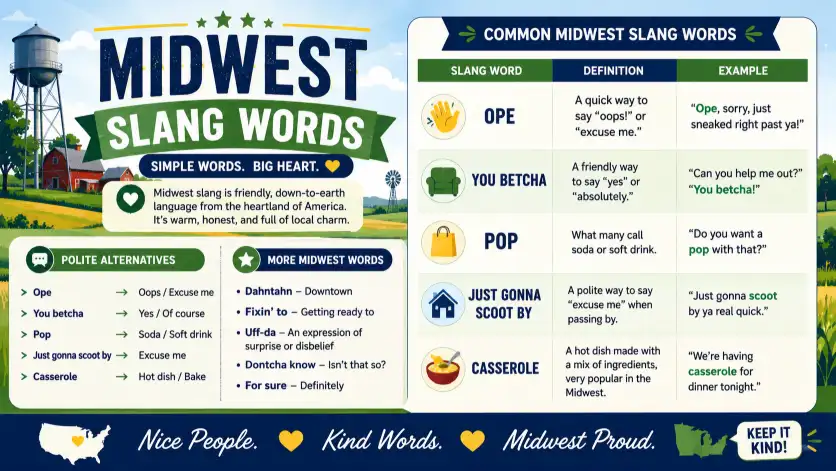
Midwest slang words are unique expressions and everyday phrases commonly used across the American Midwest.
Many people search for these terms because they hear them in conversations, social media videos, TV shows, or while visiting states like Minnesota, Wisconsin, Illinois, Michigan, Ohio, Iowa, Indiana, Missouri, Nebraska, Kansas, and the Dakotas.
While some Midwest slang sounds unusual to outsiders, locals often use these words naturally in daily life.
Learning Midwest slang helps you better understand regional culture, communicate with native speakers, and recognize expressions that may not appear in standard English. Some phrases are friendly, some are humorous, and others simply reflect local traditions.
Quick Answer
Midwest slang words are informal words and phrases commonly used in the Midwestern United States. Most are friendly, regional expressions that describe everyday situations, people, food, weather, and local culture.
What Does Midwest Slang Words Mean in Text?
When someone mentions Midwest slang words, they are referring to the collection of informal expressions that people living in the American Midwest commonly use.
Unlike internet abbreviations or texting acronyms, Midwest slang is based on regional speech.
These words appear mostly in face-to-face conversations, but many are also shared on TikTok, Instagram, Reddit, Facebook, and YouTube because people enjoy highlighting regional accents and vocabulary.
Examples include:
- “Ope!”
- “You betcha!”
- “Don’tcha know?”
- “Pop” (instead of soda)
- “Hotdish”
- “Uff da”
These expressions often sound warm, polite, and community-focused.
Midwest Slang Words Full Form / Definition
Unlike abbreviations such as LOL or BRB, Midwest slang words do not have a full form.
Instead, they are regional expressions passed down through generations.
They often describe:
- Everyday greetings
- Food
- Weather
- Family life
- Local traditions
- Friendly conversations
Many originated from German, Scandinavian, and other European immigrant communities that settled throughout the Midwest.
Popular Midwest Slang Words and Their Meanings
| Midwest Slang | Meaning | Example |
| Ope | Small apology or surprise | “Ope, sorry!” |
| You Betcha | Absolutely or certainly | “You betcha I’ll help.” |
| Pop | Soft drink | “Can I get a pop?” |
| Hotdish | Casserole meal | “Grandma made hotdish.” |
| Uff Da | Surprise or frustration | “Uff da, that’s cold!” |
| Don’tcha Know | Friendly conversation phrase | “It’s nice here, don’tcha know?” |
| Bubbler | Drinking fountain (Wisconsin) | “Where’s the bubbler?” |
| Kitty Corner | Diagonally across | “The store is kitty corner.” |
| Crick | Creek | “Let’s fish in the crick.” |
| Holy Buckets | Expression of surprise | “Holy buckets, that’s expensive!” |
Is Midwest Slang Rude, Offensive, or Neutral?
Most Midwest slang words are completely neutral.
They are generally:
- Friendly
- Respectful
- Family-friendly
- Suitable for daily conversations
However, a few regional expressions may sound confusing or unusual to people outside the Midwest.
Very few common Midwest slang words are offensive. Context always matters.
Where Is Midwest Slang Commonly Used?
Midwest slang is heard throughout states such as:
- Minnesota
- Wisconsin
- Michigan
- Illinois
- Indiana
- Iowa
- Missouri
- Ohio
- Nebraska
- Kansas
- North Dakota
- South Dakota
You may also see these expressions on:
- TikTok videos
- Facebook posts
- Reddit communities
- Local news
- YouTube creators
- Podcasts
- Family gatherings
Unlike Gen Z internet slang, Midwest slang is mostly regional rather than age-based.
Real-Life Meanings of Common Midwest Slang
Ope
Perhaps the most famous Midwest expression.
People say “Ope!” after:
- Accidentally bumping someone
- Dropping something
- Interrupting someone
Example:
“Ope! Sorry, I didn’t see you.”
You Betcha
Means:
- Of course
- Definitely
- Absolutely
Example:
“Can you help tomorrow?”
“You betcha!”
Pop
Many Midwesterners call carbonated soft drinks pop instead of soda.
Example:
“I’ll grab a pop from the fridge.”
Hotdish
Especially common in Minnesota.
A baked casserole containing meat, vegetables, potatoes, or noodles.
Example:
“We’re bringing hotdish to the family dinner.”
Uff Da
A Scandinavian expression still used today.
Can express:
- Surprise
- Exhaustion
- Frustration
Example:
“Uff da, that was a long day.”
Origin and Background of Midwest Slang Words
Midwest slang developed from a mix of cultures.
Major influences include:
- German immigrants
- Norwegian immigrants
- Swedish immigrants
- Finnish communities
- Farming traditions
- Small-town lifestyles
Because many communities stayed close together for generations, local speech patterns became part of everyday identity.
Today, social media has introduced Midwest slang to audiences worldwide.
Why People Use Midwest Slang Words
People continue using Midwest slang because it helps:
- Show regional identity
- Sound friendly
- Build community
- Keep family traditions alive
- Add humor to conversations
Many expressions also make conversations feel warmer and less formal.
Midwest Slang vs Other American Slang
| Midwest Slang | Similar General English | Difference |
| Pop | Soda | Regional word |
| Ope | Sorry | More spontaneous |
| You Betcha | Definitely | More friendly |
| Uff Da | Oh no | Scandinavian influence |
| Hotdish | Casserole | Midwest food term |
Is Midwest Slang Safe for Social Media?
Yes.
Most Midwest slang is perfectly safe on:
- TikTok
- Snapchat
- X (Twitter)
People often use these expressions in funny videos about regional differences.
Since the terms are generally friendly, they rarely violate platform guidelines.
When Should You Avoid Using Midwest Slang?
Although Midwest slang is harmless, there are situations where standard English may be better.
Avoid heavy use when:
- Writing academic papers
- Sending professional business emails
- Preparing legal documents
- Speaking with international audiences unfamiliar with the terms
Using too much regional slang may confuse readers who are not from the United States.
Polite Alternatives
If you’re speaking with someone unfamiliar with Midwest expressions, consider using standard English.
| Midwest Slang | Standard Alternative |
| Ope | Sorry |
| Pop | Soda or soft drink |
| You Betcha | Certainly |
| Uff Da | Oh my goodness |
| Holy Buckets | Wow |
Impact of Using Midwest Slang in Communication
Midwest slang often creates a friendly atmosphere.
Benefits include:
- Makes conversations feel natural
- Shows cultural identity
- Creates humor
- Builds local connections
- Makes storytelling more authentic
However, using regional slang with people unfamiliar with it may require brief explanations.
Real-Life Examples of Usage
Friendly
“You betcha! I’ll be there at six.”
Casual
“Ope! I almost forgot my keys.”
Family Conversation
“Mom made hotdish for dinner tonight.”
Shopping
“Let’s grab a pop before we leave.”
Social Media
“Only Midwesterners understand saying ‘ope’ ten times a day.”
Road Trip
“Uff da! That snowstorm came fast.”
Humorous
“Don’tcha know it’s freezing outside?”
Conversation Between Friends
Friend 1:
“Want to come over later?”
Friend 2:
“You betcha!”
Comparison Table of Midwest Slang and Other Regional Slang
| Midwest Slang | Southern Slang | New York Slang |
| Ope | Y’all | Yo |
| You Betcha | Bless your heart | For real |
| Pop | Coke (regional) | Soda |
| Hotdish | Casserole | Casserole |
| Uff Da | Lordy | Jeez |
Frequently Asked Questions
Q1: What are Midwest slang words?
They are informal regional expressions commonly spoken across the American Midwest.
Q2: Is “Ope” only used in the Midwest?
Mostly yes. While others may use it, it is strongly associated with Midwestern speech.
Q3: Why do Midwesterners say “pop”?
Many Midwestern states traditionally use “pop” instead of “soda” for carbonated soft drinks.
Q4: Is Midwest slang appropriate at work?
Some expressions are acceptable in casual workplace conversations, but standard English is usually preferred in formal settings.
Q5: Does Midwest slang appear on TikTok?
Yes. Many creators make humorous videos comparing Midwest slang with expressions from other regions.
Q6: Can tourists use Midwest slang?
Yes. Locals generally appreciate visitors who use these expressions respectfully and naturally.
Conclusion
Midwest slang words are a colorful part of American regional culture. Expressions like “Ope,” “You Betcha,” “Pop,” and “Uff Da” reflect the friendly, polite, and community-oriented communication style found throughout the Midwest.
While these phrases may sound unusual to people from other regions, they are widely understood and appreciated by locals.
Learning Midwest slang words helps you better understand conversations, social media content, regional humor, and local traditions.
If you’re traveling through the Midwest, chatting with friends, or simply curious about American regional language, knowing these expressions can make communication more natural and enjoyable.
Most importantly, use them in the right context and with the friendly tone that makes Midwest speech so recognizable.
Discover More Articles:

Hi, I’m Rachel Simmons, a language writer specializing in American English and modern slang. I research regional expressions, everyday phrases, and evolving word meanings across the United States. I enjoy making complex language trends simple, practical, and easy for everyone to understand.