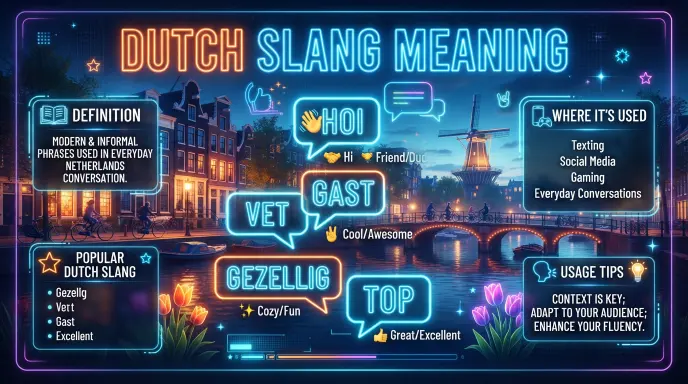
Dutch slang meaning refers to informal words, phrases, and expressions that people in the Netherlands use in everyday conversations.
These words often differ from standard Dutch and may vary by age, region, or social group.Many people search for dutch slang meaning because they hear these expressions while traveling, watching Dutch videos, chatting online, or learning the Dutch language.
Understanding slang helps you follow casual conversations and communicate more naturally. In this guide, you’ll learn what Dutch slang means, how it is used, where you might hear it, and the most common meanings you should know.
Quick Answer: Dutch Slang Meaning
Dutch slang meaning refers to casual, informal language used by Dutch speakers instead of formal Dutch words. It includes modern expressions, street language, youth slang, and everyday phrases commonly heard in conversations, social media, text messages, and online communities.
What Does Dutch Slang Meaning Mean?
Dutch slang is the collection of informal words and expressions that people use in relaxed conversations. These terms are usually easier, shorter, or more expressive than formal Dutch.
Unlike standard Dutch taught in language courses, slang changes over time. New words appear because of youth culture, music, sports, social media, and online communities.
Some slang words are understood across the Netherlands, while others are only common in certain cities or regions.
Standard Dutch vs. Dutch Slang
| Standard Dutch | Dutch Slang | Meaning in English |
| Hallo | Yo | Hi |
| Vriend | Gast | Friend / Mate |
| Goed | Chill | Good / Relaxed |
| Leuk | Vet | Cool / Awesome |
| Ja | Yep | Yes |
These examples show how casual conversations often sound different from textbook Dutch.
Is Dutch Slang an Official Language?
No. Dutch slang is not an official language. It is simply the informal way many people speak with friends, classmates, teammates, or family members.
Formal Dutch is still used in schools, government offices, business communication, and official documents.
Full Form or Complete Meaning
The phrase “dutch slang meaning” does not have a full form or abbreviation.
Instead, it simply means:
- Informal Dutch words
- Casual Dutch expressions
- Everyday Dutch phrases
- Street language used in the Netherlands
- Modern words popular among younger speakers
Unlike internet abbreviations such as “LOL” or “BRB,” Dutch slang is made up of real words and phrases rather than shortened forms.
Different Meanings of Dutch Slang
The meaning of Dutch slang depends on the context because not every slang word is used in the same way. Most Dutch slang falls into a few common categories.
Everyday Casual Slang
These words replace standard Dutch during normal conversations with friends.
Example:
“Dat is echt vet!”
Meaning:
“That’s really cool!”
Youth Slang
Teenagers and young adults often create new slang influenced by music, fashion, and internet culture.
These words may become popular for a few years before changing or disappearing.
Street Language
Some Dutch slang comes from multicultural neighborhoods and combines Dutch with words influenced by languages such as Moroccan Arabic, Turkish, Sranan Tongo, and English.
Because of these diverse influences, not every slang word is understood equally across all age groups or regions.
Online and Social Media Slang
Dutch speakers also use internet slang while chatting on platforms such as TikTok, Instagram, Reddit, Discord, Snapchat, and messaging apps.
This often mixes Dutch words with English internet expressions.
Example:
- “Nice!”
- “Bro.”
- “GG.”
- “Mood.”
Many younger Dutch users switch naturally between Dutch and English during online conversations.
Where Is Dutch Slang Commonly Used?
Dutch slang is mostly used in informal situations rather than professional settings.
Friends and Everyday Conversations
People often use slang when talking with close friends because it sounds relaxed and natural.
Social Media
Platforms where Dutch slang is commonly seen include:
- TikTok
- Snapchat
- Discord
- YouTube comments
Short videos and comments frequently introduce new slang expressions that spread quickly online.
Text Messages
Many Dutch speakers use slang when texting because it makes conversations feel friendly and informal.
Gaming Communities
Online games often include a mix of Dutch slang and English gaming terms.
Players may switch between both languages during voice chat or text chat.
School and University
Students commonly use slang when talking to classmates between lessons or during social activities.
Teachers, however, usually expect standard Dutch in assignments and formal communication.
Workplace
In relaxed workplaces, coworkers who know each other well may occasionally use mild slang. However, formal Dutch remains the better choice for meetings, emails, presentations, and conversations with clients.
Is Dutch Slang Rude, Offensive, or Harmless?
Most Dutch slang is harmless and simply makes conversations sound more natural and friendly. However, some slang words can be rude, sarcastic, or insulting depending on the situation.
The tone, the people involved, and the context all matter.
Harmless Dutch Slang
Many common slang words are safe to use with friends.
Examples include:
- Vet: Cool or awesome
- Chill: Relaxed or easy-going
- Gast: Mate, buddy, or friend
- Top: Great or excellent
These words are widely understood and are generally considered friendly.
Slang That Can Be Offensive
Some Dutch slang includes swear words or insults. Others may sound harmless among close friends but can offend strangers.
If you are learning Dutch, it is best to avoid words you do not fully understand. Native speakers often know when a slang term is playful and when it crosses the line.
Can You Use Dutch Slang at Work?
Usually, no. Use standard Dutch in:
- Business emails
- Job interviews
- Meetings
- School assignments
- Speaking with teachers
- Government offices
Casual slang is better suited to conversations with friends or people you know well.
Real-Life Examples
These examples show how Dutch slang may appear in everyday conversations.
Friendly Conversation
Person A: “Hoe was het feestje?”
Person B: “Het was echt vet!”
English: “It was really awesome!”
Text Message
Friend: “Ben je straks vrij?”
Reply: “Ja, chill!”
English: “Yeah, sounds good!”
School
Student: “Die toets was zwaar.”
Friend: “Ja, maar het komt goed.”
English: “That test was tough.”
“Yeah, it’ll be fine.”
Gaming Chat
Player 1: “Goed gespeeld!”
Player 2: “GG, bro!”
This mixes Dutch with common English gaming slang.
Social Media
Someone posts a travel photo.
Comment:
“Echt top!”
Meaning:
“Really great!”
Origin and History
Dutch slang has developed over many generations. It is not a new form of language but a natural part of everyday speech.
Older slang often came from local dialects and regional expressions. More recent slang has been influenced by:
- Youth culture
- Music
- Television
- Movies
- Online gaming
- Social media
- English-language internet culture
In larger Dutch cities, modern slang has also been shaped by multicultural communities. Words from languages such as Sranan Tongo, Moroccan Arabic, Turkish, and English have become part of everyday speech for many young people.
Because slang changes quickly, some popular words disappear after only a few years, while others become part of everyday Dutch.
Similar Slang or Related Terms
If you’re interested in Dutch slang, you may also come across these related language styles.
| Term | Meaning |
| Street language | Informal language influenced by multicultural communities. |
| Youth slang | Words popular among teenagers and young adults. |
| Internet slang | Words used online and in text messages. |
| Gaming slang | Expressions commonly used while playing games. |
| Regional dialect | Local vocabulary used in specific areas of the Netherlands. |
| Everyday Dutch | Informal spoken Dutch used in daily life. |
Although these categories overlap, they are not exactly the same.
When Should You Avoid Using It?
Dutch slang is not appropriate in every situation.
Avoid using it when:
- Speaking with teachers during formal lessons.
- Attending a job interview.
- Writing business emails.
- Talking to government officials.
- Giving a professional presentation.
- Speaking with someone who may not understand the slang.
If you are unsure if a slang word is appropriate, choose standard Dutch instead.
Polite Alternatives
If you want to sound respectful, use standard Dutch instead of slang whenever possible.
| Slang | Polite Alternative | English Meaning |
| Vet | Geweldig | Great |
| Gast | Vriend | Friend |
| Chill | Rustig | Calm / Relaxed |
| Top | Uitstekend | Excellent |
| Yo | Hallo | Hello |
These alternatives are suitable in schools, workplaces, and formal conversations.
Why Do People Use Dutch Slang?
People use Dutch slang because it makes conversations feel more natural and personal.
Common reasons include:
- It sounds friendly.
- It helps people fit into a group.
- It reflects modern culture.
- It makes texting quicker.
- It adds emotion and personality.
- It is popular on social media.
- It helps people connect with friends.
For younger speakers, slang can also show shared interests or a sense of belonging within a community.
Common Misunderstandings
Many people believe Dutch slang is simply “incorrect Dutch.” That is not true.
Slang follows its own informal rules and is widely understood by native speakers in the right context.
Here are a few common misconceptions:
- Myth: All Dutch people use the same slang.
- Reality: Slang varies by region, age, and social group.
- Myth: Slang is always rude.
- Reality: Most Dutch slang is friendly and harmless.
- Myth: Learning slang is more important than standard Dutch.
- Reality: Standard Dutch should come first. Slang is useful once you understand the basics.
- Myth: Dutch slang never changes.
- Reality: New slang appears regularly, while older expressions may become outdated or less common.
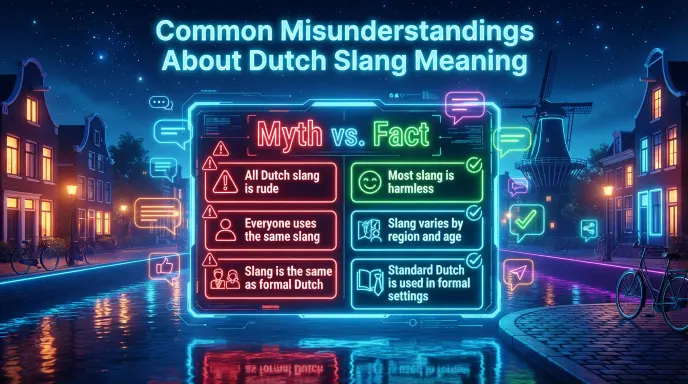
Understanding the context is the key to using Dutch slang naturally and respectfully.
Frequently Asked Questions
Q1. What does Dutch slang mean?
Dutch slang means informal words and expressions that people in the Netherlands use in everyday conversations. These terms are more casual than standard Dutch and are common among friends, online, and on social media.
Q2. Is Dutch slang the same as standard Dutch?
No. Standard Dutch is the formal version used in schools, business, government, and official writing. Dutch slang is informal and is mainly used in relaxed conversations.
Q3. Is Dutch slang rude?
Not usually. Most Dutch slang is friendly and harmless. However, some slang words can be rude or offensive depending on the context and the people involved.
Q4. Where is Dutch slang commonly used?
You will often hear Dutch slang in:
- Everyday conversations
- Text messages
- TikTok
- Snapchat
- Discord
- Gaming communities
It is much less common in formal workplaces or official communication.
Q5. Can I use Dutch slang with teachers or at work?
It is better to use standard Dutch with teachers, employers, clients, or anyone in a formal setting. Save slang for friends and casual conversations.
Q6. Why do Dutch people use slang?
People use slang to sound natural, friendly, and expressive. It also helps people connect with friends and reflects modern culture and online trends.
Q7. Does Dutch slang change over time?
Yes. Like slang in every language, Dutch slang changes regularly. Some words stay popular for many years, while others disappear as new expressions become popular.
Q8. Can English words become Dutch slang?
Yes. Many English words are used by Dutch speakers, especially on social media, in gaming, and in everyday conversations. Younger generations often mix Dutch and English naturally.
Q9. What does “go” Dutch mean in slang?
“Go Dutch” means each person pays for their own food, drinks, or other shared expenses.
Q10. What is Dutch in Cockney slang?
In Cockney rhyming slang, Dutch means mate or friend, from “Dutch plate.”
Q11. What is Dutch in dating?
In dating, going Dutch means both people pay for their own share of the bill.
Q12. What is a Dutch in slang?
In slang, Dutch is mainly associated with going Dutch, meaning sharing or splitting costs.
Q13. Is it okay to say “Dutch treat”?
Yes. It means everyone pays for themselves, though some people avoid the term because of its historical origins.
Q14. What does “I’m in Dutch” mean?
“I’m in Dutch” means I’m in trouble or I’m in someone’s bad books.
Q15. Is going Dutch always 50/50?
No. It usually means each person pays for what they ordered, not necessarily an equal split.
Q16. How do I say “hi” in Dutch?
Common greetings are Hallo, Hoi, and Hey, with Hoi being the most informal.
Q17. What is the meaning of Double Dutch?
“Double Dutch” usually means something that is difficult or impossible to understand.
Conclusion
Dutch slang meaning refers to the informal words and phrases that Dutch speakers use in everyday life. These expressions make conversations sound more relaxed, natural, and personal.
While many slang terms are harmless and widely understood, their meaning can change depending on the context, region, or age group of the speakers.
If you’re learning Dutch or planning to visit the Netherlands, understanding common slang can help you follow conversations, enjoy social media content, and communicate more confidently.
At the same time, remember that standard Dutch is still the best choice for schools, workplaces, and other formal situations. Learning when to use slang,and when to avoid it,is the key to sounding natural and respectful.
Explore More Articles:

Hi, I’m Tyler Brooks, a writer specializing in Gen Z culture and internet slang. I track trending terms across TikTok and social media to explain their real-world meanings. My goal is to provide clear, accurate, and up-to-date definitions that help readers understand modern online language.