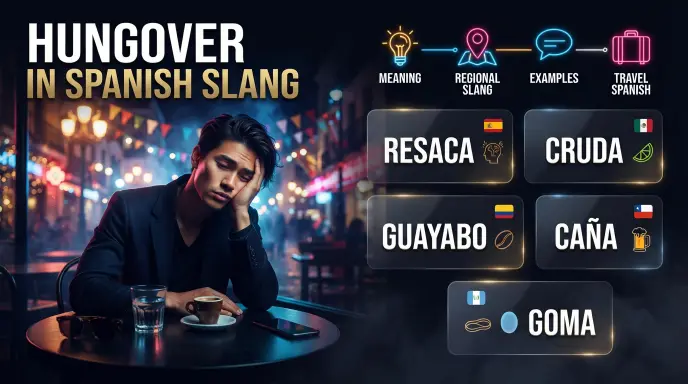
Resaca Spanish slang for “hungover,” referring to the rough, groggy, headachy feeling someone gets the morning after drinking too much alcohol.
“Resaca” is the most common word used across Spain and Latin America, though different countries have their own local twists on it for example, Mexicans often say “cruda” (literally “raw”), while in Colombia people say “guayabo.”
All of these describe the same universal experience: pounding headache, dry mouth, nausea, and regret after a big night out.
In everyday conversation, you’ll hear phrases like “Tengo una resaca terrible” (I have a terrible hangover) or “Estoy crudo/a” (I’m hungover) used casually among friends the next morning.
Quick Answer
Hungover in Spanish slang refers to informal words and phrases people use after drinking too much alcohol. The most common word is resaca, but many Spanish-speaking countries also use regional slang such as cruda, guayabo, caña, goma, and ratón, depending on the country.These expressions are common in casual conversations with friends but are usually avoided in formal writing or professional settings.
What Does Hungover in Spanish Slang Mean?
Hungover in Spanish slang means feeling sick, tired, or having a headache after drinking too much alcohol. Instead of using a formal medical description, native speakers often choose informal words that sound more natural in everyday conversation.
People search for hungover in Spanish slang because they want to:
- Understand conversations with native Spanish speakers.
- Learn travel-friendly vocabulary.
- Watch Spanish TV shows or movies more easily.
- Use natural expressions while speaking Spanish.
- Understand social media posts and memes.
Although many learners think there is only one Spanish word for “hungover,” the reality is different. Every Spanish-speaking country has its own favorite expression.
For example:
| Country | Common Slang for Hungover |
| Spain | Resaca |
| Mexico | Cruda |
| Colombia | Guayabo |
| Guatemala | Goma |
| Chile | Caña |
| Argentina | Resaca (most common) |
Knowing these regional differences helps you sound more natural and avoid confusion while traveling or talking with native speakers.
Is There One Spanish Slang Word for “Hungover”?
No. There is no single slang word that everyone uses across the Spanish-speaking world. While resaca is the most widely understood term, many countries have created their own informal expressions over time.
Regional slang is a normal part of Spanish. Just as English speakers might say “hungover,” “rough,” or “feeling awful after drinking,” Spanish speakers use different words depending on where they live.
Here is a quick comparison:
| Word | Meaning | Commonly Used In | Tone |
| Resaca | Hangover | Spain, Argentina, many countries | Neutral and widely understood |
| Cruda | Hangover | Mexico | Informal |
| Guayabo | Hangover | Colombia | Informal |
| Goma | Hangover | Guatemala, Honduras, El Salvador | Informal |
| Caña | Hangover | Chile | Informal |
When speaking with people from different countries, resaca is usually the safest choice because most Spanish speakers recognize it.
Different Spanish Slang Words for Hungover
Resaca (Spain and Many Spanish-Speaking Countries)
Resaca is the most common and widely understood word for a hangover. Although dictionaries list it as the standard term, people also use it naturally in everyday conversations.
Example:
- Tengo mucha resaca después de la fiesta.
- I have a bad hangover after the party.
This is the best word to learn first because almost every Spanish speaker will understand it.
Cruda (Mexico)
In Mexico, cruda is one of the most popular informal words for being hungover.
Example:
- Hoy tengo una cruda terrible.
- I’m terribly hungover today.
You’ll hear this word often among friends, in Mexican TV shows, and on social media.
Guayabo (Colombia)
In Colombia, many people say guayabo instead of resaca.
Example:
- Todavía tengo guayabo de anoche.
- I’m still hungover from last night.
This word is very common in casual Colombian Spanish but may not be familiar to speakers from every country.
Goma (Guatemala, Honduras, and El Salvador)
Several Central American countries use goma to describe a hangover.
Example:
- No puedo salir; tengo mucha goma.
- I can’t go out; I’m really hungover.
If you travel through Central America, you’ll likely hear this expression often.
Caña (Chile)
In Chile, people commonly use caña to talk about a hangover after drinking.
Example:
- Tengo una caña enorme.
- I have a huge hangover.
Outside Chile, this meaning is less common, so some Spanish speakers may not recognize it immediately.
Which Word Should You Use?
If you’re learning Spanish or speaking with people from different countries, resaca is usually the safest and most widely understood option.
However, if you’re visiting a specific country, using the local slang can make your Spanish sound more natural and help you connect better with native speakers.
In the next part, we’ll explore where these words are commonly used, if they’re considered rude or harmless, and how native speakers use them in real-life conversations.
Where Is Hungover in Spanish Slang Commonly Used?
Spanish slang for hungover is mainly used in casual conversations. You’ll hear these words among friends, family members, classmates, and coworkers when talking informally about a night of drinking.
The exact word depends on the country, but the situations are very similar.
Everyday Conversations
People often use these slang words the morning after a party or celebration.
Example:
Friend: ¿Cómo estás hoy?
You: Tengo una resaca terrible.
English: “How are you today?” , “I have a terrible hangover.”
Text Messages
These expressions are common in text chats because they are short and easy to understand.
Example:
- “No puedo salir. Tengo cruda.”
- “Hoy sigo con guayabo.”
- “Necesito café para esta resaca.”
These messages simply let friends know you’re not feeling your best after drinking.
Social Media
You’ll often see these words in captions, memes, and humorous posts after weekends, holidays, birthdays, weddings, or festivals.
Examples include:
- “Domingo de resaca.”
- “Sobreviviendo a la cruda.”
- “Mi mejor amigo después de la fiesta: el café.”
These posts are usually lighthearted and meant as jokes.
Movies and TV Shows
Spanish-language movies and television series often use local slang to make dialogue sound natural.
For example:
- A Mexican character is more likely to say cruda.
- A Colombian character may say guayabo.
- A Chilean character may say caña.
- A character from Spain will usually say resaca.
Knowing these regional words makes movies easier to understand.
While Traveling
If you travel to a Spanish-speaking country, learning the local slang helps you understand conversations more easily.
For example:
| Country | Most Common Word |
| Spain | Resaca |
| Mexico | Cruda |
| Colombia | Guayabo |
| Chile | Caña |
| Guatemala | Goma |
Even if you only remember resaca, most Spanish speakers will understand what you mean.
7. Is Hungover in Spanish Slang Rude, Offensive, or Harmless?
Most Spanish slang for “hungover” is harmless. These words simply describe how someone feels after drinking too much alcohol. They are not considered swear words or insults.
However, they are still informal.
Safe to Use with Friends
These expressions are perfectly normal among friends.
Examples:
- “Tengo mucha resaca.”
- “Estoy con cruda.”
- “Todavía tengo guayabo.”
Native speakers use these naturally in everyday conversations.
At Work or School
In professional settings, it’s usually better to use more neutral language.
Instead of saying:
- “Tengo una cruda horrible.”
You could simply say:
- “No me siento bien hoy.”
- “Tengo dolor de cabeza.”
These sound more appropriate in formal situations.
With Teachers or Older Adults
Although resaca is widely understood, many people choose more polite wording when speaking with teachers, employers, or older family members.
Choosing formal language often sounds more respectful.
8. Real-Life Examples of Hungover in Spanish Slang
The easiest way to remember these expressions is to see them in real conversations.
Friends After a Party
Carlos: ¿Quieres desayunar?
Luis: No puedo. Tengo una resaca terrible.
English
Carlos: “Want to get breakfast?”
Luis: “I can’t. I have a terrible hangover.”
Mexican Friends
Ana: ¿Cómo amaneciste?
Sara: Con una cruda horrible.
English
Ana: “How are you feeling this morning?”
Sara: “I have an awful hangover.”
Colombian Friends
Mateo: ¿Sales hoy?
Daniel: No. Todavía tengo guayabo.
English
Mateo: “Are you going out today?”
Daniel: “No. I’m still hungover.”
8.4 Family Conversation
Mom: ¿Por qué estás tan cansado?
Son: Creo que tengo un poco de resaca.
English
Mom: “Why are you so tired?”
Son: “I think I have a bit of a hangover.”
Group Chat
Friend 1: “Who’s coming to brunch?”
Friend 2: “Not me. Tengo mucha resaca.”
Friend 3: “Same here.”
This type of conversation is very common after weekend celebrations.
Which Spanish Slang Word Should You Learn First?
If you can remember only one word, choose resaca.
Here’s why:
- It is understood in many Spanish-speaking countries.
- It appears in dictionaries.
- Native speakers use it regularly.
- Travelers can use it almost everywhere.
- It is less regional than words like cruda or guayabo.
If you’re planning to visit a specific country, learning its local slang is also a good idea.
For example:
- Visiting Mexico? Learn cruda.
- Visiting Colombia? Learn guayabo.
- Visiting Chile? Learn caña.
- Visiting Central America? Learn goma.
Using the local expression can make conversations feel more natural and show appreciation for regional language differences.
Common Mistakes Learners Make
Many Spanish learners make small mistakes when talking about hangovers. Avoiding these will help your Spanish sound more natural.
Thinking Every Country Uses the Same Word
Spanish has many regional expressions.
Someone from Spain may never say cruda, while someone from Mexico may use it every weekend.
Using Slang in Formal Situations
Although these words are harmless, they are informal.
In a job interview, business meeting, or formal email, it’s better to avoid slang.
Assuming All Native Speakers Know Every Regional Word
Most people understand resaca, but regional slang like goma or caña may confuse speakers from other countries.
When speaking with people from different regions, resaca is usually the clearest choice.
Origin and History
The idea of having a special word for a hangover has existed in Spanish for many years. While resaca is the best-known term today, different Spanish-speaking countries developed their own local expressions over time.
The exact origin of every slang word is not always clear. However, language experts agree that many of these terms became popular through everyday speech rather than social media or the internet.
Here is a brief overview:
| Word | Country or Region | Notes |
| Resaca | Spain and many Spanish-speaking countries | The most widely understood and standard term. |
| Cruda | Mexico | A long-established informal word used in everyday speech. |
| Guayabo | Colombia | A regional expression commonly used in casual conversations. |
| Goma | Guatemala, Honduras, El Salvador | Popular in parts of Central America. |
| Caña | Chile | A local slang term that is well known within Chile. |
Unlike many internet slang terms, these expressions existed long before platforms like TikTok, Instagram, or Discord became popular.
Similar Spanish Slang and Related Terms
Spanish speakers sometimes use other informal expressions when talking about drinking or recovering after a party.
Resaca
The safest and most widely recognized word for a hangover.
Cruda
A common Mexican slang word for being hungover.
Guayabo
Frequently used in Colombia.
Goma
Common in several Central American countries.
Caña
A popular Chilean expression.
Desvelado
This word means sleep-deprived rather than hungover. Some learners confuse the two because both can make someone feel tired.
Cansado
This simply means tired. It does not specifically mean someone drank too much alcohol.
Knowing the difference helps you choose the correct word for the situation.
When Should You Avoid Using Hungover in Spanish Slang?
Although these expressions are generally harmless, there are times when more formal language is a better choice.
Professional Settings
Avoid slang during:
- Job interviews
- Business meetings
- Workplace presentations
- Professional emails
Neutral language sounds more respectful.
School or Academic Writing
If you’re writing an essay or giving a classroom presentation, avoid informal slang unless you’re discussing language itself.
Speaking with Someone You Don’t Know Well
When meeting someone for the first time, using standard vocabulary is usually the safest option.
Once you know the person better, casual expressions may feel more natural.
Polite Alternatives
If you don’t want to use slang, these expressions work well in formal or polite conversations.
| Informal Slang | Polite Alternative | English Meaning |
| Tengo resaca. | No me siento bien. | I don’t feel well. |
| Tengo cruda. | Tengo dolor de cabeza. | I have a headache. |
| Tengo guayabo. | Me siento un poco mal. | I feel a little unwell. |
| Tengo goma. | Estoy cansado hoy. | I’m tired today. |
These alternatives are suitable for workplaces, schools, and conversations with older adults.
Why Do People Use These Slang Words?

People use slang because it sounds more natural and friendly than formal language.
These expressions also make conversations shorter and easier.
Common reasons include:
- Talking with friends after a party.
- Making jokes about the previous night.
- Posting funny captions on social media.
- Speaking like local native speakers.
Using regional slang can also help people express their local identity and culture.
Common Misunderstandings
Many Spanish learners misunderstand these expressions at first.
Here are a few common mistakes.
Thinking “Resaca” Is Only Used in Spain
While resaca is strongly associated with Spain, it is understood and used in many Spanish-speaking countries.
Believing Every Country Uses “Cruda”
Cruda is mainly used in Mexico. It may not be the first choice in other countries.
Assuming Slang Is Always Offensive
Words like resaca, cruda, and guayabo are informal, but they are not considered offensive.
They simply describe someone’s condition after drinking alcohol.
Confusing Tiredness with a Hangover
Feeling tired and having a hangover are not the same thing.
A hangover usually includes symptoms such as:
- Headache
- Nausea
- Fatigue
- Thirst
- Sensitivity to light or noise
Someone can be tired without being hungover.
17. Frequently Asked Questions
Q1. What is the Spanish slang for “hungover”?
The most common word is resaca. Depending on the country, people may also say cruda, guayabo, goma, or caña.
Q2. What do people in Mexico say instead of “hungover”?
People in Mexico commonly say cruda.
Example:
“Tengo una cruda horrible.”
Q3. What do Colombians call a hangover?
Many Colombians use the word guayabo in casual conversations.
Q4. Is “resaca” slang?
Resaca is the standard Spanish word for a hangover and is widely understood. It is also commonly used in everyday informal speech, so learners often encounter it alongside regional slang.
Q5. Is Spanish slang for “hungover” offensive?
No. These expressions are generally harmless and are not considered offensive. They are simply informal words used in everyday conversations.
Q6. Can I use these words at work?
It is better to avoid slang in professional settings. Neutral expressions like “No me siento bien” or “Tengo dolor de cabeza” are usually more appropriate.
Q7. Which word should travelers learn first?
If you are learning Spanish for travel, resaca is the best word to remember because it is understood in many Spanish-speaking countries.
Q8. How do you say hungover in Spanish slang?
The most common word is resaca, but people also say cruda (Mexico), guayabo (Colombia), caña (Chile), and goma (Central America).
Q9. What do Mexicans call hangovers?
Mexicans usually call a hangover cruda, which is the most common informal term.
Q10. Does crudo mean hungover?
Yes. Crudo means “hungover” for a man in Mexican Spanish, while cruda is used for a woman.
Q11. How do I say I’m hungover in Mexico?
Say “Estoy crudo” (male) or “Estoy cruda” (female). You can also say “Tengo cruda.”
Q12. Does Spain have a word for hangover?
Yes. The standard Spanish word is resaca, and it is widely used throughout Spain.
Q13. What does estoy crudo mean?
Estoy crudo means “I’m hungover” in Mexican Spanish when spoken by a man.
18. Conclusion
Hungover in Spanish slang includes several informal words that describe how someone feels after drinking too much alcohol.
The most widely recognized term is resaca, while countries such as Mexico, Colombia, Chile, and Guatemala use regional expressions like cruda, guayabo, caña, and goma.
The best word depends on where you are speaking Spanish. If you’re talking with people from different countries, resaca is usually the safest choice.
If you’re visiting a specific region, learning the local slang can make your conversations sound more natural.
Understanding these expressions will help you follow everyday conversations, enjoy Spanish-language movies and social media more easily, and communicate with native speakers with greater confidence.
Explore More Articles:

Hi, I’m Rachel Simmons, a language writer specializing in American English and modern slang. I research regional expressions, everyday phrases, and evolving word meanings across the United States. I enjoy making complex language trends simple, practical, and easy for everyone to understand.