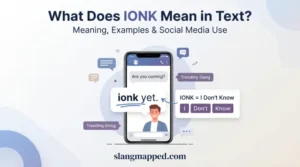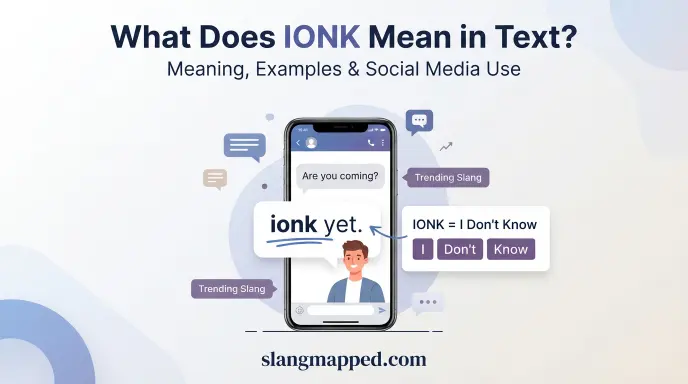
IONK usually means “I don’t know” in text messages and online chats. It is an informal texting expression used when someone is unsure, does not have an answer, or simply wants to say “I don’t know” in a quick, casual way.
You may see ionk in text messages, TikTok comments, Snapchat chats, Instagram DMs, WhatsApp conversations, and other casual online spaces. It can appear by itself or as part of a longer sentence, such as “ionk what happened.”
People often search for the meaning of IONK because it is less familiar than common abbreviations such as IDK, IDC, IMO, or BRB. The spelling can look like a typo until you understand how it is being used.
In most everyday contexts, the easiest way to understand it is simple: IONK = I don’t know. The exact tone, however, can depend on the conversation and the person using it.
IONK Meaning in Text
The simplest definition of IONK is “I don’t know.”
Someone might type it when they do not know the answer to a question, are uncertain about something, or have not decided what they want to do.
For example:
“ionk what time they’re coming.”
This means:
“I don’t know what time they’re coming.”
Another example is:
“ionk yet.”
That means:
“I don’t know yet.”
IONK is therefore mainly used to express uncertainty or a lack of information.
Is IONK Slang, an Acronym, or an Abbreviation?
IONK is best described as informal texting slang or speech-based shorthand.
It is different from a traditional initialism such as IDK. IDK takes the first letters of “I Don’t Know.” IONK does not follow that same letter-by-letter pattern.
Instead, IONK is commonly understood as a compressed, speech-like form related to “I don’t know” or “ion know.” The slang form ion is also used online as a casual representation of “I don’t” in phrases such as “ion care” or “ion know.”
That is why calling IONK simply “texting slang” is often more useful than trying to classify it as a strict acronym.
What Does IONK Mean in Everyday Chat?
In everyday conversation, IONK can communicate several closely related ideas:
- I don’t know.
- I’m not sure.
- I have no idea.
- I haven’t decided.
- I don’t have enough information.
- I’m unsure what happened.
- I cannot give you an answer right now.
For example:
Friend: “Are you going to the party?”
You: “ionk yet.”
The person is saying they have not decided.
Likewise:
“ionk why he left.”
means:
“I don’t know why he left.”
The basic meaning stays the same, but the tone can change depending on the conversation.
A friendly conversation may make IONK sound relaxed. A one-word reply to an important question might sound dismissive or uninterested.
Where People Use IONK
IONK is mainly associated with informal digital communication. It can appear across different social platforms, although the meaning normally remains the same.
IONK on TikTok
On TikTok, IONK may appear in comments, replies, captions, or conversations between users.
For example:
“ionk why this video is so funny 😭”
The person means:
“I don’t know why this video is so funny.”
It can also be used when reacting to something confusing:
“ionk what I just watched.”
Here, the person is saying that they do not understand what they just saw.
TikTok comments are often short and conversational, so slang like IONK fits naturally into that style.
IONK on Snapchat
On Snapchat, IONK can appear in direct messages and casual conversations between friends.
For example:
“Are we still going out?”
“ionk, depends on the weather.”
The person is uncertain rather than giving a definite yes or no.
Snapchat conversations are usually informal, so lowercase spelling such as ionk can feel natural.
IONK on Instagram
On Instagram, you may encounter IONK in DMs, comments, Story replies, or reactions.
For example:
“ionk why everyone is talking about this.”
The phrase means:
“I don’t know why everyone is talking about this.”
Someone might also use it in a private conversation:
“ionk what she wants me to say.”
Again, the intended meaning is generally “I don’t know.”
IONK on WhatsApp
IONK can also appear in WhatsApp chats, particularly when friends or family members use casual internet slang.
For example:
“Do you know where Ali went?”
“ionk.”
This is simply a quick response meaning:
“I don’t know.”
WhatsApp itself does not give IONK a special meaning. The slang meaning comes from how people use it in conversation.
IONK in SMS Text Messages
Traditional SMS conversations can also contain IONK.
For example:
“What time is the appointment?”
“ionk yet, I’ll check.”
Here, IONK works exactly like it does on social media.
The platform does not usually change the definition. Context and the surrounding words are more important than the app being used.
Real Chat Examples
Seeing IONK in realistic conversations can make the meaning much easier to understand.
Example 1: Asking About Plans
A: Are you coming tonight?
B: ionk yet.
A: Let me know before 8.
B: Yeah, I will.
Here, IONK means “I don’t know yet.”
Example 2: Asking About Someone
A: Where did Sarah go?
B: ionk.
A: She was just here.
B: Maybe she went home.
The short reply simply means “I don’t know.”
Example 3: Talking About School
A: Did the teacher say when the test is?
B: ionk what day.
A: I think it’s Friday.
B: Oh okay.
IONK shows that the person does not have the information.
Example 4: Talking About a Friend
A: Why is Jake ignoring everyone?
B: ionk honestly.
A: Maybe he’s busy.
B: Could be.
Here, “ionk honestly” means “I honestly don’t know.”
Example 5: Making a Decision
A: Pizza or burgers?
B: ionk 😭
A: You always say that.
B: Pick for me.
In this example, IONK is playful and means the person cannot decide.
Example 6: Social Media
A: Why is this video suddenly everywhere?
B: ionk lol.
A: It’s actually pretty funny.
B: True.
The slang expresses uncertainty in a relaxed way.
Example 7: Weekend Plans
A: What are you doing Saturday?
B: ionk yet.
A: We might go shopping.
B: Keep me posted.
Again, the person has not made a decision.
Example 8: Confusing Situation
A: Did you hear what happened?
B: No, ionk what’s going on.
A: Apparently they canceled the event.
B: Oh wow.
IONK indicates a lack of information.
Example 9: Asking for an Opinion
A: Do you think this outfit looks good?
B: ionk 😭 maybe try the other one.
A: Fair enough.
Here, IONK can sound hesitant rather than completely unaware.
Example 10: Group Chat
A: Who knows when the movie starts?
B: ionk.
C: 7:30 I think.
A: Perfect.
The person using IONK simply does not know the answer.
How to Reply When Someone Says “IONK”
If someone sends you “ionk,” your reply should depend on the conversation.
You do not always need to make the response complicated. A simple answer or follow-up question is usually enough.
Funny Replies
If you are joking with a friend, you could respond:
- “You never know anything 😂”
- “That’s your favorite answer.”
- “Helpful as always 😭”
- “Guess we’re both clueless.”
- “Okay detective, investigate it.”
These replies work best when the conversation is already playful.
Casual Replies
For a normal conversation, try:
- “Okay, no worries.”
- “Alright, let me check.”
- “Same honestly.”
- “Fair enough.”
- “I’ll find out.”
These keep the conversation relaxed.
Friendly Replies
If someone genuinely does not know something, you can say:
- “No problem!”
- “That’s okay.”
- “I’ll ask someone else.”
- “Let me know if you find out.”
- “Thanks anyway.”
There is no need to make someone feel bad because they do not know the answer.
Neutral Replies
If you want to stay completely straightforward:
- “Do you know who might know?”
- “Can you check?”
- “Okay, I’ll look it up.”
- “Do you have any idea?”
- “No worries.”
The best response depends on what the original question was.
Is IONK Rude or Offensive?
IONK is not inherently rude or offensive. It is generally casual slang for saying “I don’t know.”
However, the way it is used can affect how the message feels.
For example:
“ionk lol”
may sound relaxed and harmless between friends.
But:
“IONK. Stop asking.”
could sound irritated or dismissive.
The issue is not the word itself. It is the context, punctuation, relationship, and tone behind the message.
Is IONK Safe to Use?
In casual conversations, IONK is generally harmless.
It can work when talking to:
- Friends
- Siblings
- Classmates
- Online friends
- Social media followers
- People you regularly chat with
But slang is not always appropriate in every setting.
Can You Use IONK at School?
It is usually better to avoid IONK in formal school assignments.
For example, do not write:
“IONK what the author meant.”
in an essay or formal assignment.
Instead, write:
“I do not know what the author meant.”
You can still see or use casual slang in informal conversations with classmates, depending on the situation.
Can You Use IONK at Work?
It is generally better to use standard language in professional communication.
Instead of:
“ionk when the meeting starts.”
you could write:
“I’m not sure when the meeting starts.”
That sounds clearer and more professional.
The same rule applies to emails, reports, applications, presentations, and other formal writing.
Who Uses This Term?
IONK is mainly associated with casual internet communication and younger online users, although slang can spread beyond one age group.
Gen Z Usage
IONK fits a broader style of online communication where people shorten phrases, write words phonetically, and imitate natural speech.
Other examples include:
- IDK
- IDC
- IMO
- TBH
- FR
- NGL
- BRB
IONK is less universally recognized than some of these older and more established abbreviations.
Younger Internet Users
You are more likely to encounter IONK in casual conversations involving people who frequently use internet slang.
It can appear in:
- TikTok comments
- Instagram DMs
- Snapchat chats
- Group chats
- Text messages
- Gaming conversations
- Online communities
However, this does not mean every Gen Z user uses IONK. Slang varies significantly between individuals, communities, regions, and online groups.
How Often Does IONK Appear Online?
IONK is recognizable as internet slang, but it is not as universally established as IDK.
That distinction matters.
If someone writes IDK, most frequent internet users will immediately understand it.
If someone writes IONK, some readers may need to infer the meaning from the sentence or ask what they mean.
That is one reason context is particularly useful when interpreting IONK.
Origin of the Term IONK
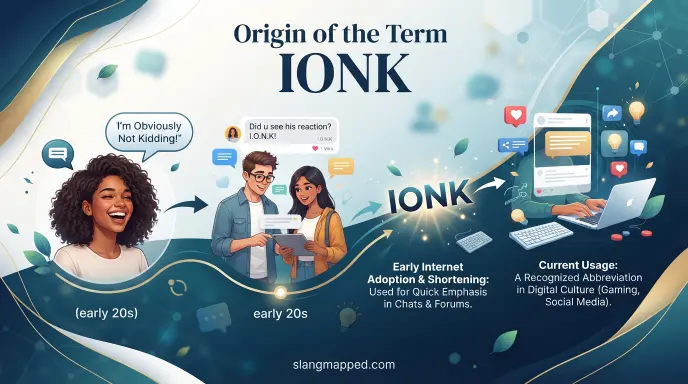
The exact origin of IONK is not clearly documented as a single event or official invention.
Current slang references generally connect it with the informal form “ion” for “I don’t” and the phrase “ion know.” In that sense, IONK can be understood as a compressed, speech-like version of “I don’t know.”
It is important not to treat this as a confirmed step-by-step historical origin. Internet slang often develops gradually through communities rather than being created by one person on one particular date.
Internet Culture and IONK
Online communication encourages people to make messages shorter and more conversational.
People may:
- Remove unnecessary letters.
- Spell phrases according to pronunciation.
- Combine words.
- Use abbreviations.
- Copy expressions from online communities.
- Develop shortcuts within friend groups.
IONK fits this broader pattern.
The relationship can be understood like this:
I don’t know → ion know → ionk
This helps explain why the spelling looks unusual if you have never seen the expression before.
Why Does It Look Different From IDK?
IDK is based on the first letters of:
I + Don’t + Know
IONK is different because it reflects a more speech-like spelling.
That difference is useful to remember:
IDK = letter-based abbreviation
IONK = informal, speech-based slang
Both can communicate essentially the same idea in casual conversation.
IONK vs. IDK, IDC, IMO, and BRB
These terms can look similar because they are all common types of texting shorthand, but they have different meanings.
| Term | Meaning | Type | Usage | Popularity |
| IONK | I don’t know | Informal slang/shorthand | Casual chats, DMs, comments | Less standardized |
| IDK | I don’t know | Initialism | Texting, social media, online chats | Very widely recognized |
| IDC | I don’t care | Initialism | Casual conversations and texts | Very widely recognized |
| IMO | In my opinion | Initialism | Discussions, comments, messages | Widely recognized |
| BRB | Be right back | Initialism | Chats and messaging | Widely recognized |
The most important comparison is IONK vs. IDK.
Both can mean “I don’t know,” but they are formed differently and can have slightly different stylistic feels.
For example:
“idk what happened”
and
“ionk what happened”
communicate essentially the same basic idea.
The second version has a more speech-like slang style.
IONK vs. IDC
These two should not be confused.
IONK = “I don’t know”
IDC = “I don’t care”
Compare:
“ionk where he went.”
“I don’t know where he went.”
versus:
“idc where he went.”
“I don’t care where he went.”
The difference is significant because one expresses uncertainty while the other expresses indifference.
IONK vs. IMO
IMO means “in my opinion.”
For example:
“IMO, the first movie was better.”
This gives an opinion.
IONK does not express an opinion. It expresses uncertainty or a lack of knowledge.
IONK vs. BRB
BRB means “be right back.”
For example:
“brb, getting some food.”
IONK has nothing to do with leaving a conversation. It is used when someone does not know something.
Real-World Usage Example
Imagine two friends are planning what to do on Saturday.
One friend sends:
“Do you know if Maya is coming with us?”
The other replies:
“ionk yet.”
The first friend might answer:
“Okay, ask her when you get a chance.”
Here, IONK is completely natural in a casual conversation.
It tells the other person that the sender does not have the information yet.
Now imagine the same situation in a formal work environment.
A manager asks:
“Do you know if the client has confirmed the meeting?”
Replying with:
“ionk”
would be unnecessarily informal.
A better response would be:
“I’m not sure yet, but I’ll check.”
This shows an important rule about texting slang: the meaning can be correct while the communication style is inappropriate for the situation.
How to Understand IONK From Context
If you see IONK and are unsure what it means, look at the words around it.
For example:
“ionk what happened”
The meaning is easy to understand as:
“I don’t know what happened.”
Another example:
“ionk if I can go”
means:
“I don’t know if I can go.”
If the sentence does not make sense with “I don’t know,” consider the possibility that the sender is using IONK differently.
This matters because internet slang is not perfectly standardized. Some slang sites list alternative interpretations, but “I don’t know” is the dominant interpretation found in current references for ordinary texting use.
When the context still does not make sense, the simplest solution is to ask:
“What do you mean by ionk?”
There is nothing wrong with asking for clarification.
Frequently Asked Questions
Q1. What does IONK mean in text messages?
IONK usually means “I don’t know.” It is informal texting slang used to express uncertainty or a lack of information.
Q2. What does IONK mean on TikTok?
On TikTok, IONK generally means “I don’t know.” You may see it in comments, replies, captions, or casual messages.
Q3. Is IONK slang?
Yes. IONK is best understood as informal internet or texting slang rather than standard English or a formal abbreviation.
Q4. Is IONK rude or offensive?
No. IONK is not inherently rude or offensive. However, a very short reply can sometimes sound dismissive depending on the conversation and tone.
Q5. How should you reply to IONK?
You can reply naturally based on the situation. Try “No worries,” “Okay,” “I’ll check,” or “Do you know who might know?” If the conversation is playful, a funny response can also work.
Final Thoughts
So, what does IONK mean in text? In most casual online conversations, it means “I don’t know.”
You may see it in texts, TikTok comments, Snapchat chats, Instagram DMs, WhatsApp messages, and other informal conversations. It is especially useful when someone wants to express uncertainty without typing the full phrase.
IONK is similar in meaning to IDK, but the two are formed differently. IDK is a familiar initialism, while IONK is better understood as informal, speech-based slang.
The main thing to remember is that context matters. A friendly “ionk ” can sound completely harmless, while the same one-word response during a serious conversation may feel dismissive.
Use IONK with friends and in casual online spaces if it fits your normal texting style. For school assignments, professional emails, workplace messages, or other formal situations, writing “I don’t know” or “I’m not sure” is usually clearer.
In short:
IONK = I don’t know.
Once you recognize that meaning, the term is much easier to understand when it appears in everyday online conversations.

Hi, I’m Tyler Brooks, a writer specializing in Gen Z culture and internet slang. I track trending terms across TikTok and social media to explain their real-world meanings. My goal is to provide clear, accurate, and up-to-date definitions that help readers understand modern online language.