American slang insults are informal words or phrases people in the United States use to tease, criticize, or mock someone. Many people search for these expressions because they see them on TikTok, Reddit, Instagram, movies, TV shows, online games, or in text messages and want to know what they really mean.
Some slang insults are playful jokes between friends, while others can be rude or offensive depending on the situation. Understanding the tone, context, and audience is important before using them.
If you’re learning English, watching American shows, or chatting online, knowing these slang terms can help you avoid misunderstandings and communicate more naturally.
Quick Answer
American slang insults are casual U.S. expressions used to insult, tease, or criticize someone. Their meaning depends on the situation, relationship, and tone of voice.
What Do American Slang Insults Mean in Text?
In texting and online conversations, informal U.S. insults are usually short, informal expressions aimed at another person. Sometimes they are meant as harmless jokes, while other times they express frustration or anger.
For example, close friends might jokingly call each other names without causing offense. However, using the same words with strangers can easily start an argument.
The meaning often depends on:
- The relationship between the speakers
- The tone of the message
- The platform where it is used
- The surrounding conversation
American Slang Insults: Full Form or MeaningF
Unlike abbreviations such as LOL or BRB, american slang insults do not have a full form. Instead, they are informal expressions people use informally in insulting talk to tease, criticize, or mock someone.
Instead, they are:
- Informal expressions
- Nicknames used negatively
- Playful or rude descriptions
- Words that criticize someone’s behavior or intelligence
Most are not meant to be taken literally.
Common American Slang Insults and Their Meanings
| Slang | Meaning | Tone |
| Jerk | Someone acting rude or selfish | Mild |
| Loser | Someone seen as unsuccessful | Negative |
| Dork | A socially awkward person | Usually playful |
| Goofball | Someone acting silly | Friendly |
| Weirdo | Someone behaving unusually | Depends on context |
| Airhead | Someone acting forgetful | Mild insult |
| Dummy | Someone making a foolish mistake | Mild |
| Clown | Someone behaving foolishly | Casual |
| Drama queen | Someone who overreacts | Playful or negative |
| Couch potato | Someone who is lazy | Light-hearted |
These are among the safest and most commonly understood American slang insults.
Are American Slang Insults Rude, Offensive, or Neutral?
The answer depends on the expression and the context.
Usually Friendly
- Goofball
- Dork
- Nerd (among friends)
- Silly goose
These are often playful.
Mildly Offensive
- Dummy
- Airhead
- Jerk
- Clown
These may hurt someone’s feelings.
Strongly Offensive
Some American insults include profanity or offensive language. These should be avoided in professional settings, classrooms, workplaces, or conversations with people you do not know well.
Always consider your audience before using slang insults.
Where Are American Slang Insults Commonly Used?
You may see these expressions on:
- TikTok comments
- Reddit discussions
- Instagram captions
- Snapchat chats
- Discord servers
- Online gaming
- YouTube comments
- Movies and TV shows
- Casual text messages
Each platform has its own style, so meanings may vary slightly.
Why People Use American Slang Insults
People use slang insults for different reasons.
Humor
Friends often tease each other without intending harm.
Example:
“You’re such a goofball.”
Frustration
Someone may use an insult after becoming annoyed.
Example:
“Don’t be a jerk.”
Competition
Gamers sometimes use insults during competitive matches.
Entertainment
Many comedians and internet creators use mild slang insults to make people laugh.
Real-Life Examples
Understanding the tone makes these examples easier to follow.
Friendly Examples
- You’re such a dork, but we love you.
- Stop being a goofball.
- Nice move, dummy!
- You always make us laugh, weirdo.
These are usually playful.
Casual Examples
- Don’t be such a couch potato.
- He’s acting like a clown today.
These may or may not offend someone.
Argumentative Examples
- Quit acting like a jerk.
- Only a loser would do that.
These express criticism and may create conflict.
Gaming and Social Media Examples
- That camper is such a clown.
- Our teammate played like a dummy.
These are common in gaming communities and online chats.
Origin and Background of American Slang Insults
American slang changes constantly.
Many popular insults came from:
- High school culture
- Sports
- Television
- Comedy shows
- Hip-hop culture
- Internet memes
- Gaming communities
- Social media trends
Some words have existed for decades, while others become popular almost overnight through viral videos.
Language continues to evolve as younger generations create new expressions.
American Insult Words and Common Examples
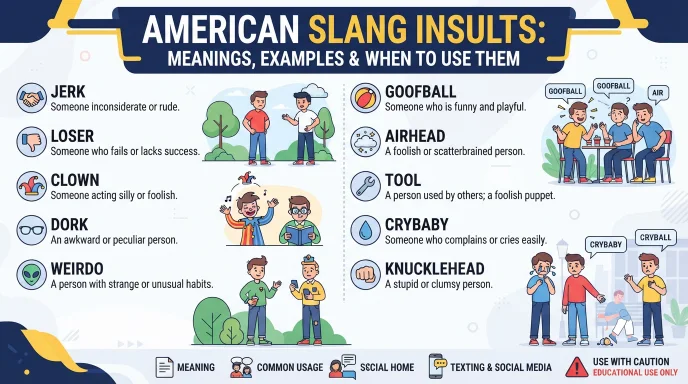
American insult words are informal expressions people use to criticize, mock, or tease someone. Some are mild and playful, while others can be much more offensive. These informal american insults slang can refer to casual U.S. expressions that are commonly used in conversations, texting, entertainment, and online communities.
Some common examples include:
- Jerk: a rude or unpleasant person.
- Loser: someone viewed as unsuccessful or unimpressive.
- Clown: someone behaving foolishly or making themselves look silly.
- Dork: a person who seems awkward or uncool.
- Weirdo: someone who behaves in an unusual way.
- Dummy: a mild way to call someone foolish.
- Airhead: a person seen as forgetful or lacking common sense.
- Knucklehead: a playful term for someone acting foolishly.
- Crybaby: someone who complains or gets upset easily.
- Tool: informal slang for someone who is acting foolishly or being used by others.
These common american insults can sound very different depending on tone. A word used jokingly between friends may sound much harsher when directed at a stranger.
Insult Examples in Everyday English
Here are a few simple insult examples:
- “Don’t be a jerk.”
- “You’re such a goofball.”
- “Stop acting like a clown.”
- “He’s being a total knucklehead.”
These examples show how a colloquial insult can appear in casual American English without necessarily being a serious personal attack.
American Slang Insults vs Similar Slang
| Term | Meaning | Usage |
| Insult | Direct criticism | Negative |
| Roast | Humorous criticism | Friendly or funny |
| Trash talk | Competitive teasing | Sports and gaming |
| Banter | Playful conversation | Friends |
| Comeback | Clever reply | Arguments |
Although these terms are related, they are not identical.
Slang for Making Fun of Someone
The slang for making fun of someone is not always a serious insult. In American English, people may use playful teasing, roasting, banter, or casual nicknames to joke about another person’s behavior.
For example, calling a close friend a “dork,” “goofball,” or “clown” can be friendly when the relationship and tone support the joke. This is different from using a harsh insults to deliberately hurt someone.
Common forms of slang for insulting or teasing someone include:
- Roasting: making humorous comments about someone, often in a joking way.
- Banter: playful teasing between people who are comfortable with each other.
- Trash talk: competitive teasing, especially in sports and gaming.
- Clowning: making fun of someone’s actions or behavior.
- Calling someone a goofball: lightly describing someone as silly.
This is why slang for an insult can sometimes overlap with humor. The same expression may be funny in one conversation but offensive in another.
Online, internet slang insults are especially common in gaming chats, comment sections, Reddit discussions, Discord servers, and social media. Some expressions may also become modern slang insults after spreading through memes, viral videos, or popular online communities.
The key difference is intent. Making fun of someone playfully is usually meant to entertain, while a direct insult is more likely to criticize or offend.
When Should You Avoid American Slang Insults?
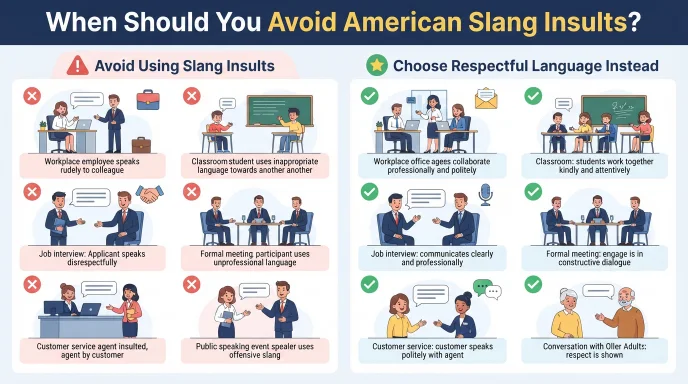
Not all offensive american slang has the same level of seriousness. Some insults are simply rude, while others may target a person’s identity, background, appearance, or other sensitive characteristics. Those expressions should not be treated as ordinary jokes.
It is also important to understand that American insults can vary by age group, region, social setting, and online community. A phrase that sounds common in a movie or gaming chat may be inappropriate in a classroom, workplace, or professional conversation.
Avoid using strong insults when:
- You are speaking to someone you do not know well.
- You are in a workplace or classroom.
- The expression targets someone’s identity or background.
- The other person has shown that they are uncomfortable with teasing.
- You are angry and may say something you later regret.
Some people search for american insults because they encounter these phrases online. However, understanding an expression is different from using it against a person or group. Slang is best learned in context rather than used simply to provoke someone.
If you see a phrase that is peppered with insults in slang, look at the entire conversation before deciding what it means. Tone, relationship, and context can change how an expression is understood.
Polite Alternatives
Instead of using insults, try respectful language.
| Instead of | Try Saying |
| You’re a jerk. | That wasn’t very kind. |
| You’re ignorant. | I think there’s a misunderstanding. |
| You’re lazy. | You could be more active. |
| You’re annoying. | That behavior is bothering me. |
| You’re weird. | You’re different. |
Polite alternatives reduce conflict and encourage better communication.
Why Context Matters
The same word can have different meanings.
For example:
Friend:
You’re such a nerd!
This may be a compliment.
Stranger:
You’re such a nerd!
This could sound insulting.
Always pay attention to:
- Voice
- Facial expression
- Relationship
- Situation
Context changes everything.
Impact of Using Slang in Communication
American slang insults have both advantages and disadvantages.
Positive Effects
- Builds humor among friends
- Makes conversations feel natural
- Reflects modern American culture
- Creates shared jokes
Negative Effects
- Can hurt feelings
- May cause misunderstandings
- Sounds disrespectful in formal settings
- May offend people from different cultures
Responsible communication means choosing words carefully.
Is It Safe for Social Media?
Generally, mild slang insults are common on social media, but users should still be careful.
Before posting, ask yourself:
- Could someone misunderstand this?
- Does it sound like bullying?
- Would I say this face to face?
- Could it violate community guidelines?
Repeated insults, harassment, or abusive language can lead to removed comments or account penalties on many platforms.
Frequently Asked Questions
Q1. What are American slang insults?
They are informal words or phrases used to tease, criticize, or mock someone in everyday American English.
Q2. Are all American slang insults offensive?
No. Some are playful among friends, while others are rude or offensive depending on the context.
Q3. Where are American slang insults most common?
They often appear on TikTok, Reddit, Discord, Instagram, online games, movies, TV shows, and casual text messages.
Q4. Do American slang insults have a full form?
No. Most are ordinary slang words rather than abbreviations or acronyms.
Q5. Can I use American slang insults in professional settings?
It is best not to. Professional communication should remain respectful and polite.
Q6. Why do people use American slang insults?
People use them for humor, teasing, competition, expressing frustration, or adding personality to casual conversations.
Q7. What are some slang insults?
Some common slang insults include jerk, idiot, loser, clown, dork, weirdo, tool, airhead, crybaby, and knucklehead, used to mock or criticize someone informally.
Conclusion
American slang insults are a common part of casual American English, especially in texting, social media, movies, gaming, and everyday conversations.
While many expressions are used playfully among friends, others can be offensive if used in the wrong context. Understanding the speaker’s tone, relationship, and situation is the key to interpreting these terms correctly.
If you’re unsure if an insult will be taken as a joke, it’s usually better to choose a polite alternative. Learning the meaning and proper use of American slang insults helps you communicate more confidently while avoiding unnecessary misunderstandings.
Read More:

Hi, I’m Tyler Brooks, a writer specializing in Gen Z culture and internet slang. I track trending terms across TikTok and social media to explain their real-world meanings. My goal is to provide clear, accurate, and up-to-date definitions that help readers understand modern online language.