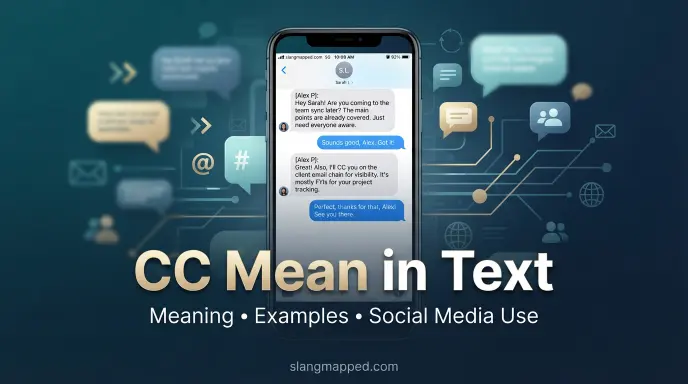
CC in text usually means “carbon copy,” or simply including someone so they can see the same information or conversation. You may see it in texting, WhatsApp, Instagram, Snapchat, TikTok, email, and other online conversations.
The meaning can change with context, though. In a message about a video, CC may mean closed captions, while in a gaming conversation it can mean crowd control. In a creator or social-media context, it can also be used to indicate credit.
That is why people often search for cc mean in text after seeing the abbreviation in a message. Two letters can have several meanings, and the words around them usually tell you which meaning the sender intended.
If you are new to texting abbreviations, there is no need to overthink it. This guide explains the most common meaning, how people use CC online, and how to reply naturally.
CC Meaning in Text
The most common meaning of CC in text is “carbon copy.” In everyday digital communication, it generally means including another person in a message, conversation, or update so they can see the information too. The meaning comes from email, where “cc” is used to send a copy of a message to another recipient.
For example:
“Can you CC me on the update?”
This means:
“Can you include me so I can see the update?”
You may also see:
“I’ll CC Sarah.”
That means the person plans to include Sarah in the communication.
Is CC Slang, an Acronym, or an Abbreviation?
CC is more accurately described as an abbreviation or initialism than traditional slang.
It is short for carbon copy, and each letter is pronounced separately: “C-C.” It became common through letters and email before people started using it casually in online messages.
Because people now use it in informal chats, social media conversations, and group messages, it can sometimes feel like texting slang. However, it is not quite the same type of slang as words such as “LOL,” “rizz,” or “sus.”
Oxford lists cc as an abbreviation for “carbon copy,” particularly when a copy of a business letter or email is sent to another person.
What Does “CC Me” Mean?
When someone says “CC me,” they usually mean:
- Include me in the message.
- Keep me informed.
- Let me see the conversation.
- Send me a copy.
- Make sure I receive the same information.
For example:
A: “I’m sending the schedule to the team.”
B: “CC me, please.”
Here, B is asking to receive a copy or be included.
CC Can Have Other Meanings
Context is important because CC does not have only one meaning.
Depending on the conversation, CC may also refer to:
- Closed captions text displayed with a video or audio.
- Credit giving recognition to the creator of content.
- Credit card especially in financial conversations.
- Crowd control common in gaming.
- Cubic centimetres a measurement, especially with engines or technical subjects.
The Oxford dictionary also lists cubic centimetre(s) as another meaning of “cc.”
So if someone writes “Turn CC on,” they probably mean captions. If they write “CC me on that email,” they mean carbon copy or inclusion.
The surrounding words are the key.
Where People Use CC
CC can appear across several platforms, but its meaning may shift depending on what people are discussing.
CC on TikTok
On TikTok, CC can commonly refer to closed captions, especially when people are talking about videos.
For example:
“Does this video have CC?”
Here, the person is asking if captions are available.
You may also see CC used around content attribution or creator credit. For example, someone might use it while discussing who created or originally posted a piece of content.
Because TikTok combines videos, captions, comments, and creator conversations, the same abbreviation can have different meanings.
A simple rule is:
Video or accessibility context → CC may mean closed captions.
Sharing or attribution context → CC may refer to credit.
CC on Snapchat
On Snapchat, CC is less likely to have one fixed slang meaning.
If friends are discussing a message or someone being included in an update, CC can carry the idea of copying or informing another person.
If they are discussing a video, CC may refer to captions.
For example:
“Can you CC Emma?”
This likely means:
“Can you include Emma or make sure she gets the information?”
The exact meaning depends on the conversation.
CC on Instagram
Instagram users may encounter CC in messages, comments, captions, or content-creation discussions.
In a messaging context:
“CC him so he knows.”
This means to include or inform him.
In a creator context, CC may be associated with giving credit to someone whose content, image, artwork, or idea is being shared.
That makes context especially important on Instagram. A CC appearing underneath a post may not mean the same thing as CC appearing in a private DM.
CC on WhatsApp
WhatsApp does not have a traditional email-style CC field.
Still, people may use the abbreviation informally.
For example:
“CC Ali on this.”
The sender may simply mean:
“Include Ali or make sure Ali sees this.”
In a WhatsApp group, the person may also simply tag the relevant person instead of using CC.
CC in SMS Text Messages
In ordinary SMS conversations, CC usually appears when people are borrowing terminology from email or workplace communication.
For example:
“I’ll CC you when I send it.”
The person probably means:
“I’ll include you when I send the message.”
However, if the conversation is about a video, gaming, money, or another subject, a different meaning may apply.
Real Chat Examples of CC
Here are realistic examples showing how the meaning can change depending on the conversation.
Example 1: Including Someone
A: Did you send the meeting details?
B: Not yet.
A: Okay, CC me when you do.
Here, CC me means “include me.”
Example 2: Keeping Someone Updated
A: I’m sending the final plan tonight.
B: Can you CC Jake too?
A: Sure.
B wants Jake to receive the information.
Example 3: Email-Style Usage
A: Who did you send the report to?
B: Just Mia and the manager.
A: Please CC me next time.
The meaning is clearly connected to sending someone a copy.
Example 4: Closed Captions
A: I can’t understand the audio.
B: Turn CC on.
A: Oh, I see it now.
Here, CC means closed captions, not carbon copy.
Example 5: Video Context
A: Does this clip have CC?
B: Yeah, just tap the captions button.
Again, CC means captions.
Example 6: Social Media Credit
A: Where did you get that artwork?
B: I found the original creator.
A: Make sure you CC them when you post it.
Here, CC is being used informally around giving credit or attribution.
Example 7: Group Chat
A: I’m updating everyone about tomorrow.
B: CC Tom too.
A: Good call. I almost forgot him.
The person wants Tom included.
Example 8: Work Conversation
A: I sent the invoice to accounting.
B: Did you CC the project manager?
A: Yes, she’s on the email.
This is a typical professional use.
Example 9: Gaming
A: What does CC mean in this game?
B: Crowd control. It means abilities that restrict enemies.
A: Got it.
Here, the gaming context completely changes the meaning.
Example 10: Asking for Clarification
A: CC me on that.
B: You mean add you to the message?
A: Yep.
This is a good example of how people may use CC casually even when there is no actual email CC button.
How to Reply When Someone Says “CC”
Your response depends on what the person means.
If they are asking you to include them, a simple confirmation is enough.
Funny Replies
If you are chatting with a close friend, you can make the response playful.
- “You want VIP access? ”
- “Say less, you’re getting the copy.”
- “CC department reporting for duty.”
- “Yep, adding you to the secret files ”
- “Consider yourself officially included.”
These work best with friends who understand your humor.
Casual Replies
For normal conversations, keep it simple.
- “Sure, I will.”
- “Yep, got you.”
- “No problem.”
- “Sure, I’ll add you.”
- “Okay, I’ll include you.”
Friendly Replies
If you want to sound warm and helpful:
- “Of course! I’ll make sure you get it.”
- “Sure, I’ll keep you in the loop.”
- “Absolutely, I’ll include you.”
- “No worries, I’ll send you a copy too.”
Neutral Replies
For school, work, or less familiar conversations:
- “Sure, I’ll include you.”
- “Understood. I’ll add you to the message.”
- “Okay, I’ll make sure you receive it.”
- “Certainly. I’ll copy you on the email.”
If you are unsure what the sender means, simply ask:
“Do you mean include me?”
That is much better than guessing.
Is CC Rude or Offensive?
CC is not normally rude or offensive. It is a standard communication abbreviation, especially when referring to carbon-copying someone on a message.
The tone depends more on the sentence than on the abbreviation itself.
For example:
“Please CC me on the report.”
sounds neutral.
But:
“CC me this time. You always forget.”
could sound annoyed because of the rest of the sentence.
The abbreviation itself is not the problem.
Is CC Safe to Use?
Yes, in ordinary communication, CC is generally safe.
It is commonly understood in email and may be understood in casual online conversations. However, because it has several meanings, using the full phrase can sometimes be clearer.
Instead of:
“CC me.”
you could write:
“Please include me in the message.”
This is especially useful when talking to someone who may not be familiar with online abbreviations.
Is CC Appropriate at School?
It can be appropriate in some school-related situations, especially email.
For example:
“Please CC my group members.”
However, students should still follow their teacher’s or school’s communication preferences.
In a formal school email, writing the full sentence may be clearer than relying on abbreviations.
Is CC Appropriate at Work?
Yes. CC is completely normal in professional email.
For example:
“Please CC the finance team on future updates.”
This is a standard business use of the term.
In fact, “cc” is more established in professional email than it is as internet slang.
Who Uses This Term?
CC is not limited to one particular age group.
Adults may use it in workplace emails, while younger users may encounter it through social media, video captions, gaming, and messaging.
Age Groups
There is no single age group that owns the term.
People may use or recognize CC because they:
- Send emails.
- Use social media.
- Watch captioned videos.
- Participate in group chats.
- Play online games.
- Work with digital documents.
Unlike newer slang terms that may be strongly associated with younger users, CC has been used in communication for many years.
Gen Z Usage
Gen Z users may encounter CC in several digital contexts, particularly social media and video platforms.
However, it would be misleading to assume that every Gen Z user uses CC as slang or uses it with the same meaning.
The context matters more than age.
Common Platforms
You may encounter CC in:
- TikTok
- Snapchat
- Text messages
- YouTube
- Discord
- Gaming chats
The most likely meaning depends on the type of content surrounding it.
How Often Does CC Appear Online?
CC is a familiar abbreviation, but its frequency varies greatly by context.
You are more likely to see CC in email, workplace communication, videos with captions, creator discussions, or gaming conversations than in a random casual text such as “What are you doing?”
That is another reason context is so useful.
Origin of the Term
The original meaning of CC comes from “carbon copy.”
Before modern digital communication, carbon paper was used to create duplicate copies of written or typed documents. A sheet of carbon paper placed between pages could transfer the text onto another sheet.
The term continued into office communication and eventually became part of email terminology.
Today, when an email has a CC field, the people listed there receive a copy of the message without necessarily being the primary recipient.
That established meaning later influenced casual digital communication.
How CC Entered Online Communication
Email made “CC” familiar to millions of internet users.
As people became accustomed to saying things like:
“I’ll CC you.”
the expression naturally moved into other forms of digital conversation.
People began using it more loosely to mean:
- Include someone.
- Keep someone informed.
- Add someone to the conversation.
- Give someone access to the same information.
Social media then added additional meanings, especially around captions and content credit.
So there is not one single modern internet invention behind every use of CC. Instead, different online communities use the same two letters for different established ideas.
Is the Origin Completely Clear?
The origin of CC as “carbon copy” is well established. Oxford records “carbon copy” as the standard meaning in business letters and emails.
What is less straightforward is the origin of every newer social-media use.
For example, CC can mean closed captions in video contexts, while creator communities may use it around credit or attribution. These are context-specific uses rather than one single slang definition.
CC vs. IDK vs. IDC vs. IMO vs. BRB
CC belongs to a much larger group of digital abbreviations.
Here is a simple comparison:
| Abbreviation | Meaning | Type | Usage | Popularity |
| CC | Carbon Copy / include someone; context can change the meaning | Abbreviation | Email, texting, social media, video, gaming | Common |
| IDK | I Don’t Know | Text abbreviation | Texting, chats, social media | Common |
| IDC | I Don’t Care | Text abbreviation | Texting, chats, social media | Common |
| IMO | In My Opinion | Text abbreviation | Texting, comments, discussions | Common |
| BRB | Be Right Back | Text abbreviation | Texting, gaming, chats | Common |
These terms are not interchangeable.
For example:
IDK = I don’t know.
IDC = I don’t care.
IMO = In my opinion.
BRB = Be right back.
CC = usually carbon copy/include someone, but its meaning can change with context.
That last point is important. CC is more context-dependent than many familiar texting abbreviations.
Real-World Usage Example
Imagine that three coworkers are preparing a presentation.
One employee sends an email to the project manager and attaches the finished presentation. Another coworker needs to know what was sent, but they are not the main person responsible for the project.
The coworker might say:
“Can you CC me when you send the final version?”
The sender then adds that coworker to the CC field.
The coworker receives a copy of the email and can stay informed without necessarily being the primary person the email is addressed to.
Now imagine a completely different situation.
A friend sends you a TikTok and says:
“Turn CC on.”
In that case, they almost certainly mean closed captions, not carbon copy.
This shows why reading the surrounding message matters. The same two letters can have different meanings in different situations.
Common Mistakes When Understanding CC
Because CC has several meanings, beginners sometimes make the wrong assumption.
Assuming CC Always Means Carbon Copy
Carbon copy is the most established meaning, but it is not the only one.
If someone says:
“Turn CC on.”
they are probably talking about captions.
Assuming CC Is Always Slang
CC is generally better described as an abbreviation. It can be used casually, but its origins are tied to established communication terminology.
Ignoring the Platform
A message about an email and a message about a TikTok should not automatically be interpreted in the same way.
Ask yourself:
What are we talking about?
That question often solves the confusion immediately.
Confusing CC With Mentioning Someone
In some casual chats, people use CC to mean “include this person,” but that does not mean every social-media platform has a formal CC feature.
Someone may simply be using the term informally.
When Should You Use CC?
Use CC when the context is clear.
It works especially naturally in:
- Emails
- Workplace messages
- Group communication
- Project updates
- Content-credit discussions
- Video-caption conversations
If you are speaking with someone unfamiliar with abbreviations, use clearer wording.
For example:
Instead of:
“CC me.”
Try:
“Please include me in the email.”
Instead of:
“CC Sarah.”
Try:
“Please include Sarah in the update.”
Clear language is often better than an abbreviation when there is a possibility of confusion.
When Should You Avoid CC?
There is no general reason to avoid the abbreviation, but there are situations where another phrase may be clearer.
Avoid using it when:
- The recipient may not know what CC means.
- The context contains several possible meanings.
- You are writing a formal message where clarity is important.
- You are communicating with someone who is learning English.
- You are unsure if they mean captions, credit, or carbon copy.
For example, instead of:
“CC is required.”
you could say:
“Please include me in the email.”
The second sentence leaves less room for misunderstanding.
Frequently Asked Questions
Q1. What does CC mean in text messages?
CC usually means “carbon copy” or including someone so they can receive or see the same information. The exact meaning can change depending on the conversation.
Q2. What does CC mean on TikTok?
On TikTok, CC can mean closed captions, especially when someone is talking about video captions. In creator-related conversations, it may also be used around credit. Context determines the meaning.
Q3. Is CC slang?
CC is primarily an abbreviation rather than traditional slang. People use it casually in texts and online conversations, which can make it feel like slang.
Q4. Is CC rude or offensive?
No. CC is not normally rude or offensive. It is a standard abbreviation. The tone depends on the sentence and situation.
Q5. How should you reply to CC?
If someone means “include me,” you can reply “Sure,” “Got you,” “No problem,” or “I’ll include you.” If you are unsure, ask what they mean.
Conclusion
So, what does cc mean in text? Most commonly, CC means “carbon copy” and refers to including someone in a message or keeping them informed. The expression comes from traditional communication and is now especially familiar through email.
But CC does not have just one meaning online. On a video platform, it can mean closed captions. In creator conversations, it may relate to credit, while gamers may use CC for crowd control.
The easiest way to understand CC is to look at the context. Check the platform, the topic, and the words surrounding the abbreviation before deciding what it means.
For casual conversations, CC is generally safe to use. In school, work, or formal communication, however, writing the full meaning can be a better choice when there is any chance of confusion.
Once you know the context, these two little letters are usually much easier to understand.
You May Also Like:
- What Does Slime Mean in Slang? Real Definition & Examples
- Borg Meaning Slang: Origin, Recipe, and Why It’s Controversial
- Chuzz Meaning Slang: TikTok’s Controversial Slang Explained

Hi, I’m Rachel Simmons, a language writer specializing in American English and modern slang. I research regional expressions, everyday phrases, and evolving word meanings across the United States. I enjoy making complex language trends simple, practical, and easy for everyone to understand.