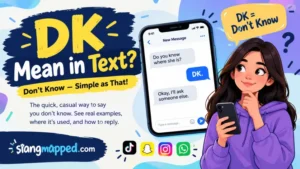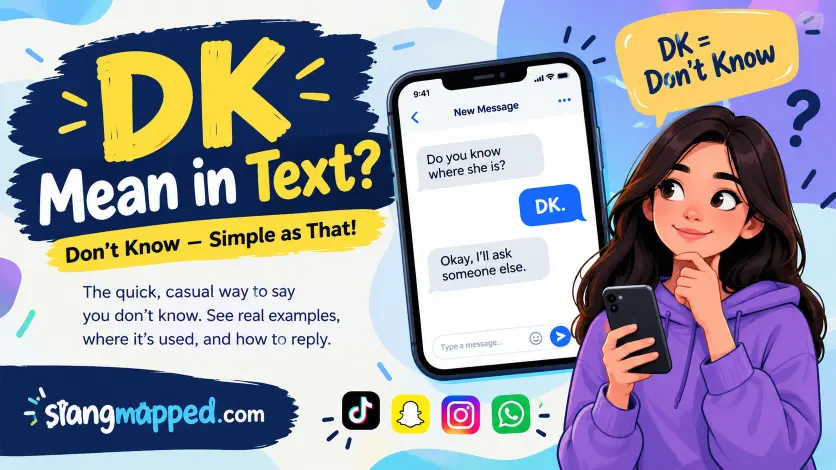
DK usually means “don’t know” in text messages and online chats. It is a short abbreviation people use when they do not know the answer to something.
You may see “DK” in texting, TikTok comments, Snapchat messages, Instagram DMs, WhatsApp, and other casual conversations.
People often search for “dk mean in text” because abbreviations can have different meanings depending on the conversation. In most everyday texting situations, however, DK = don’t know.
It is especially useful when someone wants to give a quick answer without typing the full phrase. For example, “DK what time she’s coming” simply means “I don’t know what time she’s coming.”
DK Meaning in Text
The most common meaning of DK in text is “don’t know.”
It is an abbreviation rather than a traditional slang word. People shorten “don’t know” to “DK” to make messages quicker and more casual.
For example:
A: Do you know where Jake went?
B: DK.
Here, “DK” means “I don’t know.”
The abbreviation can also appear in longer messages:
“DK what happened.”
This means:
“I don’t know what happened.”
Is DK an Acronym or Abbreviation?
“DK” is commonly described as a texting abbreviation. It represents the first letters of “don’t know.”
Technically, it is not usually treated as a conventional acronym because people generally do not pronounce “DK” as a word. Instead, they read the letters individually.
You may see it written as:
- DK
- dk
- Dk
The capitalization usually does not change the meaning.
What Does DK Mean in Everyday Chat?
In everyday conversation, DK is a quick way of saying that you do not have the information someone is asking for.
For example:
- “DK where he is.”
- “DK what time it starts.”
- “DK if she’s coming.”
- “DK why they left.”
- “DK, ask Sarah.”
The tone is normally casual.
It does not necessarily mean the person is refusing to answer. They may genuinely not know.
DK Can Sometimes Depend on Context
Although “don’t know” is the common texting meaning, abbreviations can occasionally have other meanings in specialized conversations.
For example, “DK” might refer to a person’s initials, a brand, a game-related term, or another expression. Context matters.
If someone writes:
“DK if I can go tonight.”
the intended meaning is almost certainly “don’t know.”
Where People Use DK
DK is mainly used in informal digital communication. You are more likely to see it in a quick message than in formal writing.
DK on TikTok
On TikTok, DK can appear in comments, replies, captions, or direct messages.
For example:
“DK, I haven’t watched it yet.”
A TikTok user might use DK because the comment is informal and short.
However, not every occurrence of “DK” on TikTok means “don’t know.” If the letters appear as part of a username, name, hashtag, or specific community term, the meaning may be different.
DK on Snapchat
Snapchat is built around quick conversations, so abbreviations such as DK can fit naturally into messages.
Someone might send:
“DK where we’re meeting lol.”
This means:
“I don’t know where we’re meeting.”
The short form can make a message feel relaxed and conversational.
DK on Instagram
On Instagram, DK may appear in DMs or comments.
For example:
“DK if I can make it.”
Instagram users often mix abbreviations with emojis, shortened words, and casual expressions.
DK on WhatsApp
WhatsApp conversations can be more personal and informal. Friends and family members may use DK when replying quickly.
For example:
“DK yet. I’ll let you know.”
This means:
“I don’t know yet. I’ll let you know.”
DK in SMS
Traditional text messages are another place where you may encounter DK.
Someone might text:
“DK what time I’ll be home.”
It saves a few characters while still communicating the same basic idea.
Real Chat Examples
Seeing DK in realistic conversations makes its meaning easier to understand.
Example 1: Asking About a Friend
A: Do you know where Mia is?
B: DK.
A: I thought she was with you.
B: Nope, haven’t seen her today.
Here, DK simply means “I don’t know.”
Example 2: Making Plans
A: What time are we meeting?
B: DK yet.
A: Let me know when you find out.
B: Sure.
The person does not know the meeting time yet.
Example 3: Talking About School
A: Is the test tomorrow?
B: DK, I need to check the schedule.
A: Same.
B: I’ll look later.
The abbreviation is being used in a casual school-related conversation.
Example 4: Social Media
A: Did you see that new video?
B: DK which one you mean.
A: The one everyone is posting.
B: Oh yeah, I saw it.
Here, DK means the person does not know which video the other person is talking about.
Example 5: Making Dinner Plans
A: Are you eating with us tonight?
B: DK yet.
A: Okay, just tell me later.
B: Will do.
The speaker has not decided yet.
Example 6: Asking About an Event
A: Who’s going to the party?
B: DK.
A: You should ask Alex.
B: Good idea.
Again, DK means “I don’t know.”
Example 7: Discussing a TV Show
A: When is the next episode coming out?
B: DK. Maybe Friday?
A: I’ll check.
B: Let me know.
The person is uncertain about the release date.
Example 8: Talking About Someone’s Plans
A: Is Tom coming tomorrow?
B: DK if he can make it.
A: Hopefully he comes.
B: Yeah, same.
Here, “DK if” means “I don’t know if.”
Example 9: A Quick Reply
A: Why did she leave early?
B: DK.
A: Okay, I’ll ask her.
B: Probably best.
The short reply indicates that the person does not know the reason.
Example 10: Casual Group Chat
A: Who’s bringing snacks?
B: DK 😂
A: Someone better bring them.
B: I’ll bring chips.
The abbreviation works naturally in a relaxed group conversation.
How to Reply When Someone Says “DK”
Your response depends on what the other person means and the tone of the conversation.
If someone simply says “DK,” you can ask another person, provide more information, or continue the conversation.
Funny Replies
If you are joking with a friend, you might respond:
- “DK? Ask Google ”
- “You never know anything lol.”
- “That was helpful 😂”
- “Mystery solved… not.”
- “Okay, detective mode activated.”
These replies work best with people who understand your humor.
Casual Replies
For an ordinary conversation, you can say:
- “Okay.”
- “No worries.”
- “Got it.”
- “Alright, let me know.”
- “I’ll check.”
These are simple and natural.
Friendly Replies
If you want to keep the conversation warm:
- “No worries! I’ll find out.”
- “That’s okay, I’ll ask them.”
- “All good. Let me know if you hear anything.”
- “Thanks anyway!”
Neutral Replies
A neutral response is useful when you do not know the person very well.
You could say:
- “Okay, thanks.”
- “Understood.”
- “No problem.”
- “I’ll check.”
- “Thanks for letting me know.”
Is DK Rude or Offensive?
DK is generally not rude or offensive. It is simply a short way to say “don’t know.”
The tone depends more on the surrounding message than on the abbreviation itself.
For example:
“DK, sorry.”
sounds fairly polite.
But:
“DK. Stop asking.”
could sound impatient because of the rest of the message.
Is DK Safe to Use?
In casual conversations, DK is generally safe to use.
It can work with:
- Friends
- Family
- Online acquaintances
- Group chats
- Social media conversations
Still, the relationship and context matter.
Is DK Appropriate at School?
It depends on the situation.
In a casual message to a friend about homework, using DK is usually understandable.
For example:
“DK what page we’re on.”
But when submitting an assignment, answering a teacher formally, or writing an academic response, it is better to write:
“I don’t know.”
instead of:
“DK.”
Is DK Appropriate at Work?
For professional communication, writing the complete phrase is usually clearer.
Instead of:
“DK when the meeting starts.”
you could write:
“I don’t know when the meeting starts.”
In a workplace, especially when communicating with clients or managers, full sentences can prevent confusion and make the message sound more professional.
Who Uses This Term?
DK is mainly associated with informal digital communication.
Younger Internet Users
Teenagers and young adults may use short abbreviations frequently in texting and social media conversations.
However, DK is not exclusive to Gen Z.
Adults who regularly use texting and online messaging may also understand or use it.
Gen Z Usage
Gen Z commonly encounters abbreviations across platforms such as TikTok, Instagram, Snapchat, Discord, WhatsApp, and messaging apps.
That does not mean every Gen Z user uses DK regularly. Some people prefer typing “idk,” which is much more recognizable.
Older Users
Older adults who text frequently may also understand DK from context.
Because “don’t know” is such a common phrase, the meaning can often be understood even by people who do not regularly use internet slang.
Common Platforms
You may encounter DK in:
- Text messages
- TikTok
- Snapchat
- Discord
- Facebook Messenger
- Online forums
- Group chats
The exact frequency varies by platform and community.
Origin of the Term
The exact origin of DK as a texting abbreviation for “don’t know” is difficult to pin to one specific person, website, or date.
It belongs to a broader pattern of shortening common phrases in digital communication.
Texting encouraged people to communicate quickly using fewer characters. Abbreviations such as “IDK,” “BRB,” “IMO,” and “LOL” became familiar through online messaging and text-based communication.
Why Did People Start Shortening Words?
Early digital communication often encouraged brevity.
People wanted to send messages quickly, and shortened expressions were convenient. Over time, common abbreviations became recognizable enough that many users could understand them immediately.
DK follows the same general idea:
Don’t Know → DK
However, IDK (“I don’t know”) is generally more recognizable than DK in modern internet conversations.
DK vs. IDK
The difference is small but useful.
- DK = Don’t know
- IDK = I don’t know
For example:
“DK where he went.”
means:
“Don’t know where he went.”
While:
“IDK where he went.”
means:
“I don’t know where he went.”
Both communicate uncertainty, but IDK is often more immediately recognizable as a texting abbreviation.
DK vs. IDK vs. IDC vs. IMO vs. BRB
These abbreviations can appear together in online conversations, but they have different meanings.
| Term | Meaning | Type | Usage | Popularity |
| DK | Don’t know | Abbreviation | Casual texting and chats | Less common than IDK |
| IDK | I don’t know | Abbreviation | Texting, social media, DMs | Very common |
| IDC | I don’t care | Abbreviation | Casual conversations | Very common |
| IMO | In my opinion | Abbreviation | Discussions, comments, chats | Common |
| BRB | Be right back | Abbreviation | Chats and messaging | Well-known |
DK and IDK
Both relate to not knowing something.
DK:
“DK where she went.”
IDK:
“IDK where she went.”
DK and IDC
These two can look similar, but their meanings are completely different.
DK = Don’t know
IDC = I don’t care
Compare:
“DK what happened.”
The person does not know.
“IDC what happened.”
The person is saying that they do not care about what happened.
DK and IMO
IMO means “in my opinion.”
It is used when someone is giving a personal view.
“IMO, the first movie was better.”
That is different from DK:
“DK which movie is better.”
The first expresses an opinion. The second expresses uncertainty.
DK and BRB
BRB means “be right back.”
It tells someone that the speaker is temporarily leaving the conversation.
“BRB, getting some food.”
DK does not indicate that someone is leaving. It simply communicates that they do not know something.
Real-World Usage Example
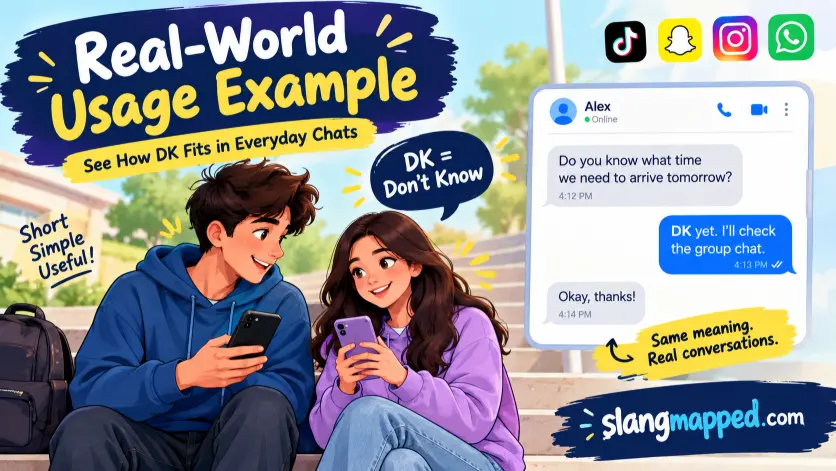
Imagine two classmates are preparing for a school activity.
One student sends a message:
“Do you know what time we need to arrive tomorrow?”
The other student has not checked the schedule yet and replies:
“DK yet. I’ll check the group chat.”
In this situation, DK is a quick and informal way of saying “I don’t know yet.”
Later, the student finds the information and sends:
“It’s 8:00. We need to be there before 8:30.”
This shows how DK can be used naturally when someone does not have an answer at the moment.
When Should You Use DK?
DK works best when the conversation is casual and the other person understands texting abbreviations.
You can use it when:
- You are chatting with friends.
- You are replying quickly.
- You are in a casual group chat.
- You are messaging someone on social media.
- You genuinely do not know the answer.
For example:
“DK what time we’re leaving.”
That is perfectly understandable in a casual chat.
However, you may want to avoid it when clarity and professionalism are important.
Instead of:
“DK when the report is due.”
a professional message could say:
“I’m not sure when the report is due. I’ll check and let you know.”
The second version is clearer and more appropriate for formal communication.
Why DK Can Be Confusing
Short abbreviations can sometimes be confusing because they remove words that normally make a sentence clearer.
Consider:
“DK.”
Without context, you know the person probably means “don’t know,” but you may not know what they are responding to.
For example:
A: “Are you coming tomorrow?”
B: “DK.”
This clearly means the person does not know if they are coming.
But if someone simply sends:
“DK”
with no previous conversation, you may need to ask what they mean.
This is why context matters when interpreting internet abbreviations.
DK vs. “I Don’t Know”
The biggest difference is style.
“I don’t know” is the complete phrase.
“DK” is a shortened, casual version.
Compare:
“I don’t know where she is.”
with:
“DK where she is.”
The basic meaning remains the same, but the second version is shorter and more informal.
If you are writing an email, school assignment, formal message, or professional document, the complete phrase is usually the safer choice.
Frequently Asked Questions
Q1. What does DK mean in text messages?
DK usually means “don’t know.” It is a casual abbreviation used when someone does not know the answer to a question.
Q2. What does DK mean on TikTok?
On TikTok, DK can mean “don’t know” when it appears in a casual comment, message, or conversation. Context should always be considered.
Q3. Is DK slang?
DK is better described as a texting abbreviation rather than a traditional slang word. It is a shortened form of “don’t know.”
Q4. Is DK rude or offensive?
No. DK is generally not rude or offensive. However, the full message and tone can make a response sound friendly, neutral, or impatient.
Q5. How should you reply to DK?
You can reply naturally with “Okay,” “No worries,” “I’ll check,” or “Let me know if you find out.” The best response depends on the conversation.
Final Thoughts
DK usually means “don’t know” in text and online conversations. It is a short abbreviation used to quickly tell someone that you do not have an answer or information.
You may see it in texting, TikTok comments, Snapchat, Instagram DMs, WhatsApp, and other casual chats. It can also appear in longer phrases such as “DK what happened” or “DK if she’s coming.”
The abbreviation is generally harmless and not offensive. However, DK is most appropriate for informal communication. For schoolwork, professional messages, or situations where clarity matters, writing “I don’t know” is usually better.
One useful point to remember is that IDK is more widely recognized than DK. If you see either abbreviation in a casual conversation, the surrounding context will usually make the intended meaning clear.

Hi, I’m Rachel Simmons, a language writer specializing in American English and modern slang. I research regional expressions, everyday phrases, and evolving word meanings across the United States. I enjoy making complex language trends simple, practical, and easy for everyone to understand.