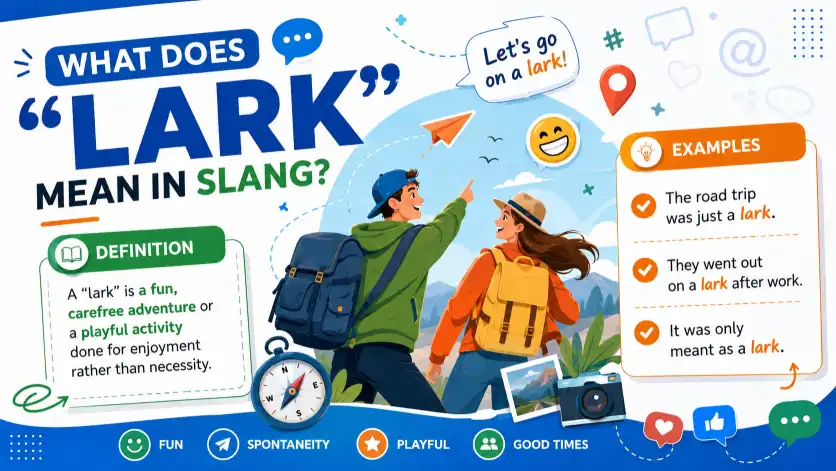
Lark definition slang is a bit of harmless fun, mischief, or a playful, spontaneous adventure; something done just for enjoyment rather than a serious purpose.
Lark meaning slang is something a lot of people search for after seeing the word pop up in a chat, a caption, or a casual conversation and not being totally sure what it’s getting at.
It’s not a brand-new internet slang term , it’s actually an old English word that has quietly worked its way into modern texting because it sounds fun, a little old-fashioned, and oddly charming.
People search for it because context alone doesn’t always make the meaning obvious, especially if you’ve only ever heard “lark” used to describe a bird.
Quick Answer: Lark Slang Meaning
In texting and casual conversation, “lark” usually means a bit of harmless fun, a playful adventure, or something done just for amusement , as in “we only did it for a lark.” It can also describe someone who’s a natural early riser (a “morning lark”).
What Does Lark Mean in Text?
When someone uses “lark” in a text message, lark slang definition is almost always about doing something fun, silly, or spontaneous, not necessarily something planned or serious.
It’s the kind of word people use when they want to downplay an activity as lighthearted rather than important.
For example, if a friend texts “we snuck into the rooftop for a lark,” they mean it was a fun, slightly cheeky thing to do , not a big deal, just a laugh.
The second common meaning shows up when people describe someone’s sleep schedule. Calling someone a “lark” (as opposed to a “night owl”) means they wake up early and feel most energetic in the morning.
What Does It Mean to Call Someone a Lark?
If you’re wondering what’s a lark or what does it mean to call someone a lark, the answer depends on the context. A person may be called a “lark” because they enjoy playful adventures, harmless mischief, or simply because they are naturally active and energetic in the morning.
In the fun-related sense, calling someone a lark can suggest that they are playful, spontaneous, or always ready to join in on something amusing.
It does not normally mean that the person is troublesome or badly behaved. The expression usually has a light and friendly tone.
For example, someone might say, “She’s a bit of a lark; she is always getting us into fun little adventures.” Here, “lark” describes a person who enjoys doing things for amusement rather than taking everything too seriously.
The meaning can also connect to the familiar idea of a morning lark. In this context, a lark is someone who naturally wakes early, feels energetic in the morning, and prefers starting the day early. This is the opposite of the better-known “night owl.”
Lark as a Description of Personality
When “lark” is used to describe a person’s personality, context is especially important. It can suggest someone who enjoys fun, spontaneous plans, playful behavior, or an early-morning routine.
The word is generally neutral or positive, so calling someone a lark is unlikely to be taken as an insult. However, the surrounding sentence and tone can make the expression sound humorous, affectionate, or slightly old-fashioned.
Full Form / Definition of the Slang
“Lark” doesn’t actually have a full form , it isn’t an acronym like “LOL” or “BRB.”
It’s a genuine English word with roots that go back centuries, and its slang usage comes from its older, informal meaning rather than letters standing for something else.
If someone searches “lark full form” expecting an acronym breakdown, the honest answer is that there isn’t one. The word itself already carries the meaning:
- As a noun (fun/adventure): a harmless bit of mischief, fun, or amusement.
- As a noun (bird-related): referring to someone as an early riser, based on the actual bird known for singing at dawn.
Is It Rude, Offensive, or Neutral?
“Lark” is completely neutral and, if anything, leans positive. It doesn’t carry any offensive weight, and there’s no context where it’s used as an insult or slur.
It’s more commonly associated with light, cheerful, or nostalgic tones than anything negative.
The only mild exception is when “lark” is used sarcastically , for example, “that was a real lark” said after something went wrong , where tone shifts the meaning toward irony rather than genuine fun. Even then, it’s not offensive, just sarcastic.
Where Is It Commonly Used?
“Lark” tends to show up more in British and Irish English, and it’s used somewhat less frequently in American slang, though it’s understood widely thanks to books, shows, and online content.
You’ll typically come across it in:
- Everyday texting between friends, especially in the UK, Ireland, Australia, and parts of the Commonwealth
- People may also search lark urban dictionary when they want to compare informal definitions or see how the term is used in casual slang.
- Reddit threads, especially in British-focused subreddits or nostalgic “old-school slang” discussions
- Instagram or Facebook captions describing a fun outing
- Casual storytelling on TikTok when someone recounts a funny or spontaneous moment
- Workplace chats, when describing something done just for a laugh rather than a serious task
It’s less common on platforms driven by fast-moving Gen Z slang like Discord gaming servers, though it does occasionally appear when someone’s going for a more playful or old-fashioned vibe.
What Does “Lark About” Mean?
If you’ve come across the phrase lark about meaning in British English, it refers to behaving in a playful, silly, or carefree way instead of focusing on something serious.
It can describe people joking around, wasting time in a fun way, or simply messing around without a serious purpose.
For example, “The children were larking about in the garden” means the children were playing around and having fun.
Likewise, “We spent the afternoon larking about” suggests that the time was spent relaxing, joking, or doing amusing things rather than working toward a specific goal.
The phrase is closely connected to the older informal sense of “lark.” It often has a friendly tone, but it can sometimes sound mildly critical if someone is expected to be working or behaving seriously.
Lark About in Everyday Conversation
“Lark about” is especially useful when describing casual behavior. The phrase can appear in conversations about friends, children, trips, parties, or situations where people are not taking things too seriously.
For example:
- “Stop larking about and help me with this.”
- “We were just larking about after school.”
- “They spent the whole weekend larking about by the beach.”
The exact tone depends on context. Between friends, it can sound playful. In a situation where someone should be concentrating, it may suggest that they are fooling around instead of getting something done.
Real-Life Examples of Usage
- “Let’s go, it’ll be a lark!”
- “We only entered the competition for a lark, we didn’t expect to win.”
- “He’s such a lark, up at 5 a.m. every single day.”
- “It started as a lark and turned into an actual hobby.”
What Is Larking? Understanding the Verb Form of Lark
If you’re searching what is larking, “larking” is the -ing form of “lark.” In informal English, it usually describes playing around, behaving in a silly or carefree way, or spending time doing something simply for amusement.
The word can describe an activity rather than a specific joke or prank. Someone who is “larking about” may be joking with friends, playing around, or enjoying a spontaneous moment without having a serious goal.
For example, “They were larking around all afternoon” means they spent the afternoon having fun and not doing anything particularly serious.
How “Larking” Differs From a Serious Activity
The key idea behind “larking” is a lack of seriousness. It does not necessarily mean that someone is causing trouble. Instead, it often suggests lighthearted behavior, playful activity, or harmless fun.
This makes “larking” useful in casual storytelling. Someone might describe a trip, childhood memory, weekend activity, or funny situation as larking when the main purpose was enjoyment rather than achievement.
Because the expression has a somewhat traditional British feel, it may sound more old-fashioned than newer expressions such as “messing around” or “goofing off.” That distinctive tone is part of what makes the word interesting in modern casual English.
Origin and Background of the Slang
The “fun/mischief” meaning of “lark” is believed to have developed in 19th-century British English, possibly linked to the word “lake,” an old dialect term meaning “to play.”
Over time, it evolved into the “lark” we recognize today, meaning a playful or adventurous act done without serious intent.
The “early riser” meaning comes directly from the actual bird, the skylark, known for singing loudly at sunrise. This gave rise to phrases like “up with the lark,” describing someone who wakes early, energized and ready for the day.
Comparison With Similar Slang
| Slang Term | Meaning | Tone | Common Platforms |
| Lark | Harmless fun or early riser | Playful, neutral | Texting, Reddit, Instagram |
| Shenanigans | Mischievous or silly behavior | Playful, sometimes mock-serious | Texting, TikTok |
| Jape | An old-fashioned prank or joke | Playful, slightly archaic | Rare, mostly written/British |
| Night owl | Someone active late at night | Neutral, descriptive | Texting, social media |
When to Avoid Using It
- In very formal writing, since “lark” reads as casual and conversational
- When texting someone unfamiliar with British-leaning slang, since it might just cause confusion
- In professional emails, unless intentionally used for a light, informal tone with someone you know well
Polite Alternatives
Since “lark” isn’t offensive, there’s no real need for a “polite” substitute, but if you want a more universally understood term, you could use:
- “Just for fun”
- “A bit of harmless fun”
- “An adventure”
- “Early riser” (for the sleep-related meaning)
Why People Use This Slang
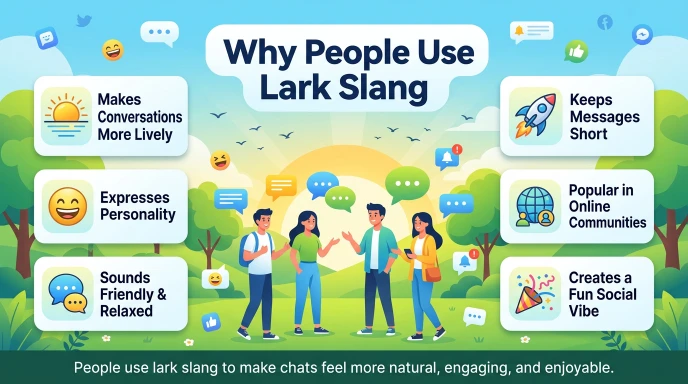
People reach for “lark” because it instantly signals that something isn’t meant to be taken seriously. It softens the tone of a story or plan, making it clear that the intent was fun rather than trouble, ambition, or importance.
It also has a slightly nostalgic, charming quality that appeals to people who enjoy older or more colorful vocabulary.
Impact of Using Slang in Communication
Using a word like “lark” can make a message feel warmer, friendlier, and more personal. It signals familiarity with more traditional or regional expressions and can make casual writing feel more distinctive than relying on overused modern slang. That said, in mixed audiences, it can occasionally require a bit of context if the reader isn’t familiar with it.
Is It Safe for Social Media?
Yes, “lark” is completely safe to use on any platform. It carries no offensive, controversial, or age-restricted connotations, making it appropriate for captions, comments, and posts of any kind.
Examples Section
Friendly
“Come with us, it’ll be a proper lark!”
Casual
“Honestly, the whole trip was just a lark from start to finish.”
Argumentative
“This isn’t a joke, this isn’t some lark , I’m being serious right now.”
Gaming or Social Media Context
“Joined the tournament for a lark and somehow made it to round three lol.”
FAQs
Q1. What does lark mean in slang?
It usually means something done for fun or amusement, without serious intent.
Q2. Does “lark” have a full form or acronym meaning?
No, it’s a regular English word, not an acronym, so it doesn’t stand for anything.
Q3. Is “lark” considered rude or offensive?
No, it’s a neutral, generally positive word with no offensive connotation.
Q4. Where did the slang meaning of “lark” come from?
It likely developed from 19th-century British dialect, possibly linked to the word “lake,” meaning “to play.”
Q5. Can “lark” also refer to a morning person?
Yes, calling someone a “lark” often means they’re an early riser, based on the skylark bird.
Q6. Is “lark” commonly used on TikTok or Discord?
It appears occasionally, especially in storytelling captions, but it’s more common in British-leaning slang usage than fast-paced gaming chats.
Q7. What is a lark in British slang?
In British slang, a “lark” is something done just for fun or mischief , a playful, low-stakes activity, as in “we only did it for a lark.”
Q8. What is the meaning of lark?
Beyond the slang sense, “lark” is also the name of a small songbird known for singing at dawn, which is where the “early riser” meaning comes from.
Q9. What is a synonym for the word lark?
Depending on the sense, synonyms include “prank,” “escapade,” “romp,” or “shenanigan” for the fun/mischief meaning, and “early bird” for the sleep-related meaning.
Q10. What does “lark” slang mean?
As slang, it means a harmless bit of fun or a spontaneous, playful activity done without serious intent.
Q11. Where do larks live?
The actual bird, the skylark, is typically found in open grasslands, farmland, and meadows across Europe, Asia, and parts of Africa, where it’s known for its song while flying high above open fields.
Q12. Is lark a positive term?
Yes, “lark” is generally seen as a positive or neutral term, associated with fun, playfulness, and lighthearted energy rather than anything negative.
Q13. What is the rarest chronotype?
Among the four sleep chronotypes popularized by sleep doctor Michael Breus , lion, bear, wolf, and dolphin , the dolphin is considered the rarest, making up only around 10% of the population. Lions, associated with the classic early-rising “lark” pattern, make up roughly 15–20%, while bears (about 55%) are the most common.
Conclusion
At its core, “lark” is a warm, playful word used to describe something done purely for fun, along with a secondary meaning describing someone who thrives in the early morning.
It’s neutral, safe to use anywhere, and adds a slightly old-fashioned charm to casual conversation.
Understanding the tone and context around it makes it easy to use naturally, if you’re texting a friend or writing a caption for social media.
Discover More Articles:

Hi, I’m Tyler Brooks, a writer specializing in Gen Z culture and internet slang. I track trending terms across TikTok and social media to explain their real-world meanings. My goal is to provide clear, accurate, and up-to-date definitions that help readers understand modern online language.