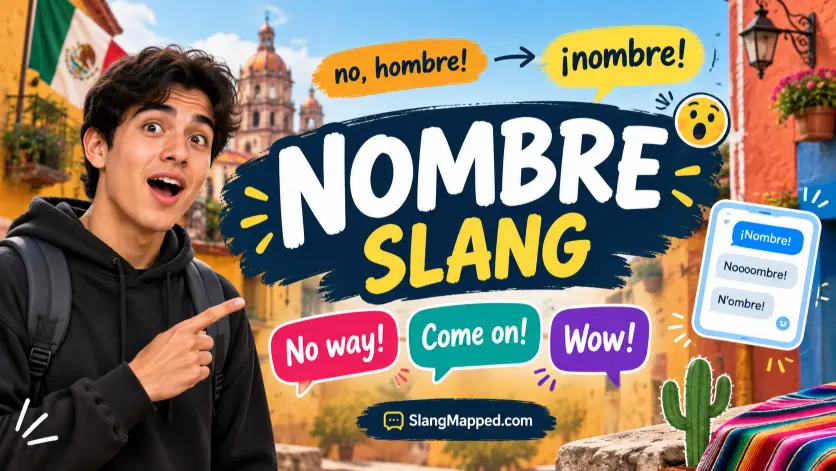
Nombre slang is a Mexican and broader Central American colloquial expression that can mean “no way,” “come on,” “wow,” or an emphatic “no,” depending on the situation.
It is generally understood as a shortened or contracted form of “no, hombre!”, rather than the ordinary Spanish word nombre meaning “name.”
People searching for nombre slang often see the word in Mexican Spanish, social media posts, videos, comments, or conversations and wonder why it does not mean “name.” The key is context and pronunciation.
In this guide, you will learn the nombre slang meaning, where it comes from, how people use it, what it means in different situations, and if it is appropriate in formal conversations.
The spelling can appear as nombre, ¡nombre!, n’ombre, or stretched forms such as noooombre in casual writing.
Quick Answer: What Does Nombre Slang Mean?
Nombre slang is a casual Mexican Spanish expression used to show strong disagreement, disbelief, surprise, or rejection. It is commonly understood as a shortened form of “no, hombre!” and can translate naturally as “no way,” “come on,” “nah,” “oh wow,” or “you’ve got to be kidding.”
The exact English translation depends on the speaker’s tone and the situation.
What Does Nombre Slang Mean?
When nombre is used as slang, it is not referring to someone’s name.
Instead, it works as an interjection—a short expression that shows an immediate reaction.
It can communicate:
- Disbelief: “No way!”
- Strong refusal: “Absolutely not!”
- Surprise: “Wow!”
- Annoyance: “Come on!”
- Dismissal: “Nah, that’s not happening.”
- Reaction to something unbelievable: “You’ve got to be kidding!”
For example:
“¿Te vas a comprar otro teléfono?”
“¡Nombre!”
A natural English translation could be:
“No way!”
The meaning changes with the speaker’s tone.
Where Does Nombre Slang Come From?
The slang nombre is generally explained as a contraction of the Spanish expression “no, hombre!” The spoken sounds can run together, producing something that sounds like nombre. Linguistic material discussing Mexican Spanish specifically identifies nombre as slang for no hombre, with an emphatic sense similar to “no way.”
The ordinary Spanish word nombre, however, has a completely different meaning. In standard Spanish, nombre means “name” and can also mean “noun” in grammar.
So there are two different uses:
| Form | Meaning |
| nombre | name |
| nombre as slang | no way / wow / absolutely not |
| ¡nombre! | emphatic reaction |
| n’ombre | informal spelling showing the contraction |
| noooombre | stretched casual spelling for emphasis |
The slang spelling reflects informal speech, so it does not follow the same pattern as the ordinary dictionary word.
Different Meanings of Nombre Slang
1. “No Way!”
This is one of the clearest uses.
Someone may say ¡nombre! when they strongly reject or doubt something.
Example:
“¿Vas a lend me your new car?”
“¡Nombre! No way!”
Here, nombre means something close to “No way!”
2. “Come On!”
It can also express disbelief or mild annoyance.
“You forgot your keys again?”
“¡Nombre! I can’t believe this.”
In this situation, the speaker is not simply saying “no.” They are reacting emotionally to the situation.
3. “Wow!”
In some contexts, especially when the speaker reacts to something surprising, nombre can express astonishment.
Dictionary resources list the Mexican slang use with meanings such as “no way” and “oh wow.”
4. “Absolutely Not!”
When someone strongly refuses a request, the expression can sound much firmer.
“Can I borrow your car for the weekend?”
“¡Nombre!”
The intended meaning may be:
“Absolutely not.”
Tone is important here. A friendly speaker may use it playfully, while a frustrated speaker can make it sound much stronger.
Nombre Slang in Mexican Spanish
The slang use is especially associated with Mexico. Some sources also record or discuss the expression in other parts of Central America, including El Salvador and Costa Rica.
It is therefore better to describe nombre as a regional colloquial expression, rather than claiming that it is universal Spanish slang.
That distinction matters because a Spanish learner who uses nombre this way everywhere may sound unusual in places where the expression is not commonly used.
How Is Nombre Used in Texting and Social Media?
Online, people often exaggerate the spelling to show emotion.
You may see:
- ¡Nombre!
- N’ombre!
- Noombre!
- Noooombre!
- Nombreeee!
The extra letters usually do not create a new definition. They show emotion, emphasis, surprise, or humor.
For example:
“Noooombre That can’t be real.”
Here, the stretched spelling makes the reaction more dramatic and playful.
On platforms such as TikTok, Instagram, Reddit, or messaging apps, the expression may appear in comments when someone reacts strongly to a story, price, mistake, joke, or surprising event.
Nombre Slang vs. Regular Nombre
This is the most important distinction to understand.
| Context | Meaning |
| ¿Cuál es tu nombre? | What is your name? |
| Mi nombre es Ana. | My name is Ana. |
| ¡Nombre! ¿En serio? | No way! Seriously? |
| ¡Nombre, ni loco! | No way, not a chance! |
The surrounding sentence usually makes the meaning clear.
If nombre appears inside a normal Spanish noun phrase, it probably means “name.” If it appears as a standalone reaction, it may be the slang interjection.
Is Nombre Slang Rude or Offensive?
Nombre slang is generally not a profanity or inherently offensive expression. It is a casual reaction.
However, it can sound blunt depending on how it is delivered.
For example:
“¡Nombre! Eso no va a pasar.”
can sound firm or dismissive.
With friends or family, that tone may be completely normal. In a formal setting, however, a more neutral phrase is safer.
Also remember that “no, hombre” itself can have different tones. It can be friendly, surprised, annoyed, or dismissive depending on the speaker’s voice and facial expression.
Is Nombre Appropriate at Work or School?
It is best treated as informal.
You may hear it naturally among friends, relatives, or people having casual conversations. It is less suitable for:
- formal business emails
- academic writing
- official documents
- professional presentations
- formal interviews
- communication with someone you do not know well
If you are learning Spanish for professional use, it is better to understand nombre as slang without making it a regular part of your formal vocabulary.
Real-Life Examples of Nombre Slang
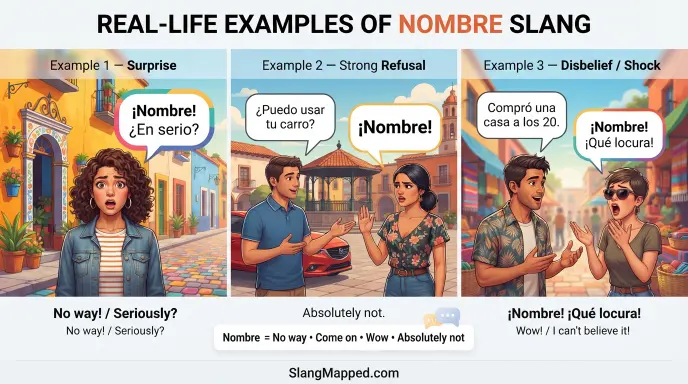
Friendly Conversation
“Did you really eat the whole pizza?”
“¡Nombre! I only had three slices.”
Here, the expression adds a playful reaction.
Strong Refusal
“Can I take your new laptop?”
“¡Nombre! Not a chance.”
Here, it means absolutely not.
Surprise
“He bought a house at 20.”
“¡Nombre! That’s unbelievable.”
Here, it expresses surprise.
Text Message
“Noooombre You actually did it?”
The extended spelling makes the reaction more emotional.
Social Media Comment
“¡Nombre! That price is wild.”
The speaker is reacting strongly to something surprising or unreasonable.
How Tone Changes the Nombre Slang Meaning
The same word can produce different meanings because tone carries a lot of the message.
| Tone | Possible meaning |
| Laughing | No way! / You’re kidding! |
| Surprised | Wow! |
| Annoyed | Come on! |
| Firm | Absolutely not! |
| Disbelieving | I don’t believe you! |
| Playful | Nah, seriously? |
This is why translating nombre into only one English phrase can be misleading.
Similar Slang and Related Expressions
Several expressions can overlap with the meaning of nombre, although they are not exact replacements.
| Expression | Approximate English meaning | Tone |
| ¡Nombre! | No way! / Wow! | Casual |
| No, hombre | No, man / Come on | Casual |
| No manches | No way / Seriously? | Very casual |
| No way | No way | English |
| ¿En serio? | Seriously? | Neutral |
| De ninguna manera | No way / By no means | More formal |
The best choice depends on the country, audience, and situation.
When Should You Avoid Using Nombre Slang?
Avoid using the slang form when you are not sure if the listener understands regional Spanish.
It is also better to avoid it in formal situations.
Be especially careful if you are:
- speaking to a client for the first time
- writing a formal message
- giving a school presentation
- writing an academic paper
- completing an official form
- speaking in a professional interview
There is no major safety concern with the expression itself. The main issue is register—it is casual rather than formal.
Common Misunderstandings About Nombre Slang
“Does nombre always mean ‘name’?”
No. Nombre normally means “name,” but the slang interjection ¡nombre! can express disbelief, refusal, surprise, or a similar reaction.
“Is nombre an abbreviation of the word name?”
No. The slang use is generally connected with “no, hombre!”, not with the ordinary noun nombre.
“Does everyone who speaks Spanish use it?”
No. Its slang use is regional. It is particularly associated with Mexican Spanish, with sources also recording it in parts of Central America.
“Is it the same as saying ‘no’?”
Not always. It can mean a strong “no,” but it can also communicate surprise, disbelief, or a reaction similar to “wow” or “come on.”
Frequently Asked Questions
Q1. What does nombre mean in slang?
Nombre can mean “no way,” “wow,” “come on,” or “absolutely not” when used as a colloquial interjection, especially in Mexican Spanish.
Q2. Is nombre Mexican slang?
Yes. The slang use is strongly associated with Mexican Spanish, although related usage is also found in some other Spanish-speaking regions.
Q3. Is nombre short for no hombre?
Yes. The slang form is generally explained as a contraction of “no, hombre!”
Q4. Does nombre mean “name” in Spanish?
Yes, in standard Spanish, nombre means “name.” It can also mean “noun” in a grammar context.
Q5. Is nombre rude?
Usually no. It is a casual expression, but the tone can make it sound dismissive or annoyed.
Q6. Can I use nombre slang at work?
It is better to avoid it in formal workplace communication. Use neutral expressions such as “No,” “I don’t think so,” or “Really?” depending on what you want to say.
Q7. What does “noooombre” mean?
Noooombre is an exaggerated informal spelling of the expression. The extra letters usually show stronger emotion, surprise, disbelief, or humor.
Q8. Is “nombre” the same as “no way”?
Not exactly. “No way” is often a good English translation, but nombre can also express surprise, disbelief, or “come on,” depending on context.
Conclusion
Nombre slang is a casual Spanish expression, especially associated with Mexican Spanish, that can communicate “no way,” “wow,” “come on,” or a strong “no.” Its slang use is generally understood as a contraction of “no, hombre!”, while the ordinary Spanish word nombre simply means “name.”
The easiest way to understand the slang is to look at context and tone. A friendly “¡Nombre!” might mean “No way!” while a firm version can mean “Absolutely not!”
If you are speaking formally, stick with clearer standard expressions. In casual conversations, however, understanding nombre slang can help you follow Mexican Spanish conversations, comments, videos, and messages more naturally.
You May Also Like:

Hi, I’m Tyler Brooks, a writer specializing in Gen Z culture and internet slang. I track trending terms across TikTok and social media to explain their real-world meanings. My goal is to provide clear, accurate, and up-to-date definitions that help readers understand modern online language.