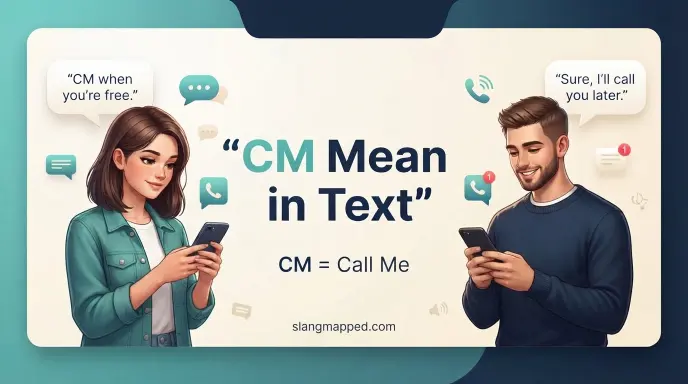
“CM” usually means “call me” in text messages, especially when someone wants you to phone them instead of continuing the conversation by text. You may see it in texting, Snapchat, Instagram DMs, WhatsApp, or other casual online chats.
People often use CM because it is quick and easy to type. For example, someone might send, “CM when you’re free,” meaning “Call me when you’re free.”
If you searched for cm mean in text, you may have seen the abbreviation in a message and were unsure what the sender meant.
The exact meaning can sometimes depend on the conversation, but “call me” is a common interpretation in casual texting.
The abbreviation is especially useful when someone wants to move a conversation from messages to a phone call.
Understanding the context around it can help you decide if the person is simply asking for a quick call or wants to discuss something that is easier to explain by speaking.
CM Meaning in Text
In texting, CM commonly means “call me.” It is a short abbreviation used when someone wants another person to call them.
For example:
“CM when you get home.”
This means:
“Call me when you get home.”
It can be used as a complete message or as part of a longer sentence. The abbreviation is usually informal, so you are more likely to see it in personal conversations than in formal writing.
Is CM Slang, an Acronym, or an Abbreviation?
CM is best described as a texting abbreviation.
People sometimes call abbreviations like this “slang,” but technically they are not always slang. Slang usually refers to informal words or expressions that have a particular social or cultural meaning. CM is mainly a shortened form of “call me.”
It works in a similar way to other common texting shortcuts such as:
- IDK = I don’t know
- IDC = I don’t care
- IMO = In my opinion
- BRB = Be right back
- TBH = To be honest
- BTW = By the way
These shortcuts help people communicate quickly without typing every word.
What Does CM Mean in Everyday Chat?
In everyday conversation, CM usually tells someone to call the sender.
For example:
“CM ASAP.”
This could mean:
“Call me as soon as possible.”
Or:
“CM tonight.”
This means:
“Call me tonight.”
The tone depends heavily on the surrounding message. A simple “CM” may sound casual, while “CM ASAP” can suggest that the sender wants to talk soon.
CM Can Depend on Context
Although “call me” is a common texting meaning, abbreviations can have different meanings in different communities.
For example, CM can stand for other things in business, education, gaming, sports, technology, or professional settings. Someone discussing measurements might use “cm” to mean centimeters.
That is why the surrounding conversation matters.
If someone says:
“CM when you get a chance.”
They probably mean “call me.”
But if someone says:
“The table is 120 cm long.”
They clearly mean centimeters.
Where People Use CM
The abbreviation can appear across several messaging and social media platforms. However, people generally use it in informal conversations rather than official communication.
CM on TikTok
On TikTok, CM may appear in comments, direct messages, captions, or conversations between users.
If someone writes:
“CM later”
they may be asking another person to call them later.
TikTok comments can be short and informal, so abbreviations are common. However, because TikTok content can have many different communities, the meaning should always be checked against the surrounding text.
CM on Snapchat
Snapchat is a natural place to see short texting abbreviations.
People often communicate quickly through snaps and chats, so a message such as:
“CM when ur free”
can mean:
“Call me when you’re free.”
The sender may be trying to move the conversation from Snapchat to a phone call.
CM on Instagram
On Instagram, you might see CM in a direct message.
For example:
“CM after dinner?”
The sender is probably asking:
“Can you call me after dinner?”
Instagram DMs are generally casual, so short abbreviations can make messages faster to type.
CM on WhatsApp
WhatsApp conversations frequently use abbreviations, especially between friends and family members.
Someone might send:
“CM tonight. Need to tell you something.”
Here, the meaning is straightforward: the person wants a phone call later.
WhatsApp users may also use the abbreviation when they do not want to type a long explanation.
CM in SMS
Traditional SMS texting is another place where you may encounter CM.
Because SMS historically encouraged short messages, abbreviations became a convenient way to communicate quickly.
A person might text:
“CM when u can.”
That simply means:
“Call me when you can.”
Real Chat Examples
Seeing the abbreviation in realistic conversations makes its meaning much easier to understand.
Example 1: Calling After Work
A: Are you still at work?
B: Yeah, almost done.
A: CM when you leave.
B: Sure, I will.
Here, CM means “call me.”
Example 2: Making Plans
A: Are we still going out tonight?
B: I think so.
A: CM when you know the time.
B: Okay, I’ll call you.
The sender wants a phone call once the plans are confirmed.
Example 3: Something Important
A: Hey, are you busy?
B: A little. Why?
A: CM ASAP.
B: Okay, give me five minutes.
In this context, “CM ASAP” means “call me as soon as possible.”
Example 4: Casual Conversation
A: I have something funny to tell you 😂
B: What happened?
A: Just CM later lol.
B: Now I’m curious.
The abbreviation is being used casually to move the conversation to a call.
Example 5: Family Chat
A: Mom wants to talk to you.
B: What about?
A: CM when you’re free.
B: Okay.
Here, the sender is simply asking the person to call when available.
Example 6: Making a Quick Decision
A: Which one should I buy?
B: Send me the pictures.
A: It’s easier to explain. CM?
B: Yeah, call me.
The sender wants to discuss the choice by phone.
Example 7: After School
A: Are you home yet?
B: Not yet.
A: CM when you get home.
B: Sure.
The person wants a call once the other person arrives home.
Example 8: Talking About a Problem
A: I don’t want to explain this over text.
B: Is everything okay?
A: Yeah, just CM when you can.
B: Okay, I’ll call soon.
The abbreviation is being used to request a more direct conversation.
Example 9: Checking Availability
A: Are you free tonight?
B: Probably after 8.
A: CM then.
B: Sounds good.
“CM then” means “call me then.”
Example 10: Friendly Chat
A: Haven’t talked to you in forever!
B: I know 😂
A: CM sometime this week.
B: Definitely!
Here, the abbreviation is friendly and informal.
How to Reply When Someone Says “CM”
How you respond depends on what the person means and if you actually want to talk on the phone.
If the sender says only “CM,” you can ask when they want you to call.
Funny Replies
If you are talking with a close friend, you can respond playfully.
- “Okay, but you better have a good story 😂”
- “Calling now. What happened?”
- “Only if you promise not to keep me on the phone for two hours 😂”
- “You have my attention. Calling you now.”
- “Is this an emergency or are you just bored? 😂”
The best funny response depends on your relationship with the person.
Casual Replies
For everyday conversations, you can keep your response simple.
- “Sure, I’ll call you later.”
- “Okay, give me a few minutes.”
- “Yeah, I can call tonight.”
- “Sure, what time?”
- “I’ll call when I’m free.”
These replies work well with friends and family.
Friendly Replies
If you want your response to sound warm and positive, try:
- “Of course! I’ll call you soon.”
- “Sure, I’d love to chat.”
- “No problem. I’ll call you after dinner.”
- “Definitely. I’ll give you a call later.”
- “Sure thing!”
Neutral Replies
If you do not know what the person wants, you can ask for more information.
- “Sure. When should I call?”
- “Is everything okay?”
- “Can I call you in an hour?”
- “What’s up?”
- “Are you available now?”
A neutral question is especially useful when the message simply says “CM” without any explanation.
Is CM Rude or Offensive?
CM is generally not rude or offensive. It is normally just a short way of asking someone to make a phone call.
The tone depends more on the rest of the message than on the abbreviation itself.
For example:
“CM when you can.”
sounds casual.
But:
“CM NOW.”
could sound demanding, especially if there is no explanation.
Is CM Safe to Use?
In ordinary personal conversations, CM is generally safe to use when the other person understands texting abbreviations.
It is most appropriate between people who already communicate informally.
If you are unsure if someone understands the abbreviation, writing “call me” is clearer.
Is CM Appropriate at School?
It depends on the situation.
In a casual message to a friend, using CM is normally fine.
However, if you are writing to a teacher, school administrator, or submitting formal school work, it is better to write the full phrase.
Instead of:
“CM when you can.”
you could write:
“Please call me when you have a chance.”
That sounds clearer and more respectful in a formal setting.
Is CM Appropriate at Work?
For professional communication, context matters.
A message to a close coworker might use informal language, but a formal email or business message should usually avoid unexplained texting abbreviations.
Instead of:
“CM ASAP.”
a professional message could say:
“Could you please call me as soon as you are available?”
This removes ambiguity and sounds more professional.
Who Uses This Term?
The abbreviation CM is most likely to appear in informal digital communication, particularly where people already use shortened expressions.
Younger Users
Teenagers and young adults may use short forms when chatting with friends. However, it would be inaccurate to assume that every young person uses CM regularly.
Some people prefer writing “call me,” while others use voice messages, video calls, or platform-specific communication instead.
Gen Z Usage
Gen Z frequently uses abbreviations and shortened expressions in digital conversations, but CM is not necessarily a uniquely Gen Z expression.
The idea of shortening “call me” predates modern social media. Texting culture has used short forms for many years because people wanted to communicate quickly.
Therefore, seeing CM does not automatically indicate that the sender belongs to Gen Z.
Common Platforms
You may encounter the abbreviation in:
- Text messages
- Snapchat
- Instagram DMs
- TikTok messages
- Facebook Messenger
- Discord
- Other private chats
It is generally more common in personal conversations than in public posts.
How Often Does CM Appear Online?
There is no single reliable frequency figure that applies to all platforms or users.
Some people use it often, while others rarely use it. Its meaning is also affected by the context and the community where it appears.
For that reason, it is better to treat “call me” as a common possible meaning, rather than assuming CM always means exactly the same thing.
Origin of the Term
The exact origin of CM meaning “call me” is difficult to pin to one person, website, or specific date.
It developed naturally from the broader culture of abbreviated digital communication.
Early Texting Culture
Mobile texting encouraged people to keep messages short. Typing fewer characters could make communication faster, especially on older phones with physical keypads.
Expressions such as:
- “call me”
- “be right back”
- “I don’t know”
- “talk to you later”
were often shortened into compact forms.
This helped create the large collection of abbreviations that people still recognize today.
Internet Culture
The growth of chat rooms, instant messaging, forums, social networks, and mobile messaging helped abbreviations spread.
People began carrying these short forms from one platform to another.
That is why a person might understand CM in a text message even if they first encountered it in an online chat.
Is the Origin Certain?
Not completely.
Unlike a newly created brand name or a slang term tied to a specific viral event, CM does not have one clearly documented origin story.
It is better understood as part of the larger development of shorthand communication.
Also remember that “CM” has existed as an abbreviation for many unrelated things. The texting meaning should therefore be understood from context rather than from the letters alone.
CM vs. IDK vs. IDC vs. IMO vs. BRB
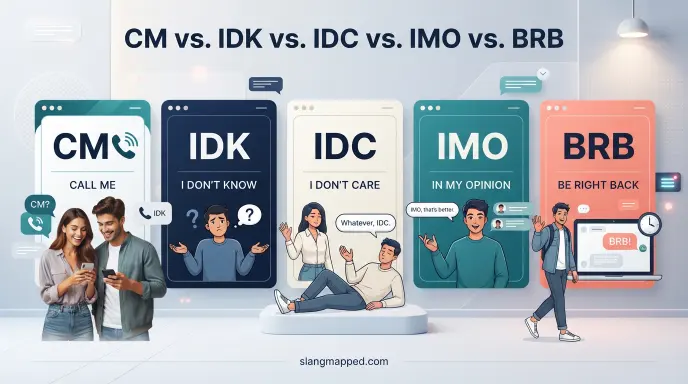
These abbreviations are all common examples of short-form digital communication, but they serve different purposes.
| Term | Meaning | Type | Usage | Popularity |
| CM | Call me | Texting abbreviation | Asking someone to make a phone call | Common in casual texting |
| IDK | I don’t know | Texting abbreviation | Showing uncertainty or lack of knowledge | Very common |
| IDC | I don’t care | Texting abbreviation | Showing indifference | Very common |
| IMO | In my opinion | Texting abbreviation | Introducing a personal opinion | Common |
| BRB | Be right back | Texting abbreviation | Saying you will return shortly | Well-known and common |
The main difference is that CM is often a request or instruction, while the others communicate information or attitude.
For example:
- CM → “Call me.”
- IDK → “I don’t know.”
- IDC → “I don’t care.”
- IMO → “In my opinion.”
- BRB → “Be right back.”
These shortcuts can make messages faster, but they also depend on the reader understanding the abbreviation.
Real-World Usage Example
Imagine two friends who normally text each other throughout the day.
One friend is trying to explain a complicated problem about a trip. Typing the entire story would take several messages, so they send:
“CM when you’re free. Easier to explain.”
The other person understands that they should make a phone call when they have time.
This is a practical reason someone might use the abbreviation. CM does not necessarily mean that something is wrong or urgent. Sometimes the sender simply thinks a phone conversation will be easier than texting.
The same phrase can also be used for a quick personal check-in:
“CM tonight if you’re free.”
Here, it is simply an invitation to talk.
Context is important. If someone sends “CM ASAP,” the situation may be more urgent. If they send “CM sometime,” the request is much more relaxed.
Other Meanings of CM You May See
One important point is that CM does not always mean “call me.”
The meaning can change completely depending on where you see it.
For example, in measurements:
“The box is 30 cm wide.”
Here, cm means centimeters.
In professional or academic contexts, CM may also be used as an abbreviation for different terms. In business, technology, education, medicine, entertainment, and other fields, the same two letters can have specialized meanings.
This is why context should always come first.
Ask yourself:
- Is this a casual conversation?
- Is the person asking me to do something?
- Are they talking about a phone call?
- Is “cm” written next to a number?
- Is the conversation about a specific professional subject?
If someone says:
“CM when you get home.”
“Call me” makes sense.
If someone says:
“The wall is 200 cm long.”
“Centimeters” clearly makes sense.
The surrounding words usually make the intended meaning obvious.
Why Do People Use CM Instead of “Call Me”?
The biggest reason is convenience.
Texting is fast, and people often want their messages to be short. Writing CM takes less effort than typing “call me.”
There is also a social reason. Short abbreviations have become a normal part of casual digital communication.
For close friends, a message like:
“CM later?”
can feel perfectly natural.
However, shorter is not always better. If you are talking to someone who may not know the abbreviation, writing the full phrase can prevent confusion.
This is especially true when communicating with:
- Teachers
- Employers
- Customers
- Clients
- School administrators
- Older relatives who may not use texting abbreviations
Clear communication matters more than saving a few characters.
CM in Different Tones
The same abbreviation can communicate different tones depending on the words around it.
Friendly
“CM later 😊”
This sounds like a relaxed invitation to talk.
Urgent
“CM ASAP.”
This suggests the sender wants a call soon.
Casual
“CM when free.”
This gives the other person flexibility.
Direct
“CM now.”
This is much more forceful and may sound demanding.
Playful
“CM, I have gossip 😂”
This gives the request a humorous or friendly tone.
So, the abbreviation itself is not necessarily emotional. The surrounding words, punctuation, emojis, and relationship between the speakers help establish the tone.
When You Should Avoid Using CM
Although CM is useful in casual texting, there are situations where spelling out the words is better.
Avoid using unexplained abbreviations when:
- You are writing a formal email.
- You are contacting a teacher.
- You are communicating with a new client.
- You are writing a professional application.
- The recipient may not understand texting shorthand.
- The message could be misunderstood.
Instead of:
“CM ASAP.”
write:
“Please call me as soon as you are available.”
Instead of:
“CM later.”
you can write:
“Please call me later when you have time.”
The longer versions are clearer and more appropriate for formal situations.
Frequently Asked Questions
Q1. What does CM mean in text messages?
In text messages, CM commonly means “call me.” Someone may use it when they want you to call them instead of continuing the conversation through text.
Q2. What does CM mean on TikTok?
On TikTok, CM can mean “call me” when it appears in a private message or casual conversation. The exact meaning can depend on the context.
Q3. Is CM slang?
CM is more accurately described as a texting abbreviation for “call me.” People may casually call it slang because it is used in informal digital communication.
Q4. Is CM rude or offensive?
No. CM is generally neither rude nor offensive. However, a message such as “CM NOW” can sound demanding depending on the situation and relationship between the people.
Q5. How should you reply to CM?
You can reply with something simple such as “Sure, when should I call?”, “I’ll call you later,” or “Can I call you in a few minutes?” If you are unsure what they mean, ask for clarification.
Final Thoughts on CM Meaning in Text
CM commonly means “call me” in casual text conversations. It is a short texting abbreviation that someone may use when they want another person to phone them.
You can see it in texts, Snapchat chats, Instagram DMs, WhatsApp messages, TikTok conversations, and other informal digital spaces.
The meaning is usually easy to understand from context. For example, “CM when you’re free” clearly suggests that the sender wants a call.
However, CM can have other meanings in different subjects, including centimeters, so it should not automatically be interpreted as “call me” every time.
The abbreviation itself is not normally rude or offensive. It is simply informal. Use it freely with people who understand texting shorthand, but consider writing “call me” in school, work, business, or other formal communication.
When in doubt, look at the words around CM. Context is usually the best clue to what the sender intended.

Hi, I’m Tyler Brooks, a writer specializing in Gen Z culture and internet slang. I track trending terms across TikTok and social media to explain their real-world meanings. My goal is to provide clear, accurate, and up-to-date definitions that help readers understand modern online language.