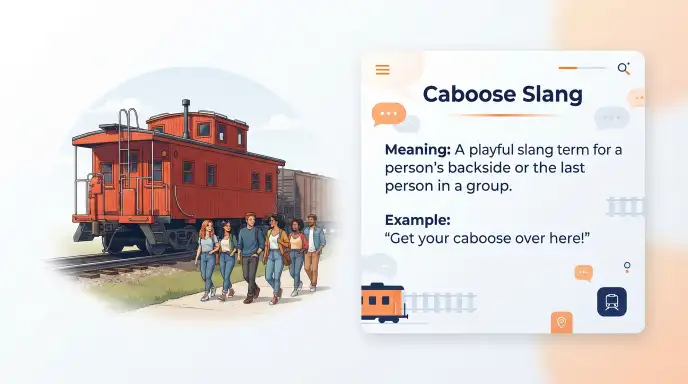
Caboose slang is a playful informal term that usually means a person’s butt or backside, and in some contexts, it also refers to the last person or thing in a line or group.
If you’ve seen someone say, “Get your caboose over here!” or “I was the caboose of the hiking group,” you might wonder what they really mean.
Since the word has both a literal railroad meaning and a modern slang meaning, its definition depends on the context in which it is used.
Today, caboose slang is most commonly heard in casual conversations, jokes, family-friendly TV shows, movies, and text messages.
Understanding its tone and different meanings helps you interpret it correctly and use it naturally without sounding rude or out of place.
Quick Answer: Caboose Slang
Caboose slang most commonly means a person’s butt or backside in a humorous, informal way. It can also refer to the last person or thing in a line, based on the original railroad caboose that was attached to the end of a train.
| Quick Information | Details |
| Keyword | Caboose slang |
| Meaning | A playful word for someone’s butt or the last person/thing in a line |
| Tone | Casual, humorous, informal |
| Commonly Used On | Everyday conversations, movies, TV shows, texting, social media |
| Offensive? | Usually no, but it can sound rude if used to comment on someone’s body |
| Full Form | No full form; “caboose” is a standalone word |
| Related Terms | Backside, rear end, butt, tail end, last in line |
What Does Caboose Mean in Text?
When someone uses caboose slang in a text message, they are usually being funny or playful. The exact meaning depends on the conversation.
Caboose Meaning as “Backside”
The most common slang meaning of caboose is a person’s butt or rear end. It is usually said as a joke rather than an insult.
Meaning: Someone’s backside or butt.
Example:
“Be careful sitting on that bench, you’ll hurt your caboose!”
Here, the speaker is simply talking about someone’s backside in a lighthearted way.
Caboose Meaning as “Last Person”
Sometimes caboose refers to the last person, vehicle, or object in a line. This meaning comes from the railroad caboose, which was the last car on a freight train.
Meaning: The person or thing at the end.
Example:
“I was the caboose during our hiking trip because I walked the slowest.”
In this sentence, caboose means the person at the back of the group.
Caboose as a Playful Nickname
Friends or family members may jokingly call someone “caboose” if they always end up walking behind everyone else or if they want to tease them in a harmless way.
Meaning: A humorous nickname based on being last or bringing up the rear.
Example:
“Come on, Caboose! We’re waiting for you.”
The tone is friendly rather than serious.
Caboose Full Form / Definition
Unlike many internet slang terms, caboose does not have a full form or abbreviation. It is a regular English word that later gained informal slang meanings.
Literal Definition
Originally, a caboose was the last railcar on a freight train. It was used by train crews for work, rest, and monitoring the train.
Example:
“The conductor stayed in the caboose during the journey.”
Slang Definition
Over time, people started using caboose to describe anything at the back, especially a person’s backside. This figurative use became popular because the caboose is located at the end of a train.
Meaning: A humorous term for a person’s rear end or the last position in a group.
Example:
“He slipped and landed right on his caboose.”
What Does Caboose Stand For?
Many people search for “what does caboose stand for?” because they think it might be an acronym.
The answer is simple:
- Caboose is not an acronym.
- It has no full form.
- It is an independent English word that later developed slang meanings through everyday use.
Is Caboose Rude, Offensive, or Neutral?
The answer depends on how and where you use it.
Usually Neutral and Humorous
In most conversations, caboose slang is considered playful. It is often used between friends, family members, or in comedy.
Example:
“Get your caboose over here!”
This usually sounds humorous rather than offensive.
It Can Sound Rude in Some Situations
Because caboose can refer to someone’s body, using it to comment on another person’s appearance may make them uncomfortable.
For example, saying:
“Everyone was looking at her caboose.”
may be seen as disrespectful or inappropriate.
Professional Settings
It is best to avoid using caboose slang in workplaces, schools, business emails, or formal conversations. A more respectful word such as back, rear, or backside is usually a better choice.
Quick Tone Guide
| Situation | Appropriate? | Tone |
| Talking with close friends | ✅ Yes | Funny and casual |
| Family conversations | ✅ Usually | Lighthearted |
| Social media jokes | ✅ Yes | Informal |
| Workplace | ❌ Not recommended | Too casual |
| School presentation | ❌ Avoid | Informal |
| Talking about strangers | ⚠️ Use carefully | Could sound disrespectful |
Where Is Caboose Commonly Used?
Caboose slang is mostly found in spoken English and informal conversations rather than formal writing.
Everyday Conversations
People often use it jokingly when talking with friends or family.
Example:
“Move your caboose, we’re going to be late!”
Movies and TV Shows
Comedy shows and family-friendly movies sometimes use caboose because it sounds less harsh than other slang words for the backside.
Text Messages
It occasionally appears in texts between friends who enjoy playful language.
Example:
“Get your caboose over here “
Social Media
Although it isn’t one of today’s trending internet slang terms, you’ll still see caboose in humorous captions, memes, and nostalgic posts on platforms like Instagram, Facebook, and X.
Gaming and Online Communities
Unlike gaming slang such as “GG” or “AFK,” caboose is not commonly used in gaming or Discord conversations. If it appears, it usually keeps its regular humorous meaning rather than becoming gaming-specific.
Real-Life Examples of Caboose Slang
Seeing caboose slang in real conversations makes it much easier to understand. The examples below show how the meaning changes depending on the tone and situation.
Friendly Conversation
Friends often use caboose as a funny way to tell someone to hurry up or move.
Example 1
“Come on, get your caboose over here!”
Meaning: Hurry up and join us.
Example 2
“You carried all those boxes? Your caboose must be tired.”
Meaning: Referring to someone’s backside in a playful way.
Casual Conversation
In everyday speech, caboose is usually lighthearted and not meant to offend.
Example 1
“I slipped on the ice and landed on my caboose.”
Meaning: The speaker fell on their backside.
Example 2
“He’s always the caboose during our walks.”
Meaning: He is always the last person in the group.
Argumentative Tone
Although caboose is generally harmless, it can sound sarcastic during an argument.
Example 1
“If you’d move your caboose a little faster, we’d be on time.”
Meaning: Someone is being criticized for moving slowly.
Example 2
“Stop sitting on your caboose and help us.”
Meaning: A sarcastic way of telling someone to stop being lazy.
Texting Example
Text messages often use caboose to keep the conversation fun.
Person A: “Where are you?”
Person B: “Almost there! Get your caboose outside.”
Meaning: Come outside quickly.
Social Media Example
“Weekend vibes… parked my caboose on the couch all day. “
Meaning: The person relaxed on the sofa all day.
Family Conversation
Parents sometimes use caboose because it sounds softer than other slang words.
Example
“Scoot your caboose over so your sister can sit.”
Is Caboose Used in Gaming?
Not really.
Unlike terms such as GG, AFK, or NPC, caboose is not recognized as gaming slang. If gamers use it, they usually mean someone’s backside or the last player in a group rather than using it as gaming terminology.
Origin and Background of Caboose Slang
The story behind caboose slang begins with the railroad industry.
The Original Meaning
A caboose was the last car attached to a freight train. Train crews used it for resting, storing equipment, and watching the rest of the train.
Because it was always at the back, people gradually began comparing anything located at the rear to a caboose.
How It Became Slang
Over time, English speakers started using caboose as a humorous nickname for a person’s backside.
The comparison was simple:
- A train has a caboose at the back.
- A person also has a “back end.”
- The word naturally became a funny metaphor.
This type of language change is common in English slang, where everyday objects become playful nicknames.
Modern Usage
Today, many younger speakers know caboose only as humorous slang, while older generations may recognize both the railroad meaning and the slang meaning.
The railroad definition is still correct, but because modern freight trains rarely use cabooses, the slang meaning is now more familiar in everyday conversations.
Comparison of Caboose Slang With Similar Terms
| Term | Meaning | Tone | Offensive? | Example |
| Caboose | Butt or backside | Playful | Usually No | “Get your caboose over here.” |
| Backside | Rear of the body | Neutral | No | “I fell on my backside.” |
| Rear End | Polite way to describe the butt | Neutral | No | “He hurt his rear end.” |
| Butt | Common informal word | Casual | Sometimes | “I landed on my butt.” |
| Behind | Softer expression | Neutral | No | “Watch your behind.” |
| Tail End | Last position in a group | Neutral | No | “We were at the tail end of the parade.” |
Which Term Is Best?
- Caboose → Funny and playful.
- Backside → Best for polite conversations.
- Rear end → Appropriate in most situations.
- Tail end → Best when talking about position instead of the body.
Why People Use Caboose Slang
People use caboose slang because it sounds more humorous and less direct than other informal words.
To Be Funny
Many people choose caboose simply because it makes conversations more entertaining.
Example
“Shake your caboose!”
This expression is playful and often used jokingly.
To Avoid Stronger Slang
Some slang words for the body can sound rude or vulgar.
Caboose is usually considered a milder alternative.
To Add Personality
Using playful slang helps casual conversations feel more relaxed.
Instead of saying:
“Sit down.”
Someone might say:
“Park your caboose.”
This sounds friendlier and more humorous.
To Describe Someone at the Back
The original meaning still appears in everyday speech.
Example
“Our dog was the caboose during the hike.”
Meaning: The dog walked behind everyone else.
Impact of Using Caboose Slang in Communication
Like many informal expressions, caboose slang can make conversations feel more natural when used in the right setting.
Positive Effects
- Makes conversations sound friendly.
- Adds humor.
- Creates a relaxed atmosphere.
- Easy for native English speakers to understand.
Possible Drawbacks
- Not everyone knows the slang meaning.
- May sound childish in formal situations.
- Could offend someone if it comments on their body.
- Can confuse people who only know the railroad definition.
Using the correct tone is more important than the word itself.
Is Caboose Safe for Social Media?
Yes in most cases.
The word caboose is generally considered safe for platforms like:
- X
- TikTok
People often use it in funny captions, memes, or family-friendly jokes.
Example
“Planted my caboose on the beach all afternoon.”
This is harmless and unlikely to violate platform guidelines.
However, avoid using caboose to make fun of another person’s body or appearance, as it may be viewed as disrespectful or insensitive.
When to Avoid Using Caboose Slang
Although caboose slang is usually harmless, there are situations where a more neutral word is a better choice.
Professional Communication
Avoid using it in:
- Business emails
- Job interviews
- Workplace meetings
- Professional presentations
Academic Writing
Schools and universities usually expect formal language.
Use words such as:
- Back
- Backside
- Rear
instead of slang.
When Talking to Strangers
Not everyone enjoys playful comments about their body.
If you don’t know the person well, choose more respectful language.
Sensitive Situations
Avoid using caboose if someone has been injured or feels embarrassed. Humor may not be appropriate.
Polite Alternatives to Caboose Slang
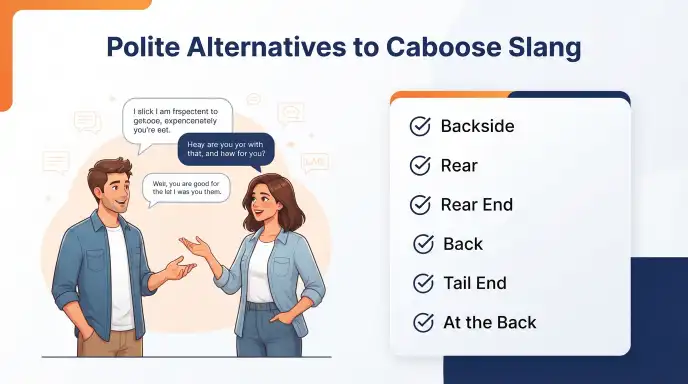
If you want a more respectful or professional option, consider these alternatives.
| Alternative | Best Used For |
| Backside | Everyday polite conversations |
| Rear | Professional situations |
| Rear end | Medical or general discussion |
| Back | Formal writing |
| Tail end | Referring to the last position in a group |
| At the back | Describing someone’s location |
These alternatives help you communicate clearly without sounding too casual.
FAQs
Q1. What does caboose mean in slang?
In slang, caboose usually means a person’s butt or backside. It is a playful, informal term that is commonly used in casual conversations and jokes.
Q2. What does caboose mean in text messages?
In text messages, caboose often means your backside or is used humorously to tell someone to move or hurry up.
Example:
“Get your caboose over here!”
Q3. Is caboose an offensive slang word?
Not usually. Caboose is generally considered a lighthearted and humorous slang term. However, it can seem rude if it is used to make fun of someone’s body or make an unwanted personal comment.
Q4. Does caboose have a full form?
No. Caboose is not an acronym, so it does not have a full form. It is an English word that originally referred to the last railcar on a freight train before becoming a slang expression.
Q5. Why do people call someone a caboose?
People may call someone a caboose because they are walking at the back of a group or as a playful nickname referring to their backside. The intended meaning depends on the context of the conversation.
Q6. Is caboose slang still commonly used today?
Yes, but mostly in casual conversations. While it is not one of the most popular modern internet slang terms, many English speakers still use caboose slang in jokes, family conversations, movies, and everyday speech.
Q7. What is a synonym for caboose?
Common synonyms for caboose include backside, rear end, butt, behind, and tail end. The best synonym depends on if you’re referring to a person’s body or the last position in a group.
Q8. What does the slang term “big caboose” mean?
Big caboose is a playful slang phrase that refers to someone having a large butt or backside. It is usually used humorously, but it may be considered impolite or offensive depending on the context and audience.
Conclusion
Caboose slang is a playful expression that usually refers to a person’s backside or the last person or thing in a line.
Although the word originally described the last car on a freight train, its informal meaning has become much more common in everyday English.
The tone of caboose slang is generally humorous and friendly, making it suitable for casual conversations with friends and family.
However, because it refers to someone’s body, it should be used carefully and avoided in professional settings or when speaking with people who may find it disrespectful.
Understanding the caboose meaning in text, its origin, and the situations where it fits best helps you interpret messages correctly and communicate more naturally.
If you hear it in a conversation, read it in a text, or see it on social media, the context will tell you if it refers to someone’s backside or simply the person at the end of the group. By using the term thoughtfully, you can enjoy its humorous tone without causing confusion or offense.
Read More:
- Balls in Spanish Slang: A Full Guide to Huevos, & Cojones
- Funny Southern Slang Words: Meanings, Examples, and Usage
- American Slang Insults: Popular U.S. Insults You Should Know

Hi, I’m Rachel Simmons, a language writer specializing in American English and modern slang. I research regional expressions, everyday phrases, and evolving word meanings across the United States. I enjoy making complex language trends simple, practical, and easy for everyone to understand.