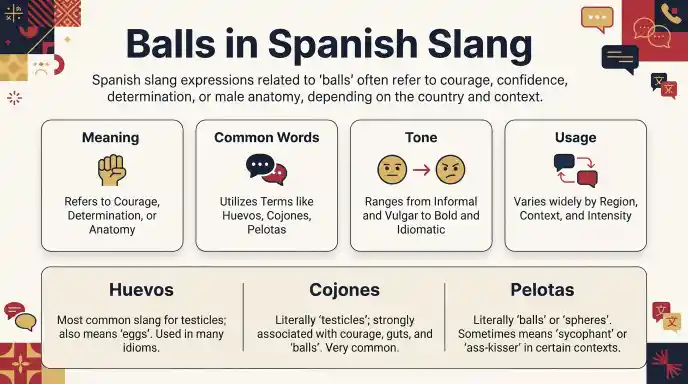
Balls in spanish slang refers to informal Spanish expressions that literally mean male testicles but are often used figuratively to describe courage, bravery, confidence, determination, or strong emotions, depending on the country and context.
Many people search for this phrase after hearing it in movies, TV shows, music, gaming, or conversations with native Spanish speakers and want to understand what it really means.
Spanish slang is not the same in every country, so the meaning of these expressions can change based on where they are used and who is saying them. Some phrases are friendly jokes between close friends, while others may be considered vulgar or offensive.
In this guide, you’ll learn the different meanings of balls in spanish slang, where it’s commonly used, if it’s rude, and how to understand it correctly in everyday conversations.
Quick Answer
In balls in spanish slang, the term usually refers to testicles but is commonly used to express bravery, confidence, determination, or emphasis. Its meaning and offensiveness depend on the context and the Spanish-speaking region.
What Does Balls in Spanish Slang Mean in Text?
The meaning of balls in spanish slang depends on which Spanish slang word or phrase is being used. Unlike English, there isn’t one universal slang term that means “balls” everywhere. Different Spanish-speaking countries use different words.
Some common meanings include:
- Referring to male anatomy in a vulgar way.
- Describing someone as brave or fearless.
- Showing determination or confidence.
- Expressing anger, annoyance, or disbelief.
- Appearing in jokes, memes, or casual conversations.
For example, someone might use an expression similar to saying a person has “a lot of guts” or “has courage.” In another situation, the same type of expression may simply be an insult.
Because of these differences, you should always pay attention to who is speaking, where they are from, and the tone of the conversation.
Full Form / Definition of Balls in Spanish Slang
Is there a full form?
No. Balls in spanish slang is not an acronym, so it does not have a full form. Instead, it refers to slang expressions that use Spanish words for “balls” or “testicles.”
General definition
In everyday Spanish slang, these expressions commonly represent one of the following ideas:
- Physical anatomy (often vulgar)
- Courage or bravery
- Confidence
- Boldness
- Frustration or emphasis
The intended meaning changes depending on the sentence.
Common Spanish slang words related to “balls”
| Spanish Word | Literal Meaning | Common Slang Meaning | Offensive Level |
| Huevos | Eggs | Courage, guts, or testicles | Mild to moderate |
| Cojones | Testicles | Bravery, frustration, emphasis | Moderate to strong |
| Pelotas | Balls | Sometimes anatomy or informal expression | Mild (depends on country) |
Remember that these words are not interchangeable in every Spanish-speaking country. Regional differences are very common.
Is Balls in Spanish Slang Rude, Offensive, or Neutral?
The answer depends entirely on the expression and the situation.
Neutral situations
Some phrases are used casually among close friends and simply mean:
- Be brave.
- Show confidence.
- Don’t be afraid.
In these cases, native speakers may not find the expression especially offensive.
Informal situations
Among friends, gamers, classmates, or teammates, slang involving “balls” is sometimes used humorously or to encourage someone to take action.
For example, someone might use an expression meaning:
- “Have some courage.”
- “Don’t be scared.”
Although informal, these expressions are usually best reserved for people who know each other well.
Offensive situations
Some phrases using these words become vulgar when:
- Directed at someone during an argument.
- Used to insult another person.
- Spoken in professional settings.
- Used around children or formal audiences.
If you’re learning Spanish, it’s safer to avoid repeating these expressions until you fully understand the regional context.
Where Is Balls in Spanish Slang Commonly Used?
The slang appears in many informal conversations, but the exact wording changes across Spanish-speaking countries.
Everyday conversations
Friends often use these expressions during casual chats, sports discussions, or humorous conversations.
Social media
You’ll sometimes see these slang terms on:
- TikTok
- X (formerly Twitter)
People may use them in memes, reaction videos, or funny comments.
Gaming
Online gamers occasionally use these expressions while:
- Celebrating a risky move.
- Complimenting someone’s courage.
- Reacting to an unexpected play.
- Joking with teammates.
Movies and TV shows
Many Spanish-language films and television series include these expressions to make dialogue sound more natural or emotional.
Music
Some rap, reggaeton, and regional music lyrics include slang related to “balls” for emphasis or emotional expression. Because lyrics often contain adult language, the meaning can be stronger than in everyday conversation.
Real-Life Examples of Balls in Spanish Slang
Understanding the tone is just as important as understanding the words. The same slang expression can sound friendly, funny, or offensive depending on who says it and why.
Friendly Tone
Friends sometimes use these expressions to praise someone’s courage or confidence.
Examples:
- “You really had the guts to say that.”
- “That was a brave decision.”
- “He wasn’t afraid to take the risk.”
In Spanish-speaking cultures, expressions involving “huevos” or “cojones” are often used this way among close friends.
Casual Tone
People may use the slang in relaxed conversations without trying to offend anyone.
Examples:
- “Come on, don’t be scared.”
- “Just do it.”
- “You can handle it.”
These phrases usually encourage someone to be confident.
Argumentative Tone
During an argument, the same slang can become much stronger.
Examples:
- “Stop pretending you’re brave.”
- “You think you’re so tough.”
- “Don’t talk to me like that.”
When used this way, the expression may sound rude or insulting.
Gaming and Social Media Context
Gamers and social media users often use the slang to react to bold plays.
Examples:
- “That player had serious guts.”
- “Only a fearless person would try that.”
- “What a bold move!”
The exact Spanish wording depends on the country and gaming community.
Origin and Background of Balls in Spanish Slang
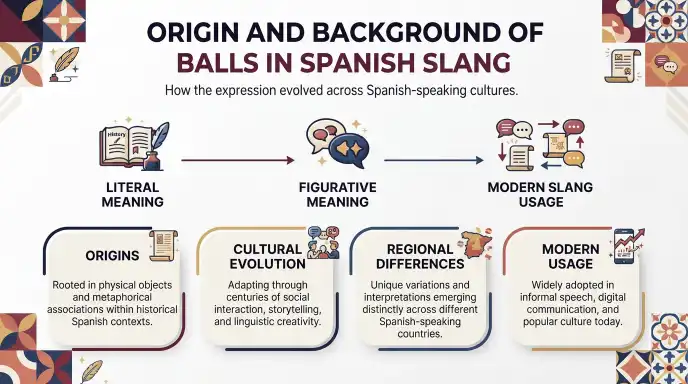
Why does this slang exist?
Many languages connect parts of the body with personality traits. English uses expressions like:
- “Have guts.”
- “Grow a backbone.”
- “Have balls.”
Spanish developed similar expressions over many centuries.
How did the meaning change?
Originally, these words referred only to anatomy. Over time, native speakers began using them figuratively to describe:
- Courage
- Confidence
- Determination
- Fearlessness
- Emotional intensity
Today, many Spanish speakers understand both the literal and figurative meanings immediately from the context.
Does every country use the same slang?
No.
Spanish slang changes significantly between countries. A phrase commonly heard in Spain might sound unusual in Mexico, while an expression from Argentina may not be common in Colombia.
That’s why it’s always best to learn the regional meaning before using unfamiliar slang.
Comparison with Similar Slang
Comparison Table
| Slang Expression | Main Meaning | Common Tone | Offensive Level |
| Balls (English slang) | Courage or male anatomy | Casual | Moderate |
| Huevos | Courage or testicles | Informal | Mild to Moderate |
| Cojones | Bravery, emphasis, or anatomy | Informal/Vulgar | Moderate to Strong |
| Guts | Courage | Neutral | Not offensive |
| Backbone | Confidence and strength | Neutral | Safe |
This comparison shows that while English and Spanish use similar ideas, the level of offensiveness can vary.
Similar Slang Expressions
“Huevos”
One of the most common Spanish slang words connected to bravery.
It can mean:
- Courage
- Confidence
- Male anatomy
The intended meaning depends on the sentence.
“Cojones”
This expression is stronger and is often considered more vulgar.
People may use it to express:
- Determination
- Frustration
- Surprise
- Anger
Because it is stronger, learners should use it carefully.
“Guts”
Although this is English slang, it often expresses the same idea as the figurative use of “balls.”
Unlike many Spanish expressions, “guts” is generally considered polite.
Why Do People Use Balls in Spanish Slang?
People don’t usually use this slang literally. Instead, they use it to communicate emotions quickly and naturally.
To describe bravery
Someone may praise another person’s courage.
For example:
- Taking a difficult risk.
- Standing up for a friend.
- Making a tough decision.
To add emphasis
Native speakers often use slang to make a sentence sound stronger or more emotional.
To joke with friends
Among close friends, these expressions can be playful rather than offensive.
Humor plays a big role in everyday Spanish conversations.
To sound natural
Movies, TV shows, online videos, and music often include slang because it reflects real-life speech.
Impact of Using Slang in Communication
Positive impact
When used correctly, slang can:
- Make conversations feel more natural.
- Help people connect socially.
- Add humor.
- Show familiarity with local culture.
Negative impact
Using slang incorrectly can create problems.
Possible issues include:
- Accidentally offending someone.
- Sounding disrespectful.
- Misunderstanding the intended meaning.
- Using a phrase that isn’t common in that country.
For language learners, understanding slang is valuable, but using it requires caution.
Is Balls in Spanish Slang Safe for Social Media?
Usually yes; but context matters
Many adults use these expressions casually on social media.
However, because several versions refer to anatomy or contain vulgar language, they may not be appropriate for every audience.
Safe situations
These expressions are generally more acceptable in:
- Private chats
- Meme pages
- Adult discussions
- Casual conversations between friends
Situations to avoid
Avoid using this slang in:
- School assignments
- Professional emails
- Workplace chats
- Business social media accounts
- Content intended for children
When posting publicly, remember that followers from different Spanish-speaking countries may interpret the slang differently.
When to Avoid Using Balls in Spanish Slang
While these slang expressions are common in informal conversations, there are situations where using them is not appropriate.
Professional Settings
Avoid using slang involving “balls” during:
- Business meetings
- Job interviews
- Professional emails
- Workplace conversations
Formal language is always the safer choice.
Around Children
Since many of these expressions refer to anatomy or contain vulgar language, they are generally not suitable for children or family-friendly environments.
With People You Don’t Know
If you’re speaking with someone for the first time, avoid using slang until you understand their communication style.
Using offensive slang too early may create a negative impression.
In Another Spanish-Speaking Country
A phrase that sounds normal in one country may be considered rude somewhere else.
If you’re traveling or chatting with people from different regions, choose neutral Spanish unless you’re sure of the local usage.
Polite Alternatives
If you want to express the same idea without using potentially offensive slang, these alternatives work well.
| Instead of Slang | Polite Alternative | Meaning |
| Balls | Courage | Being brave |
| Balls | Confidence | Believing in yourself |
| Balls | Determination | Staying committed |
| Balls | Fearless | Not easily scared |
| Balls | Bold | Willing to take risks |
These words are suitable for:
- School writing
- Professional communication
- Public speaking
- Social media for general audiences
- Conversations with people you don’t know well
Key Takeaways
Remember these points
- Balls in spanish slang does not have one universal meaning.
- Different Spanish-speaking countries use different slang words.
- Some expressions mean courage or bravery.
- Others literally refer to male anatomy.
- Many expressions are informal, while some are vulgar.
- Context, tone, and region are more important than the word itself.
- If you’re unsure, use neutral language instead of slang.
Frequently Asked Questions
Q1. What does balls in Spanish slang mean?
It usually refers to testicles, but it is also commonly used to describe courage, bravery, confidence, or determination, depending on the country and context.
Q2. Is balls in Spanish slang offensive?
It can be. Some expressions are casual among friends, while others are considered vulgar or insulting. The meaning depends on the situation and regional usage.
Q3. What is the full form of balls in Spanish slang?
There is no full form. It is not an acronym. The phrase refers to slang words and expressions related to “balls” in Spanish.
Q4. Is balls in Spanish slang used on social media?
Yes. It sometimes appears in memes, comments, videos, gaming communities, and casual conversations on platforms like TikTok, Instagram, Reddit, and X. However, some expressions may not be suitable for all audiences.
Q5. Do all Spanish-speaking countries use the same slang?
No. Spanish slang varies widely by country. A phrase commonly used in Spain may be uncommon or have a different meaning in Mexico, Argentina, Colombia, or other Spanish-speaking regions.
Q6. Should Spanish learners use this slang?
It’s better to understand these expressions before using them. Because some versions are vulgar or region-specific, beginners should use them cautiously and choose neutral language when speaking in formal situations.
Q7. What is the slang word for balls in Spanish?
Common Spanish slang words for “balls” include huevos, cojones, and sometimes pelotas. The exact word and meaning vary by country and can range from casual to vulgar.
Q8. What is the Mexican slang for big balls?
In Mexican Spanish, people may use huevotes (a slang variation of huevos) to describe someone with great courage or, literally, “big balls.” It is informal and can be considered vulgar depending on the context.
Q9. What do balls mean in Gen Z?
In Gen Z slang, balls usually means courage, confidence, or boldness, as in “having the balls to do something.” It can also literally refer to male anatomy, depending on the conversation.
Conclusion
Balls in spanish slang is a broad term that covers several expressions used across the Spanish-speaking world. Depending on the country and context, it can refer to male anatomy, courage, confidence, determination, or simply add emphasis to a conversation.
The most important thing to remember is that tone, audience, and regional differences matter. Some expressions are perfectly normal among close friends, while others can sound rude or offensive in formal settings.
If you’re learning Spanish, understanding these slang terms can help you better follow conversations, movies, music, and social media but it’s wise to use them carefully until you’re familiar with the local culture and context.
By knowing the different meanings and when they’re appropriate, you’ll be able to communicate more naturally while avoiding misunderstandings.
Discover More Articles:

Hi, I’m Rachel Simmons, a language writer specializing in American English and modern slang. I research regional expressions, everyday phrases, and evolving word meanings across the United States. I enjoy making complex language trends simple, practical, and easy for everyone to understand.