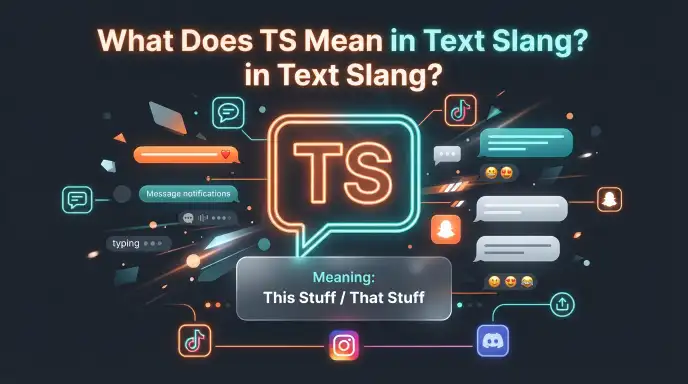
What does TS mean in text slang? TS is a common texting abbreviation that most often means “This Stuff” or “That Stuff,” although it can have other meanings depending on the context.
People frequently use it in text messages, TikTok comments, Snapchat chats, Instagram DMs, Discord conversations, and other social media platforms to keep their messages short and casual.
Many people search for what does TS mean in text slang after seeing it in a message or online post and wondering what the sender is referring to. Since TS can represent different phrases in gaming, music, technology, and internet culture, understanding the surrounding conversation is important to interpret it correctly.
This guide explains the most common TS meaning, its full forms, real-life examples, where it’s used, and when you should or shouldn’t use it.
Quick Answer: TS Meaning in Text Slang
In text slang, TS most commonly means “This Stuff” or “That Stuff.” It is a casual abbreviation people use in messages and social media to refer to a situation, topic, object, or event without repeating the full phrase.
| Term | Details |
| Slang | TS |
| Most Common Meaning | This Stuff / That Stuff |
| Category | Text Slang |
| Tone | Casual and Informal |
| Common Platforms | Texting, TikTok, Snapchat, Instagram, Discord |
| Offensive? | No, usually neutral |
| Popular Among | Teens, Gen Z, online communities |
What Does TS Mean in Text Slang?
The meaning of TS depends on the conversation, but in everyday texting, it usually refers to “This Stuff” or “That Stuff.” Instead of repeating the name of something, people simply type TS to keep their messages short and easy to read.
For example, if someone is talking about a difficult homework assignment, they might say:
“TS is harder than I expected.”
Here, TS simply means “this stuff.”
If two friends are discussing drama online, one could write:
“I’m done with TS.”
In this sentence, TS refers to “that stuff” or the drama they were discussing.
The Most Common Meaning of TS
The most widely used meaning of TS is:
- This Stuff
- That Stuff
People use it when both people already know what they are talking about. It saves time and makes texting faster.
Examples:
- “TS makes no sense.”
- “I’m not dealing with TS anymore.”
- “Can we stop talking about TS?”
- “TS keeps happening every week.”
In all of these examples, TS replaces a longer phrase that both people understand from the conversation.
Can TS Have More Than One Meaning?
Yes. Although “This Stuff” and “That Stuff” are the most common meanings in texting, TS can have other meanings depending on the platform or topic.
Some possible meanings include:
| TS Meaning | Where It May Be Used |
| This Stuff | Casual texting |
| That Stuff | Text messages and chats |
| TeamSpeak | Gaming communities |
| Taylor Swift | Fan communities and social media |
| Transgender | Identity-related discussions (context-specific) |
| Timestamp | Technology and video discussions |
Because TS has multiple meanings, always read the surrounding conversation before deciding what it stands for.
How Context Changes the Meaning
Context is the biggest clue when reading internet slang.
For example:
Texting
“I’m tired of TS.”
Meaning: I’m tired of this stuff.
Gaming
“Join TS before the match.”
Meaning: Join TeamSpeak.
Music Discussion
“TS released another amazing album.”
Meaning: Taylor Swift.
The same two letters can mean completely different things, which is why context matters more than the abbreviation itself.
TS Full Form in Texting
Unlike many internet abbreviations that have only one fixed expansion, TS does not have a single official full form. Its meaning changes based on where it is used.
In everyday texting, the most common full forms are:
- This Stuff
- That Stuff
These are informal expressions that help people type faster without changing the meaning of the conversation.
For example:
Instead of writing:
“I’m tired of this stuff.”
Someone may simply write:
“I’m tired of TS.”
The message is shorter, but the meaning stays the same.
Other Full Forms of TS
Outside casual texting, TS can represent different phrases.
| Full Form | Common Context |
| This Stuff | Personal conversations |
| That Stuff | Text messaging |
| TeamSpeak | Online gaming |
| Taylor Swift | Music discussions |
| Timestamp | Technology and editing |
| Technical Support | Workplace or customer service |
These meanings are not interchangeable. Always look at the topic before deciding which one fits.
For example:
- “Contact TS if your account isn’t working.” → Technical Support
- “Meet us on TS tonight.” → TeamSpeak
- “TS announced a new tour.” → Taylor Swift
Is TS Rude, Offensive, or Neutral?
You can place this table below the “Is TS Rude, Offensive, or Neutral?” section.
| Situation | Tone | Is TS Appropriate? | Reason |
| Texting friends | Neutral | ✅ Yes | Common in casual conversations. |
| Family group chats | Neutral | ✅ Yes | Fine if everyone understands the meaning. |
| TikTok comments | Casual | ✅ Yes | Frequently used in social media discussions. |
| Snapchat messages | Casual | ✅ Yes | Short and quick for everyday chats. |
| Instagram DMs | Casual | ✅ Yes | Suitable for informal messaging. |
| Discord chats | Casual | ✅ Yes | Common among online communities and gamers. |
| Gaming chats | Neutral | ✅ Yes | May also mean TeamSpeak, depending on context. |
| Workplace emails | Professional | ❌ No | Write the full words instead of using slang. |
| School assignments | Formal | ❌ No | Avoid internet abbreviations in academic writing. |
| Business communication | Formal | ❌ No | Clear language is more professional. |
Quick Summary
| Question | Answer |
| Is TS rude? | Usually No |
| Is TS offensive? | No, by itself it isn’t offensive. |
| Is TS neutral? | Yes, in most text conversations. |
| Does context matter? | Yes, the surrounding message determines the tone. |
| Safe to use on social media? | Yes, in casual conversations. |
| Suitable for formal writing? | No, use complete words instead. |
In most conversations, TS is completely neutral. It is simply a shorthand people use while texting friends or commenting online.
By itself, TS is not considered rude or offensive.
However, the tone of the sentence can change how it feels.
For example:
Positive:
- “TS is actually pretty interesting.”
Neutral:
- “Let’s finish TS today.”
Negative:
- “I’m sick of TS.”
Notice that the abbreviation stays the same, but the speaker’s attitude changes.
When Can TS Sound Negative?
Although TS itself isn’t offensive, it may sound harsh if it’s used while expressing frustration or anger.
Examples include:
- “I’m done with TS.”
- “Stop sending TS.”
- “I don’t care about TS anymore.”
In these situations, the negative feeling comes from the sentence—not from the abbreviation itself.
Overall, TS is generally safe to use in casual conversations, especially when texting friends or chatting on social media.
Where Is TS Commonly Used?
Because TS is short and easy to type, it appears across many online platforms. It is most common in casual conversations where people want to save time.
You’ll often see TS used on:
- Text messages
- TikTok comments
- Snapchat chats
- Instagram direct messages
- Discord conversations
- Online gaming chats
- Group chats
- X (formerly Twitter)
Each platform may use the abbreviation slightly differently, but the idea is the same: typing less while communicating quickly.
TS in Text Messages
Text messaging is where TS is most commonly used.
Friends often use it instead of repeating the same topic again and again.
Examples:
- “TS is getting expensive.”
- “Forget TS. Let’s do something else.”
- “I can’t deal with TS today.”
TS on TikTok
On TikTok, TS often appears in comments and captions.
People may write:
- “TS is so funny.”
- “Everyone is talking about TS.”
- “I love TS.”
The exact meaning depends on what the video is about. It could refer to this stuff, Taylor Swift, or another topic mentioned in the content.
TS on Snapchat and Instagram
Snapchat and Instagram users prefer short messages, making TS a popular abbreviation.
Examples include:
- “Did you see TS?”
- “Ignore TS.”
- “I’m over TS already.”
Because these apps focus on fast conversations, abbreviations like TS help people communicate more quickly.
Real-Life Examples of TS in Text Slang
The meaning of TS becomes much easier to understand when you see it used in real conversations. Below are examples from different situations.
Friendly Conversations
Friends often use TS when talking about everyday topics.
Examples:
- “TS was really fun yesterday.”
- “I can’t stop thinking about TS.”
- “Let’s finish TS before dinner.”
- “TS made me laugh so much.”
In these examples, TS refers to something both people already understand from the conversation.
Casual Texting
People use TS to make messages shorter and faster.
Examples:
- “I’m tired of TS.”
- “Forget TS and let’s go out.”
- “I don’t want to deal with TS today.”
- “We’ll talk about TS later.”
The abbreviation keeps the message simple without changing its meaning.
Argumentative Tone
Sometimes TS appears in messages during disagreements or frustration.
Examples:
- “Stop bringing up TS.”
- “I’m done with TS.”
- “Don’t blame me for TS.”
- “TS isn’t my problem anymore.”
Here, TS itself isn’t rude, but the overall tone of the sentence is negative.
Gaming and Social Media Context
In gaming or online communities, TS may have different meanings depending on the discussion.
Examples:
- “Join TS before the match starts.” (TeamSpeak)
- “TS released another great song.” (Taylor Swift)
- “Everyone is talking about TS in the comments.” (Context-dependent)
- “Check TS after the update.” (Meaning depends on the conversation.)
Always read the surrounding messages before deciding what TS means.
Origin and Background of TS Slang
The abbreviation TS became popular because people wanted a faster way to type common phrases in online conversations.
During the early days of texting, many users shortened words and phrases to save time and reduce typing. As social media grew, abbreviations like LOL, BRB, IMO, IDK, TBH, and TS became part of everyday online communication.
Unlike some slang terms that have one fixed meaning, TS developed naturally across different online communities. As a result, it now has several meanings depending on the topic.
Today, TS is commonly seen in:
- Personal text messages
- Group chats
- TikTok comments
- Instagram captions
- Snapchat conversations
- Discord servers
- Gaming communities
Its popularity continues because it is short, flexible, and easy to understand in context.
Why TS Has Multiple Meanings
Many internet abbreviations are reused by different communities.
For example:
- Gamers may understand TS as TeamSpeak.
- Music fans may use TS for Taylor Swift.
- Friends texting each other usually mean This Stuff or That Stuff.
This is why context is always more important than the abbreviation itself.
TS vs Similar Text Slang
Many texting abbreviations look similar or serve a similar purpose. Knowing the difference helps avoid confusion.
| Slang | Meaning | Common Use |
| TS | This Stuff / That Stuff | Casual texting |
| TBH | To Be Honest | Giving an honest opinion |
| IDK | I Don’t Know | Expressing uncertainty |
| IMO | In My Opinion | Sharing personal views |
| FR | For Real | Showing agreement or seriousness |
| NGL | Not Gonna Lie | Introducing an honest statement |
TS vs TBH
TS refers to a topic or situation.
TBH introduces an honest opinion.
Example:
- “TS is confusing.”
- “TBH, I don’t like it.”
TS vs IDK
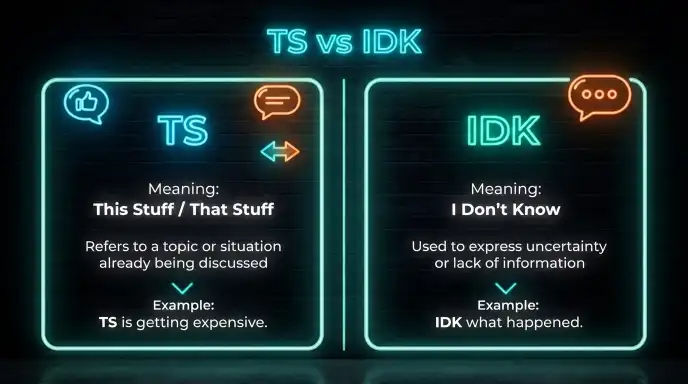
TS points to something being discussed.
IDK means you don’t know the answer.
Example:
- “TS is getting out of hand.”
- “IDK what happened.”
TS vs FR
FR means “For Real.”
It expresses surprise or agreement, while TS refers to the topic itself.
Example:
- “TS is amazing.”
- “FR? I didn’t know that.”
Why People Use TS Slang
People use TS because it makes conversations faster and more natural.
Instead of repeating the same words, they simply type two letters.
Common reasons include:
- Saves typing time.
- Makes conversations flow faster.
- Fits character limits on social media.
- Sounds casual and modern.
- Easy for friends to understand.
- Frequently used by Gen Z and online communities.
Because online conversations move quickly, short abbreviations like TS help people communicate more efficiently.
Benefits of Using TS
Using TS has several advantages in casual communication.
Some benefits include:
- Faster replies.
- Less typing.
- Easy to remember.
- Common across many platforms.
- Works well in group chats.
- Keeps conversations short and simple.
As long as everyone understands the context, TS helps make messaging quicker.
Impact of Using TS in Communication
Like most internet slang, TS has both advantages and disadvantages.
When used correctly, it makes conversations feel relaxed and natural. However, using it in the wrong situation can confuse readers.
Positive Effects
Some positive effects include:
- Speeds up conversations.
- Makes texting more convenient.
- Feels friendly and informal.
- Helps users communicate quickly.
- Common among younger internet users.
Possible Drawbacks
There are also a few disadvantages.
For example:
- Not everyone knows what TS means.
- Older readers may misunderstand it.
- It can have different meanings in different communities.
- It isn’t suitable for formal writing.
- Context is required to understand it correctly.
If you’re unsure if someone knows the abbreviation, it’s usually better to write the full words instead.
Is TS Safe for Social Media?
Yes. TS is generally safe to use on social media.
The abbreviation itself is not offensive, harmful, or inappropriate.
People regularly use it on:
- TikTok
- Snapchat
- Discord
- Facebook Messenger
- X (Twitter)
As always, make sure the people you’re talking to understand what you mean.
Tips for Using TS Online
Follow these simple tips:
- Use TS only in casual conversations.
- Avoid using it in professional emails.
- Consider your audience.
- Don’t assume everyone knows the abbreviation.
- Read the conversation carefully before interpreting its meaning.
These habits help prevent misunderstandings.
When Should You Avoid Using TS?
Although TS is common online, there are situations where writing the full words is a better choice.
Avoid using TS when:
- Writing school assignments.
- Sending professional emails.
- Applying for jobs.
- Speaking with clients.
- Writing official documents.
- Communicating with people unfamiliar with internet slang.
Using clear language shows professionalism and reduces confusion.
Professional Situations
Business communication should always be clear.
Instead of writing:
“Let’s finish TS today.”
Write:
“Let’s finish this task today.”
The second version leaves no room for misunderstanding.
Academic Writing
Teachers, professors, and examiners usually expect complete words instead of internet abbreviations.
Writing “this stuff,” “that topic,” or another clear phrase is much more appropriate than using TS in essays or reports.
Polite Alternatives to TS
If you’re talking to someone who may not understand internet slang, it’s better to use clear words instead of TS. This makes your message easier to read and avoids confusion.
Better Alternatives
Instead of TS, you can use:
- This stuff
- That stuff
- This situation
- That topic
- This issue
- This problem
- That matter
- This thing
- That thing
- The conversation
When to Use the Full Words
Using the complete phrase is a better choice when you are:
- Writing professional emails
- Sending messages to teachers or clients
- Creating school assignments
- Speaking with people who are unfamiliar with texting slang
- Writing articles or formal documents
Clear language helps everyone understand your message without guessing what TS means.
Frequently Asked Questions
Q1. What does TS mean in text slang?
In text slang, TS most commonly means “This Stuff” or “That Stuff.” People use it in casual conversations to refer to something already being discussed.
Q2. What does TS stand for in texting?
The most common TS full form in texting is “This Stuff” or “That Stuff.” However, in different contexts, it may also stand for TeamSpeak, Taylor Swift, Timestamp, or Technical Support.
Q3. Is TS a bad word?
No. TS is generally a neutral abbreviation. It is not considered offensive by itself. The tone depends on the rest of the sentence.
Q4. Is TS popular on TikTok and Snapchat?
Yes. TS is commonly used on TikTok, Snapchat, Instagram, Discord, WhatsApp, and in text messages because it is quick and easy to type.
Q5. Can TS have more than one meaning?
Yes. TS has several meanings depending on the conversation. In casual texting, it usually means “This Stuff” or “That Stuff,” but it can also represent other terms in gaming, music, technology, or online communities.
Q7. What is TS on social media?
On social media, TS most commonly means “This Stuff” or “That Stuff,” referring to a topic or situation already being discussed. However, its meaning can change based on the context, such as Taylor Swift in fan communities.
Q8. What does “TS” mean in Gen Z slang?
In Gen Z slang, TS usually means “This Stuff” or “That Stuff” as a quick way to refer to something in casual chats. Gen Z commonly uses it on TikTok, Snapchat, Instagram, and in text messages to keep conversations short and fast.
Conclusion
What does TS mean in text slang? In most text messages and online conversations, TS simply means “This Stuff” or “That Stuff.” It is a common abbreviation used to make texting faster and more convenient.
Depending on the context, TS can also stand for other terms such as TeamSpeak, Taylor Swift, Timestamp, or Technical Support, so it’s always important to read the surrounding conversation.
Because TS has multiple meanings, context is the key to understanding it correctly. While it is perfectly acceptable in casual chats, social media, and messaging apps, it is usually best to avoid it in professional or academic communication.
By understanding what does TS mean in text slang, you’ll be able to read online conversations more confidently and use the abbreviation naturally whenever the situation is appropriate.
Explore Related Articles:
- WYA Meaning: The Texting Slang Everyone’s Using in 2026
- DC Slang Meaning: What It Means in Gaming, and Social Media
- ATP Slang Meaning in Text: How People Use it on Social Media

Hi, I’m Rachel Simmons, a language writer specializing in American English and modern slang. I research regional expressions, everyday phrases, and evolving word meanings across the United States. I enjoy making complex language trends simple, practical, and easy for everyone to understand.