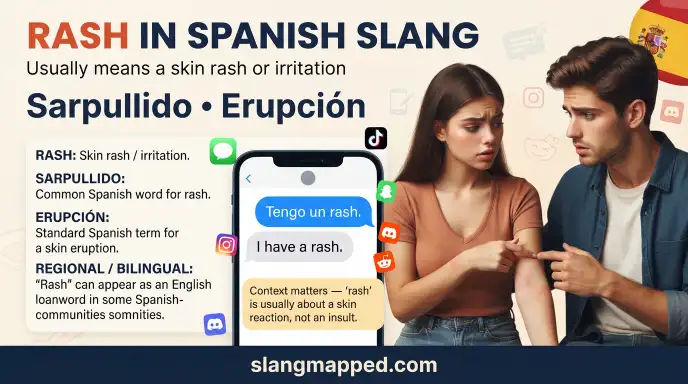
Rash in Spanish slang usually refers to a skin rash, irritation, or eruption, but it is important to understand that rash is not a universal Spanish slang word.
In standard Spanish, sarpullido and erupción are the usual terms for a skin rash. Major English-Spanish dictionaries list both as direct translations of the medical meaning of rash.
If you saw rash in a Spanish text, TikTok comment, Instagram post, or bilingual conversation, you may be wondering if it has a hidden slang meaning. In many cases, it does not.
The word may simply be an English loanword used by a bilingual or regional Spanish speaker. The surrounding sentence and the speaker’s location can help you understand what they mean.
Quick Answer
Rash in Spanish slang usually means a skin rash, irritation, or skin eruption. In everyday Spanish, sarpullido is a common equivalent, while erupción is another standard option.
What Does Rash in Spanish Slang Mean?
The main meaning
When rash is used to describe a person’s skin, it means an area of skin that has become irritated, red, itchy, bumpy, or otherwise abnormal.
For example:
Tengo un rash en el brazo.
This can be understood as:
“I have a rash on my arm.”
However, this does not mean that rash has developed a completely different Spanish slang definition. In this context, the speaker is borrowing the English word while speaking Spanish.
The standard Spanish equivalent would be:
Tengo un sarpullido en el brazo.
SpanishDictionary lists el sarpullido and la erupción as Spanish translations for the skin-related meaning of rash.
Is “rash” actually Spanish slang?
Not exactly.
This is one of the most important points for understanding the keyword rash in Spanish slang.
People sometimes call a regional or borrowed word “slang” because it appears in casual speech. But slang, regional vocabulary, and borrowed words are not always the same thing.
In this case, rash is better understood as an English-derived or borrowed term that can appear in Spanish-speaking environments, particularly in bilingual speech. It should not be presented as a secret Spanish slang word with a completely different meaning.
That distinction makes the meaning much easier to understand.
Rash vs. Sarpullido: What Is the Difference?
Sarpullido is the natural Spanish word
If you want to say “rash” in ordinary Spanish, sarpullido is one of the safest choices.
For example:
Tengo un sarpullido.
means:
“I have a rash.”
SpanishDictionary identifies sarpullido as a masculine Spanish noun and gives rash as its medical meaning.
Rash sounds more bilingual
A sentence such as:
Tengo un rash.
mixes an English word with Spanish grammar.
This kind of code-switching can sound completely natural in bilingual communities. However, a Spanish speaker who does not commonly use English may find rash unusual and prefer sarpullido.
Simple comparison
| Word | Meaning | Typical use |
| rash | Rash or skin irritation | Borrowed English term / bilingual speech |
| sarpullido | Rash | Common Spanish word |
| erupción | Skin eruption/rash | Standard Spanish |
| erupción cutánea | Skin eruption | More precise or medical |
| ronchas | Welts/raised bumps | Used when describing certain skin reactions |
| brote | Flare-up/outbreak | Context-dependent |
The important point is that these words are related, but they are not always perfect substitutes. A rash can have many appearances, while ronchas, for example, can refer more specifically to raised welts.
Why the Context Matters
“Tengo un rash”
If someone writes:
Tengo un rash después de usar esa crema.
the meaning is quite straightforward:
“I got a rash after using that cream.”
There is no insult or hidden social meaning.
“Eso es rash”
A sentence like this is less clear without context. The surrounding conversation could tell you if the speaker is talking about a skin condition, using English casually, or making a different reference.
This is why you should not translate a slang-looking word in isolation.
Social media context
On TikTok, Instagram, Snapchat, Reddit, Discord, or in texting, bilingual speakers frequently mix English and Spanish. Seeing an English word inside an otherwise Spanish sentence does not automatically make that word internet slang.
For rash, the safest interpretation is still the skin-related meaning when the conversation is about someone’s body or skin.
What Does Sarpullido Mean?
A common Spanish word for rash
Sarpullido describes a visible skin eruption or irritation, often involving small bumps or reddish areas and sometimes itching.
The medical dictionary from Clínica Universidad de Navarra explains that sarpullido is a common-language term describing a mild, usually temporary skin eruption rather than the name of one specific disease.
This is useful because it explains why sarpullido is not necessarily telling you why the skin changed.
It describes what the skin looks or feels like rather than automatically identifying its cause.
Example
Me salió un sarpullido después de estar en el sol.
English: “I developed a rash after being in the sun.”
This sounds natural in Spanish.
What Does Erupción Mean?
A broader term
Erupción can also mean a rash or skin eruption.
Cambridge Dictionary gives sarpullido and erupción as translations for the skin-related meaning of rash.
The word can be useful when discussing skin changes more generally.
For example:
Tengo una erupción en la piel.
means:
“I have a rash on my skin.”
Erupción cutánea
You may also see:
erupción cutánea
This literally refers to a cutaneous or skin eruption and is a clear expression when the topic is medical or health-related.
Is Rash in Spanish Slang Rude or Offensive?
Usually neutral
When rash refers to a skin condition, it is not normally rude or offensive.
It is not a Spanish swear word.
It is also not normally used as an insult.
For example:
Tengo un rash en la cara.
is simply a statement about someone’s skin.
Don’t confuse it with English “rash”
English has another meaning of rash that describes a person or action as careless, impulsive, or unwise.
For example:
“That was a rash decision.”
In Spanish, this meaning can be translated with words such as imprudente, impulsivo, or temerario.
That meaning is completely different from the skin-related use.
Rash Has More Than One Meaning in English
Rash as a skin condition
This is the meaning most relevant to rash in Spanish slang.
I have a rash.
Spanish:
Tengo un sarpullido.
“A rash of” meaning many or a sudden series
English also has the expression “a rash of something.”
For example:
“A rash of complaints.”
This means a large number or sudden series of complaints.
Spanish translations can include expressions such as una oleada, una serie, or una racha, depending on context.
This meaning has nothing to do with skin.
Rash as an adjective
English can also use rash to describe an action taken without enough thought.
“He made a rash decision.”
Possible Spanish translations include:
- una decisión imprudente
- una decisión impulsiva
- una decisión temeraria
- una decisión precipitada
So, if you encounter rash in an English-Spanish conversation, always check how the word is being used.
How Do You Say Rash Naturally in Spanish?
Everyday option
For most everyday situations, sarpullido is a strong choice.
Tengo un sarpullido.
General skin-related option
You can also say:
Tengo una erupción.
More specific expression
For clearer medical wording:
Tengo una erupción cutánea.
Casual bilingual option
In a bilingual conversation, you may hear:
Tengo un rash.
The last example is understandable in the right community, but it is not the best universal Spanish translation.
Why Do Some Spanish Speakers Say Rash?
English influence
Spanish and English come into close contact in many bilingual communities.
When people regularly use both languages, English words can become part of casual Spanish conversations.
This is known as code-switching or language mixing.
A bilingual speaker might therefore say:
Me salió un rash.
instead of:
Me salió un sarpullido.
Both can communicate the same basic idea, but they reflect different language habits.
Convenience and familiarity
A bilingual speaker may have learned the word rash first or simply hear it frequently in English-language conversations.
This can make the English term feel natural even when speaking Spanish.
Regional differences
Spanish is spoken across many countries and communities. Vocabulary is not identical everywhere.
A word that sounds normal to one group can sound foreign or unusual to another.
Therefore, rash should not be treated as a word that every Spanish speaker uses.
Where Might You See Rash Used?
Texting
In bilingual texting, you might see:
Tengo un rash desde ayer
The meaning is simply:
“I’ve had a rash since yesterday.”
The emoji makes the message more casual but does not change the meaning of rash.
Instagram and TikTok
Someone discussing skincare, allergies, cosmetics, or a reaction to a product might use rash in a bilingual caption.
For example:
Este producto me dio un rash.
This means:
“This product gave me a rash.”
Casual conversations
Friends who speak both English and Spanish may naturally mix vocabulary.
The important thing is not to assume that every English word appearing in Spanish is “slang.”
Some are simply borrowed terms or examples of code-switching.
Reddit and Discord
Bilingual communities on Reddit and Discord can also contain mixed English-Spanish vocabulary.
If you encounter rash there, check the surrounding discussion before deciding that it has a special slang meaning.
Key Takeaway So Far
If someone asks “What does rash mean in Spanish slang?”, the simplest accurate answer is:
It usually refers to a skin rash or irritation when used as a borrowed English word in Spanish conversation. The standard Spanish words are sarpullido and erupción.
The biggest mistake is assuming that rash is a universal Spanish slang term. It is much more useful to think about regional vocabulary, bilingual speech, and context.
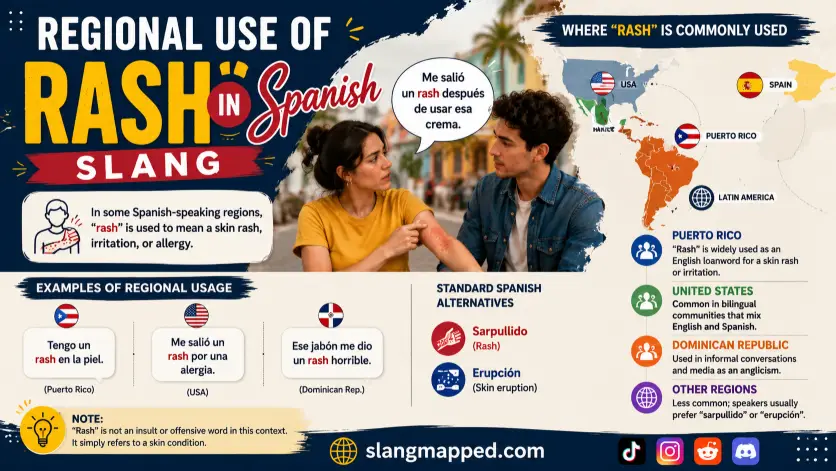
Regional Use of Rash in Spanish Slang
Puerto Rican Spanish
One of the most important regional points about rash in Spanish slang is its connection with Puerto Rican Spanish.
The Diccionario de americanismos from ASALE records rash as an English-origin word used in Puerto Rico and the United States, with meanings connected to a skin rash, allergy, or skin irritation.
This shows that the word is not simply a mistake made by Spanish speakers. It has documented regional use.
For example, a bilingual Puerto Rican speaker might say:
Me salió un rash después de comer eso.
The intended meaning is:
“I got a rash after eating that.”
However, this does not mean that every Puerto Rican speaker uses rash. Language can vary between families, age groups, communities, and levels of English exposure.
Spanish in the United States
The word can also appear in U.S. Spanish, especially in communities where Spanish and English are used together.
A bilingual speaker may switch between languages without thinking about it.
For example:
Tengo un rash en la piel.
The sentence is mostly Spanish, but the noun rash comes from English.
This type of language mixing is common in bilingual environments. It is better described as code-switching or borrowing than as a universal slang definition.
Dominican Spanish and other regional varieties
Regional Spanish can also adopt English words in informal communication. Some language authorities and usage guides have discussed rash as an anglicism in Spanish-language communication in the Dominican Republic and elsewhere.
However, this does not mean rash is equally common across the Spanish-speaking world.
A Spanish speaker from Spain, Mexico, Colombia, Argentina, or another country may prefer a traditional Spanish word such as sarpullido.
Rash vs. Other Spanish Skin Terms
Rash vs. sarpullido
These two words are often closest in everyday meaning.
Rash is an English-derived term used in some Spanish-speaking environments.
Sarpullido is an established Spanish word.
If you want the most broadly understandable Spanish option, sarpullido is usually safer.
Rash vs. erupción
Erupción is another standard Spanish term.
It can describe a skin eruption and may sound more formal or medical depending on the context.
For example:
Tengo una erupción en la piel.
This is a clear way to say:
“I have a rash on my skin.”
Rash vs. ronchas
Ronchas is different because it can refer to raised welts or bumps on the skin.
Someone may describe an allergic reaction as ronchas, but not every rash consists of raised welts.
Therefore, translating every instance of rash as ronchas can change the meaning.
Rash vs. brote
Brote can mean an outbreak or flare-up.
In a skin-related conversation, it can refer to a flare-up or outbreak, but it is broader than rash.
For example:
Tengo un brote de eczema.
means:
“I have an eczema flare-up.”
That is not exactly the same as simply saying “I have a rash.”
Common Phrases With Rash
Tengo un rash
Tengo un rash.
Meaning:
“I have a rash.”
This is a short, casual bilingual expression.
Me salió un rash
Me salió un rash.
Meaning:
“I got a rash.”
This is useful when someone has recently developed a skin reaction.
Me dio un rash
Me dio un rash.
Meaning:
“It gave me a rash.”
The subject can be a product, food, medication, plant, or another possible trigger.
Un rash en la piel
Tengo un rash en la piel.
Meaning:
“I have a rash on my skin.”
This phrase combines the borrowed English noun with Spanish wording.
Rash por una crema
Me salió un rash por esa crema.
Meaning:
“I got a rash from that cream.”
Again, this is informal bilingual usage rather than a separate slang definition.
Real-Life Examples of Rash in Spanish Slang
Friendly conversation
Amiga, creo que tengo un rash por el jabón nuevo.
Meaning: “Girl, I think I got a rash from the new soap.”
The tone is friendly and casual.
Text message
Tengo un rash horrible
Meaning: “I have a horrible rash.”
The crying emoji communicates frustration or discomfort.
Social media caption
Este producto me dejó un rash en la cara.
Meaning: “This product left me with a rash on my face.”
Here, rash is being used in a beauty or skincare context.
Asking for advice
¿Qué puedo hacer si tengo un rash?
Meaning: “What can I do if I have a rash?”
The speaker is asking about a skin problem, not using an insult.
Bilingual conversation
I think me salió un rash después de usarlo.
This is a stronger example of code-switching because the speaker moves between English and Spanish within the same sentence.
The meaning remains:
“I think I got a rash after using it.”
Argumentative context
Te dije que esa crema me iba a dar un rash.
Meaning: “I told you that cream was going to give me a rash.”
The sentence sounds argumentative because of the tone, but rash itself is still neutral.
Gaming or online context
Imagine someone in a gaming Discord discussing a reaction to a gaming chair, headset material, or another product:
Bro, este material me dio un rash.
The word rash still means a skin reaction. The gaming context does not create a new gaming slang meaning.
What Rash Does Not Mean in Spanish Slang
It is not normally an insult
If someone says:
Tengo un rash.
they are not calling themselves or another person a bad name.
It is not a sexual slang term
There is no general Spanish slang definition of rash that makes it a sexual expression.
If you see the word in an adult or suggestive conversation, the surrounding context should be examined separately.
It is not a Gen Z acronym
Rash is not normally an acronym such as LOL, BRB, or IDK.
There is also no standard Spanish expansion of the letters R-A-S-H that explains its everyday use.
It does not automatically mean “reckless”
The English adjective rash can mean reckless or impulsive, but that is a different English meaning.
Do not automatically apply that meaning to a Spanish sentence about someone’s skin.
Is Rash Commonly Used by Gen Z?
Sometimes, but context matters
Young bilingual speakers may use English and Spanish together online, so you can certainly encounter rash in messages written by younger people.
However, this does not make rash a uniquely Gen Z Spanish slang term.
There is an important difference between:
“Young people sometimes use this word.”
and
“This word is Gen Z slang.”
The first can be true without the second being true.
Social media can spread borrowed vocabulary
TikTok, Instagram, Snapchat, Reddit, and other platforms allow language to move quickly between English and Spanish.
A bilingual creator may use English words because they are common in their online community.
That can make a borrowed word appear more widespread than it actually is.
How to Understand Rash in a Spanish Text
Look at the words around it
Context is your best tool.
If the sentence includes words such as:
- Piel: skin
- Picazón: itching
- Comezón: itch
- Crema: cream
- Alergia: allergy
- Rojo: red
- Cara: face
- Brazo: arm
then rash almost certainly relates to a skin problem.
Check the speaker’s language background
If the person frequently mixes English and Spanish, rash is likely a borrowed English term.
If they normally write in standard Spanish, they may use sarpullido or erupción instead.
Don’t translate slang word-for-word
A common mistake is assuming that every unusual Spanish word has a hidden slang meaning.
Sometimes the explanation is much simpler: the speaker is borrowing an English word.
Why People Use Rash Instead of Sarpullido
English exposure
People who regularly communicate in English may already know rash very well.
When they speak Spanish, the English term can come naturally.
Personal language habits
Some bilingual speakers prefer certain English words even when a Spanish equivalent exists.
This happens with many everyday terms.
Community influence
Friends, family members, workplaces, schools, entertainment, and social media can all influence vocabulary.
As a result, one person may say:
Tengo un rash.
while another says:
Tengo un sarpullido.
Both speakers can communicate the same basic idea.
How to Say Rash in Spanish Naturally
Casual Spanish
Use:
Sarpullido
Example:
Me salió un sarpullido.
More formal Spanish
Use:
Erupción cutánea
Example:
Tengo una erupción cutánea.
Describing skin irritation
Use:
Irritación de la piel
Example:
Tengo irritación de la piel.
Describing raised welts
Use:
Ronchas
Example:
Me salieron ronchas.
The best expression depends on what you are actually describing.
Pronunciation and Grammar of Rash in Spanish
How is rash pronounced?
When Spanish speakers borrow the English word, pronunciation can vary depending on the speaker’s accent and level of English exposure.
In English, rash is pronounced approximately like “rash” with a short vowel sound.
Spanish speakers may adapt the pronunciation to their own speech patterns.
Is it masculine or feminine?
When English nouns are borrowed into Spanish, grammatical gender can vary according to regional and individual usage.
If rash is treated as a Spanish noun, you may encounter:
un rash
For example:
Tengo un rash.
This is one reason not to assume that English grammar can simply be transferred into Spanish.
When Should You Use Sarpullido Instead?
For school assignments
If you are writing a Spanish assignment and need to translate “rash,” sarpullido is a safer choice than rash.
For formal communication
In formal writing, standard Spanish vocabulary is generally clearer.
When speaking with a Spanish learner
If the listener is learning Spanish, teaching them sarpullido gives them a more useful standard vocabulary word.
When regional vocabulary may cause confusion
If you are communicating with Spanish speakers from different countries, a standard term can reduce misunderstanding.
Is Rash Safe to Use on Social Media?
Generally safe
The word itself is generally harmless when used to describe a skin problem.
A sentence such as:
Tengo un rash después de probar esta crema.
does not contain offensive slang.
Be careful when discussing another person’s body
Although the word is neutral, discussing someone’s skin publicly can become insensitive if the goal is to embarrass them.
The issue in that situation is the content and intent, not the word rash itself.
Social media meaning can depend on context
If a post uses rash alongside unusual expressions, jokes, or memes, you should interpret the entire sentence rather than assuming a new slang definition.
Rash in Spanish Slang vs. English Rash
| Feature | Rash in Spanish usage | Rash in English |
| Skin problem | Yes | Yes |
| Reckless/unwise | Not normally | Yes |
| “A rash of” = sudden series | Not normally | Yes |
| Spanish slang | Regional/borrowed use | English vocabulary |
| Standard Spanish equivalent | Sarpullido / erupción | — |
| Offensive by itself | No | No |
| Secret internet code | No | No |
This distinction is especially useful when translating online conversations.
Common Mistakes About Rash in Spanish Slang
Mistake 1: Assuming it is universal Spanish
Spanish has many regional varieties.
A word used naturally in Puerto Rico or U.S. Spanish may not be the preferred word in Spain or Mexico.
Mistake 2: Calling every borrowed word slang
An English loanword can become part of informal speech without having a special slang meaning.
Mistake 3: Ignoring the skin-related context
If someone says rash while discussing a cream, allergy, or skin problem, the meaning is usually straightforward.
Mistake 4: Confusing it with “rash” meaning reckless
The English sentence:
“That was a rash decision.”
has nothing to do with a skin rash.
Mistake 5: Treating sarpullido and ronchas as identical
These terms can overlap in everyday descriptions, but they can refer to different appearances or conditions.
Why Understanding Regional Spanish Matters
Spanish is a global language with hundreds of millions of speakers.
Vocabulary changes across countries and communities.
For slang research, this is particularly important because informal language changes faster than formal vocabulary.
A word can be:
- Common in one country
- Familiar but uncommon in another
- Considered an English borrowing somewhere else
- Rare or strange to another Spanish speaker
That is why a good explanation of rash in Spanish slang should always include regional context instead of presenting one translation as universal.
What Is the Best Spanish Translation for Rash?
For general use
Sarpullido is a strong everyday choice.
For formal or medical contexts
Erupción cutánea is clear and precise.
For bilingual casual speech
Rash may appear naturally in some communities.
For raised welts
Ronchas may be appropriate when that is what the person is actually describing.
The key is to choose the word according to meaning, context, and audience rather than simply replacing one word with another.
FAQs
Q1. What does rash mean in Spanish slang?
Rash can mean a skin rash, irritation, or allergy when it is used as a borrowed English term in some Spanish-speaking communities. It is especially documented in U.S. and Puerto Rican Spanish.
Q2. What is rash called in standard Spanish?
The most common options are sarpullido and erupción. You can also use erupción cutánea for a clearer medical expression.
Q3. Is rash a bad word in Spanish?
No. When rash refers to a skin condition, it is generally a neutral word and is not normally considered an insult or swear word.
Q4. Is rash Spanish slang used everywhere?
No. Its use varies by region and language background. ASALE specifically documents the English-origin term in the United States and Puerto Rico.
Q5. Why would a Spanish speaker say rash instead of sarpullido?
English influence and bilingual speech are common reasons. A speaker who regularly uses both languages may naturally borrow rash while speaking Spanish.
Q6. Does rash mean “reckless” in Spanish?
Not normally when it appears as a Spanish loanword referring to skin. In English, however, rash can mean reckless or unwise, as in “a rash decision.”
Conclusion
Rash in Spanish slang generally refers to a skin rash, irritation, or eruption when the English word is borrowed into Spanish conversation. It is not best understood as a universal Spanish slang term. Instead, its use is regional and often connected with bilingual English-Spanish speech.
For standard Spanish, sarpullido is one of the best everyday choices, while erupción and erupción cutánea are useful alternatives. The word ronchas can be appropriate when someone specifically means raised welts, while brote can describe a flare-up in certain contexts.
The most important lesson is to check the context and the speaker’s regional background. If you see rash in a Spanish TikTok, text, Instagram caption, Reddit comment, or casual conversation, it usually does not contain a hidden or offensive meaning. In most skin-related contexts, it simply means “rash.”
For formal Spanish, however, sarpullido or erupción cutánea will usually be clearer and more widely understood.
Discover More:
- Rico Meaning Slang: Full Definition, Examples & Usage Explained
- What Does Fresh Slang Mean? Here’s the Answer
- Scoom Slang: What It Means and How People Use It

Hi, I’m Tyler Brooks, a writer specializing in Gen Z culture and internet slang. I track trending terms across TikTok and social media to explain their real-world meanings. My goal is to provide clear, accurate, and up-to-date definitions that help readers understand modern online language.