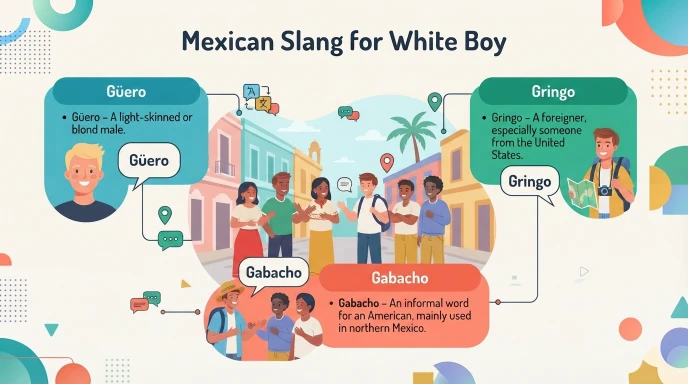
Mexican slang for white boy refers to informal Spanish words used in Mexico to describe a white or light-skinned male, such as güero or gringo.
Many people search for this phrase after hearing it in movies, social media videos, travel vlogs, or conversations with native Spanish speakers. While these terms may sound similar, they do not always have the same meaning.
The tone, location, and relationship between speakers all influence how these words are understood. Some are friendly nicknames, while others can become offensive if spoken with a negative attitude.
Learning the context behind each term helps you avoid misunderstandings and communicate more naturally.
Quick Answer
Mexican slang for white boy usually refers to words like güero (a light-skinned or blond man) and gringo (a foreigner, especially an American). These terms are often neutral or friendly, but their meaning depends on the context and tone.
Most Common Mexican Slangs for White Boy
The table below shows the most common slang terms and how they are generally used.
| Slang Word | Meaning | Friendly | May Be Offensive | Commonly Used In |
| Güero | Fair-skinned or light-haired person | ✅ Yes | Rarely | Throughout Mexico |
| Gringo | Foreigner, often an American | ✅ Sometimes | ✅ Sometimes | Mexico & Latin America |
| Gabacho | American or foreigner (regional usage) | Depends | Sometimes | Northern Mexico |
| Bolillo | Nickname for a white person | Sometimes | Sometimes | Mexico |
| Güerito | Friendly or affectionate form of güero | ✅ Yes | Rarely | Mexico |
Important: The meaning of these words depends on the speaker’s tone, relationship, and local culture. A word that sounds friendly among friends may feel disrespectful when used with strangers.
What Do Mexicans Call White People?
If you are wondering what do mexicans call white people, the most common answer is güero. In Mexican Spanish, güero usually describes someone with fair skin, blond hair, or other light features. It can be used for a Mexican person as well as a foreigner, so it does not automatically mean someone is American.
Other expressions may also appear depending on the situation. Gringo usually points to a foreigner, especially an American, while gabacho is an informal term for an American that is especially associated with parts of northern Mexico.
This means the mexican word for white boy is not always the same as the word for an American. If someone is describing appearance, güero is usually more relevant. If they are describing nationality, gringo or gabacho may be more appropriate.
Common Mexican Terms for White People
| Term | Meaning |
| Güero / Güera | A fair-skinned or light-haired man or woman |
| Gringo / Gringa | Usually a foreigner, especially an American |
| Gabacho / Gabacha | Informal regional term, especially for an American |
So, when someone asks what do mexican call white people, the safest short answer is güero for a man and güera for a woman, especially when the description is based on light skin or hair.
What Does Mexican Slang for White Boy Mean in Text?
The phrase mexican slang for white boy does not describe one specific slang word. Instead, it includes several informal expressions commonly used in Mexico to describe a person’s appearance, nationality, or background.
The most common terms include:
- Güero: A light-skinned or blond male.
- Gringo: A foreigner, especially someone from the United States.
- Gabacho: An informal word for an American, mainly used in northern Mexico.
These words are part of everyday Mexican Spanish and are widely understood.
How the Meaning Changes
The same slang word can have different meanings depending on:
- The speaker’s tone
- The relationship between the speakers
- The region of Mexico
- The situation
For example, a friend saying “Hey, güero!” is usually being friendly, while the same word spoken angrily may sound disrespectful.
Full Form / Definition of Mexican Slang for White Boy
Does It Have a Full Form?
No. Mexican slang for white boy does not have a full form because it is not an acronym.
Instead, it refers to several descriptive slang words.
| Slang Word | Meaning | Typical Tone |
| Güero | Light-skinned or blond man | Friendly or neutral |
| Gringo | Foreigner, usually American | Neutral, friendly, or negative |
| Gabacho | American, especially from the U.S. | Informal |
How Do You Say White Boy in Spanish Slang?
If you are wondering how to say white boy in Spanish slang, there is no single expression that works in every situation. In Mexican Spanish, güero is often the most natural informal term for a fair-skinned or light-haired man.
This is why people may search for white boy in spanish güero, spanish slang for white boy, or mexican word for white boy when trying to understand Mexican usage.
The literal phrase chico blanco means “white boy” or “white guy,” depending on context, but it does not have the same nickname-like quality as güero. For casual Mexican Spanish, güero is generally more natural when the speaker is referring to someone’s light appearance.
Common Ways to Express the Idea
- güero — a common Mexican term for a fair-skinned or light-haired male
- güerito — an affectionate or diminutive form of güero
- chico blanco — a literal way to say “white boy,” but not necessarily slang
- hombre blanco — literally “white man,” usually descriptive rather than slang
This explains why searches such as white guy in spanish slang, white guy spanish slang, spanish slang for white guy, white man in spanish slang, and spanish word for white guy often lead to güero when the intended context is Mexican Spanish.
It is also important to distinguish white person in spanish slang from a literal translation. Spanish has different words for describing appearance, nationality, and ethnicity, so the best term depends on what the speaker actually means.
What Does Güero Mean in English?
The guero in english meaning is usually “fair-skinned,” “light-haired,” or, depending on context, “white guy.” The exact translation changes because güero is a cultural nickname rather than a perfect one-word equivalent of “white.”
If you see spellings such as wero spanish, el wero meaning, or what does wero mean in spanish, they generally refer to the same word. Wero is a common informal spelling of güero, especially in casual writing, while güero is the standard spelling.
Güero Meaning in Mexican Slang
Güero is the most common Mexican term for a fair-skinned or light-haired man.It describes someone with fair skin, light-colored hair, or light-colored eyes. Unlike many slang terms, güero usually refers to appearance rather than nationality.
Many Mexicans use this word as a friendly nickname, even for people who are Mexican by nationality. In restaurants, markets, or everyday conversations, it is common to hear someone say güero to politely get a person’s attention.
Pronunciation
Güero is pronounced:
GWEH-ro
Is Güero Offensive?
Most of the time, no.
It is generally considered a friendly or neutral expression. However, like many slang words, the tone of voice and situation matter.
Examples
Spanish: ¡Oye, güero! Ven un momento.
English: “Hey, fair-skinned guy! Come here for a moment.”
Spanish: El güero trabaja aquí todos los días.
English: “The fair-skinned guy works here every day.”
Spanish: Ese güero habla español muy bien.
English: “That white guy speaks Spanish very well.”
Gringo Meaning in Mexican Slang
Gringo is another commonly heard term, but its meaning is different from güero. Instead of describing skin color, gringo usually refers to a foreigner, especially someone from the United States. In some Latin American countries, it may also refer to foreigners from other English-speaking countries.
Pronunciation
GREEN-go
Is Gringo Offensive?
It depends on the situation.
Sometimes it is simply a casual nickname, while in other situations it may sound disrespectful if spoken with a negative tone.
Examples
Spanish: Muchos gringos visitan Cancún cada año.
English: “Many Americans visit Cancún every year.”
Spanish: Ese gringo está aprendiendo español.
English: “That foreigner is learning Spanish.”
Spanish: Los gringos disfrutan la comida mexicana.
English: “Foreign visitors enjoy Mexican food.”
Gabacho Meaning in Mexican Slang
Gabacho is another regional term for an American, especially in parts of northern Mexico.The meaning has changed over time. Today, many people use it casually for Americans, while others may use it jokingly or critically depending on the conversation.
Pronunciation
gah-BAH-cho
Is Gabacho Offensive?
Sometimes.
Among friends it may be harmless, but using it toward someone you do not know can sound rude.
Examples
Spanish: Muchos gabachos cruzan la frontera para visitar.
English: “Many Americans cross the border to visit.”
Spanish: Ese gabacho habla muy buen español.
English: “That American speaks very good Spanish.”
Bolillo Meaning in Mexican Slang
Bolillo literally means a type of white bread in Mexico. As slang, it may refer to a white or fair-skinned person because of the bread’s color.
This expression is less common than güero and is more informal.
Pronunciation
boh-LEE-yo
Is Bolillo Offensive?
It can be.
Among close friends it may be playful, but strangers should avoid using it because it may sound insulting.
Examples
Spanish: Le dicen bolillo por su piel muy clara.
English: “They call him bolillo because of his very fair skin.”
Spanish: Ese bolillo vive en mi barrio.
English: “That white guy lives in my neighborhood.”
Güerito Meaning in Mexican Slang
Güerito is the affectionate or diminutive form of güero. It often means “little fair-skinned boy” or is simply used as a warm, friendly nickname.
Parents, relatives, and close friends commonly use this expression.
Pronunciation
GWEH-ree-to
Is Güerito Offensive?
No.
It is generally considered friendly and affectionate.
Examples
Spanish: Hola, güerito. ¿Cómo estás?
English: “Hi, buddy. How are you?”
Spanish: El güerito juega con sus amigos.
English: “The fair-skinned boy is playing with his friends.”
Whitexican Meaning in Mexican Slang
Whitexican is not traditional Mexican slang for white boy. Instead, it is a modern internet term that combines the words white and Mexican.
It is often used online to describe Mexicans perceived as wealthy, privileged, or socially disconnected from broader Mexican society. Because it comments on social class and stereotypes, it should not be used as a direct synonym for güero or gringo.
Example
Someone may describe a wealthy social media influencer as a Whitexican, even if that person is fully Mexican.
Regional Differences in Mexico
The meaning of Mexican slang for white boy changes depending on the region.
| Region | Common Terms |
| Northern Mexico | Gabacho, Gringo, Güero |
| Central Mexico | Güero, Güerito |
| Southern Mexico | Güero, Gringo |
| Tourist Areas | Güero, Gringo |
| Border Cities | Gabacho, Gringo, Güero |
These regional differences explain why one word may be common in one city but rarely heard in another.
Mexican Slang for White Boy vs White Girl
The slang often changes based on gender.
| Male | Female |
| Güero | Güera |
| Güerito | Güerita |
| Gringo | Gringa |
| Gabacho | Gabacha (less common) |
Learning both masculine and feminine forms will help you understand conversations more naturally.
Is Mexican Slang for White Boy Rude, Offensive, or Neutral?
Usually Neutral
The word güero is commonly used as a nickname. Many Mexicans use it naturally without any negative meaning.
Example:
“Gracias, güero.”
It simply means “Thanks, light-skinned guy.”
Friendly Between Friends
Close friends often use these expressions casually.
Example:
“What’s up, gringo?”
Among friends, this is usually harmless.
Can Become Offensive
These words may sound insulting if spoken:
- During an argument
- With sarcasm
- To stereotype someone
- With an angry tone
The tone matters much more than the word itself.
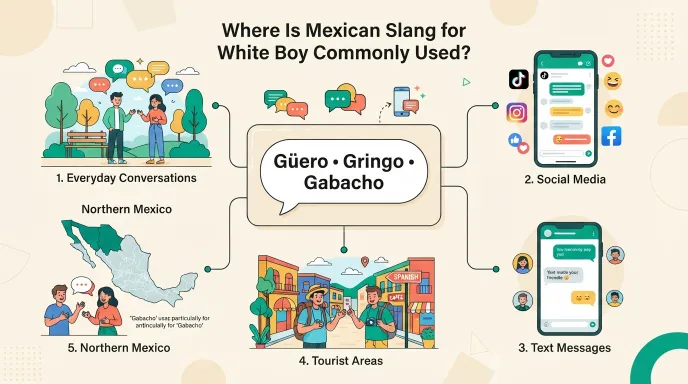
Where Is Mexican White Boy Slang Commonly Used?
Everyday Conversations
These expressions are common in daily life across Mexico.
Social Media
You may see them on:
- TikTok
- YouTube
Travel creators and language learners frequently discuss these terms.
Movies and TV Shows
Mexican films and television often include words like güero and gringo to make dialogue sound natural.
Travel
Tourists with fair skin may hear locals politely calling them güero.
Real-Life Examples of Usage
Friendly
Hey, güero! Come join us for dinner.
Casual
The waiter smiled and said, ‘Gracias, güero.’
Argumentative
He called him a gringo during the heated discussion.
Social Media
Everyone in Mexico kept calling me güero, and now I know why.
Travel
My tour guide explained that güero is often just a friendly nickname.
Origin and Background of the Slang
Güero
The word güero has been used in Mexican Spanish for generations. It traditionally describes someone with fair skin or blond hair, although today it is often used as a casual nickname.
Gringo
The exact origin of gringo remains uncertain. Several theories exist, but none has been fully proven. Today, it commonly refers to foreigners, especially Americans.
Gabacho
Originally used in older Spanish, gabacho later became associated with Americans in parts of northern Mexico, especially near the U.S. border.
Güero vs Gringo: What Is the Difference?
The difference between guero and gringo is mainly about appearance versus nationality.
Güero usually describes someone’s physical appearance, especially fair skin or light-colored hair. Gringo usually refers to a foreigner, particularly an American. This is why guero vs gringo, gringo vs guero, and difference between guero and gringo are common searches among people learning Mexican Spanish.
A person can be both güero and gringo, but the two words are not interchangeable.
Güero vs Gringo at a Glance
| Term | Main Meaning | Based On | Typical Mexican Usage |
| Güero | Fair-skinned or light-haired person | Appearance | Common nickname |
| Gringo | Foreigner, often American | Nationality | Informal term |
| Gabacho | American or foreigner | Nationality/background | Regional and informal |
| Güerito | Affectionate form of güero | Appearance | Friendly nickname |
For example, a Mexican man with very light skin may be called güero even though he is Mexican. An American with darker skin could still be called gringo because gringo is about foreign identity rather than skin color.
This is also why the question does gringo mean white boy does not have a simple “yes” answer. Usually, gringo means a foreigner, especially an American, rather than specifically a white male.
Comparison with Similar Slang
| Term | Meaning | Friendly | May Be Offensive |
| Güero | Light-skinned man | Yes | Rarely |
| Gringo | Foreigner, usually American | Often | Sometimes |
| Gabacho | American | Sometimes | Sometimes |
| Extranjero | Foreigner (standard Spanish) | Yes | No |
The safest option in formal situations is extranjero, which simply means “foreigner.”
When to Avoid Using It
Formal Settings
Avoid slang in:
- Business meetings
- Job interviews
- Schools
- Government offices
With Strangers
If you do not know someone personally, use respectful language instead.
During Arguments
Even neutral slang can sound offensive during conflicts.
Polite Alternatives to Mexican Slang for White Boy

Better Choices
Instead of slang, you can use:
| Alternative | Meaning |
| Señor | Sir |
| Joven | Young man |
| Caballero | Gentleman |
| Amigo | Friend |
| Extranjero | Foreigner |
These words are respectful and suitable for most situations.
Why People Use This Slang
Easy Description
People often describe someone based on visible characteristics.
Friendly Nicknames
Many Mexican families and friends naturally use descriptive nicknames.
Cultural Tradition
These expressions have been part of Mexican Spanish for many years.
Casual Communication
Slang makes conversations sound more relaxed and natural.
Common Misunderstandings About this Term
Many learners misunderstand these expressions. Here are the most common mistakes:
- Güero does not always mean an American. It mainly refers to a person’s appearance.
- Gringo does not always mean a white person. It usually refers to a foreigner, especially an American.
- Whitexican is not a replacement for güero. It describes a social stereotype rather than skin color.
- Not every slang word is offensive. The speaker’s tone, relationship, and location all influence how the word is understood.
Impact of Using Slang in Communication
Positive Effects
- Makes conversations feel natural.
- Builds friendly relationships.
- Reflects local culture.
- Helps learners understand native speakers.
Possible Drawbacks
- Can be misunderstood.
- Meanings vary by region.
- Tone can make the words offensive.
- Some people dislike labels based on appearance.
Using slang respectfully is always the best approach.
Is It Safe for Social Media?
Generally Yes
Words like güero and gringo are commonly seen on:
- TikTok
- X
Use Responsibly
Avoid using these words:
- To insult someone
- To stereotype people
- In hateful comments
- During online arguments
Respectful language creates better conversations online.
Key Takeaways
- Mexican slang for white boy usually refers to words like güero, gringo, and sometimes gabacho.
- Güero is commonly used for a light-skinned or blond man and is usually friendly or neutral.
- Gringo generally refers to a foreigner, especially an American, and its meaning depends on the speaker’s tone.
- Gabacho is an informal regional term for an American and is more common in northern Mexico.
- These slang words do not have a full form because they are not abbreviations.
- The same word can sound friendly, neutral, or offensive depending on the context and relationship between the speakers.
- Güero is often used as a casual nickname rather than an insult.
- These expressions are commonly heard in everyday conversations, social media, movies, and while traveling in Mexico.
- In formal situations or with strangers, polite terms like señor, caballero, or extranjero are safer choices.
- Understanding the cultural context helps you use Mexican slang respectfully and avoid misunderstandings.
Frequently Asked Questions
Q1. What is the most common Mexican slang for white boy?
The most common term is güero, which usually refers to a light-skinned or blond male.
Q2. Is güero an insult?
No. It is generally a friendly or neutral nickname, although tone always matters.
Q3. Does gringo always mean an American?
Not always. It usually refers to a foreigner, especially someone from the United States, but usage varies across Latin America.
Q4. What does mexican slang for white boy stand for?
It does not stand for anything because it is not an abbreviation. It refers to informal Spanish slang words used to describe a white or light-skinned male.
Q5. Can tourists be called güero?
Yes. Many tourists with fair skin are politely called güero by locals in Mexico.
Q6. Should I use these slang words?
You can use them if you understand the context and know the people you are speaking with. In formal situations, standard Spanish is a better choice.
Q7. What do Mexicans call white people?
In Mexico, güero (or güera for a woman) is a common, usually friendly nickname for someone with fair skin or light-colored hair. It doesn’t always refer to ethnicity.
Q8. Is “white boy” in Spanish güero?
Sometimes. Güero is often used for a fair-skinned or light-haired man, while the literal translation of “white boy” is chico blanco or niño blanco, depending on the context.
Conclusion
Mexican slang for white boy includes several informal terms rather than a single expression. The most common are güero, gringo, and gabacho, each with its own meaning and cultural background.
Most of these words are not automatically offensive, but their tone and context determine how they are received.
If you are learning Spanish or traveling in Mexico, understanding when and how these expressions are used will help you communicate respectfully and confidently.
When in doubt, choose polite language and pay attention to the situation before using slang.
Explore More Articles:

Hi, I’m Rachel Simmons, a language writer specializing in American English and modern slang. I research regional expressions, everyday phrases, and evolving word meanings across the United States. I enjoy making complex language trends simple, practical, and easy for everyone to understand.