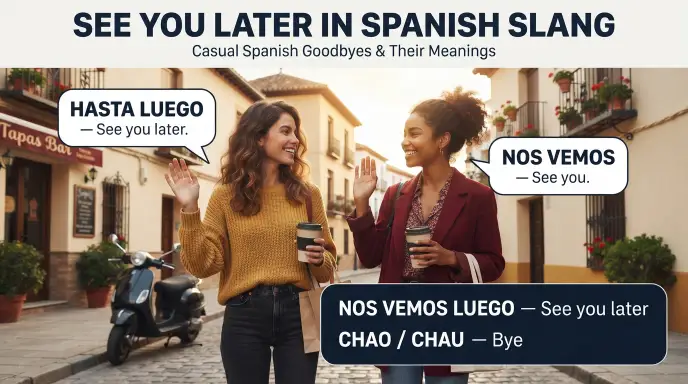
See you later in Spanish slang can be expressed in several casual ways, but “hasta luego” is the most direct everyday translation. “Nos vemos” is another very common informal option that usually means “see you” or “see you later.”
People often search for this phrase because Spanish has several ways to say goodbye, and they do not all carry exactly the same tone.
A phrase used with a close friend may sound different from one used with a coworker, teacher, or stranger.
Regional Spanish also matters. For example, chao is widely used as a casual goodbye, while chau is especially familiar in places such as Argentina and Uruguay. Other countries have their own playful or local expressions.
If you saw “see you later” translated into Spanish on TikTok, Instagram, Reddit, Discord, or in a text message, the context can help you understand which expression sounds most natural.
Quick Answer
The most direct casual translation of “see you later” is “hasta luego.” “Nos vemos” is also extremely common and usually means “see you,” with the exact sense understood from context.
What Does “See You Later” Mean in Spanish Slang?
When someone wants to say “see you later” casually in Spanish, “hasta luego” is usually the safest expression. It literally has the idea of “until later,” and it is widely used in everyday conversation.
“Nos vemos” is slightly different. Its literal sense is closer to “we’ll see each other,” but in everyday speech it naturally works as “see you” or “see you later.” SpanishDictionary lists it as a colloquial farewell.
This distinction is useful because “see you later” does not always have to be translated word for word.
For example:
Hasta luego.
See you later.
Nos vemos.
See you.
Nos vemos luego.
See you later.
All three can work in casual situations, but they are not identical in structure.
Is “See You Later” Actually Spanish Slang?
Strictly speaking, “hasta luego” and “nos vemos” are informal conversational expressions rather than slang in the strongest sense.
This is an important distinction for Spanish learners. Search engines may group everyday expressions under “Spanish slang,” but native speakers do not necessarily consider every casual goodbye to be slang.
For example, SpanishDictionary describes nos vemos as colloquial, while hasta luego is presented as a standard phrase meaning “see you later.”
Best Spanish Slang and Casual Expressions for “See You Later”
There is no single Spanish slang expression that works identically in every Spanish-speaking country. Here are the most useful choices.
| Spanish phrase | English meaning | Tone | Best use |
| Hasta luego | See you later | Casual, neutral | Everyday goodbye |
| Nos vemos | See you | Casual, friendly | Friends and everyday conversation |
| Nos vemos luego | See you later | Casual | Texting and conversation |
| Hasta pronto | See you soon | Friendly | When you expect to meet soon |
| Chao | Bye | Informal | Everyday casual goodbye |
| Chau | Bye | Informal | Common in parts of South America |
| Hasta mañana | See you tomorrow | Casual | When you know you’ll meet tomorrow |
| Nos vemos por ahí | See you around | Very casual | Friends and acquaintances |
The first four are broadly useful, while expressions such as “nos vemos por ahí” are more conversational and context-dependent. SpanishDictionary includes nos vemos por ahí among very informal farewell expressions.
How to Say “See You Later” in Spanish Texting
Spanish texting often uses short expressions, just like English texting.
A friend might simply write:
Nos vemos
This can mean “See you” or “See you later.”
Another natural message is:
Nos vemos luego.
This is particularly clear if you specifically want to communicate the idea of seeing the person later. SpanishDictionary lists nos vemos luego as “see you later.”
You may also see:
- Hasta luego
- Nos vemos
- Nos vemos luego
- Chao
- Chau
- Hasta pronto
- Hasta mañana
People may stretch letters or add emojis in casual chats:
Nos veeemooos 😂
That does not create a new slang meaning. It simply adds emotion or playfulness to the message.
How Do You Pronounce “See You Later” in Spanish?
Pronunciation can make a casual phrase sound much more natural.
Hasta luego
A simple English-friendly approximation is:
AH-stah LWEH-goh
The exact pronunciation varies somewhat by accent.
Nos vemos
A rough approximation is:
nohs VEH-mohs
The v sound in Spanish may not sound exactly like the English “v.”
Chao
This is pronounced approximately:
CHOW
It is easy for English speakers because it sounds very similar to “ciao.”
Learning the pronunciation is especially useful if you heard the expression in a TikTok, YouTube video, game chat, or real-life conversation rather than reading it.
Is It Rude, Offensive, or Neutral?
“Hasta luego,” “nos vemos,” and “nos vemos luego” are generally neutral or friendly. They are not offensive slang.
The emotional meaning can still change because of tone and context.
For example:
Nos vemos
can sound warm and friendly.
But:
Nos vemos.
said very abruptly after an argument could feel cold or dismissive.
The phrase itself is not insulting. The surrounding situation determines how it feels.
Where Is It Commonly Used?
These expressions are common in everyday Spanish communication, including:
- Face-to-face conversations
- Text messages
- Instagram DMs
- TikTok
- Snapchat
- Discord
- Online gaming
- School chats
- Casual workplace conversations
However, the expression should not automatically be called slang simply because it appears online. “Hasta luego” and “nos vemos” are established conversational Spanish.
Spanish-speaking regions also have their own preferences. Babbel notes, for example, that hasta luego is especially common in Spain, while chau is strongly associated with Argentina and Uruguay.
Regional Spanish Slang for “See You Later”
One of the biggest opportunities to make this topic more useful is understanding regional variation.
Mexico
Nos vemos is a very common informal goodbye in Mexico. Other friendly send-offs may also be used depending on the situation.
Spain
Hasta luego is especially common for casual goodbyes in Spain. It can be used even when “later” does not refer to a precise time.
Argentina and Uruguay
Chau is a very familiar informal goodbye in Argentina and Uruguay. You may also hear playful combinations such as “nos vemos, che” among friends.
Colombia
Some informal regional expressions are more playful. Babbel lists “nos pillamos” as Colombian slang for “see you around.”
Central America
Some playful expressions use wordplay, such as “ahí nos vidrios,” a humorous twist on “ahí nos vemos.” This is much more informal and should not be treated as universal Spanish.
This regional approach makes the phrase easier to understand because Spanish is not one uniform variety.
Which Spanish Expression Should You Use?
If you are learning Spanish and simply want to know which phrase to use, this quick guide helps.
Use “Hasta luego” when:
- You want the closest everyday translation of “see you later.”
- You are speaking to someone you do not know extremely well.
- You want something casual but widely understood.
- You are in Spain or another Spanish-speaking setting where it is familiar.
Use “Nos vemos” when:
- You are saying goodbye to a friend.
- You expect to see the person again.
- You want a short, natural goodbye.
- You are texting or chatting casually.
Use “Nos vemos luego” when:
- You specifically mean “see you later.”
- You are texting someone.
- You expect to see the person later the same day or afterward.
Use “Chao” or “Chau” when:
- You want a simple “bye.”
- The conversation is informal.
- You are comfortable with the regional usage.
Real-Life Examples of Usage
Friendly
¡Nos vemos, amigo!
See you, buddy!
This sounds relaxed and friendly.
Casual
Bueno, hasta luego.
Alright, see you later.
This works in ordinary conversation.
Warm
Hasta pronto, cuídate.
See you soon, take care.
This adds a caring tone.
Texting
Nos vemos luego
This is short and natural for a casual message.
Gaming or Social Media
Me tengo que ir, nos vemos luego.
I have to go, see you later.
This works well when leaving a game, Discord chat, or online group.
Regional / Playful
Nos vemos, che.
See you, mate.
This can have an Argentine or Uruguayan flavor because of che.
See You Later vs. See You vs. Bye in Spanish
These English expressions overlap in Spanish, but the Spanish choices can communicate slightly different ideas.
| English | Natural Spanish | Meaning/Tone |
| See you later | Hasta luego | Direct, casual |
| See you | Nos vemos | Friendly, casual |
| See you later | Nos vemos luego | Explicitly later |
| See you soon | Hasta pronto | Soon |
| See you tomorrow | Hasta mañana | Tomorrow |
| Bye | Chao / Chau | Informal |
| Goodbye | Adiós | General goodbye |
SpanishDictionary gives hasta luego as the direct translation of “see you later” and also lists nos vemos, chao, and chau for colloquial “see ya” usage.
Origin and Background of the Expressions
“Hasta luego” is built from hasta, meaning “until,” and luego, meaning “later.” The expression therefore carries the idea of meeting or speaking again later. SpanishDictionary also lists luego as meaning “later” and gives nos vemos luego as “see you later.”
“Nos vemos” comes from the verb ver, meaning “to see.” The phrase literally has the idea of “we see each other,” which explains why it works naturally as “see you.”
“Chao” has a different background. It comes from Italian ciao and is now widely used as an informal goodbye across much of the Spanish-speaking world. In places such as Argentina, chau is a common spelling.
When to Avoid Very Casual Spanish Goodbyes
Not every goodbye needs to be slangy.
Be more careful with highly regional expressions when:
- You are speaking in a formal business setting.
- You are writing an official email.
- You are talking to someone for the first time.
- You are speaking to an authority figure.
- You are unsure about a regional expression.
For most learners, “hasta luego” and “nos vemos” are safer starting points than highly regional slang.
Polite Alternatives to “See You Later”
If you want a friendly but broadly understandable expression, try:
- Hasta luego: See you later
- Hasta pronto: See you soon
- Nos vemos: See you
- Hasta mañana: See you tomorrow
- Cuídate: Take care
- Que tengas un buen día: Have a good day
- Hasta la próxima: Until next time
These expressions let you adjust the goodbye according to the situation. SpanishDictionary and Babbel both list several of these as common or informal farewell options.
Why People Use These Expressions
Short goodbyes are useful because they make conversations feel natural.
Instead of saying a long sentence every time they leave, Spanish speakers can simply say:
Nos vemos.
or:
Hasta luego.
These expressions also communicate more than the literal words. They can signal friendliness, familiarity, or the expectation that the two people will meet again.
In texting, their short length makes them especially convenient.
Impact of Using Spanish Slang in Communication
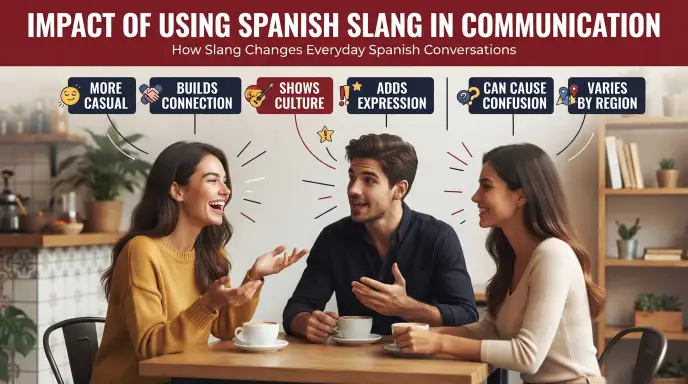
Using casual Spanish can make your messages sound more natural, but regional awareness matters.
A learner who uses nos vemos or hasta luego is unlikely to confuse most Spanish speakers. However, a highly regional slang expression may be unfamiliar outside its home region.
That is why learning standard conversational expressions first is useful. Once you understand the basics, regional expressions can add personality and cultural detail to your Spanish.
Is “See You Later” Spanish Slang Safe for Social Media?
Yes. “Hasta luego,” “nos vemos,” and “nos vemos luego” are safe for normal social media use.
They do not contain offensive, sexual, violent, or controversial meanings.
You can comfortably use them in:
- TikTok comments
- Instagram captions
- Snapchat
- Discord
- Gaming chats
- Text messages
Regional slang may require more cultural awareness, but ordinary goodbye expressions are generally safe.
FAQs
Q1. What is “see you later” in Spanish slang?
The most direct casual expression is “hasta luego.” “Nos vemos” is another very common informal way to say “see you.”
Q2. Is “nos vemos” the same as “see you later”?
Usually, yes in casual conversation. Literally, nos vemos means something like “we’ll see each other,” but it naturally functions as “see you.”
Q3. Is “hasta luego” formal or informal?
Hasta luego is generally conversational and informal or neutral. It is widely used in everyday Spanish.
Q4. What is the Spanish slang for “see you around”?
A common casual expression is “nos vemos por ahí,” meaning “see you around.” Some regions also have their own slang alternatives.
Q5. What does “chao” mean in Spanish?
Chao means “bye” and is an informal goodbye. It comes from Italian ciao and is widely used in Spanish-speaking communities.
Q6. Is “chau” different from “chao”?
They generally have the same meaning, but chau is especially familiar in countries such as Argentina and Uruguay.
Conclusion
See you later in Spanish slang can be expressed in several ways, but “hasta luego” is the clearest everyday choice.
“Nos vemos” is equally useful when you want a friendly, casual “see you,” while “nos vemos luego” makes the “later” meaning more explicit.
For regional flavor, expressions such as “chau,” “nos vemos, che,” or “nos pillamos” may appear depending on the country and community.
These should be understood as regional or informal expressions rather than universal Spanish slang.
The safest approach for learners is simple: use hasta luego when you mean “see you later,” and nos vemos when you want a natural casual “see you.”
Once you know the basic expressions, exploring regional Spanish can make your conversations sound even more authentic.
You May Also Like:
- Rash in Spanish Slang: Full Meaning Revealed
- Rico Meaning Slang: Full Definition, Examples & Usage Explained
- Snacks in Spanish Slang: Fun and Casual Terms to Know

Hi, I’m Rachel Simmons, a language writer specializing in American English and modern slang. I research regional expressions, everyday phrases, and evolving word meanings across the United States. I enjoy making complex language trends simple, practical, and easy for everyone to understand.