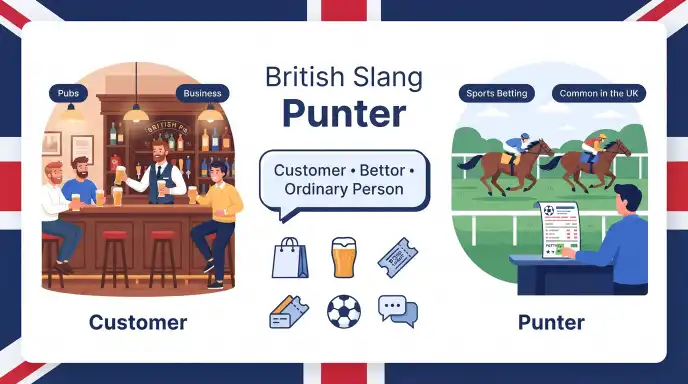
British slang punter means an ordinary customer, a person who places bets, or sometimes an average member of the public in the UK.
Many people search for this term after hearing it in British TV shows, football discussions, betting websites, or everyday conversations and wonder what it really means.
Unlike many modern internet slang terms, british slang punter has been part of British English for many years. Its meaning changes depending on the situation, which can confuse people who are unfamiliar with UK expressions.
In one conversation, it may refer to customers visiting a shop, while in another, it may describe someone placing a bet on a horse race or football match. Understanding the context helps you interpret the word correctly and use it naturally.
In this guide, you’ll learn the british slang punter meaning, where it came from, how British people use it in daily life, if it is rude or neutral, and real-life examples to help you understand the term with confidence.
Quick Answer
British slang punter is a neutral British expression that usually means a customer, bettor, or ordinary person. The exact meaning depends on the context, but it is commonly used in everyday conversations, businesses, and sports betting across the UK.
What Does British Slang Punter Mean in Text?
When someone uses british slang punter in a text or conversation, they are usually talking about a regular person rather than someone with a special role.
For example:
- “The pub was full of punters on Friday night.”
- “The shop gives discounts to loyal punters.”
In these examples, punter simply means customers or people using a service.
The exact meaning depends on the topic being discussed.
Punter as a Customer
This is one of the most common meanings in the UK.
Businesses often call their customers punters in casual conversations. You may hear restaurant owners, shop workers, taxi drivers, or market sellers use the word.
Example:
- “We’ve had lots of punters today.”
- “The café welcomes new punters every weekend.”
Here, punter means customer without sounding formal.
Punter as a Gambler
Another very common meaning appears in betting.
A punter is someone who places bets on sports, horse racing, or other gambling activities.
Examples:
- “Many punters backed the favorite horse.”
- “The punter won a large prize after the football match.”
This meaning is especially common during horse racing events and football betting in Britain.
Punter as an Ordinary Person
Sometimes British people use punter to mean an average member of the public.
Examples include:
- “The average punter probably won’t notice the difference.”
- “The new phone is affordable for most punters.”
In this context, the word refers to everyday people instead of experts or professionals.
British Slang Punter Full Form / Definition
Many people search for british slang punter full form or ask what does british slang punter stand for.
The answer is simple:
Punter does not have a full form. It is not an acronym or abbreviation.
Instead, it is a standalone British slang word that has developed different meanings over time.
Depending on the context, punter can mean:
| Situation | Meaning |
| Shopping | Customer |
| Business | Client |
| Gambling | Person placing bets |
| General conversation | Ordinary person or member of the public |
Because it has multiple meanings, listening to the rest of the sentence is the easiest way to understand which definition applies.
Is British Slang Punter Rude, Offensive, or Neutral?
The word punter is generally considered neutral.
Most British people use it in casual conversation without intending to insult anyone.
Usually Neutral
These situations sound completely normal:
- Talking about customers
- Talking about betting
- Referring to the general public
- Casual conversations with friends or coworkers
Example:
“We’re expecting more punters this afternoon.”
No one would normally find this offensive.
When It Can Sound Slightly Dismissive
Although punter is not an insult, the tone of voice can change how it feels.
For example:
“The average punter doesn’t understand the rules.”
Some people may feel this sounds slightly dismissive because it suggests ordinary people know less than experts.
However, the word itself is still not offensive. The speaker’s attitude creates the negative impression.
Overall, british slang punter remains one of the most accepted informal words in British English.
Where Is British Slang Punter Commonly Used?
Unlike many modern slang terms, punter is not mainly associated with TikTok or online gaming. Instead, it is deeply connected with everyday life in the United Kingdom.
People commonly hear it in:
- Shops and local businesses
- Restaurants and pubs
- Football discussions
- Horse racing
- Betting websites
- Sports commentary
- British television
- Newspapers
- Radio programs
- Casual conversations
In Business
Owners often refer to customers as punters.
Example:
“Our regular punters always come back.”
In Betting
Bookmakers and sports analysts frequently use the term.
Example:
“Thousands of punters placed bets before kickoff.”
In Everyday Conversation
Friends may casually use it when talking about ordinary people.
Example:
“Most punters won’t care about that small change.”
On Social Media
The word occasionally appears on:
- X (formerly Twitter)
- Reddit communities focused on UK culture
- Sports discussion forums
It is much less common on TikTok, Snapchat, or Discord than newer internet slang because it is a traditional British expression rather than a Gen Z abbreviation.
Why People Use British Slang Punter?
British speakers often choose punter because it sounds more relaxed and natural than formal words like customer, client, or consumer.
The word helps conversations feel friendly and conversational.
People also use it because it is:
- Short and easy to say
- Familiar across the UK
- Widely understood
- Suitable for many everyday situations
- Common in sports and betting culture
Using punter also creates a distinctly British tone that many native speakers recognize immediately.
Origin and Background of British Slang Punter
The history of british slang punter goes back hundreds of years. The word punter comes from the idea of making a punt, which originally meant placing a bet. Because of this, the term first became popular in British gambling, especially horse racing.
Over time, the meaning expanded beyond betting. Businesses, pubs, restaurants, and entertainment venues began using punter to describe their customers. Today, many British people also use it to mean an ordinary member of the public.
Unlike many modern slang words that started on social media, punter became part of everyday British English long before the internet existed. Its meaning has stayed largely the same, although the exact definition depends on the situation.
Today, you are most likely to hear punter in:
- Sports betting
- Horse racing
- Football discussions
- Shops and businesses
- British TV shows
- Everyday conversations
Because it has been used for generations, punter is one of the most recognizable informal words in British English.
Real-Life Examples of British Slang Punter
The meaning of punter changes slightly depending on the situation. Before using it, think about who you are talking about and what the conversation is about.
Friendly Tone
People often use punter in a light-hearted and friendly way when talking about customers or the general public.
Examples:
- “Our regular punters always stop by for coffee.”
- “The pub was packed with happy punters after the match.”
- “Local punters loved the new menu.”
Casual Conversation
Friends may use punter to describe ordinary people without sounding formal.
Examples:
- “Most punters won’t notice the difference.”
- “The average punter just wants a good deal.”
- “Every punter gets the same offer.”
Argumentative Tone
Although the word is usually neutral, it can sound slightly dismissive if someone uses it to suggest that ordinary people lack knowledge.
Examples:
- “The average punter doesn’t understand how the system works.”
- “Some punters complain about everything.”
- “Those punters expect too much.”
In these examples, the speaker’s tone not the word itself creates the negative feeling.
Sports and Betting Context
This is one of the most common uses of punter.
Examples:
- “Thousands of punters placed bets before the race.”
- “Experienced punters studied the odds carefully.”
- “Many punters celebrated after the final whistle.”
Business Context
Many business owners use punter instead of customer in informal conversations.
Examples:
- “We welcomed hundreds of punters this weekend.”
- “Our loyal punters support us every month.”
- “Happy punters often recommend the café to friends.”
British Slang Punter vs Similar Slang
Several British English words describe customers or ordinary people. However, each one has a slightly different meaning.
| Term | Meaning | Common Use | Tone |
| Punter | Customer, bettor, or ordinary person | Business, betting, everyday conversation | Neutral |
| Customer | Someone buying goods or services | Everywhere | Neutral |
| Client | Person receiving professional services | Business and legal settings | Formal |
| Consumer | Person purchasing products | Business, economics | Formal |
| Bettor | Person placing bets | Gambling | Neutral |
| Mate | Friend | Casual conversation | Friendly |
Among these words, punter has the strongest connection to British English and informal speech.
Why People Use British Slang Punter
British speakers continue using punter because it is familiar, flexible, and easy to understand.
Common reasons include:
- It sounds natural in British English.
- It feels less formal than customer.
- It works in several different situations.
- It is widely recognized across the UK.
- It creates a friendly conversational tone.
Businesses often prefer punter because it makes conversations sound relaxed without being disrespectful.
Sports commentators also use it because it quickly identifies people placing bets.
When Should You Avoid Using British Slang Punter?
Although punter is generally safe to use, there are situations where another word may be more appropriate.
Avoid using it when:
- Writing formal business reports.
- Preparing legal documents.
- Speaking with international audiences unfamiliar with British English.
- Writing academic papers.
- Communicating in highly professional settings.
In these situations, words such as customer, client, consumer, or member of the public are usually clearer.
You should also avoid assuming everyone understands the word. Outside the UK, many people may not recognize its meaning.
Polite Alternatives to British Slang Punter
Since punter is not offensive, you do not usually need to replace it. However, these alternatives may fit better in formal or international communication.
| Alternative | Best Used When |
| Customer | Retail and shopping |
| Client | Professional services |
| Consumer | Marketing and business reports |
| Visitor | Tourism and attractions |
| Guest | Hotels, restaurants, and events |
| Member of the public | News reports and official communication |
Choosing the right word depends on your audience and the level of formality.
Impact of Using British Slang Punter in Communication
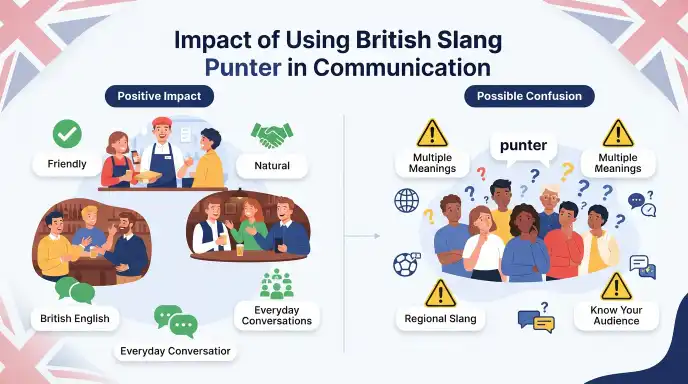
Like many regional slang terms, punter affects how people perceive your message.
Positive Impact
When used correctly, it can:
- Make conversations sound natural.
- Reflect authentic British English.
- Build a friendly tone.
- Create a sense of familiarity.
Possible Drawbacks
Using punter may also cause confusion because:
- Many people outside the UK have never heard it.
- It has more than one meaning.
- Some listeners may think it refers only to gambling.
For this reason, always consider your audience before using regional slang.
Is British Slang Punter Safe for Social Media?
Yes. British slang punter is generally safe to use on social media.
It is not considered offensive, hateful, or inappropriate under normal circumstances.
People may use it on platforms such as:
- X (formerly Twitter)
- Community forums
It appears less often on TikTok, Snapchat, Discord, or gaming chats because it is a traditional British expression rather than a modern internet slang term.
As with any slang, avoid using it in a way that insults or belittles others. Respectful communication is always the best choice.
Frequently Asked Questions
Q1. What does British slang punter mean?
British slang punter usually means a customer, a person placing a bet, or an ordinary member of the public. The exact meaning depends on the context of the conversation.
Q2. What does British slang punter stand for?
Punter does not stand for anything. It is not an acronym or abbreviation. It is a standalone British slang word that has been used for many years.
Q3. Is British slang punter offensive?
No. In most situations, british slang punter is a neutral and informal expression. It is commonly used in the UK to refer to customers or bettors. However, the speaker’s tone can make it sound slightly dismissive in some contexts.
Q4. Why do British people call customers punters?
Many British people use punter as an informal way to refer to customers. The word became popular through gambling and later expanded into everyday business and casual conversations.
Q5. Is punter only used for gambling?
No. Although punter originally became well known in betting and horse racing, it is now widely used to describe customers, clients, or ordinary people in many everyday situations across the UK.
Q6. Can I use British slang punter on social media?
Yes. British slang punter is generally safe to use on social media because it is not considered offensive. Just make sure your audience understands British English, as people outside the UK may not recognize the term.
Q7. Why do Brits call customers punters?
Brits often call customers punters as an informal and friendly way to refer to people buying goods or services. The term became popular through gambling and later spread to everyday business and hospitality.
Q8. What is a punter in a pub?
In a pub, a punter simply means a customer or patron enjoying food or drinks. Pub owners and staff commonly use the term in casual conversation.
Q9. What is a punter in Scottish slang?
In Scottish slang, punter usually has the same meaning as in the rest of the UK. It generally refers to a customer, an ordinary person, or someone placing a bet, depending on the context.
Q10. Is punter an insult?
No, punter is generally not an insult. It is a neutral British slang term, although it may sound slightly dismissive if used with a negative tone or in a critical context.
Conclusion
British slang punter is a versatile and well-established expression in British English. Depending on the context, it can refer to a customer, a person who places bets, or simply an ordinary member of the public.
Although the word has roots in gambling, modern British speakers use it in many everyday situations, from business conversations to casual chats.
Understanding the context is the key to using british slang punter correctly. In most cases, it has a neutral and friendly tone, making it suitable for informal conversations, sports discussions, and customer-related situations.
However, if you are writing for an international or professional audience, clearer alternatives such as customer, client, or consumer may be easier to understand.
If you heard the term in a British TV show, a football discussion, or a conversation about local businesses, you now know what british slang punter meaning slang refers to and how to use it naturally.
Knowing regional slang like this can help you better understand British culture and communicate more confidently with native speakers.
Explore More Articles:

Hi, I’m Tyler Brooks, a writer specializing in Gen Z culture and internet slang. I track trending terms across TikTok and social media to explain their real-world meanings. My goal is to provide clear, accurate, and up-to-date definitions that help readers understand modern online language.