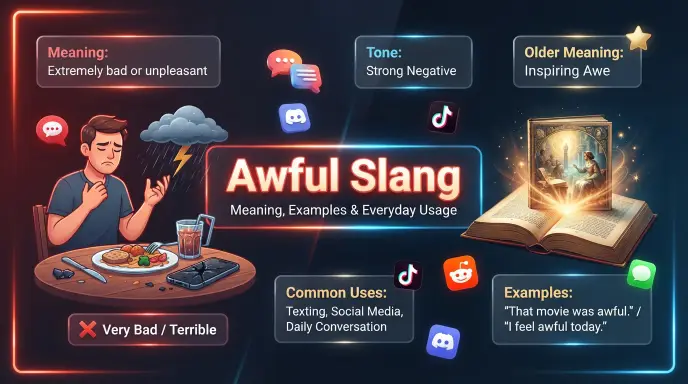
Awful slang usually refers to the informal use of the word “awful” to describe something that is very bad, unpleasant, embarrassing, or disappointing.
In some contexts, especially older English, awful could also mean very impressive or awe-inspiring, but that meaning is now much less common. Understanding the context is the key to knowing what someone means.
Many people search for awful slang after seeing the word in text messages, social media posts, movies, or everyday conversations.
Although awful is a standard English word rather than pure slang, people often use it informally with stronger emotion than in formal writing.
In this guide, you’ll learn what awful slang means, where people use it, if it is rude, how its meaning has changed over time, and how to use it correctly in real-life conversations.
Quick Answer:
Awful slang usually means extremely bad, unpleasant, or disappointing. It is commonly used in casual conversations, texting, social media, and everyday speech to express a strong negative opinion. Despite its name, awful is not offensive, but it can sound harsh depending on the situation.
What Does Awful Slang Mean?
In modern English, awful is an informal way to say that something is very bad or terrible. People use it to show disappointment, frustration, or dislike.
For example:
- “That movie was awful.”
- “The food tasted awful.”
- “I had an awful day at work.”
In each example, awful adds stronger emotion than simply saying “bad.”
Awful as an Intensifier
Sometimes people use awful before another word simply to make it stronger.
Examples include:
- “I’m awful tired.”
- “She’s awful quiet today.”
- “That was awful expensive.”
This use is mostly heard in some regional English dialects and is less common in modern standard English. In these cases, awful means very rather than terrible.
The Older Meaning of Awful
Historically, awful originally meant full of awe or inspiring wonder and respect.
For example:
- “The mountains were awful in their beauty.”
Today, this older meaning is rare outside literature, history, or religious writing. Most people now understand awful to mean something negative.
Meaning Comparison
| Context | Meaning | Example |
| Everyday conversation | Very bad or terrible | “The weather is awful.” |
| Informal speech | Very or extremely | “I’m awful busy today.” |
| Historical English | Inspiring awe or wonder | “An awful sight.” |
Different Meanings of Awful Slang
Although awful usually has one main meaning today, its use changes depending on the situation.
Meaning 1: Something Very Bad
This is the most common meaning.
People use awful when they strongly dislike something.
Examples:
- “That restaurant was awful.”
- “His excuse was awful.”
- “The service was awful.”
The tone is clearly negative.
Meaning 2: Describing an Unpleasant Experience
Sometimes awful describes how someone feels instead of describing an object.
Examples:
- “I feel awful today.”
- “She looked awful after the long trip.”
- “He felt awful about forgetting her birthday.”
Here, awful means feeling physically sick, emotionally guilty, or generally unhappy.
Meaning 3: Regional Meaning of “Very”
In certain dialects, especially older American and British English, awful can simply mean very.
Examples:
- “It’s awful cold outside.”
- “You’re awful kind.”
- “That was awful nice of you.”
This usage is becoming less common but still appears in some regions and among older speakers.
Where Is Awful Commonly Used?
The word awful appears in many everyday situations because it is easy to understand and expresses strong feelings.
People commonly use it in:
- Casual conversations
- Text messages
- Social media posts
- Online reviews
- School discussions
- Family conversations
- Workplace chats (informal)
- Movies and TV shows
Platform Usage
| Platform | Is “Awful” Common? | Typical Usage |
| Text Messages | ✅ Yes | Expressing disappointment |
| TikTok | ✅ Yes | Reacting to trends, food, or experiences |
| ✅ Yes | Comments and captions | |
| ✅ Yes | Sharing opinions and reviews | |
| Discord | ✅ Yes | Casual conversations |
| Workplace Chat | ⚠️ Sometimes | Informal discussions only |
Unlike many internet slang terms, awful is understood by people of all ages because it has been part of English for centuries.
Is Awful Rude, Offensive, or Harmless?
Awful is generally not considered offensive. However, it is a strong negative word.
If it sounds rude depends on what you are describing.
For example:
- Saying “The weather is awful” is completely normal.
- Saying “Your work is awful” may sound hurtful.
- Saying “You look awful” can easily offend someone unless you are expressing genuine concern.
When It Sounds Acceptable
You can safely use awful when talking about:
- Weather
- Traffic
- Movies
- Food
- Long delays
- Bad experiences
When You Should Be Careful
Avoid using awful when directly describing:
- Someone’s appearance
- A person’s abilities
- Sensitive personal situations
In these cases, softer words are usually more polite.
Real-Life Examples of Awful Slang
Seeing awful in real conversations makes its meaning much easier to understand.
Friendly Conversation
Alex: How was the concert?
Ben: Honestly, it was awful. The sound system kept cutting out.
Text Message
Emma: How was the exam?
Lily: Awful! I forgot half of what I studied.
Social Media
“That ending was awful. I expected so much more.”
Online Review
“The hotel looked nice online, but the rooms were awful.”
Family Conversation
Mom: How was your day?
Son: Pretty awful. I missed the bus and got caught in the rain.
Workplace Chat
Coworker: How’s the printer?
You: It’s awful today. It keeps jamming every few minutes.
These examples show that awful is mainly used to express disappointment, frustration, or dissatisfaction rather than anger.
Origin and History of Awful
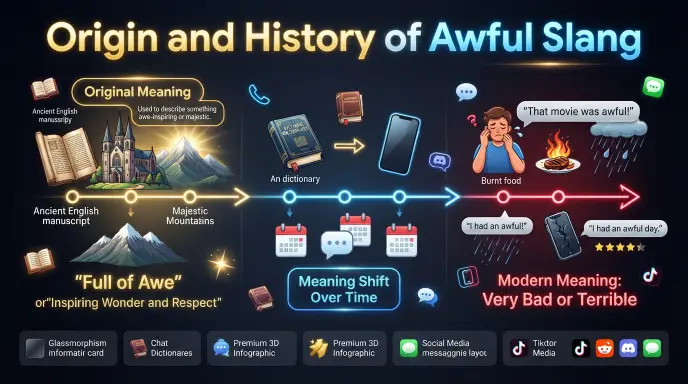
The word awful has a long history in the English language. It comes from the noun awe, which means a feeling of deep respect, wonder, or fear.
When the word first appeared several centuries ago, awful meant worthy of awe or inspiring great respect. In older books and religious writing, people used it to describe powerful natural events, important ceremonies, or divine authority.
Over time, the meaning gradually changed. By the 18th and 19th centuries, people increasingly used awful to describe something extremely unpleasant or terrible. Eventually, this newer meaning became the standard definition used in everyday English.
In some parts of the United States and the United Kingdom, awful also developed an informal meaning of very or extremely, as in “awful nice” or “awful cold.” This regional use still exists but is less common than it once was.
Today, when someone says something is awful, they almost always mean it is very bad, unless the surrounding context clearly suggests the older or regional meaning.
Similar Slang or Related Terms
Several words have a similar meaning to awful, but each has its own tone and level of intensity.
| Word | Meaning | Tone |
| Terrible | Extremely bad | Strong |
| Horrible | Very unpleasant | Strong |
| Bad | Not good | Neutral |
| Trash | Very poor quality (slang) | Informal |
| Garbage | Worthless or very bad (slang) | Informal |
| Sad | Boring or disappointing (slang) | Casual |
| Weak | Poor or unimpressive (slang) | Casual |
| Cringe | Embarrassing or awkward (internet slang) | Social media |
| Rough | Difficult or unpleasant | Informal |
| Miserable | Very unhappy or uncomfortable | Descriptive |
Choose the word that best matches the situation. For example, cringe is common online, while terrible is suitable in both speech and writing.
When Should You Avoid Using It?
Although awful is a common word, there are times when using it may sound too harsh.
In Professional Settings
Avoid saying things like:
- “Your presentation was awful.”
- “This report is awful.”
Instead, try giving constructive feedback such as:
- “I think this could be improved.”
- “There are a few areas that need revision.”
When Talking to Teachers or Parents
Using awful to describe a person can sound disrespectful.
For example:
- ❌ “My teacher is awful.”
- ✅ “I’m finding the class difficult.”
During Sensitive Conversations
If someone is upset or sharing a personal problem, softer language often shows more empathy.
Instead of saying:
- “That’s awful.”
You could also say:
- “I’m sorry that happened.”
- “That sounds really difficult.”
Polite Alternatives
If you want to sound more respectful or professional, consider these alternatives.
| Instead of “Awful” | Try Saying |
| Awful | Unpleasant |
| Awful | Poor |
| Awful | Unsatisfactory |
| Awful | Disappointing |
| Awful | Difficult |
| Awful | Not very good |
| Awful | Could be better |
| Awful | Below expectations |
These alternatives work well in emails, school assignments, workplace conversations, and formal discussions.
Why Do People Use Awful?
People use awful because it quickly communicates a strong negative opinion.
Common reasons include:
- To express disappointment.
- To describe a bad experience.
- To emphasize frustration.
- To react emotionally.
- To make conversations more expressive.
Compared with simply saying bad, the word awful carries more emotion and leaves little doubt about how the speaker feels.
Common Misunderstandings
People sometimes misunderstand the word awful because it has changed over time.
“Awful” Is Not Modern Internet Slang
Many people search for awful slang, but awful is actually a long-established English word. It becomes “slang-like” only because people often use it informally in everyday speech.
It Doesn’t Always Mean Someone Is Angry
A person can say:
“The movie was awful.”
This usually means they disliked the movie, not that they are angry.
The Older Meaning Is Rare
Some older books use awful to mean awe-inspiring or majestic.
Modern readers almost always understand awful as very bad, so context is important when reading historical texts.
Regional Usage Can Be Confusing
Expressions like:
- “Awful nice”
- “Awful good”
may sound strange to some people. In these regional dialects, awful simply means very rather than terrible.
Frequently Asked Questions
Q1. Is “awful” a slang word?
No. Awful is a standard English word, but people often use it informally in everyday conversation, which is why some refer to it as slang.
Q2. What does awful mean in texting?
In text messages, awful usually means very bad, terrible, or extremely unpleasant.
Q3. Is awful considered rude?
Not usually. However, calling someone’s work, appearance, or abilities awful can sound harsh or insulting.
Q4. Can I use awful at work?
Yes, but use it carefully. It is better to choose more professional words like poor, unsatisfactory, or needs improvement when giving feedback.
Q5. Why did awful change its meaning?
Originally, awful meant full of awe or inspiring wonder. Over many years, its meaning shifted to describe something extremely bad, which is now the standard usage.
Q6. Is awful used on social media?
Yes. People frequently use awful on platforms like TikTok, Instagram, Reddit, X, Facebook, and Discord to react to experiences, products, entertainment, or news.
Q7. Can awful mean “very”?
Yes. In some regional varieties of English, awful can mean very, as in “awful nice” or “awful cold.” This usage is less common today.
Q8. What does awful mean in slang?
In slang or casual speech, awful means extremely bad, terrible, or very unpleasant. People use it to express strong disappointment.
Q9. What does “bad” mean in Gen Z slang?
In Gen Z slang, bad can mean very attractive, impressive, or cool, depending on the context. It often has a positive meaning.
Q10. What can I say instead of “awful”?
You can say terrible, horrible, dreadful, poor, disappointing, or really bad, depending on the situation and tone.
Q11. What does I’m awful mean?
I’m awful usually means I feel very bad, either physically sick, emotionally upset, or guilty about something.
Q12. How do you say “bad” in slang?
Common slang words for bad include trash, garbage, weak, mid, sad, and cringe, depending on the context.
Q13. Is it awful or awfully?
Both are correct. Awful is an adjective (e.g., The movie was awful), while awfully is an adverb (e.g., I’m awfully sorry or It’s awfully cold).
Conclusion
Awful slang generally refers to the informal use of awful to describe something that is extremely bad, unpleasant, or disappointing.
While the word itself is not true internet slang, it is widely used in casual conversations, texting, social media, and everyday English to express strong negative feelings.
Context is the most important factor when interpreting awful. In modern English, it almost always means very bad, while older literature may use it to mean awe-inspiring, and some regional dialects use it to mean very.
Understanding these different meanings will help you recognize the word correctly and use it naturally in conversations.
Explore More Articles:

Hi, I’m Rachel Simmons, a language writer specializing in American English and modern slang. I research regional expressions, everyday phrases, and evolving word meanings across the United States. I enjoy making complex language trends simple, practical, and easy for everyone to understand.