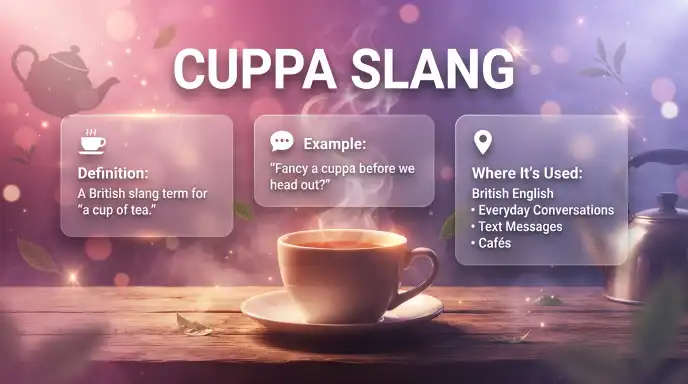
Cuppa slang is a British slang term that means “a cup of tea” and is commonly used in casual conversations to invite someone for tea or talk about having one. It comes from the spoken phrase “cup of” and has become one of the most recognizable expressions in British English.
You may hear it in everyday conversations, British TV shows, movies, books, or text messages. Many people search for cuppa slang after seeing phrases like “Fancy a cuppa?” and wonder if it has a special meaning or is simply another word for tea.
Understanding this expression helps you follow British conversations more naturally and appreciate the friendly, relaxed tone behind it. Although cuppa usually refers to tea, it can occasionally mean coffee depending on the context.
Quick Answer
Cuppa is British slang for “a cup of tea.” It is a friendly, informal expression used in everyday speech and text messages, and it can sometimes refer to coffee if the context makes that clear.
What Does Cuppa Mean in Text?
Basic Meaning
In text messages and everyday conversations, cuppa almost always means a cup of tea. It is a shortened way of saying “cup of,” most commonly referring to tea because tea is deeply connected with British culture.
For example:
- “I’m making a cuppa now.”
- “Fancy a cuppa after work?”
- “Let’s chat over a cuppa.”
In each example, the speaker is simply talking about having tea in a relaxed and friendly way.
What Does Cuppa Mean in Text Messages?
If someone texts you:
“Do you fancy a cuppa?”
They are asking:
“Would you like a cup of tea?”
It is not a hidden code, internet abbreviation, or secret slang. It simply makes the message sound warmer and more conversational.
You may also see messages like:
- “Need a cuppa after today!”
- “Just had my morning cuppa.”
- “Let’s grab a cuppa tomorrow.”
In these cases, cuppa keeps the conversation casual and friendly.
Can Cuppa Mean Coffee?
Yes, but only in certain situations.
Although tea is the usual meaning, cuppa can sometimes refer to coffee if everyone already knows the conversation is about coffee.
For example:
“I’m grabbing a cuppa before work.”
If the speaker normally drinks coffee every morning, they may be referring to coffee instead of tea.
Because of this, context is important. If there is no other clue, most people assume cuppa means tea.
Full Form / Definition of Cuppa
Does Cuppa Have a Full Form?
No. Cuppa does not have a full form like many online abbreviations.
Instead, it comes from combining two simple words:
- Cup
- Of
When spoken quickly, “cup of” naturally sounds like “cuppa.”
Over time, this pronunciation became a common word in British English.
Cuppa Meaning Slang
The slang meaning is straightforward:
| Word | Meaning |
| Cuppa | A cup of tea |
| Fancy a cuppa? | Would you like a cup of tea? |
| Having a cuppa | Drinking tea |
Unlike internet slang such as LOL or BRB, cuppa is part of everyday spoken English rather than online culture.
What Does Cuppa Stand For?
Some people search for “what does cuppa stand for” because many slang terms are acronyms.
However, cuppa does not stand for anything. It is simply an informal pronunciation of “cup of.”
That is why you will not find any official abbreviation or expanded version of the word.
Is Cuppa Rude, Offensive, or Neutral?
A Friendly Expression
Cuppa is completely neutral and polite.
People use it every day without worrying about offending anyone. It creates a welcoming and relaxed atmosphere, especially when inviting someone to sit down and chat.
For example:
“Come in and have a cuppa.”
This invitation sounds warm and friendly rather than formal.
Who Uses Cuppa?
People of all ages use this expression, including:
- Parents
- Grandparents
- Friends
- Neighbors
- Coworkers
- Café staff
Because it has been part of British English for generations, it is understood by nearly everyone in the UK.
Is It Appropriate Everywhere?
While cuppa is perfectly acceptable in casual conversations, it is less suitable in very formal situations.
For example, in a business report or academic paper, it is usually better to write:
- Cup of tea
- Tea
- Refreshment
These options sound more professional than the informal word cuppa.
Where Is Cuppa Commonly Used?
Countries Where You Will Hear It
The word cuppa is most commonly used in:
- England
- Scotland
- Wales
- Northern Ireland
- Australia
- New Zealand
People in other English-speaking countries also understand it because of British television, books, and movies.
Everyday Situations
You may hear cuppa in many everyday places, such as:
- Family homes
- Offices
- Cafés
- Tea breaks
- Friendly gatherings
- Visits with neighbors
Someone might say:
- “Let’s have a cuppa.”
- “I’ll make us a cuppa.”
- “Would you like a cuppa before you leave?”
These expressions are common and sound completely natural.
Is It Used on Social Media?
Unlike many slang words, cuppa is not strongly connected to TikTok, Discord, Reddit, Snapchat, or gaming communities.
However, people still use it on social media when talking about:
- Morning routines
- Relaxing after work
- Cozy evenings
- Rainy weather
- Reading books
- Weekend breaks
For example:
“Rain outside, blanket on, and a hot cuppa. Perfect evening!”
Why People Use Cuppa Slang
It Sounds More Natural
People use cuppa because it feels more relaxed than saying “cup of tea.” In everyday British English, shortening common phrases makes conversations sound friendly and informal.
For example:
Formal: “Would you like a cup of tea?”
Casual: “Fancy a cuppa?”
Both mean the same thing, but the second sounds much warmer.
It Reflects British Culture
Tea is more than just a drink in Britain. It is often associated with:
- Hospitality
- Relaxation
- Friendly conversations
- Taking a break
- Spending time with family
Because tea is such an important part of daily life, the word cuppa has become a natural part of everyday speech.
It Creates a Friendly Atmosphere
Offering someone a cuppa is often a way to make them feel welcome.
For example:
- Come in and have a cuppa.
- Let’s sit down for a cuppa.
- I’ll put the kettle on.
These expressions show kindness and friendliness rather than simply offering a drink.
Real-Life Examples of Cuppa Slang
Friendly Conversation
Emma: Fancy a cuppa?
Lily: Yes, please. I’d love one.
Casual Conversation
“I’m having a cuppa while watching my favorite show.”
Family Setting
“Dad always starts his morning with a hot cuppa.”
Workplace Conversation
“Let’s grab a cuppa before the meeting starts.”
Text Message
Alex: Fancy a cuppa later?
Sam: Sounds good. I’ll be there around four.
Social Media Post
“Nothing beats a warm cuppa on a rainy afternoon.”
Examples in Different Tones
Friendly Tone
“Come over for a cuppa whenever you’re free.”
This sounds welcoming and caring.
Casual Tone
“I’m just making a quick cuppa.”
This is a normal everyday statement.
Argumentative Tone
Unlike many slang words, cuppa is rarely used during arguments because it has a positive meaning.
However, someone might jokingly say:
“You need a cuppa and a break.”
This suggests the other person should calm down.
Social Media Context
“Finished work. Time for a cuppa and my favorite book.”
Posts like this often appear with photos of tea, blankets, or cozy evenings.
Workplace Context
“Anyone fancy a cuppa before we get started?”
This is a friendly way to invite coworkers for a tea break.
Origin and Background of Cuppa Slang
Where Did Cuppa Come From?
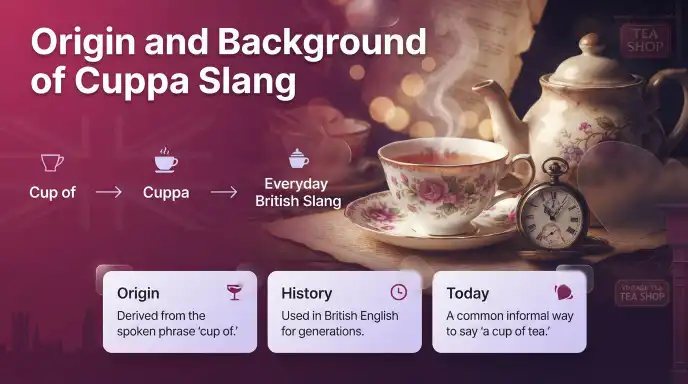
The word cuppa developed naturally from the spoken phrase “cup of.”
When people say “cup of tea” quickly, it often sounds like:
Cup of → Cuppa
Over time, this pronunciation became accepted as an informal word in British English.
A Long History
Unlike modern internet slang, cuppa is not a recent invention.
It has been used in Britain for many decades and has appeared in:
- Everyday conversations
- Television shows
- Radio programs
- Newspapers
- Books
Because tea has been an important part of British culture for centuries, the expression has remained popular across generations.
Why It Stayed Popular
Many slang words disappear after a few years, but cuppa has survived because it is:
- Easy to say
- Easy to understand
- Friendly
- Closely connected with everyday life
Today, it remains one of the best-known informal expressions in British English.
Comparison with Similar Slang
Similar Words and Their Meanings
| Slang Term | Meaning | Common Region | Tone |
| Cuppa | A cup of tea | United Kingdom | Friendly |
| Brew | Tea or coffee | UK | Casual |
| Tea | Tea drink or sometimes an evening meal | UK | Neutral |
| Coffee | Coffee drink | Worldwide | Neutral |
| Hot drink | Any warm beverage | Worldwide | Formal |
Cuppa vs Brew
Both words are common in Britain, but they are not always identical.
Cuppa
- Usually means tea.
- Often used when offering someone a drink.
- Sounds warm and welcoming.
Brew
- Can mean tea or coffee.
- Sometimes refers to the process of making the drink.
- Slightly more informal depending on the region.
Example:
- Fancy a cuppa?
- I’ll make us a brew.
Both are correct, but cuppa is more closely associated with tea.
Impact of Using Cuppa in Communication
Makes Conversations Feel Friendlier
Using cuppa can instantly make a conversation feel more relaxed.
Instead of sounding formal, it creates a sense of comfort and familiarity.
For example:
Instead of:
“Would you like a hot beverage?”
People naturally say:
Fancy a cuppa?
The second version feels much warmer.
Shows Cultural Understanding
If you are speaking with British friends or colleagues, using cuppa appropriately shows that you understand common British expressions.
However, it is important not to force the word into every conversation. Use it only when it feels natural.
Helps Build Casual Conversations
Many friendly conversations begin with tea.
Expressions like these are common:
- Let’s have a cuppa.
- Put the kettle on.
- I’ll make a cuppa.
These simple phrases often invite people to relax and spend time together.
When Should You Avoid Using Cuppa?
In Formal Writing
Although cuppa is a polite expression, it is still informal. It is better to avoid it in:
- Academic essays
- Research papers
- Business reports
- Legal documents
- Official emails
Instead, use phrases like:
- Cup of tea
- Tea
- Hot beverage
- Refreshment
These alternatives sound more professional.
With People Who May Not Know British English
Outside the UK, some people may not recognize the word cuppa.
If you are speaking with an international audience, saying “cup of tea” is usually clearer.
In Professional Presentations
If you’re giving a formal presentation or writing workplace documents, avoid overly casual language.
For example:
❌ “Let’s stop for a cuppa.”
✅ “Let’s take a short tea break.”
This keeps your communication professional while still being friendly.
Polite Alternatives to Cuppa
Formal Alternatives
If you want a more neutral or professional expression, you can use:
- Cup of tea
- Tea
- Hot drink
- Refreshment
- Beverage
Casual Alternatives
If you’re speaking informally, these expressions also work well:
- Brew
- Tea
- Coffee (when appropriate)
- Hot drink
Choose the expression that best fits your audience and situation.
Is Cuppa Safe for Social Media?
Yes, It Is Completely Safe
Cuppa is a harmless and family-friendly word. It contains no offensive language and is suitable for all ages.
You can comfortably use it on:
- X (Twitter)
- Snapchat
- Text messages
- Online forums
Common Social Media Examples
People often use cuppa in posts about:
- Morning routines
- Rainy weather
- Relaxing evenings
- Reading books
- Weekend breaks
- Working from home
Example posts:
- Starting the day with a hot cuppa.
- Rain outside, cuppa in hand. Perfect!
- Nothing beats a cuppa after a long day.
Because the word has a positive meaning, it is widely accepted across social media platforms.
Common Mistakes About Cuppa
Thinking It Is an Acronym
Many people search for “cuppa full form” because they assume it is an abbreviation.
In reality, cuppa is not an acronym. It is simply a spoken form of “cup of.”
Believing It Always Means Coffee
While cuppa can sometimes refer to coffee, the default meaning is almost always tea, especially in British English.
Assuming It Is Modern Internet Slang
Unlike terms such as LOL, BRB, or POV, cuppa is not internet slang.
It has been used in everyday British speech for many decades.
Thinking It Is Rude
Some learners worry that informal words may sound impolite.
Fortunately, cuppa is considered friendly, polite, and welcoming.
Frequently Asked Questions
Q1. What does cuppa mean in British slang?
Cuppa is British slang for a cup of tea. It is an informal and friendly expression commonly used in everyday conversations.
Q2. What does cuppa stand for?
It does not stand for anything. Cuppa comes from the spoken phrase “cup of,” especially in the expression “cup of tea.”
Q3. Does cuppa always mean tea?
Usually, yes. However, in some conversations it can refer to coffee if the context clearly indicates that.
Q4. Is cuppa rude or offensive?
No. Cuppa is a polite, neutral, and friendly expression that is suitable for casual conversations.
Q5. Can I use cuppa in text messages?
Yes. It is commonly used in texts, chats, and social media when talking about tea or inviting someone for a drink.
Q6. Is cuppa only used in the United Kingdom?
It is most common in the UK, but many people in Australia, New Zealand, and other English-speaking countries also use or understand it.
Q7. What does “tea” mean in Gen Z slang?
In Gen Z slang, “tea” means gossip, news, or juicy information, not the drink. For example, “Spill the tea” means “Tell me the gossip.”
Q8. What does “wanna cuppa?” mean?
“Wanna cuppa?” is a casual British way of asking, “Do you want a cup of tea?” It is a friendly invitation used in everyday conversation.
Q9. What is meant by cuppa?
Cuppa means a cup of tea in British slang. It comes from the spoken phrase “cup of” and is commonly used in informal conversations.
Q10. What does “hot cuppa” mean?
A hot cuppa simply means a hot cup of tea. People often use the phrase when talking about relaxing or warming up with a freshly made drink.
Conclusion
Cuppa slang is a simple but meaningful part of British English that usually refers to a cup of tea. It comes from the everyday pronunciation of “cup of” and has been used for generations in casual conversations. The word is friendly, polite, and closely linked with British hospitality and tea culture.
If you hear someone say, “Fancy a cuppa?” or see the word in a text message, it simply invites a relaxed moment over a hot drink.
Understanding the cuppa slang meaning, its origin, and the right context to use it will help you communicate more naturally and appreciate one of the most recognizable expressions in British English.
Read More:

Hi, I’m Tyler Brooks, a writer specializing in Gen Z culture and internet slang. I track trending terms across TikTok and social media to explain their real-world meanings. My goal is to provide clear, accurate, and up-to-date definitions that help readers understand modern online language.