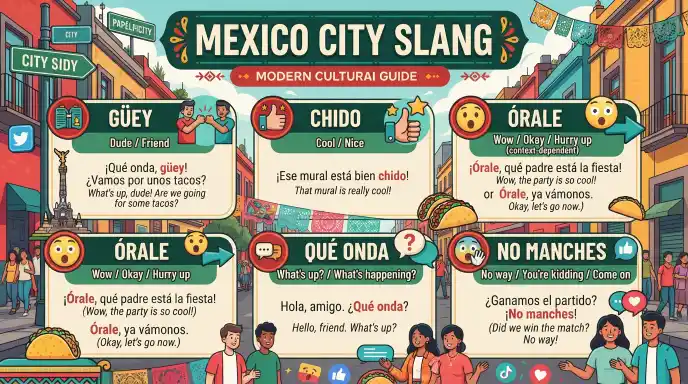
Mexico City slang refers to the informal words, phrases, and expressions commonly used by people in Mexico City (CDMX).Common words are Chilango, Chido and Guey.
It blends standard Spanish with local vocabulary, humor, and cultural influences, making everyday conversations sound more natural and authentic.
Many people search for Mexico City slang before traveling to the city, talking with native speakers, watching Mexican TV shows, or understanding social media content. While some expressions are understood across Mexico, others are closely connected to life in the capital.
In this guide, you’ll learn what Mexico City slang means, where it comes from, which expressions locals use most often, and when you should or should not use them.
Quick Answer: Mexico City Slang
Mexico City slang is a collection of informal Spanish words and phrases used by people in Mexico City. It reflects the city’s culture, humor, and everyday life. Many expressions are friendly and casual, but some are regional or depend on the situation, so understanding the context is important.
What Does Mexico City Slang Mean?
Mexico City slang means the everyday informal language spoken by many residents of Ciudad de México (CDMX). It includes nicknames, shortened words, playful expressions, and phrases that may not appear in formal Spanish textbooks.
Unlike standard Spanish, local slang often changes with age, neighborhood, and social groups. Younger people may introduce new words through social media, while older expressions continue to be heard in markets, schools, workplaces, and family gatherings.
People use Mexico City slang to:
- Sound friendly and relaxed.
- Show local identity.
- Add humor to conversations.
- Express emotions more naturally.
- Connect with friends and family.
Although many terms are understood across Mexico, some expressions are especially popular in Mexico City and may sound unfamiliar in other Spanish-speaking countries.
Full Form or Complete Meaning
Mexico City slang is not an abbreviation or acronym, so it does not have a full form.
Instead, the phrase describes the collection of informal words and expressions commonly used in Mexico City’s daily conversations.
Different Meanings of Mexico City Slang
Local Everyday Language
The most common meaning refers to casual words that locals use when talking with friends, classmates, coworkers, or family members.
These expressions help conversations feel natural rather than formal.
Example:
“If you want to sound more like a local in CDMX, learning a few Mexico City slang words can help.”
Cultural Identity
Mexico City slang also represents local culture and identity.
Certain expressions reflect the city’s history, humor, traditions, and way of speaking. Using them correctly shows familiarity with everyday life in the capital.
Modern Youth Expressions
Young people in Mexico City regularly create or popularize new slang through social media, music, and online communities.
Some expressions become popular across Mexico, while others remain closely associated with Mexico City.
Where Is Mexico City Slang Commonly Used?
Mexico City slang appears in many everyday situations. The exact words often change depending on who is speaking and where the conversation takes place.
| Place or Situation | How Slang Is Used |
| Everyday conversations | Friends use casual expressions instead of formal Spanish. |
| Schools and universities | Students often speak using modern local slang. |
| Family gatherings | Informal phrases are common among relatives. |
| Cafés and restaurants | Casual conversations frequently include local expressions. |
| Social media | Users post memes, jokes, and captions using Mexico City slang. |
| Text messages | Friends often shorten words and use informal phrases. |
| Online videos | Local creators use slang to sound authentic. |
| Music and entertainment | Songs, comedy, and films often include popular local expressions. |
Common Mexico City Slang Words and Their Meanings
Chilango
Meaning: A person from Mexico City.
Although the word was once used negatively by some people outside the city, many residents now proudly use it to describe themselves.
Example:
“Soy chilango y crecí en la Ciudad de México.”
Chido
Meaning: Cool, great, or awesome.
This is one of the best-known Mexican slang words and is heard frequently in Mexico City.
Example:
“¡Qué chido estuvo el concierto!”
English:
“The concert was really cool!”
Güey (Wey)
Meaning: Dude, bro, mate, or guy.
Friends often use this word casually. Depending on tone, it can also express surprise or frustration.
Example:
“¿Qué pasó, güey?”
English:
“What’s up, dude?”
Órale
Meaning: Come on, let’s go, wow, okay, or I understand.
Its meaning changes depending on the speaker’s tone and the situation.
Example:
“¡Órale! Ya es hora de salir.”
English:
“Come on! It’s time to leave.”
Neta
Meaning: Really? Seriously? The truth.
People use neta to ask if something is true or to emphasize honesty.
Example:
“¿Neta?”
English:
“Really?”
No manches
Meaning: No way! You’re kidding!
This is one of the most common informal expressions in Mexico City.
It usually shows surprise, disbelief, or amazement.
Example:
“¡No manches! Ganaste la lotería.”
English:
“No way! You won the lottery.”
Lana
Meaning: Money.
Instead of saying the standard Spanish word dinero, many locals casually say lana.
Example:
“No tengo lana ahorita.”
English:
“I don’t have any money right now.”
Carnal
Meaning: Close friend, brother, or buddy.
People use this word to show friendship and trust.
Example:
“Gracias, carnal.”
English:
“Thanks, buddy.”
Chamba
Meaning: Job or work.
Many people across Mexico use chamba, but it is especially common in everyday conversations.
Example:
“Tengo mucha chamba hoy.”
English:
“I have a lot of work today.”
Aguas
Meaning: Watch out! Be careful!
This expression warns someone about possible danger or a problem nearby.
Example:
“¡Aguas! El piso está mojado.”
English:
“Watch out! The floor is wet.”
Origin and History of Mexico City Slang
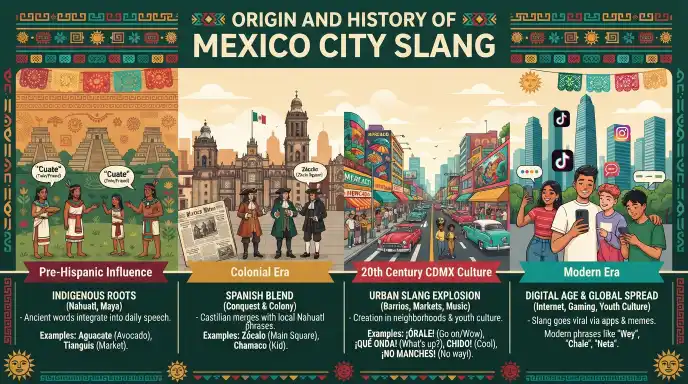
Mexico City slang has developed over hundreds of years. It combines Spanish with words influenced by Nahuatl, the language spoken by the Aztecs, as well as expressions brought by different communities that have lived in or moved to the capital.
Unlike internet slang that can appear overnight, many Mexico City expressions have been passed down through generations. At the same time, new slang continues to emerge through music, comedy, television, and social media.
Some slang words become popular across all of Mexico, while others remain closely connected to life in Ciudad de México (CDMX).
Why It Keeps Changing
Mexico City is one of the largest cities in the world. Millions of people from different regions live there, bringing their own accents and vocabulary.
As cultures mix, the local slang also evolves. Younger generations often create new expressions, while older favorites remain part of everyday speech.
Although some terms become less common over time, classics like güey, chido, neta, and órale continue to be widely used.
Why Do People Use Mexico City Slang?
People use Mexico City slang because it makes conversations feel more natural and friendly.
Some expressions also help speakers show their personality or local identity.
Common reasons include:
- Sounding relaxed in casual conversations.
- Expressing emotions quickly.
- Adding humor.
- Connecting with friends and family.
- Showing they are familiar with local culture.
- Making conversations feel less formal.
Is Mexico City Slang Rude, Offensive, or Harmless?
Most Mexico City slang is harmless when used with friends or people you know well.
However, context matters. Some words can sound disrespectful if used with strangers, older people, teachers, customers, or during professional conversations.
| Expression | Usually Safe? | Notes |
| Chido | ✅ Yes | Friendly and positive. |
| Órale | ✅ Yes | Common in many situations. |
| Neta | ✅ Yes | Informal but generally polite. |
| Güey | ⚠ Depends | Fine with friends but avoid in formal settings. |
| No manches | ✅ Usually | Informal; avoid in professional writing. |
| Carnal | ⚠ Depends | Best used with close friends. |
Can You Use It at Work?
Use standard Spanish in workplaces unless your coworkers already speak casually with each other.
In meetings, emails, customer service, or interviews, formal language is usually the better choice.
Real-Life Examples of Mexico City Slang
Friends
Carlos: “¿Qué onda, güey?”
Luis: “Todo chido.”
English
Carlos: “What’s up, dude?”
Luis: “Everything’s good.”
School
Ana: “¿Neta terminaste toda la tarea?”
Sofía: “Sí, ayer en la noche.”
English
Ana: “Really? You finished all the homework?”
Sofía: “Yes, last night.”
Text Message
Friend 1:
“¿Tienes lana para el cine?”
Friend 2:
“Sí, vamos.”
English
“Do you have money for the movies?”
“Yes, let’s go.”
Family
Dad: “¡Aguas! Está caliente.”
Child: “Gracias.”
English
“Watch out! It’s hot.”
“Thanks.”
Social Media Caption
“Fin de semana bien chido con los amigos.”
English
“Had a really cool weekend with friends.”
Mexico City Slang Across Different Platforms
| Platform | How It’s Commonly Used |
| Text Messages | Short, casual conversations with friends. |
| Everyday chats with family and friends. | |
| Funny captions and comments. | |
| TikTok | Comedy videos, trends, and storytelling. |
| Casual posts and conversations. | |
| YouTube | Vlogs and entertainment content from Mexican creators. |
| Discussions about Mexican culture and language. |
The same slang may appear differently depending on the audience. For example, people often use more casual expressions in WhatsApp chats than in workplace messages.
Similar Slang or Related Terms
| Word | Meaning | Similar To |
| Chido | Cool | Awesome |
| Güey | Dude | Bro |
| Neta | Really | Seriously |
| Órale | Come on / Okay | Let’s go |
| Carnal | Buddy | Best friend |
| Chamba | Job | Work |
| Lana | Money | Cash |
| Aguas | Watch out | Be careful |
Common Misunderstandings About Mexico City Slang
All Mexican Spanish Is the Same
This is not true.
Many slang words used in Mexico City are understood nationwide, but every Mexican state has its own regional expressions and pronunciation.
Every Slang Word Is Appropriate Everywhere
Some expressions are perfect for conversations with friends but may sound too casual in schools, workplaces, or official situations.
Always consider your audience before using slang.
Slang Never Changes
New expressions appear regularly, especially through music, online creators, and younger generations.
At the same time, many classic Mexico City slang words have remained popular for decades.
When Should You Avoid Using Mexico City Slang?
There are situations where formal Spanish is a better choice.
Avoid Mexico City slang when:
- Speaking during a job interview.
- Writing business emails.
- Talking to customers professionally.
- Giving a formal presentation.
- Completing school assignments unless discussing slang.
- Speaking with someone who may not understand regional expressions.
Using standard Spanish in these situations helps you communicate more clearly and professionally.
Polite Alternatives to Mexico City Slang
| Instead of | You Can Say | Better For |
| Güey | Amigo, Señor, Señora | Formal conversations |
| Chido | Excelente, Muy bueno | Business or school |
| No manches | No lo puedo creer | Professional settings |
| Lana | Dinero | Formal writing |
| Carnal | Amigo | Speaking politely |
These alternatives are easier for Spanish learners and are appropriate in almost every situation.
Frequently Asked Questions
Q1. What is Mexico City slang?
Mexico City slang is the collection of informal Spanish words and expressions commonly used by people in Ciudad de México (CDMX). These phrases make conversations sound more natural, friendly, and local.
Q2. Is Mexico City slang different from standard Spanish?
Yes. Standard Spanish follows formal grammar and vocabulary, while Mexico City slang includes casual words, local expressions, and cultural references that are mainly used in everyday conversations.
Q3. Is Mexico City slang used throughout Mexico?
Some Mexico City slang is understood across Mexico, but not every region uses the same expressions. Different states have their own local slang and pronunciation.
Q4. Is Mexico City slang rude?
Most Mexico City slang is harmless when used with friends and family. However, some expressions, such as güey, may sound disrespectful if used with strangers, older adults, or in professional settings.
Q5. Can tourists use Mexico City slang?
Yes. Learning a few common expressions can help tourists communicate more naturally with locals. However, it is best to understand the meaning and context before using unfamiliar slang.
Q6. What are the most common Mexico City slang words?
Some of the best-known expressions include:
- Güey: Dude or buddy
- Chido: Cool or awesome
- Órale: Come on, okay, or wow
- Neta: Really or the truth
- Lana: Money
- No manches: No way!
- Carnal: Close friend
- Chamba: Job or work
- Aguas: Watch out
Q7. Is Mexico City slang popular on social media?
Yes. Mexico City slang appears frequently on TikTok, Instagram, YouTube, Facebook, and WhatsApp, especially in videos, memes, captions, and casual conversations.
Q8. Can I use Mexico City slang at work?
Usually, no. Formal Spanish is a better choice for workplaces, business emails, customer service, and job interviews. Slang is best reserved for informal conversations with people you know well.
Q9. Why does Mexico City have its own slang?
Mexico City is one of the largest and most diverse cities in Latin America. Its slang has developed through a mix of regional cultures, historical influences, and modern trends in music, television, and social media.
Q10. Is Mexico City slang still changing?
Yes. Like most slang, it continues to evolve. New expressions become popular through younger generations, online communities, music, and entertainment, while many classic terms remain widely used.
Q11. What is common Mexican slang?
Common Mexican slang includes words like “órale” (wow/okay), “chido” (cool), “güey” (dude/friend), and “qué onda” (what’s up). These words are widely used in casual conversations in Mexico.
Q12. What is cool in Mexican slang?
In Mexican slang, “chido” and “padre” are common ways to say something is cool, awesome, or great. For example, “Está chido” means “It’s cool.”
Q13. What is slang for Mexican people?
Common slang terms for Mexican people include “mexas” (casual term for Mexicans) and “chilangos” (people from Mexico City). Some terms may be friendly or offensive depending on context and tone.
Conclusion
Mexico City slang is an important part of everyday communication in Ciudad de México. It includes friendly, informal expressions that reflect the city’s culture, humor, and identity.
Learning these words can help you better understand local conversations, movies, music, and social media.
The key to using Mexico City slang correctly is understanding the context. Many expressions are perfect for talking with friends, while others should be avoided in formal situations such as work, school, or business communication.
By learning when and how these words are used, you can communicate more naturally and appreciate the richness of Mexican Spanish.
Discover More Articles:

Hi, I’m Rachel Simmons, a language writer specializing in American English and modern slang. I research regional expressions, everyday phrases, and evolving word meanings across the United States. I enjoy making complex language trends simple, practical, and easy for everyone to understand.