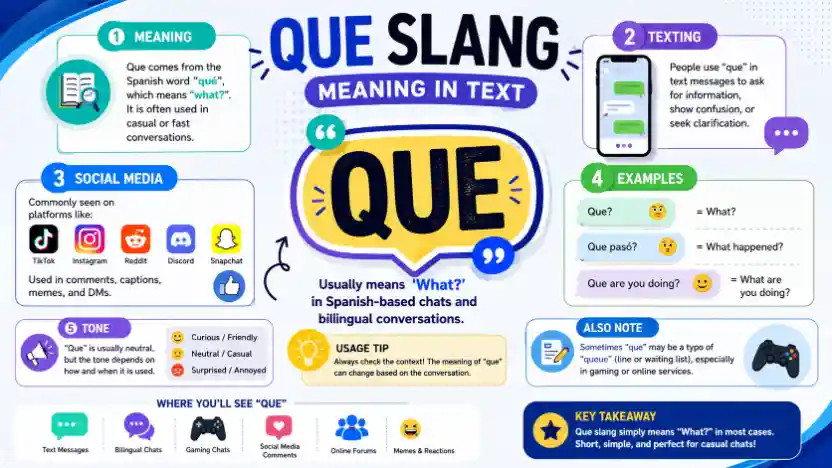
Que slang means “what?” and is commonly used as a casual expression in texting, online chats, and Spanish-influenced conversations.
People search for que slang meaning because they often see “que” in messages, comments, gaming chats, and social media posts but are unsure if it is slang, an abbreviation, or a different word.
In most cases, que slang comes from the Spanish word qué, which means “what.” Online users often remove accent marks and write “que” because digital conversations are usually quick and informal.
The term may also appear in different contexts, such as gaming, bilingual chats, or casual social media conversations.
Understanding the context is important because the meaning of “que” can change depending on the speaker, platform, and surrounding words.
Quick Answer:
Que slang means “what?” in most text conversations, especially when it comes from the Spanish word “qué.” It is usually neutral and its meaning depends on the context where it is used.
What Does Que Slang Mean in Text?
Common Meaning of Que in Online Conversations
The most common meaning of que slang comes from the Spanish word qué, which translates to “what” in English. When people type quickly online, they often remove accent marks and write “que” instead of “qué.”
For example:
- “Que?” = “What?”
- “Que pasó?” = “What happened?”
- “Que haces?” = “What are you doing?”
This usage is especially common among Spanish speakers, bilingual users, and people who mix Spanish and English while chatting.
Why People Write Que Instead of Qué
In informal digital communication, many users do not type accent marks because:
- They want to type faster.
- Their keyboard may not easily support accents.
- Online conversations usually ignore strict grammar rules.
- Slang often develops through casual writing habits.
Because of this, “que” is frequently seen without the accent symbol in texts, comments, and social media posts.
Que Slang Full Form and Definition
Does Que Have a Full Form in Texting?
Unlike abbreviations such as “LOL” or “BRB,” que slang does not have an official full form.
The term is usually a word rather than an acronym. The meaning depends on how it is being used.
Common interpretations include:
| Term | Meaning | Usage |
| Que | What? | Spanish conversations and casual chats |
| Qué | What? | Correct Spanish spelling |
| Queue (sometimes written incorrectly as que) | Waiting line | Gaming and online services |
What Does Que Stand For?
When people ask “what does que stand for?”, they are usually looking for the meaning behind the word in a message.
In most cases:
- Que = What?
- Qué = What? (Spanish word)
However, if “que” appears in a different sentence, the meaning may be different. Always look at the complete conversation before deciding what it means.
Is Que Slang Rude, Offensive, or Neutral?
Is Que Considered a Bad Word?
No, que slang is generally neutral. It is not considered offensive, harmful, or inappropriate.
Most people use it simply to ask a question or show confusion.
Example:
Person 1: I have something surprising to tell you.
Person 2: Que?
Here, “que?” simply means “What?”
When Can Que Sound Rude?
Although the word itself is not rude, tone can change how it feels.
A short reply like:
“Que?”
may sound impatient or annoyed depending on the conversation.
Similar English examples include:
- “What?”
- “Huh?”
- “Excuse me?”
These words are not automatically rude, but the tone behind them matters.
Neutral vs Negative Use
| Use | Example | Tone |
| Asking for information | “Que happened?” | Neutral |
| Showing surprise | “Que? Really?” | Curious |
| Showing frustration | “Que? Again?” | Could sound rude |
Where Is Que Slang Commonly Used?
Que Slang in Text Messages
Texting is one of the most common places where people use “que.”
Friends and family members often use short words because texting is fast and informal.
Examples:
- “Que are you doing?”
- “Que? I didn’t understand.”
In casual conversations, people may mix languages naturally without thinking about grammar rules.
Que Slang on Social Media
Platforms like TikTok, Instagram, Snapchat, and Reddit contain many examples of language mixing.
Users may use “que” because of:
- Spanish influence
- Cultural expressions
- Online trends
- Short comment styles
For example, someone might comment:
“Que cute!”
This mixes Spanish and English to express a reaction.
Que Slang in Gaming Communities
Gaming communities often have players from different countries. Because of this, words from different languages appear in chats.
However, gamers should be careful because “que” can sometimes be confused with queue.
Example:
“I am in the que.”
In a gaming context, this may mean:
“I am waiting in the queue.”
Here, it is likely a spelling mistake rather than slang.
Real-Life Examples of Que Slang Usage
Friendly Examples of Que Slang
In friendly conversations, que slang is often used as a quick reaction or a way to ask someone to explain something.
Example 1:
Friend 1: I just bought something amazing.
Friend 2: Que? Show me!
Meaning:
“What? Show me!”
Here, “que” creates a casual and curious tone.
Example 2:
“Queee , I cannot believe that happened.”
The extended spelling “queee” adds emotion and shows surprise. People often stretch words online to make their reactions feel stronger.
Casual Conversation Examples
Many people use “que” in everyday chats when speaking with friends or people who understand the language mix.
Example:
“Que are you doing today?”
Meaning:
“What are you doing today?”
This type of usage is common in bilingual conversations where people naturally combine Spanish and English.
Another example:
“Que happened last night?”
Meaning:
“What happened last night?”
Although this is informal, the meaning is usually clear from the conversation.
Argumentative or Emotional Examples
The tone of que slang can change during disagreements.
Example:
“Que? You think that is true?”
In this situation, “que?” may show disbelief or frustration.
Another example:
“Que are you talking about?”
This may sound more direct because the speaker is questioning someone’s statement.
The word itself is not aggressive, but the surrounding words and tone decide how it sounds.
Gaming and Social Media Examples
Online communities often create their own language styles. In gaming chats or social media comments, “que” may appear in different ways.
Example:
“Que? That was the best match ever!”
Meaning:
“What? That was the best match ever!”
Another gaming example:
“I am waiting in the que.”
Here, the user may mean “queue,” which refers to waiting for a game, match, or activity.
This shows why context matters when understanding online slang.
Origin and Background of Que Slang
Spanish Language Influence
The main origin of que slang meaning comes from the Spanish word qué, which means “what.”
Spanish is one of the most widely spoken languages in the world, and many Spanish words have become common in online conversations.
As people communicate across cultures, language naturally changes. Online users often borrow words from other languages and adapt them into casual slang.
How Que Became Common Online
The internet has made language faster and more flexible. People often remove:
- Accent marks
- Capital letters
- Extra punctuation
- Formal grammar rules
Because of this, “qué” often becomes “que” in online messages.
For example:
Correct Spanish:
¿Qué haces?
Casual online version:
Que haces?
Both communicate the same idea, but the second version is more common in quick typing.
Influence of Social Media Culture
Social media platforms have helped spread words across different communities.
People on platforms like:
- TikTok
- Snapchat
- Discord
often mix languages, create jokes, and develop new expressions.
This makes words like “que” easier to recognize outside traditional language groups.
Comparison of Que Slang With Similar Terms
Que vs What
| Term | Meaning | Usage |
| Que | What? | Spanish influence and bilingual chats |
| What | Asking for information | Standard English |
Example:
“Que happened?”
and
“What happened?”
Both ask for information, but “que” has a cultural or language-mixing connection.
Que vs Huh
| Term | Meaning | Tone |
| Que? | What? | Casual or bilingual |
| Huh? | What? / Confusion | Informal English reaction |
Example:
“Que? I didn’t hear you.”
is similar to:
“Huh? I didn’t hear you.”
Que vs WTF
| Term | Meaning | Tone |
| Que? | What? | Usually neutral |
| WTF | Strong surprise or confusion | More intense |
“Que?” is generally safer and less emotional than stronger internet reactions.
When to Avoid Using Que Slang
Professional Communication
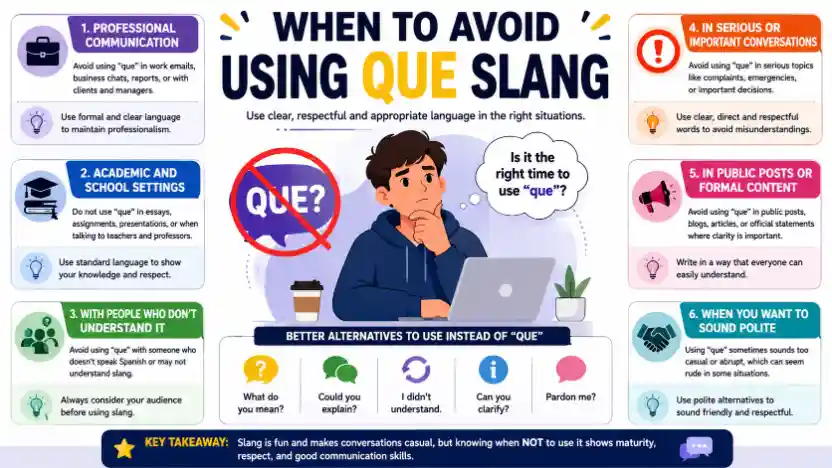
Although que slang is harmless, it is better to avoid it in formal situations.
Examples where you should use standard language:
- Work emails
- School assignments
- Business messages
- Official documents
Instead of:
“Que?”
Write:
“Could you please explain?”
This sounds clearer and more professional.
When Speaking With Unfamiliar People
Not everyone understands language-based slang.
Using “que” with someone unfamiliar with Spanish may create confusion.
For example:
“Que are you saying?”
A person may not know if it is a typo or intentional slang.
In Important Conversations
For serious topics, clear language is better.
Avoid slang when discussing:
- Important decisions
- Instructions
- Complaints
- Formal requests
Clear communication reduces misunderstandings.
Polite Alternatives to Que Slang
Alternatives for “What?”
If you want to sound more polite, use:
- Could you repeat that?
- What do you mean?
- Can you explain?
- I did not understand.
Alternatives for Confusion
Instead of:
“Que?”
You can say:
- I’m confused.
- Could you clarify?
- Can you explain that again?
Alternatives for Surprise
Instead of:
“Que? Really?”
You can use:
- Really?
- Is that true?
- Are you serious?
These options work better in professional or unfamiliar situations.
Why People Use Que Slang
It Makes Conversations Faster
Online communication is often quick. Short words help people respond faster.
Typing:
“Que?”
takes less effort than:
“What do you mean?”
It Shows Cultural Connection
For Spanish speakers and bilingual users, using “que” can represent their language and identity.
It allows people to communicate naturally without translating every word.
It Creates a Casual Tone
Slang makes conversations feel relaxed.
Friends often use informal words because they make chats feel more personal and comfortable.
Impact of Using Que Slang in Communication
Positive Effects
Using slang like “que” can:
- Make conversations more natural
- Build connections between people
- Show cultural awareness
- Create a friendly online style
Slang is an important part of how languages evolve.
Possible Problems
However, slang can sometimes create confusion.
Possible issues include:
- Different meanings in different communities
- Misunderstanding between languages
- Problems in formal communication
Good communication requires knowing when slang fits and when it does not.
Is Que Slang Safe for Social Media?
Is Que Slang Appropriate for Online Platforms?
Yes, que slang is generally safe for social media platforms. It does not usually contain harmful, offensive, or inappropriate meanings.
People commonly use it in casual spaces such as:
- TikTok comments
- Instagram captions
- Snapchat chats
- Reddit discussions
- Discord conversations
- Text messages
However, users should always consider the audience and situation before using slang.
For example:
A message to a close friend:
“Que? Tell me more.”
sounds casual and friendly.
A message to a teacher or employer:
“Que?”
may appear unclear or too informal.
Understanding Context on Social Media
Social media brings together people from different cultures and languages. Because of this, a word like “que” may be understood differently by different users.
Before interpreting the meaning, consider:
- Who wrote the message?
- What language does the person usually use?
- What words appear before and after “que”?
- Which platform is it used on?
Context helps avoid incorrect assumptions about slang.
Common Misunderstandings About Que Slang
Confusing Que With Queue
One common misunderstanding is mixing up que and queue.
A queue means:
- A waiting line
- A list of people or things waiting for a turn
Example:
“I am in the queue for the game.”
Some users write:
“I am in the que.”
This is usually a spelling mistake, not a slang meaning.
Thinking Que Always Means the Same Thing
Another mistake is assuming “que” has only one meaning.
While the most common meaning is “what?” from Spanish, it can change depending on the situation.
For example:
- Spanish conversation → “what?”
- Gaming context → possibly “queue”
- Personal shorthand → another meaning
Always check the full sentence.
Why Understanding Que Slang Matters
Helps With Online Communication
Internet conversations move quickly, and new expressions appear every day. Understanding terms like que slang helps users communicate more effectively.
It can help:
- Students understand online discussions
- Parents understand digital conversations
- Writers follow internet language trends
- Social media users avoid confusion
Shows Language Evolution
Slang shows how languages change over time.
Words move between:
- Countries
- Cultures
- Online communities
A term that starts in one language may become common in another environment.
Que is an example of how digital communication allows languages to mix naturally.
Frequently Asked Questions
Q1. What does que slang mean in text?
Que slang usually means “what?” when used in Spanish-based texting or bilingual online conversations. The exact meaning depends on the context.
Q2. Is que a slang word?
Que is not originally an English slang word. It mainly comes from the Spanish word “qué,” meaning “what,” but it is often used casually online.
Q3. What does que stand for in texting?
Que does not have an official texting full form. In most cases, it means “what?” or is a shortened spelling of another word depending on the situation.
Q4. Is que slang rude?
No, que slang is usually neutral. However, a short “que?” can sound impatient depending on the tone and conversation.
Q5. Where is que slang used?
Que slang is commonly seen in texting, bilingual conversations, TikTok, Instagram, Discord, Reddit, and other online communities.
Q6. Should I use que slang in formal writing?
No. It is better to use standard words in professional emails, academic writing, and official communication.
Conclusion
Que slang meaning in text depends on the context where the word appears. In most online conversations, “que” comes from the Spanish word qué, which means “what.” It is commonly used in casual chats, bilingual conversations, and social media interactions.
The term is usually neutral and not offensive, but its meaning can change depending on the platform and surrounding words. In some cases, people may also use “que” when they mean “queue,” especially in gaming conversations.
Understanding slang is important because online language changes quickly. Knowing how and when to use terms like que slang helps people communicate more clearly and avoid misunderstandings.
For casual conversations with friends, “que” can be a simple and natural expression. However, in professional or formal situations, clearer language is always the better choice.
Discover More Articles:

Hi, I’m Tyler Brooks, a writer specializing in Gen Z culture and internet slang. I track trending terms across TikTok and social media to explain their real-world meanings. My goal is to provide clear, accurate, and up-to-date definitions that help readers understand modern online language.