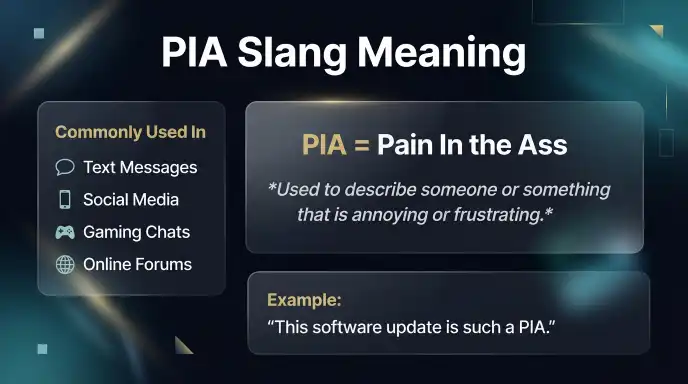
PIA slang meaning usually stands for “Pain In the Ass.” People use it to describe someone or something that is annoying, difficult, or frustrating.
It is a casual slang abbreviation often seen in text messages, online chats, emails, gaming communities, and social media.
Many people search for pia slang meaning after seeing “PIA” in a message, comment, or online discussion. While it most commonly means “Pain In the Ass,” the abbreviation can have other meanings depending on the situation.
In this guide, you’ll learn what PIA means, where people use it, if it is rude, and how to understand it correctly in different conversations.
Quick Answer: PIA Slang Meaning
PIA slang meaning is “Pain In the Ass.” It is an informal abbreviation used to describe a person, task, or situation that is irritating, inconvenient, or hard to deal with. Because it contains mild profanity, it is best used only in casual conversations with people who are comfortable with slang.
What Does PIA Slang Meaning Mean?
The most common PIA slang meaning is “Pain In the Ass.”
People use it when they feel that something is causing trouble or taking more effort than expected. It often expresses frustration, but it is usually not meant as a serious insult.
- This software update is a real PIA.
- Getting a parking spot here is such a PIA.
- The paperwork was a PIA to finish.
For example:
In each example, PIA means that the task or situation is annoying rather than impossible.
What Feeling Does PIA Express?
PIA often shows emotions like:
- Annoyance
- Frustration
- Mild anger
- Impatience
- Disappointment
The tone depends on the conversation. Sometimes it is playful, while other times it reflects genuine frustration.
Full Form of PIA
The most widely accepted full form is:
| Abbreviation | Full Form | Common Use |
| PIA | Pain In the Ass | Internet slang, texting, casual conversations |
Outside slang, PIA can also stand for different organizations or technical terms. For example:
| PIA | Meaning | Context |
| Pakistan International Airlines | National airline | Travel |
| Privacy Impact Assessment | Data privacy | Business and government |
| Public Information Act | Legal term | Law |
| Pain In the Ass | Slang | Informal conversations |
Always read the surrounding conversation before deciding which meaning is correct.
Different Meanings of PIA
Because PIA is an abbreviation, it does not always mean the same thing. Context is very important.
PIA as “Pain In the Ass”
This is the most common slang meaning.
It describes something that is difficult, irritating, or inconvenient.
Example:
Fixing that printer was a total PIA.
PIA as an Organization or Official Term
Sometimes PIA refers to a company, government process, or legal document instead of slang.
For example:
- Pakistan International Airlines
- Privacy Impact Assessment
- Public Information Act
If the conversation is about travel, privacy, business, or law, the abbreviation is probably not slang.
How to Identify the Correct Meaning
Ask yourself:
- Is the conversation casual or professional?
- Are people talking about a frustrating situation?
- Is the topic related to travel, privacy, or government?
These clues usually make the intended meaning clear.
Where Is PIA Commonly Used?
People mainly use PIA in informal communication.
| Platform or Situation | Is PIA Common? | Notes |
| Text messages | ✅ Yes | Very common among friends |
| Social media | ✅ Yes | Used in comments and posts |
| Online forums | ✅ Yes | Common in discussions |
| Gaming chats | ✅ Yes | Used when something is frustrating |
| Workplace chat | ⚠️ Sometimes | Best avoided in formal conversations |
| School assignments | ❌ No | Too informal |
| Professional emails | ❌ No | Not appropriate |
Text Messages
Friends often shorten “Pain In the Ass” to PIA to save time.
Example:
Traffic was a PIA today.
Social Media
On platforms like TikTok, Reddit, Facebook, and X, people use PIA when sharing everyday frustrations.
Example:
Customer service was a real PIA.
Gaming Communities
Gamers sometimes use PIA to describe:
- Difficult missions
- Game bugs
- Challenging levels
- Complicated settings
Example:
That final boss is a PIA to beat.
Workplace Chats
Some coworkers who know each other well may use PIA in private chats. However, because it comes from a mildly offensive phrase, it is generally better to choose a more professional word in work-related communication.
Is PIA Rude, Offensive, or Harmless?
PIA is mildly rude because it is short for “Pain In the Ass.” While many people use it casually, it still comes from a phrase that contains profanity. If it sounds offensive depends on your audience and the situation.
With Friends
Using PIA among close friends is usually acceptable if everyone is comfortable with informal language.
Example:
Homework was a real PIA last night.
At Work
Avoid using PIA in professional emails, reports, or messages to managers and clients. Even though it is abbreviated, many people know what it stands for.
Instead, say:
- Annoying
- Inconvenient
- Challenging
- Difficult
- Time-consuming
With Teachers or Parents
It is better not to use PIA with teachers or in schoolwork. Some parents may also consider it disrespectful because it represents a swear word.
Real-Life Examples of PIA Slang Meaning
Here are some natural examples of how people use PIA in everyday conversations.
Friendly Conversation
Emma: How was moving to your new apartment?
Jake: It was a real PIA, but everything is finally unpacked.
Text Message
Alex: Did you finish renewing your license?
Sam: Yes, but the online forms were such a PIA.
Gaming Chat
Player 1: Did you beat the final mission?
Player 2: Yeah, but that last level was a PIA.
Workplace Chat
Coworker 1: How’s the new software?
Coworker 2: It’s a bit of a PIA to learn, but I’m getting used to it.
Family Conversation
Dad: Was fixing the washing machine easy?
Son: Not really. It turned into a PIA.
Origin and History of PIA
The abbreviation PIA developed from the longer expression “Pain In the Ass.” People began shortening the phrase in letters, emails, and online messages to type faster while still expressing frustration.
The exact first use of the abbreviation is unclear. However, it became more common as internet forums, email, text messaging, and workplace communication grew in popularity.
Unlike newer slang that started on platforms like TikTok or Discord, PIA has been used for many years and is widely recognized by adults as well as younger internet users.
Is PIA Still Popular?
Yes, but its popularity is fairly steady rather than trendy.
It is not a viral Gen Z expression. Instead, it remains a common abbreviation that many English speakers understand in casual conversations.
Similar Slang and Related Terms
If someone uses PIA, they may also use these expressions.
| Slang | Meaning | Tone |
| Pain in the neck | Annoying person or problem | Polite |
| Pain in the butt | Softer version of PIA | Mild |
| Hassle | Something inconvenient | Neutral |
| Headache | A difficult problem | Neutral |
| Nuisance | Something irritating | Formal |
| Bother | Minor annoyance | Polite |
PIA vs. Pain in the Neck
Both describe something annoying.
The difference is that pain in the neck is more polite and suitable for a wider audience.
PIA vs. Pain in the Butt
These have almost the same meaning.
However, pain in the butt sounds less offensive because it avoids stronger language.
When Should You Avoid Using It?
Although PIA is common slang, there are situations where using it is not a good idea.
Professional Emails
Avoid writing:
The new system is a PIA.
Instead write:
The new system is difficult to use.
Job Interviews
Using slang during interviews can appear unprofessional.
Choose clear and respectful language instead.
Academic Writing
Do not use PIA in essays, reports, research papers, or assignments.
Formal writing should avoid slang abbreviations.
Speaking to Someone You Don’t Know Well
Some people may not recognize the abbreviation, while others may dislike its connection to profanity.
When in doubt, use a more neutral expression.
Polite Alternatives to PIA
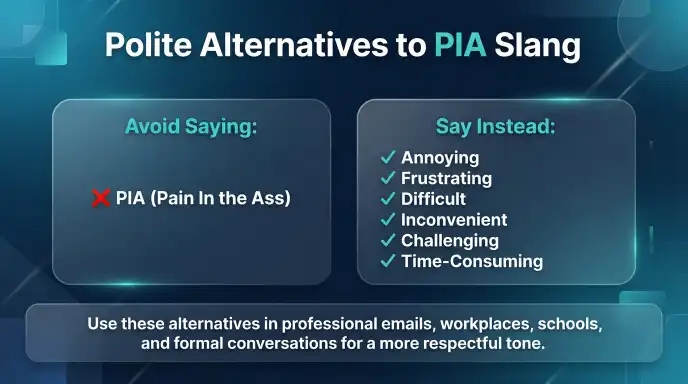
If you want to express frustration without using slang, try these alternatives.
| Instead of PIA | Better Alternative |
| PIA | Annoying |
| PIA | Frustrating |
| PIA | Difficult |
| PIA | Complicated |
| PIA | Inconvenient |
| PIA | Time-consuming |
| PIA | Challenging |
These alternatives work well in schools, workplaces, and professional communication.
Why Do People Use PIA?
People use PIA because it quickly communicates frustration without writing the full phrase.
Common reasons include:
- Saving time while typing.
- Expressing mild annoyance.
- Making conversations sound casual.
- Sharing everyday frustrations with friends.
- Avoiding typing the complete phrase.
Since many internet users already know the abbreviation, it is easy to understand in informal conversations.
Common Misunderstandings
One common mistake is thinking PIA always means “Pain In the Ass.”
In reality, it has several meanings depending on the context.
For example:
- In travel, PIA often refers to Pakistan International Airlines.
- In privacy and cybersecurity, it may mean Privacy Impact Assessment.
- In casual texting, it usually means Pain In the Ass.
Always look at the topic of the conversation before deciding which meaning is intended.
Frequently Asked Questions
Q1. What does PIA mean in slang?
PIA usually means “Pain In the Ass.” It describes a person, task, or situation that is annoying, frustrating, or difficult to deal with.
Q2. Is PIA a bad word?
Not exactly. PIA is an abbreviation, but it stands for a phrase containing mild profanity. It is acceptable in many casual conversations but should be avoided in formal or professional settings.
Q3. What does PIA mean in texting?
In texting, PIA almost always means “Pain In the Ass.” People use it to complain about something inconvenient or irritating.
Q4. Is PIA used on social media?
Yes. You may see PIA on platforms like Reddit, Facebook, X, or in online chats. It is less common on TikTok than newer Gen Z slang but is still widely understood.
Q5. Can I use PIA at work?
It is better not to. Even though it is abbreviated, many people know what it stands for. Use words like annoying, challenging, or inconvenient in professional communication.
Q6. Does PIA always mean “Pain In the Ass”?
No. While that is the most common slang meaning, PIA can also stand for terms such as Pakistan International Airlines or Privacy Impact Assessment. The correct meaning depends on the context.
Q7. Who commonly uses PIA?
Adults and younger internet users both use PIA in casual conversations, text messages, gaming chats, online forums, and social media when talking about something frustrating.
Q8. Is PIA appropriate for children?
Because PIA comes from a mildly offensive phrase, it is generally better for children to use more polite alternatives such as annoying or difficult.
Q9. Does PIA mean love?
No. In slang, PIA usually means “Pain In the Ass,” not love. However, Pia is also a personal name that can have meanings related to love or devotion in some languages.
Q10. Is Pia a nickname?
Yes. Pia is commonly used as a given name or nickname in many countries. It is separate from the slang abbreviation PIA and has a completely different meaning.
Conclusion
PIA slang meaning most commonly stands for “Pain In the Ass,” an informal abbreviation used to describe something that is annoying, frustrating, or inconvenient. It is widely used in text messages, online chats, gaming communities, and casual conversations.
Although PIA is easy to recognize, remember that it can have other meanings in travel, business, or legal contexts. Always consider the surrounding conversation before deciding what it means.
If you’re communicating in a professional, academic, or formal setting, choose a more polite alternative to avoid misunderstandings.
Read More Articles:

Hi, I’m Rachel Simmons, a language writer specializing in American English and modern slang. I research regional expressions, everyday phrases, and evolving word meanings across the United States. I enjoy making complex language trends simple, practical, and easy for everyone to understand.