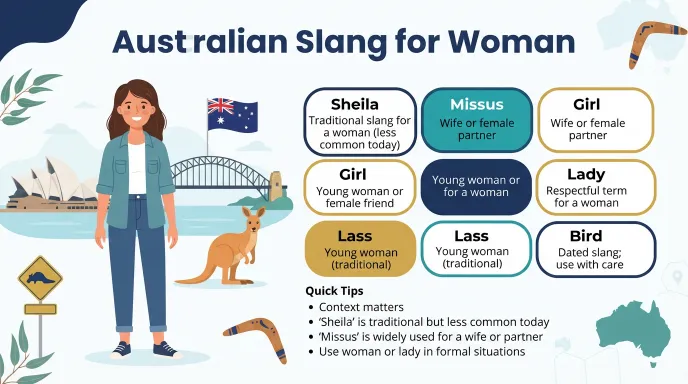
Australian slang for woman includes informal words Australians use to refer to women or girls in everyday conversation.
Some terms are friendly and respectful, while others can sound old-fashioned, humorous, or even offensive depending on the situation and tone.
Many people search for Australian slang for women because they hear these words in Australian TV shows, movies, social media, travel conversations, or while visiting Australia.
Since Australian English has many unique expressions, it can be difficult to know which ones are friendly and which should be avoided.
In this guide, you’ll learn the most common Australian slang words for women, what they mean, when Australians use them, if they’re polite, and real-life examples.
You’ll also discover which expressions are becoming less common and which ones are still widely used today.
Quick Answer: Australian Slang for Woman
Australian slang for woman includes informal terms like sheila, missus, bird, girl, lass, and lady in casual conversation. Among these, sheila is the best-known Australian slang word, although many younger Australians use it less often than previous generations.
What Does Australian Slang for Woman Mean?
Australian slang for woman refers to casual, everyday words people use instead of saying woman, lady, girl, or female.
Aussie slang for women can vary by:
- Age
- Region
- Situation
- Tone of voice
- Relationship between speakers
The Aussie girl meaning usually refers to the casual way Australians may describe a girl or young woman. Some slang sounds friendly, while others may seem disrespectful if used with. strangers or in professional settings.
For example:
- “She’s a great sheila.”
- “The missus is picking me up.”
- “That girl works at the café.”
Although all describe a woman, they carry different meanings and levels of formality.
Most Common Australian Slang Words for Woman
Below are some of the best-known expressions used in Australia. These are some of the most common examples of Australian slang for girl and woman.
| Slang | Meaning | Tone | Common Today? |
| Sheila | Woman or girl | Friendly, traditional | Sometimes |
| Missus | Wife or female partner | Casual | Very common |
| Bird | Woman | Informal, dated | Less common |
| Lass | Young woman or girl | Friendly | Occasionally |
| Girl | Female friend or young woman | Casual | Very common |
| Lady | Woman (respectful) | Polite | Very common |
Which Australian Slang Words Are Still Common?
Not every famous Australian slang word is used equally today.
| Expression | Popularity Today | Notes |
| Sheila | Moderate | Mostly older generations and media |
| Missus | High | Very common in everyday speech |
| Bird | Low | Sounds dated to many people |
| Lass | Moderate | Traditional but still understood |
| Girl | Very High | Common in everyday conversation |
| Lady | Very High | Polite and suitable almost everywhere |
Many visitors expect Australians to say sheila all the time because of movies and travel advertisements. In reality, modern Australians often use more everyday words like woman, girl, mate, or simply a person’s name instead.
When Do Australians Use These Words?
The right slang depends on the situation.
| Situation | Common Choice |
| Talking about your wife | My missus |
| Referring to a female friend | Girl |
| Traditional Aussie storytelling | Sheila |
| Speaking politely | Lady |
| Casual conversation | Girl or woman |
| Professional workplace | Woman or lady |
Choosing the right word helps your conversation sound natural and respectful. Some expressions that were popular decades ago, such as sheila or bird, are now heard less often among younger Australians, while Missus is a well-known example of Australian slang for wife or a long-term female partner.
Is Australian Slang for Woman Rude, Offensive, or Harmless?
Most Australian slang for woman is harmless when used in the right context. However, the meaning often depends on the speaker, the relationship, and the tone of voice.
Some words are friendly among friends or family but may sound disrespectful if used with strangers or in formal settings.
| Term | Usually Harmless? | Best Used With | Avoid In |
| Sheila | Yes | Casual conversations, storytelling | Formal workplaces |
| Missus | Yes | Wife or partner | Referring to someone else’s partner without knowing them |
| Bird | Sometimes | Older informal speech | Professional settings or with strangers |
| Girl | Usually | Friends or young women | Formal business situations when referring to adult women |
| Lady | Yes | Almost anywhere | Rarely inappropriate |
A Note on “Sheila”
Although sheila is one of the most famous Australian slang words, many younger Australians don’t use it regularly. It is still understood across Australia, but it can sound old-fashioned rather than trendy.
A Note on “Bird”
The word bird deserves extra care. Some people use it casually without intending any offense, but many women consider it outdated or disrespectful. If you’re unsure, it’s better to choose woman, lady, or the person’s name.
Where Is Australian Slang for Woman Commonly Used?
These expressions appear in different places depending on the audience.
| Place | Common? | Examples |
| Everyday conversations | Yes | Talking with friends and family |
| Australian TV and movies | Very common | Characters using traditional Aussie slang |
| Sports conversations | Sometimes | Casual chats between friends |
| Pubs and cafés | Yes | Relaxed conversations |
| Social media | Occasionally | Humorous Australian content |
| Workplace | Rarely | Usually “woman,” “colleague,” or the person’s name |
Unlike internet slang, these words are not common abbreviations used in texting or gaming. They belong to spoken Australian English more than online culture.
Real-Life Examples of Australian Slang for Woman
Here are some natural examples of how Australians may use these words.
Friends Talking
Tom: “Who’s that sheila talking to Jack?”
Ben: “She’s his cousin.”
Talking About a Partner
“I’m taking the missus away for the weekend.”
Family Conversation
“The girls are coming over for dinner tonight.”
At a Café
“That lady at the counter was really helpful.”
Storytelling
“My grandfather always called every woman a sheila.”
This kind of sentence reflects how older generations often spoke.
Social Media
“Taking the missus on a road trip around Australia.”
Origin and History Australian Slangs for Woman
Where Did “Sheila” Come From?
The exact origin of sheila is not completely certain.
Most language experts agree that it became popular in Australia during the late 1800s and early 1900s as an informal word for a woman. One common explanation is that it developed from the popular Irish female name Sheila, which itself comes from the Irish name Síle.
Over time, Australians began using the name as a general term for women rather than referring to someone actually named Sheila.
Because historical records are limited, linguists cannot say with complete certainty exactly how this change happened.
How Usage Has Changed
Today’s Australian English has changed a lot.
Older Australians may naturally say:
- “sheila”
- “bloke”
- “fair dinkum”
Younger Australians often prefer simpler words such as:
- woman
- girl
- mate
- partner
This doesn’t mean sheila has disappeared it simply isn’t as common as many visitors expect.
Similar Australian Slang Terms for Woman
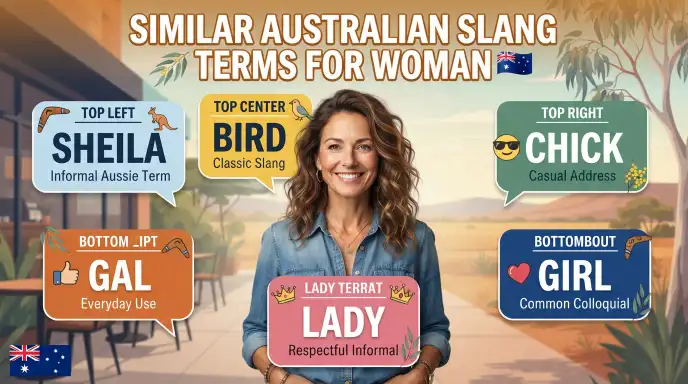
If you’re learning Australian English, you’ll probably hear these words as well.
| Slang | Meaning |
| Bloke | Man |
| Mate | Friend |
| Missus | Wife or partner |
| Old mate | Person (often humorous) |
| Cobber | Friend (older slang) |
Knowing these expressions helps you understand everyday Australian conversations more naturally.
Why Do People Use Australian Slang for Woman?
Australians often use slang because it makes conversations feel relaxed and friendly.
Common reasons include:
- Showing familiarity
- Creating a casual atmosphere
- Reflecting Australian culture
- Adding humor
- Speaking naturally with friends
Many Australians switch between slang and standard English depending on the situation.
For example:
With friends:
“The missus is waiting outside.”
At work:
“My wife is waiting outside.”
People naturally adjust their language based on who they’re speaking to.
Common Misunderstandings
“Every Australian Says Sheila”
This is one of the biggest myths.
Many Australians know the word, but not everyone uses it regularly. Younger people, especially in cities, often say woman, girl, or simply use a person’s name.
“Bird Is Always Friendly”
Not necessarily.
Some people still use bird casually, but many consider it outdated or disrespectful. Context and audience matter.
“Missus Only Means Wife”
Not always.
Many Australians also use missus to mean:
- Girlfriend
- Long-term partner
- Domestic partner
The exact meaning depends on the speaker.
When Should You Avoid Using Australian Slang for Woman?
Even friendly slang isn’t suitable everywhere.
Avoid these expressions when:
- Speaking in business meetings
- Writing professional emails
- Talking to someone you don’t know well
- Speaking in school presentations
- Addressing customers formally
- Giving speeches or interviews
In these situations, choose more neutral words such as:
- woman
- lady
- colleague
- customer
- guest
- client
Using standard English shows respect and avoids misunderstandings.
Polite Alternatives
If you’re unsure which word to use, these choices are safe in almost every setting.
| Instead of | Try Using |
| Sheila | Woman |
| Bird | Woman |
| Missus | Wife, partner |
| Girl (adult stranger) | Woman |
| Female | Woman (when referring to a person) |
| Informal nickname | Person’s name |
These alternatives work well in workplaces, schools, public speaking, and formal writing while still sounding natural.
Key Takeaways
- What are women called in Australia? In everyday Australian English, women are usually called women or ladies. Informal terms such as sheila may also appear in casual or traditional speech.
- What do Australians call girls? Australians commonly use girl in everyday conversation. Depending on the context, informal terms such as lass, chick, or sheila may also be used.
- A young woman in Australian slang may be called a lass, particularly in older or more traditional usage. Girl can also refer to a young woman in casual speech.
Frequently Asked Questions (FAQs)
What is the most common Australian slang for a woman?
The best-known Australian slang for woman is sheila. It has long been associated with Australian English, although younger Australians often use woman, girl, or mate more frequently in everyday conversations.
What does “sheila” mean in Australia?
Sheila is an informal Australian slang for attractive woman or girl. It is generally friendly but can sound old-fashioned, especially among younger speakers.
Is “sheila” considered offensive?
Usually, no. Most people understand it as a traditional slang term rather than an insult. However, because it sounds dated, some women may prefer not to be called sheila, particularly in formal or professional settings.
Do Australians still say “sheila”?
Yes, but not as often as they once did. Older Australians are more likely to use it, while many younger Australians simply say woman, girl, or refer to someone by name.
What does “missus” mean in Australian slang?
Missus usually means someone’s wife or long-term partner. It is one of the most common informal expressions still heard across Australia.
Example:
“The missus is cooking dinner tonight.”
Is “bird” Australian slang for woman?
Yes, but it originally became popular through British English and has also been used in Australia. Today, it is much less common and may sound old-fashioned or disrespectful to some people.
Can I use Australian slang for woman at work?
It’s usually better not to.
In workplaces, schools, customer service, and formal events, use words like woman, lady, colleague, or the person’s name instead of slang.
What is the female version of “bloke” in Australia?
There isn’t a perfect female equivalent to bloke.
The closest traditional slang term is sheila, but many Australians today simply say woman or girl, depending on the context.
Which Australian slang words are still popular today?
Some of the most commonly heard words include:
- Mate
- Bloke
- Missus
- No worries
- Arvo (afternoon)
- Brekkie (breakfast)
While sheila is still recognized, it is less common in everyday speech than many people outside Australia expect.
What do they call a female in Australia?
Australians commonly say woman, girl, or informally sheila. The term sheila is well known but is less common among younger Australians today.
What do Australians call a pretty girl?
Informally, Australians might say a good-looking sheila, or a lovely lass. In everyday speech, pretty girl is still the most common and natural expression.When looking for Australian slang for a beautiful girl, terms such as stunner or gorgeous girl may be heard in informal speech.
What is Aussie slang for girlfriend?
Aussies often call their girlfriends my missus, my girlfriend, my partner, or affectionately my better half. Among these, my missus is one of the most common casual expressions.
Quick Recap
| Question | Answer |
| Most famous Australian slang for woman? | Sheila |
| Most common today? | Missus, girl, woman |
| Is “sheila” rude? | Usually no, but it can sound old-fashioned. |
| Is “bird” recommended? | Generally no, as some people find it disrespectful. |
| Safe for work? | Use woman, lady, or the person’s name. |
Conclusion
Australian slang for woman includes several informal expressions, but not all of them are equally common today. Sheila remains the most famous traditional term, while missus is still widely used for a wife or partner.
Words like bird have become less popular and may not be appropriate in every situation.The key to using Australian slang naturally is understanding the context.
Friendly conversations with friends may include informal expressions, but professional settings usually call for standard words such as woman, lady, or a person’s name.
If you’re learning Australian English, focus on understanding these slang terms rather than trying to use all of them yourself.
Knowing when a word is friendly, old-fashioned, or best avoided will help you communicate more confidently and respectfully.
Explore More:

Hi, I’m Rachel Simmons, a language writer specializing in American English and modern slang. I research regional expressions, everyday phrases, and evolving word meanings across the United States. I enjoy making complex language trends simple, practical, and easy for everyone to understand.