Slang for women includes informal words or phrases people use to refer to girls or women in casual conversations, social media, texting, and everyday speech.
Some slang terms are friendly and playful, while others can be disrespectful or offensive depending on the situation and the speaker’s intent.
That is why many people search for slang for women to understand what these words really mean before using them online or in real life.
The meaning of a slang term often changes with culture, age group, and platform. A word that sounds harmless among close friends may be inappropriate in a workplace or formal setting.
Learning the context helps you communicate respectfully and avoid misunderstandings.
Quick Answer:
Slang for women refers to informal words used to describe or address women. Some are positive or neutral, while others are rude or offensive, so context and tone matter.
What Does Slang for Women Mean in Text?
In texting and online conversations, slang for women is used as a casual way to refer to a female person. The exact meaning depends on the word itself and how it is used.
For example:
- Some terms express friendship or admiration.
- Some are humorous or playful.
- Others are insulting or disrespectful.
- Certain words are only common within specific communities or regions.
Always consider your audience before using slang.
Slang for Women Full Form / Definition
Unlike abbreviations such as “LOL” or “BRB,” slang for women does not have a full form. It is simply a category of informal expressions used to describe women.
These expressions may be:
| Type | Description |
| Positive | Compliments or affectionate nicknames |
| Neutral | Casual everyday references |
| Humorous | Playful expressions among friends |
| Negative | Insults or disrespectful labels |
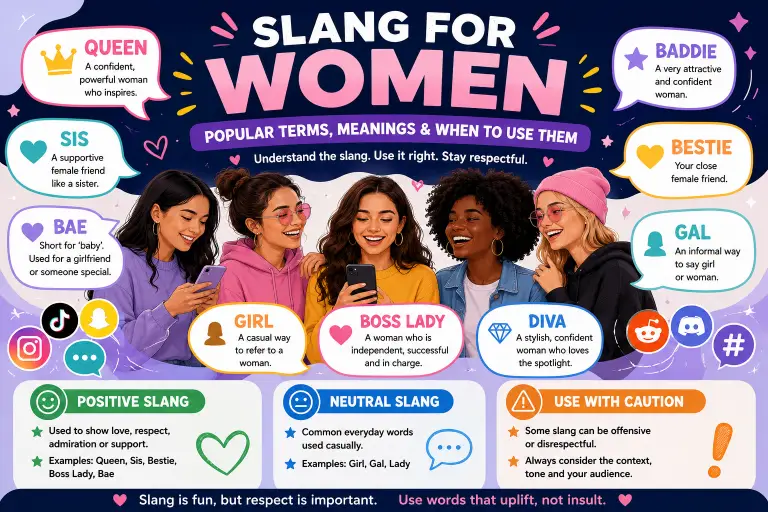
Common Slang for Women
Here are some popular slang words used in English.
| Slang | Meaning | Tone |
| Girl | Casual way to refer to a woman | Neutral |
| Gal | Informal word for woman | Friendly |
| Chick | Informal term for a young woman | Casual (can sound outdated) |
| Lady | Respectful informal reference | Positive |
| Queen | Confident, admired woman | Positive |
| Boss Lady | Successful, confident woman | Positive |
| Diva | Stylish or demanding woman | Mixed |
| Babe | Attractive woman or romantic partner | Friendly |
| Sis | Female friend or supportive term | Friendly |
| Bestie | Close female friend | Positive |
Remember that meanings vary depending on culture and personal preference.
Is Slang for Women Rude, Offensive, or Neutral?
Not every slang term carries the same tone.
Neutral
These are generally acceptable in casual conversations.
- Girl
- Gal
- Lady
- Sis
- Bestie
Positive
These usually show admiration.
- Queen
- Boss Lady
- Babe (in appropriate relationships)
Potentially Offensive
Some slang words can sound disrespectful, objectifying, or insulting depending on context.
Examples include:
- Certain insulting nicknames
- Gender-based insults
- Objectifying terms
If you are unsure if a word may offend someone, it is better to choose respectful language.
Where Is Slang for Women Commonly Used?
Many slang terms appear across modern digital communication.
Text Messages
Friends often use casual nicknames.
Example:
“Hey sis, how’s your day?”
TikTok
Positive slang like “queen” and “bestie” appears frequently in videos and comments.
Compliments often include slang.
Example:
“Looking amazing, queen!”
Snapchat
Short, casual conversations commonly include playful slang.
Different communities may use unique slang depending on the topic.
Discord
Gaming and hobby servers often use friendly nicknames among members.
Real-Life Examples of Slang for Women
Friendly
- She’s my bestie.
- Thanks, queen!
- You’re awesome, sis.
Casual
- The girls are meeting tonight.
- My gal just got promoted.
- She’s a cool lady.
Argumentative
- Avoid using insulting slang during disagreements.
- Respectful language usually leads to better conversations.
Social Media
- Slay, queen!
- You look amazing, girl!
- Proud of you, bestie.
Origin and Background of Slang for Women
Informal words for women have existed for centuries.
Older expressions such as gal became popular in American English many decades ago. Newer slang spreads rapidly through:
- TikTok
- YouTube
- Music
- Movies
- Online communities
Internet culture constantly creates new expressions, while older slang may become outdated.
Why People Use Slang for Women
People often choose slang because it makes conversations feel more relaxed.
Common reasons include:
- Building friendships
- Showing affection
- Creating humor
- Expressing admiration
- Following internet trends
- Feeling part of a community
However, slang should never replace respectful communication in professional settings.
Comparison with Similar Slang
| Slang | Meaning | Positive? | Best Used In |
| Girl | Casual female reference | Yes | Everyday conversation |
| Gal | Friendly woman | Yes | Casual speech |
| Queen | Confident woman | Very positive | Social media |
| Babe | Attractive partner | Positive | Personal relationships |
| Sis | Female friend | Positive | Texting |
| Diva | Stylish or demanding woman | Mixed | Entertainment |
When Should You Avoid Using Slang for Women?
Avoid slang in situations where it may sound disrespectful.
Examples include:
- Job interviews
- Business emails
- Academic writing
- Professional meetings
- Speaking with strangers
- Formal presentations
Respectful language is usually the safest choice.
Polite Alternatives
If you’re unsure if slang is appropriate, try these alternatives.
| Instead of Slang | Use |
| Girl | Woman |
| Chick | Young woman |
| Babe | Partner |
| Gal | Woman |
| Lady | Woman (formal settings) |
These alternatives are suitable in most situations.
Why Context Matters
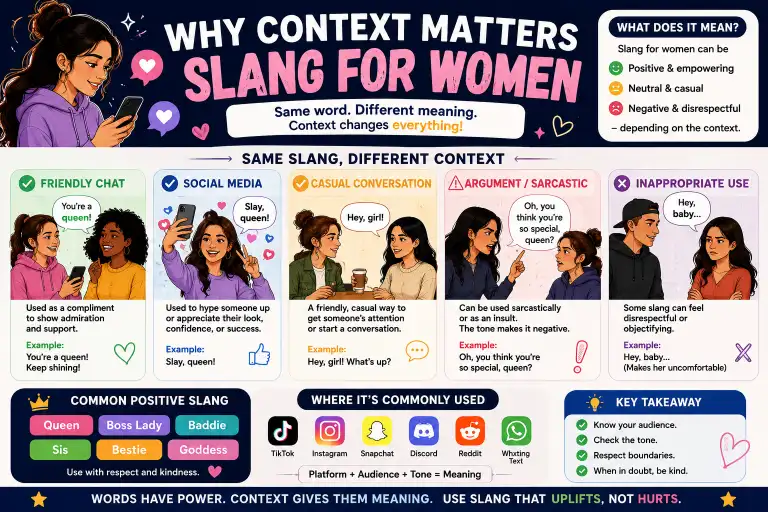
Impact of Using Slang in Communication
Positive Effects
- Makes conversations feel natural
- Creates stronger friendships
- Shows shared culture
- Makes online chats more engaging
Negative Effects
- Can offend people
- May confuse non-native speakers
- Sounds unprofessional in formal settings
- Meanings change across cultures
Using slang thoughtfully helps avoid misunderstandings.
Is Slang for Women Safe for Social Media?
Generally, yes—but only when it is respectful.
Safe examples include:
- Queen
- Sis
- Bestie
- Girl
- Lady
Avoid using offensive or insulting slang because:
- It may violate community guidelines.
- It can hurt others.
- It may damage your online reputation.
Always think about how your audience may interpret your words.
Real-Life Conversation Examples
Example 1 – Friendly
Emma: Thanks for helping me today.
Sarah: Anytime, queen!
Example 2 – Casual
Alex: Where’s Mia?
Jordan: She’s with the girls.
Example 3 – Social Media
“Happy birthday to my amazing bestie!”
Example 4 – Gaming
Player 1: Nice teamwork!
Player 2: Thanks, sis!
Example 5 – Workplace
Less Appropriate:
“That chick finished the report.”
Better:
“That colleague finished the report.”
Common Mistakes People Make
Many people accidentally misuse slang.
Common mistakes include:
- Using outdated expressions.
- Using slang in formal emails.
- Assuming everyone understands internet slang.
- Using words without knowing they may be offensive.
- Copying slang from social media without understanding the context.
Learning the meaning first helps avoid awkward situations.
FAQs
Q1. What does slang for women mean?
It refers to informal words people use to describe or address women in casual conversations, texting, and online communication.
Q2. Does slang for women have a full form?
No. It is not an abbreviation and does not stand for anything.
Q3. Is “queen” a positive slang term?
Yes. In most modern online conversations, “queen” is used as a compliment for a confident or admired woman.
Q4. Is “chick” offensive?
It depends on the speaker, audience, and culture. Some people use it casually, while others consider it outdated or disrespectful.
Q5. Can I use slang for women at work?
It is generally better to use respectful words like “woman,” “colleague,” or “team member” in professional settings.
Q6. Why do slang meanings change?
Language evolves with culture, social media, music, and online communities.
Q7. What is Gen Z slang for girlfriend?
Common Gen Z slang for girlfriend includes bae, boo, wifey, and sometimes my girl, depending on the relationship and context.
Q8. What can I say instead of “women”?
You can say ladies, girls (for informal contexts), women, females (use carefully), gals, or people if gender doesn’t need to be specified.
Q9. What does Gen Z call a hot girl?
Gen Z may describe a hot girl as a baddie, fine, gorgeous, or say she’s serving or slaying, depending on the context.
Conclusion
Slang for women includes many informal expressions used in everyday conversations, texting, and social media.
Some terms, such as queen, sis, and bestie, are positive and friendly, while others may sound disrespectful or offensive depending on the context.
Because meanings vary between cultures, age groups, and online communities, it is always important to understand a slang word before using it.
Choosing respectful language when speaking with strangers, coworkers, or in professional settings helps avoid misunderstandings.
When used thoughtfully, slang can make conversations feel more natural and help build friendly connections while still showing respect for others.
Explore More:

Hi, I’m Tyler Brooks, a writer specializing in Gen Z culture and internet slang. I track trending terms across TikTok and social media to explain their real-world meanings. My goal is to provide clear, accurate, and up-to-date definitions that help readers understand modern online language.