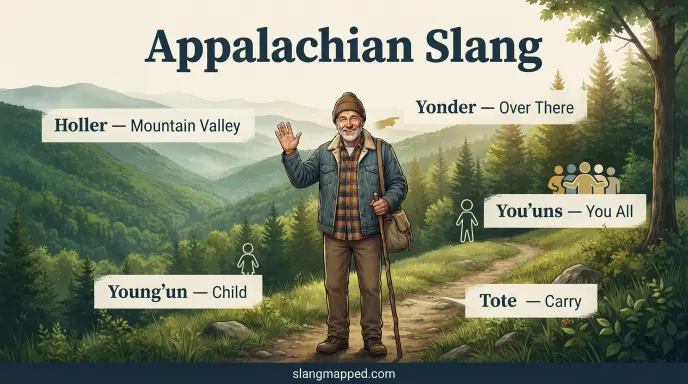
Appalachian slang is a collection of regional words and expressions used in Appalachian English, such as “holler” for a mountain valley, “yonder” for a distant place, and “you’uns” for a group of people.
You may hear these words in parts of West Virginia, Kentucky, Tennessee, Virginia, North Carolina, and other areas of Appalachia.
One important point is that not every word called “slang” online is truly slang. Some are better described as regional vocabulary, dialect words, idioms, or older forms of English.
Appalachian speech has its own vocabulary, pronunciation, grammar, and patterns of expression. Researchers have documented thousands of regional words and meanings in works such as the Dictionary of Smoky Mountain English.
Words such as holler, poke, britches, young’un, you’uns, tote, and right smart are documented examples of Appalachian or Smoky Mountain speech. Some are still familiar today, while others are more strongly associated with older or traditional speech.
This guide explains what these words mean, how they are used, which ones may sound old-fashioned, and how Appalachian speech differs from general Southern slang.
Quick Answer Table
| Question | Answer |
| Meaning | Regional words and expressions associated with Appalachian English |
| Tone | Usually informal, familiar, local, or traditional |
| Used By | Appalachian communities and people familiar with the dialect |
| Where Heard | Appalachia, family conversations, local communities, literature, music, and media |
| Offensive? | Usually no, but mocking an accent or dialect can be disrespectful |
| Still Used? | Yes, although individual words vary by place, age, and community |
The biggest thing to remember is that Appalachia is not one single speech community. The region covers a large area, so vocabulary can change from one community to another. Some expressions also overlap with Southern English and other American regional dialects.
What Does Appalachian Slang Mean?
Appalachian slang refers to informal words, phrases, and expressions associated with Appalachian English. Common examples include holler for a mountain valley, yonder for a place over there, you’uns for you plural, young’un for a child, and tote for carry.
Some are unique to Appalachia, while others are shared with Southern English.
However, linguists often use terms such as Appalachian English, Southern Appalachian English, or Smoky Mountain English instead of simply calling the speech “slang.”
That difference matters.
Slang is informal language often connected to particular groups or social settings. Dialect includes vocabulary, pronunciation, grammar, and sentence patterns connected to a region or community.
Appalachian English includes all of these features. For example, you’uns is not simply a trendy slang word. It is a regional plural form of “you,” documented in Smoky Mountain speech.
Common Appalachian Slang Words and Their Meanings
Here are some of the best-known examples.
| Word or Phrase | Meaning | Simple Example |
| Holler | A small mountain valley | “They live down in the holler.” |
| Yonder | Over there; at some distance | “The barn is over yonder.” |
| You’uns | You all; plural you | “Are you’uns coming?” |
| Young’un | Child or young person | “That young’un is fast.” |
| Tote | Carry | “Can you tote this inside?” |
| Poke | Bag or sack | “Put it in the poke.” |
| Britches | Pants or trousers | “Those britches are muddy.” |
| Right smart | A lot; a good amount | “That’s a right smart of work.” |
| Liketa | Almost; nearly | “I liketa fell down.” |
| Haint | Ghost or spirit | “They say a haint lives there.” |
| Fetch | Get or bring | “Go fetch some water.” |
| Cut a shine | Dance or make a lively display | “They cut a shine at the dance.” |
| Sigogglin | Crooked or leaning | “That fence is sigogglin.” |
| Tee-totally | Completely | “I was tee-totally worn out.” |
| Painter | Local pronunciation of “panther” | “They saw a painter in the woods.” |
| Dope | Soft drink or soda in some regional usage | “Want a dope with your meal?” |
These meanings are documented in references on Smoky Mountain and Appalachian English.
Holler
Holler can mean a small valley or hollow between mountains.
Example:
“My grandparents lived down in a holler.”
This is one of the most recognizable Appalachian words. It is especially useful because it describes the landscape itself.
Yonder
Yonder means “over there,” usually referring to a place that is some distance away.
“The truck is parked over yonder.”
You may also see over yander in documented Smoky Mountain speech.
You’uns
You’uns means “you all” when speaking to more than one person.
“Are you’uns ready to go?”
Research on Smoky Mountain English documents you’uns as a traditional plural form. It has also given way in some communities to forms such as you all and y’all.
Young’un
A young’un is a child or young person.
“That young’un can climb that tree faster than me.”
It is related to the word “young one” and appears in documented Appalachian vocabulary.
Tote
Tote means to carry.
“Can you tote these boxes to the truck?”
This word is not exclusive to Appalachia, but it is documented in Southern Appalachian speech.
Poke
In Appalachian speech, poke can mean a bag or sack.
“Put the apples in that poke.”
The word has a different meaning from the modern verb “poke,” which normally means to push or prod something. Context tells you which meaning is intended.
Appalachian Expressions You May Hear
Some Appalachian expressions are more interesting than individual words because their meaning comes from the whole phrase.
“Over yonder”
This simply means over there, often with a sense of distance.
“The old barn is over yonder.”
“Right smart”
Right smart can mean a large amount or a considerable quantity.
“We had a right smart of rain last night.”
A historical Appalachian vocabulary source defines the expression in terms of a substantial quantity or number.
“Cut a shine”
To cut a shine means to dance or make a lively display.
“Everybody was cutting a shine at the community dance.”
The expression is documented in Smoky Mountain English.
“I liketa…”
Liketa means almost or nearly.
“I liketa missed the bus.”
It is an example of how regional speech can compress words into a form that may sound unfamiliar to outsiders.
Where Appalachian Slang Is Used
Appalachian expressions can appear in spoken conversation, local storytelling, music, literature, social media, and online discussions about Appalachian culture.
| Setting | How It May Appear | Example |
| Family conversation | Local expressions passed between generations | “You’uns come on inside.” |
| Local communities | Everyday regional speech | “It’s raining up the holler.” |
| Social media | Dialect words used casually or humorously | “That storm came through fast!” |
| Music | Regional speech in lyrics and storytelling | References to hollers, mountains, or local life |
| Literature | Dialogue showing regional identity | Characters using “yonder” or “young’un” |
| Online communities | Discussions about Appalachian culture | People explaining local words |
Not every Appalachian word is common on TikTok, Instagram, Reddit, or other social platforms. Online use often depends on the speaker, audience, and purpose.
Is Appalachian Slang Still Used Today?
Yes, but usage varies greatly.
Some words remain recognizable and are still used in everyday speech. Others are more common among older speakers or in traditional local settings.
Research on Smoky Mountain English shows that forms such as you’uns have been losing ground to you all and y’all over generations in some communities.
That does not mean Appalachian English has disappeared. Linguistic research describes Appalachian English as a distinct regional variety with vocabulary, grammar, and pronunciation patterns that continue to be studied and used.
So it is better to describe individual expressions as current, traditional, regional, or less common, rather than saying all Appalachian slang is either “old” or “dead.”
Appalachian Slang vs. Southern Slang
Appalachian and Southern speech overlap, but they are not exactly the same.
| Feature | Appalachian Speech | General Southern Speech |
| Region | Appalachian areas | Much of the American South |
| Holler | Strongly associated with mountain speech | Less central outside mountain regions |
| You’uns | Strong regional Appalachian association | Less widespread |
| Y’all | Also used | Very widespread |
| Yonder | Common regional form | Also found in broader Southern speech |
| Tote | Documented in Appalachian speech | Also used elsewhere |
| Accent | Has distinctive regional patterns | Varies widely across the South |
Many words cannot be assigned to Appalachia alone. Some are shared with other Southern varieties or older forms of American English. That is why calling every Southern expression “Appalachian slang” can be misleading.
Why Does Appalachian English Sound Different?
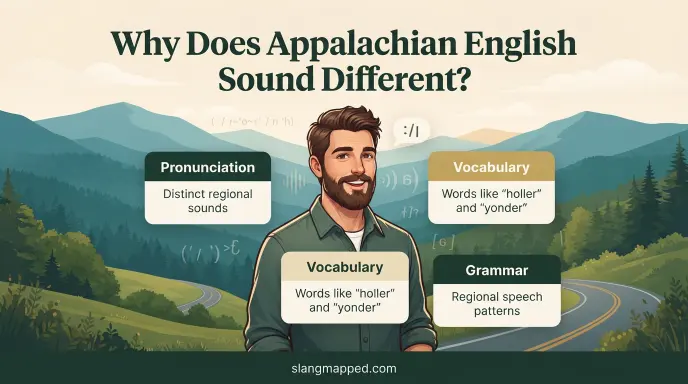
The difference is not only about vocabulary.
Appalachian English has distinctive pronunciation and grammar patterns as well. For example, linguistic descriptions of Appalachian English discuss forms such as a-talkin’ and a-runnin’, along with regional pronunciation patterns.
Smoky Mountain English also has distinctive plural pronouns, including you’uns, and other grammatical patterns that are different from standard American English.
The history is also more complex than the idea that Appalachian speech came from one single group. Appalachian English developed through contact among different communities and varieties of English over time. Researchers continue to examine these influences through historical records and recorded speech.
Is Appalachian Slang Rude or Offensive?
Most Appalachian regional words are not offensive.
Words such as holler, yonder, young’un, tote, and you’uns are simply regional forms of speech.
The problem usually comes from how someone uses the dialect.
For example, copying a person’s Appalachian accent to make fun of them can be insulting even when the individual words themselves are harmless.
It is better to treat Appalachian speech as a legitimate regional variety of English rather than as “bad English.” Linguistic research on regional dialects emphasizes that nonstandard forms are not automatically signs of inferior language ability.
Appalachian Slang Pronunciation
Some Appalachian words have pronunciations that may surprise people who are unfamiliar with the region.
For example:
- You’uns is commonly represented as sounding like “yuns.”
- Yonder may sound like “yander” in some traditional speech.
- Young’un is a shortened form of “young one.”
- Liketa compresses “like to” into one spoken form.
- Holler is associated with the pronunciation of “hollow” in Appalachian speech.
The pronunciation can vary by community and speaker, so spelling a dialect phonetically does not always capture every local pronunciation.
Real-Life Examples of Appalachian Slang
Text Message
Maddie: “Where are you?”
Caleb: “Over yonder at Grandma’s. You’uns coming?”
Here, over yonder means “over there,” while you’uns refers to more than one person.
Family Conversation
Nora: “Can you tote these bags inside?”
Eli: “Sure. Give me a minute.”
Here, tote simply means “carry.”
Social Media Caption
“Found the prettiest view down in the holler today.”
In this context, holler gives a regional description of a mountain valley.
Casual Conversation
Grace: “Did you catch your foot on that rock?”
Mason: “I liketa went straight down!”
Here, liketa means “almost.”
Storytelling
Ruth: “That old fence has been sigogglin’ for years.”
Ben: “I’m surprised it hasn’t fallen yet.”
Sigogglin means crooked or leaning.
These examples show why context matters. A reader may understand the sentence even if one regional word is unfamiliar.
Common Mistakes With Appalachian Slang
Calling Every Southern Word Appalachian
This is one of the biggest mistakes.
A word may occur in Appalachia without being exclusive to Appalachia. Southern English covers a much larger area, and many expressions cross regional boundaries.
Treating Dialect as Bad Grammar
Appalachian English has its own grammatical patterns. A regional form should not automatically be treated as an error simply because it differs from classroom or formal English.
Assuming All Appalachian Speakers Talk the Same Way
Appalachia covers a large geographic area. Speech can vary by state, community, age, social setting, and personal background.
Assuming Every Word Is Modern Slang
Some expressions are traditional or less common today. Others remain familiar. It is more accurate to check the context and region before calling a word “trending.”
Using the Dialect as a Joke
Learning regional vocabulary is fine. Mocking the people who use it is different.
Use Appalachian words naturally and respectfully rather than turning someone’s accent into a stereotype.
Appalachian Slang vs. Appalachian Dialect
| Term | What It Means |
| Slang | Informal words used by particular groups or communities |
| Dialect | A variety of language with regional vocabulary, grammar, and pronunciation |
| Regionalism | A word or phrase strongly associated with a particular area |
| Appalachian English | Regional varieties of English spoken in Appalachia |
| Appalachian slang | A broad, everyday label often used for informal Appalachian expressions |
Appalachian slang is the natural phrase many readers search for. Linguistically, however, Appalachian English is often the more precise term.
Key Takeaways
- Appalachian slang refers broadly to informal Appalachian words and expressions.
- Holler means a mountain valley, while yonder means over there.
- You’uns is a traditional plural form meaning “you all.”
- Many Appalachian words are also found in wider Southern English.
- Appalachian speech includes vocabulary, pronunciation, and grammar—not just slang.
- Usage varies by location, age, community, and context.
- Regional speech should be understood rather than treated as incorrect or inferior.
FAQs
Q1. What are some common Appalachian slang words?
Common examples include holler, yonder, you’uns, young’un, tote, poke, britches, liketa, haint, fetch, right smart, and sigogglin. These words have documented connections to Appalachian or Smoky Mountain speech, although some are also used outside Appalachia.
Q2. What does “holler” mean in Appalachian slang?
In Appalachian speech, holler refers to a valley or hollow between mountains. For example, “They live down in the holler” means that they live in a mountain valley. The word is especially associated with Smoky Mountain and Southern Appalachian English.
Q3. What does “you’uns” mean?
You’uns means “you all” or “you” when talking to more than one person. It is a documented traditional form in Smoky Mountain English. In some communities, it has become less common over generations as you all and y’all have become more widely used.
Q4. What does “yonder” mean in Appalachian speech?
Yonder means “over there,” usually pointing to a place some distance away. You might hear someone say, “The house is over yonder.” The related form yander is also documented in Smoky Mountain vocabulary.
Q5. Is Appalachian slang still used?
Yes. Some expressions remain part of everyday regional speech, while others are more traditional or less common. Usage varies by community and generation. Researchers continue to document Appalachian English, including its vocabulary, grammar, and pronunciation.
Q6. Is Appalachian slang the same as Southern slang?
No. There is considerable overlap, but Appalachian English is a regional variety with its own vocabulary and speech patterns. Some words associated with Appalachia are also used elsewhere in the South, so a word should not automatically be labeled Appalachian simply because it sounds Southern.
Q7. Is Appalachian English a real dialect?
Yes. Appalachian English is a recognized regional variety of American English with distinctive vocabulary, pronunciation, and grammatical patterns. Linguistic resources document features such as you’uns, regional pronunciation patterns, and forms such as a-talkin’.
Q8. What is a polite way to use Appalachian slang?
Use regional words in the right context and avoid exaggerating an Appalachian accent for comedy. Words such as holler, yonder, young’un, and tote can be used when you understand their regional meaning. The safest approach is to learn the expression from reliable regional language sources rather than stereotypes.
Conclusion
Appalachian slang gives a glimpse into the rich regional speech of Appalachia. Words such as holler, yonder, you’uns, young’un, tote, poke, and right smart can carry meanings that are easy to miss if you only know standard American English.
At the same time, Appalachian speech is much more than a list of funny or unusual words. It includes distinctive pronunciation, grammar, vocabulary, and ways of describing mountain life. Some expressions are strongly regional, while others overlap with Southern English or older forms of American speech.
If you hear an unfamiliar Appalachian expression, context is often the best clue. A word like poke may mean a bag in one sentence, while holler can describe the landscape itself.
Understanding these differences makes Appalachian English easier to read, hear, and appreciate and helps separate real regional language from stereotypes.
Discove More Articles:

Hi, I’m Tyler Brooks, a writer specializing in Gen Z culture and internet slang. I track trending terms across TikTok and social media to explain their real-world meanings. My goal is to provide clear, accurate, and up-to-date definitions that help readers understand modern online language.