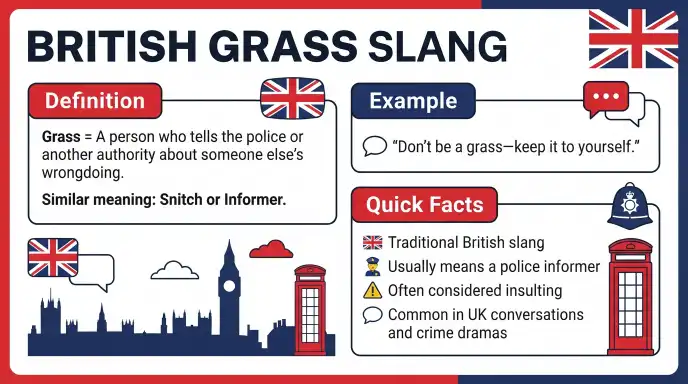
British grass slang means a person who tells the police or another authority about someone else’s wrongdoing.
In British English, calling someone a “grass” usually means accusing them of being an informer or a snitch. The term often has a negative meaning, especially in criminal circles, prisons, and some working-class communities.
Many people search for British grass slang after hearing it in British TV shows, movies, songs, or real-life conversations. If you’re unfamiliar with UK slang, the word can be confusing because it also means the green plants that grow on lawns.
This guide explains the meaning of British grass slang, where it came from, how people use it today, if it is rude, and when you should avoid using it. You’ll also see realistic examples to help you understand the term in everyday conversations.
Quick Answer: British Grass Slang
British grass slang refers to someone who reports another person to the police, teachers, employers, or other authorities. It is similar to calling someone a snitch, informant, or tattletale, although the exact tone depends on the situation. In most cases, calling someone a grass is considered an insult.
What Does British Grass Slang Mean?
In British slang, a grass is a person who gives information about someone else’s actions to people in authority. The word is most commonly linked with reporting crimes to the police, but it can also describe someone who reports classmates, coworkers, or friends.
The slang usually suggests that the person has betrayed someone’s trust. Because of this, it often carries a negative meaning.
Simple Definition
| Term | Meaning | Tone |
| Grass | Someone who informs on another person | Negative |
| Snitch | Someone who tells on others | Negative |
| Informer | Someone who gives information to authorities | Neutral to Negative |
| Tattletale | Someone who reports minor misbehavior | Informal |
Unlike the formal word informer, grass almost always sounds informal and critical.
Example Sentences
- “Don’t be a grass. Let them deal with it themselves.”
- “Everyone called him a grass after he spoke to the police.”
- “She wasn’t trying to be a grass. She simply reported what happened.”
Notice how the meaning changes depending on if the speaker believes reporting was right or wrong.
Does “Grass” Have a Full Form?
No. The British slang word grass is not an abbreviation or acronym, so it has no full form.
Some people mistakenly think it stands for a hidden phrase, but that is not true. It is simply a slang word that developed over time in British English.
Different Meanings of British Grass Slang
The word grass can have more than one meaning depending on the conversation. Understanding the context is important.
Grass as a Police Informer
This is the most common slang meaning.
A grass is someone who secretly tells the police about another person’s illegal activities.
Example
“The gang believed one member was a grass.”
This meaning is common in crime dramas, prison stories, and police investigations.
Grass as Someone Who Reports Rule Breaking
The word is also used outside criminal situations.
A student who tells a teacher about cheating or a worker who reports misconduct might be called a grass by other people.
Example
“He told the manager who broke the equipment, and everyone called him a grass.”
Here, the speaker may be criticizing the person for reporting someone else, even if reporting was the responsible thing to do.
Grass as the Plant
Outside slang, grass simply means the green plant found in gardens, parks, and sports fields.
Example
“The children played on the grass.”
This meaning has nothing to do with British slang.
Meaning Comparison Table
| Context | Meaning | Example |
| British slang | Informer or snitch | “He’s a grass.” |
| School | Student who reports others | “Don’t grass on your classmates.” |
| Workplace | Employee who reports misconduct | “They called her a grass.” |
| Nature | Green lawn plant | “The grass needs cutting.” |
The sentence usually makes the intended meaning clear.
Where Is British Grass Slang Commonly Used?
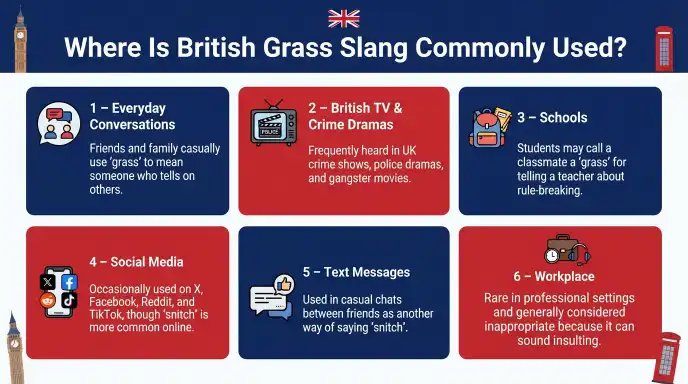
British grass slang is mainly used in the United Kingdom, although people in other English-speaking countries may recognize it from British films and television.
You are most likely to hear it in these situations:
Everyday Conversations
Friends may jokingly call someone a grass after they reveal a secret or report someone’s actions.
Example
“You told Mum I stayed out late? You’re such a grass.”
Crime and Police Discussions
The word appears frequently when discussing police investigations, organized crime, or prison life.
Example
“Nobody wanted to be known as the grass.”
British TV Shows and Movies
Many British crime dramas and gangster films use the term because it reflects real British slang.
Characters often accuse others of being a grass after speaking with the police.
Schools
Children sometimes use grass for classmates who tell teachers about rule-breaking.
Example
“Stop being a grass and let us sort it out.”
Workplace Conversations
Although less common, employees may jokingly use the word for someone who reports coworkers to a manager.
Because the term can sound insulting, it is usually inappropriate in professional settings.
Where You Are Most Likely to Hear It
| Place | Common? | Notes |
| Everyday UK conversations | ⭐⭐⭐⭐⭐ | Very common |
| British crime dramas | ⭐⭐⭐⭐⭐ | Frequently used |
| Schools | ⭐⭐⭐⭐ | Common among children and teens |
| Social media | ⭐⭐⭐ | Sometimes used in comments and memes |
| Text messages | ⭐⭐⭐ | Informal chats |
| Workplace | ⭐⭐ | Less common and often inappropriate |
| Gaming chats | ⭐⭐ | Occasionally used to mean “snitch” |
Although younger people may still understand the word, grass is more strongly associated with traditional British slang than with modern internet slang. Today, online users often choose words like snitch instead, especially on platforms such as TikTok, Discord, Reddit, and Instagram.
Is British Grass Slang Rude, Offensive, or Harmless?
British grass slang is usually considered rude because it labels someone as a “snitch” or informer. While it is not a swear word, it often carries a strong negative meaning. If it is offensive depends on the situation and the people involved.
In casual conversations, friends may use it jokingly. However, in serious situations especially those involving crime or betrayal it can be a very harsh accusation.
Tone by Situation
| Situation | Is It Appropriate? | Why? |
| Talking with close friends | Sometimes | Can be used jokingly if everyone understands the joke. |
| School | Usually no | It may upset or embarrass someone. |
| Workplace | No | It sounds unprofessional and insulting. |
| Police or legal matters | Avoid | It may suggest betrayal or criminal involvement. |
| Social media | Use carefully | Without context, people may misunderstand your meaning. |
Can You Use It at Work?
It is best not to use grass in a professional setting. If someone reports a problem at work, calling them a grass may sound disrespectful and discourage people from speaking up about genuine concerns.
Can You Say It to Teachers or Parents?
Generally, no. Because the word is informal and negative, it is better to use words like reported, informed, or told instead.
Real-Life Examples of British Grass Slang
Seeing the word in real conversations makes it much easier to understand.
Friends
Alex: “Who told Jake about the surprise party?”
Sam: “I don’t know, but someone was a grass.”
School
Student 1: “Who told the teacher we skipped homework?”
Student 2: “I’m not being a grass.”
Text Message
Friend: “Did you tell your brother where I was?”
Reply: “No chance. I’m not a grass.”
Workplace
Employee: “Someone reported the missing equipment.”
Coworker: “People are calling them a grass, but reporting it was the right thing to do.”
This example shows why context matters. The speaker uses the slang, but reporting a safety or workplace issue is often the responsible action.
British Crime Drama
Character 1: “The police knew everything.”
Character 2: “There must be a grass in the group.”
Social Media
Comment:
“Don’t grass on your mate over something so small.”
Gaming Chat
Player 1: “Who told the moderator?”
Player 2: “Someone decided to grass.”
Although gamers may understand the word, snitch is generally more common in online gaming communities.
Origin and History of British Grass Slang
The exact origin of the slang word “grass” is not completely certain, but most language experts connect it to older British rhyming slang.
A widely accepted explanation is that grass comes from the rhyming slang phrase “grasshopper,” which rhymed with “copper” (a British slang word for a police officer). Over time, the meaning shifted from referring to the police to describing someone who helped the police by giving information.
Not every linguist agrees on every stage of this development, but this explanation is the one most often accepted.
How the Meaning Changed
| Time | Development |
| Late 19th–Early 20th Century | Rhyming slang became popular in parts of England. |
| Early–Mid 20th Century | “Grass” began to mean a police informer. |
| Late 20th Century | The word became common in British films, television, and newspapers. |
| Today | Still widely understood in the UK, though “snitch” is increasingly common online. |
Is the Term Still Popular?
Yes, but its popularity has changed.
Older generations in Britain often use grass naturally in conversation. Younger people still understand it, but many now use snitch, especially on social media and international platforms.
This is one reason you may hear snitch more often on TikTok or Discord, while grass remains common in British TV shows and everyday UK speech.
Similar Slang and Related Terms
Several English slang words have a similar meaning to grass, but they are not always interchangeable.
| Slang | Meaning | Common In |
| Snitch | Someone who reports others | UK, US, internet |
| Rat | Informer, often in criminal groups | UK, US |
| Informer | Person giving information | Formal English |
| Tattletale | Someone who reports small rule-breaking | Mainly US English |
| Tell-tale | Person who tells on others | UK and US |
Grass vs. Snitch
| Grass | Snitch |
| Mainly British slang | Used worldwide |
| Older British expression | Popular online |
| Common in UK crime dramas | Common on TikTok, Discord, Reddit, and gaming chats |
Although both words mean something similar, grass immediately sounds more British.
When Should You Avoid Using British Grass Slang?
Avoid using “grass” when it could insult someone or make a serious situation worse. While it may seem harmless among close friends, it can be offensive in many real-life situations.
You should avoid using it:
- During workplace discussions.
- Around teachers or school staff.
- In formal writing.
- When talking about legal cases.
- When discussing someone who reported unsafe or dangerous behavior.
- If you are unsure if the listener understands British slang.
Why Context Matters
Sometimes reporting someone is the responsible thing to do.
For example:
- Reporting bullying.
- Reporting theft.
- Reporting unsafe behavior.
- Reporting harassment.
Calling someone a grass in these situations may unfairly suggest they did something wrong when they were actually helping others.
This is why context is more important than the slang itself.
Polite Alternatives
If you want to describe the situation without sounding insulting, use more neutral words.
| Instead of “Grass” | Try Saying |
| Grass | Informer |
| Grass | Witness |
| Grass | Reported the incident |
| Grass | Told the authorities |
| Grass | Shared information |
These alternatives work much better in schools, workplaces, and formal conversations.
Why Do People Use British Grass Slang?
People use British grass slang because it quickly describes someone who has reported another person’s actions to an authority. The word is short, familiar in the UK, and carries a strong emotional meaning.
Common reasons people use it include:
- To accuse someone of betraying trust.
- To describe a police informer.
- To joke with friends after someone reveals a secret.
- To sound natural in British English.
- To copy language heard in British films, TV shows, or books.
Although the slang is still widely recognized, many younger internet users now prefer snitch, especially in online conversations.
Common Misunderstandings About British Grass Slang
Many people misunderstand the meaning of British grass slang, especially if they are not familiar with British English. Here are some of the most common misconceptions.
It Does Not Mean the Plant
The most obvious misunderstanding is thinking someone is talking about the green plant.
Example:
- ✅ “The grass in the garden needs cutting.” (Plant)
- ✅ “He’s a grass.” (British slang for an informer)
The surrounding conversation almost always makes the meaning clear.
It Is Not an Acronym
Some users search for the full form of grass, but there isn’t one.
Grass is a standalone slang word, not an abbreviation like LOL or BRB.
It Does Not Always Mean a Criminal Informer
Many people think a grass only reports crimes to the police.
In reality, the word can also describe someone who:
- tells a teacher about classmates
- reports a coworker to a manager
- informs parents about someone’s behavior
- reveals another person’s secret
The idea is the same: telling an authority or another person about someone else’s actions.
It Is Mainly British
People outside the UK often use snitch instead.
If you hear grass, it usually suggests the speaker is British or is using British slang.
Frequently Asked Questions
Q1. What does British grass slang mean?
British grass slang means a person who tells the police, teachers, employers, or another authority about someone else’s actions. It is similar to calling someone a snitch or informer.
Q2. Is calling someone a grass an insult?
Yes. In most situations, calling someone a grass is meant as criticism. It suggests the person betrayed someone else’s trust by reporting them.
Q3. Is grass a swear word?
No. Grass is not a swear word, but it is an insulting slang term in many situations.
Q4. Is grass the same as snitch?
They have very similar meanings. The biggest difference is that grass is mainly British slang, while snitch is common in both British and American English and is widely used online.
Q5. Can grass have a positive meaning?
Usually no. Most people use grass negatively. However, reporting dangerous or illegal behavior may be the responsible thing to do, even if others unfairly call that person a grass.
Q6. Is British grass slang still used today?
Yes. The term is still common in the UK, especially in everyday conversation, British TV shows, crime dramas, and news stories. Younger people also understand it, although many prefer the word snitch online.
Q7. Where did the slang word grass come from?
The exact origin is not completely certain. Most language experts believe it developed from older British rhyming slang and later became a common word for a police informer.
Q8. Can I use the word grass at work?
It is better not to. The word sounds informal and can offend people. Neutral words like report, inform, or raise a concern are more suitable in professional settings.
Q9. What is British slang for a hot girl?
Common British slang for an attractive girl includes fit, peng, stunning, and gorgeous. Among younger people, fit and peng are especially popular, though usage varies by region and generation.
Q10. What does grass mean in Gen Z?
In Gen Z slang, grass usually keeps its traditional British meaning of a snitch or someone who tells on others. However, Gen Z users especially on TikTok, Discord, and gaming platforms are more likely to say snitch than grass.
Q11. Why do Brits call informants grass?
Most language experts believe grass comes from older British rhyming slang, where “grasshopper” was associated with “copper” (a slang word for a police officer). Over time, grass came to mean someone who gives information to the police, although the exact history is not completely certain.
Conclusion
British grass slang refers to someone who informs on another person, especially by telling the police, a teacher, or another authority about their actions. It is one of the best-known pieces of British slang and is closely related to words like snitch, rat, and informer.
Although the term is still widely understood across the UK, its tone is usually negative. If it is appropriate depends on the situation. Among close friends, it may be used jokingly, but in workplaces, schools, or serious discussions, it can sound insulting or disrespectful.
If you hear someone described as a grass, always consider the context. In some situations, the word is simply slang, while in others it reflects strong opinions about loyalty and trust. Understanding that context will help you use and interpret the term correctly.
Read More:

Hi, I’m Tyler Brooks, a writer specializing in Gen Z culture and internet slang. I track trending terms across TikTok and social media to explain their real-world meanings. My goal is to provide clear, accurate, and up-to-date definitions that help readers understand modern online language.