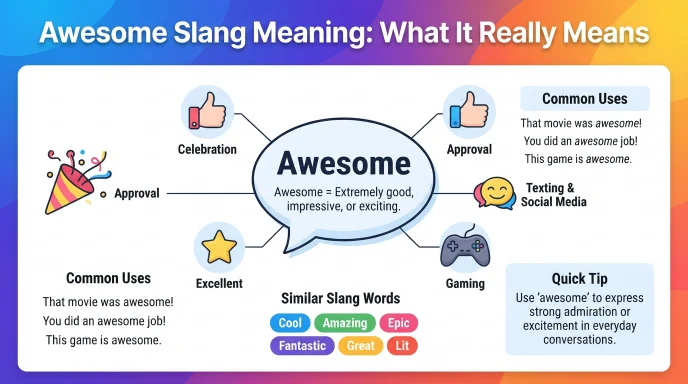
Awesome slang means something that is amazing, excellent, or really impressive, and people commonly use it in texts, social media, gaming, and everyday conversations to express excitement or approval.
Although awesome is a standard English word, its casual, enthusiastic use has made it one of the most popular slang expressions in modern communication.
If you’ve ever received a message saying, “That’s awesome!” or seen comments like “Awesome video!” on TikTok, Instagram, or Reddit, you might wonder exactly what the word means and when to use it.
In most cases, it’s simply a positive way to show admiration, happiness, or appreciation. If someone is celebrating good news, complimenting a friend, or reacting to an achievement, awesome slang helps convey genuine enthusiasm in a friendly and natural way.
Quick Answer
Awesome slang means “amazing,” “excellent,” or “really great.” It’s a positive, non-offensive expression used to show excitement, approval, or admiration in texting, social media, gaming, and everyday conversations.
What Does Awesome Mean in Text?
In texting, awesome is a positive reaction that shows you think something is impressive, exciting, or enjoyable.
Instead of writing long responses, people simply reply:
- Awesome!
- That’s awesome!
- Awesome, thanks!
- Awesome news!
The word instantly communicates enthusiasm without sounding overly formal.
Examples
Friend:
I finally passed my driving test!
Reply:
Awesome! Congratulations!
Coworker:
The meeting was moved to tomorrow.
Reply:
Awesome, that gives me more time to prepare.
Gaming Chat:
We won the tournament!
Reply:
Awesome! Great teamwork.
Awesome Full Form / Definition
Unlike abbreviations such as LOL or BRB, awesome does not have a full form.
It is simply an English adjective that originally meant inspiring awe. Over time, its everyday meaning changed.
Today, people mostly use it to mean:
- Amazing
- Excellent
- Really good
- Fantastic
- Impressive
- Exciting
So if someone asks:
What does awesome stand for?
The answer is:
It doesn’t stand for anything. It’s a regular English word commonly used as informal slang.
Is Awesome Really Slang?
Yes and no.
This is where many people get confused.
“Awesome” is both:
- A standard English adjective
- An informal slang expression
When someone says,
That movie was awesome!
they’re using the word informally rather than literally meaning it inspired “awe.”
Because of this everyday casual usage, many people consider it slang.
Is Awesome Rude, Offensive, or Neutral?
Awesome is completely neutral and positive.
It is one of the safest slang words you can use.
| Situation | Appropriate? |
| Friends | ✅ Yes |
| Family | ✅ Yes |
| School | ✅ Yes |
| Workplace | ✅ Usually |
| Social media | ✅ Yes |
| Professional reports | ❌ Better use formal words |
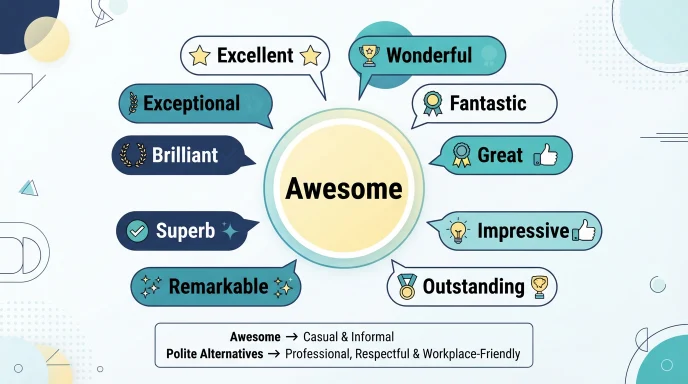
In formal writing, alternatives like excellent, outstanding, or remarkable sound more professional.
Where Is Awesome Commonly Used?
Awesome appears almost everywhere people communicate casually.
Text Messages
People use it to react quickly.
Example:
Awesome! I’ll be there at 7.
Social Media
You’ll see comments like:
- Awesome photo!
- Awesome video!
- Awesome work!
Gaming
Gamers often use it after:
- Winning matches
- Unlocking rewards
- Completing missions
Example:
Awesome play!
Online Communities
It is common in:
- Reddit discussions
- Discord servers
- Instagram comments
- Facebook posts
- Snapchat chats
- TikTok comments
Because the word is friendly and positive, it works well on almost every platform.
Awesome Meaning Slang in Different Contexts
1. Showing Excitement
The most common meaning.
Example:
Awesome! We got concert tickets.
2. Showing Approval
Someone shares an idea.
Reply:
Awesome idea.
3. Appreciating Someone
Example:
You’re awesome.
This means:
- You’re amazing.
- You’re kind.
- You’re impressive.
4. Celebrating Success
Example:
Awesome job!
Meaning:
You did really well.
Real-Life Examples of Awesome Slang
Friendly
- Awesome! Thanks for helping me.
- You look awesome today.
Casual
- That pizza was awesome.
- This song is awesome.
Social Media
- Awesome content!
- Awesome travel photos!
Gaming
- Awesome teamwork everyone.
- That was an awesome comeback.
Workplace
- Awesome presentation today.
- Awesome work on the project.
Origin and Background of Awesome
The word awesome has existed in English for hundreds of years.
Originally, it described something so powerful or beautiful that it inspired awe.
Examples from older English include:
- Awesome mountains
- Awesome power
- Awesome storms
During the 20th century, especially in American English, its meaning gradually became much more casual.
Instead of describing something majestic, people began saying:
- Awesome movie
- Awesome music
- Awesome food
By the 1980s and 1990s, “awesome” had become one of the most popular positive slang words among teenagers.
Today, people of all ages use it naturally.
Why People Use Awesome Instead of Other Words
People choose awesome because it sounds:
- Friendly
- Positive
- Natural
- Enthusiastic
- Easy to understand
It is stronger than saying:
- Good
- Nice
- Fine
But softer than saying:
- Incredible
- Mind-blowing
That balance makes it useful in daily conversation.
Comparison with Similar Slang
| Slang | Meaning | Tone |
| Awesome | Excellent or amazing | Friendly |
| Cool | Good or acceptable | Relaxed |
| Epic | Extremely impressive | Excited |
| Sick | Amazing (modern slang) | Trendy |
| Fire | Excellent or impressive | Social media slang |
| Dope | Really good | Casual |
| Lit | Exciting or fun | Youth slang |
Each word expresses approval, but “awesome” is the safest and most universally understood.
When Should You Avoid Using Awesome?
Although it’s a positive word, there are situations where a more formal alternative works better.
Avoid using it in:
- Academic essays
- Business reports
- Legal documents
- Formal presentations
- Official emails
Instead, use:
- Excellent
- Outstanding
- Exceptional
- Remarkable
- Impressive
Polite Alternatives to Awesome
Why People Use Awesome Slang
People like using awesome because it:
- Shows excitement quickly
- Sounds friendly
- Encourages others
- Creates positive conversations
- Feels natural in texting
- Works across generations
Unlike many internet slang terms, almost everyone understands it.
Impact of Using Awesome in Communication
Using “awesome” can make conversations feel:
More Positive
People appreciate encouraging language.
More Friendly
It creates warmth without sounding exaggerated.
More Natural
Instead of formal praise, “awesome” feels conversational.
More Engaging
Positive reactions often encourage further conversation.
Is Awesome Safe for Social Media?
Yes.
Awesome is considered one of the safest expressions online.
It is:
- Non-offensive
- Family-friendly
- Positive
- Widely accepted
- Appropriate for public comments
If you’re commenting on:
- TikTok
- Discord
- YouTube
the word fits naturally in most conversations.
Real-Life Usage Examples by Tone
| Tone | Example |
| Friendly | Awesome! Happy for you! |
| Casual | That game was awesome. |
| Encouraging | Awesome work today! |
| Social Media | Awesome picture! |
| Gaming | Awesome strategy, team! |
| School | Awesome presentation! |
| Workplace | Awesome collaboration everyone. |
| Family | Dinner was awesome! |
Common Variations of Awesome
People often shorten or expand the expression.
Examples include:
- Awesome!
- That’s awesome!
- So awesome!
- Totally awesome!
- Pretty awesome
- Absolutely awesome
- You’re awesome
These variations all keep the same positive meaning.
Quick Key Points About Awesome Slang
- Positive and friendly slang
- Means “amazing” or “excellent”
- Common in texting and social media
- Safe and non-offensive to use
- No full form or abbreviation
- Used to express excitement or approval
FAQs
Q1.What does awesome mean in slang?
In slang, awesome means something is amazing, excellent, exciting, or very impressive.
Q2.What does awesome stand for?
Awesome does not stand for anything. It is a regular English word that is commonly used as informal slang.
Q3. Is awesome still popular?
Yes. Although newer slang words appear frequently, “awesome” remains one of the most widely used positive expressions in English.
Q4. Is awesome appropriate for work?
Yes, in casual workplace conversations. For formal reports or official documents, words like “excellent” or “outstanding” are usually more suitable.
Q5. Is awesome a compliment?
Yes. Calling someone or something “awesome” is a positive compliment that expresses admiration or approval.
Q6. Can I use awesome on social media?
Absolutely. It is friendly, respectful, and appropriate for comments, captions, messages, and replies across most social media platforms.
Q7. What is a cool slang word for awesome?
A cool slang word for awesome is fire, which means something is extremely impressive, exciting, or excellent.
Q8. What is awesome in gen Z slang?
In Gen Z slang, awesome is commonly expressed as fire, lit, dope, or sick, depending on the context.
Q9. Is slang different online and offline?
Yes, online slang is often shorter and trend-driven, while offline slang is usually more conversational and varies by region or culture.
Q10. What slang word means “Awesome” in 2026?
In 2026, popular slang words for “awesome” include fire, lit, dope, peak, and hard, depending on the context and community.
Conclusion
Awesome slang remains one of the most positive and widely recognized expressions in modern English.
If you’re texting a friend, congratulating someone online, reacting to good news, or praising a great achievement, “awesome” is a simple and effective way to show enthusiasm and appreciation.
While the word originally described something that inspired awe, its modern slang meaning has evolved to represent anything excellent, exciting, or impressive.
Because it is friendly, non-offensive, and easy to understand, it continues to be a favorite in texts, social media, gaming, and everyday conversations. Understanding the context helps you use it naturally and confidently wherever casual communication is appropriate.
Read More:

Hi, I’m Tyler Brooks, a writer specializing in Gen Z culture and internet slang. I track trending terms across TikTok and social media to explain their real-world meanings. My goal is to provide clear, accurate, and up-to-date definitions that help readers understand modern online language.