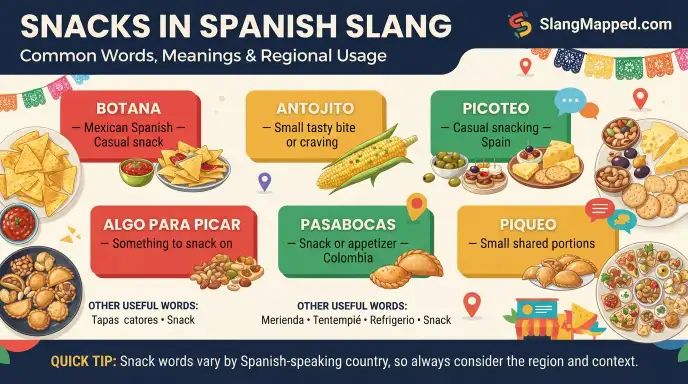
Snacks in Spanish slang refers to informal or regional Spanish words used to describe snacks, small bites, or light foods, such as botana, antojito, picoteo, pasabocas, and piqueo.
The exact word depends on the Spanish-speaking country and the context. For example, botana is commonly associated with Mexico, while picoteo is widely used in Spain. Pasabocas is associated with Colombia, and piqueo is used in parts of Latin America.
People often search for snacks in Spanish slang because a direct translation of “snack” does not always sound natural in every Spanish-speaking region.
Spanish also has standard words such as merienda and tentempié, while the English word snack is used in some modern contexts.
This guide explains the most common terms, their meanings, regional usage, examples, and the difference between slang, informal expressions, and standard Spanish.
What Does “Snack” Mean in Spanish?
A snack is a small amount of food eaten between meals or as a light bite. Spanish has several words and phrases for this idea rather than one universal slang term.
The best word depends on the country, type of food, and situation.
| Spanish term | Meaning | Common regional use |
| Botana | Casual snack or small food | Mexico |
| Antojito | Small tasty bite or food craving | Mexico and Latin America |
| Picoteo | Casual snacking or small foods | Spain |
| Algo para picar | Something to snack on | Spain and other regions |
| Pasabocas | Small snack or appetizer | Colombia |
| Piqueo | Assorted small portions | Peru and some Latin American regions |
| Merienda | Light meal or snack | Many Spanish-speaking regions |
| Tentempié | Light snack between meals | Broadly understood |
| Refrigerio | Light refreshment | Several Latin American countries |
| Snack | English loanword | Modern/casual Spanish |
Not all of these are technically slang. Some are regional informal words, while others are standard Spanish.
Common Snacks in Spanish Slang
Botana
Botana is one of the most useful informal words for snack in Mexican Spanish.
It can refer to foods such as chips, peanuts, nuts, nachos, or other small foods eaten casually. The word is often used when people are eating together, watching a movie, or having drinks.
Example:
¿Compramos unas botanas para la película?
English: “Should we buy some snacks for the movie?”
Tone: Casual and friendly.
Antojito
Antojito refers to a small food or tasty bite that someone wants or craves.
The word comes from antojo, meaning a craving or strong desire for something. In food contexts, an antojito can be a small savory dish or treat.
Example:
Se me antoja un antojito.
English: “I feel like having a little snack.”
It is especially useful when the speaker is talking about wanting something tasty, rather than simply describing food eaten between meals.
Picoteo
Picoteo describes casual eating or having small portions of different foods.
It is particularly common in Spain. People may have picoteo at a gathering instead of sitting down for a full meal.
Typical foods can include olives, cheese, nuts, tapas, or other small portions.
Example:
Vamos a preparar algo de picoteo.
English: “Let’s prepare some snacks.”
Algo para picar
Algo para picar literally means “something to nibble on” or “something to snack on.”
This is a natural conversational phrase when someone wants a small bite but does not have a specific snack in mind.
Example:
¿Hay algo para picar?
English: “Is there anything to snack on?”
It is useful because it sounds natural without requiring a specific regional slang word.
Pasabocas
Pasabocas is a regional term used especially in Colombia for small snacks or appetizers.
It can refer to bite-sized foods served at gatherings, meetings, parties, or social events.
Example:
Traje unos pasabocas para la reunión.
English: “I brought some snacks for the meeting.”
The word should not be treated as the universal Spanish word for snack. Its use is strongly connected with regional Spanish.
Piqueo
Piqueo refers to assorted small portions of food, often shared among several people.
It is associated with Peru and some other Latin American varieties of Spanish.
Example:
Vamos a pedir un piqueo para compartir.
English: “Let’s order some snacks to share.”
The idea is often closer to shared small dishes than to one packaged snack.
Snacks in Spanish Slang by Country
Spanish vocabulary changes from country to country, so the same English word may have different natural translations.
Mexico
Botana is a common informal word for snacks.
Antojito can also be used for a small tasty food or something someone is craving.
Example:
Vamos por unas botanas.
“Let’s get some snacks.”
Spain
Picoteo is commonly used for casual eating and small foods.
Algo para picar is another natural phrase.
Example:
Voy a comprar algo para picar.
“I’m going to buy something to snack on.”
Colombia
Pasabocas can mean small snacks or appetizers.
Example:
Necesitamos pasabocas para la fiesta.
“We need snacks for the party.”
Peru
Piqueo can describe assorted small portions shared by people.
Example:
Pedimos un piqueo para todos.
“We ordered some snacks for everyone.”
Quick Answer: Snacks in Spanish Slang
Snacks in Spanish slang can be called botana, antojito, picoteo, pasabocas, piqueo, or algo para picar, depending on the country and context. Botana is especially common in Mexico, while picoteo is commonly used in Spain.
There is no single slang word that works naturally across every Spanish-speaking country. Some terms are regional, while others are standard Spanish rather than slang.
Is “Merienda” Slang for Snack?
Merienda is not really slang. It is a standard Spanish word that can refer to a light meal or snack.
It is often associated with food eaten between main meals, particularly in the afternoon. The exact foods and timing can vary by country.
Example:
Voy a tomar la merienda.
English: “I’m going to have a snack.”
Because merienda is a standard word, it can be more suitable than regional slang when speaking with people from different Spanish-speaking countries.
Is “Tentempié” Spanish Slang?
No. Tentempié is a standard Spanish word for a light snack or small meal.
It is a useful choice when you want a neutral expression rather than regional slang.
Example:
Necesito un tentempié antes de la cena.
English: “I need a snack before dinner.”
Unlike botana or picoteo, tentempié is not mainly associated with a particular slang community or social-media trend.
Is “Snack” Used in Spanish?
Yes. Snack is also used in Spanish as an English loanword.
You may see it in food advertising, menus, packaging, social media, and casual conversations. However, its use does not mean that traditional Spanish alternatives have disappeared.
Depending on the speaker, snack, botana, picoteo, tentempié, or another regional expression may sound more natural.
Snacks in Spanish Slang vs. Standard Spanish
Not every word used to describe a snack should be labeled slang.
| Expression | Best description |
| Botana | Informal/regional |
| Antojito | Informal food expression |
| Picoteo | Informal/regional |
| Algo para picar | Conversational phrase |
| Pasabocas | Regional |
| Piqueo | Regional/informal |
| Merienda | Standard Spanish |
| Tentempié | Standard Spanish |
| Refrigerio | Standard Spanish |
| Snack | English loanword |
This distinction is important for Spanish learners. Calling every regional food word “slang” can make the language seem more uniform than it really is.
Where Are These Terms Commonly Used?
In Text Messages
Casual expressions are common in texting.
For example:
¿Compramos botanas?
Or:
¿Tienes algo para picar?
Both can work naturally, but the best choice depends on the speaker’s region.
On TikTok and Instagram
Food-related posts can use regional terms such as botana, antojitos, or picoteo.
A creator from Mexico may use vocabulary that sounds different from a creator from Spain. Social media does not remove these regional differences.
With Friends and Family
Informal snack vocabulary fits naturally into casual conversations.
For example:
Traje unas botanas para todos.
“I brought some snacks for everyone.”
At School or Work
Neutral terms may be better when the setting is formal.
Words such as refrigerio or tentempié can sound more neutral than strongly regional expressions, depending on the country.
Are Spanish Snack Terms Rude or Offensive?
Generally, no. Words such as botana, antojito, picoteo, pasabocas, and piqueo are not inherently rude or offensive.
The main issue is regional meaning and familiarity.
A term that sounds completely normal in Mexico may not be the first word someone from Spain or Colombia would choose. If you are speaking to an international Spanish-speaking audience, a neutral phrase can sometimes prevent confusion.
Real-Life Examples
Friendly Conversation
A: ¿Qué compraste?
B: Unas botanas para compartir.
English:
A: “What did you buy?”
B: “Some snacks to share.”
Asking for a Snack
¿Hay algo para picar?
English: “Is there anything to snack on?”
Talking About a Craving
Se me antojan unos antojitos.
English: “I feel like having some little bites.”
Planning a Gathering
Vamos a preparar algo de picoteo.
English: “Let’s prepare some snacks.”
Colombian Context
Compramos pasabocas para la reunión.
English: “We bought snacks for the meeting.”
Shared Food
Pedimos un piqueo para compartir.
English: “We ordered some small dishes to share.”
Origin and History of Spanish Snack Terms
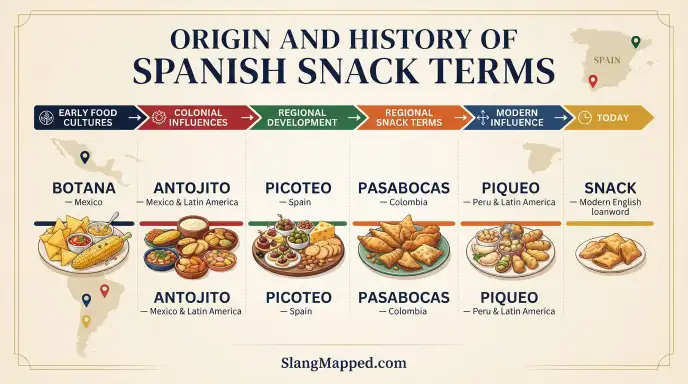
There is no single origin story for snacks in Spanish slang because the expressions come from different Spanish-speaking regions.
The English word snack is a modern loanword used in Spanish, especially in food, advertising, and casual contexts. Spanish also has older words for light meals, small bites, and food eaten between meals.
Regional expressions developed independently within different varieties of Spanish. That is why botana, pasabocas, and piqueo should not be treated as three versions of one universal slang word.
The Development of “Botana”
Botana is strongly associated with Mexican Spanish. It is used for small foods served casually, often as something to eat while socializing.
Its meaning is broader than one specific type of food. Depending on the situation, a botana can be a packaged snack, a plate of small foods, or something prepared for a group.
The Development of “Picoteo”
Picoteo is associated with Spanish usage and describes the act of eating small amounts of food, often informally and socially.
It is closely related to the verb picar, which can mean to take small bites or nibble.
This makes algo para picar another natural expression for “something to snack on.”
Regional Food Vocabulary
Spanish-speaking countries have their own food traditions and vocabulary. As a result, a snack may be described according to its size, purpose, preparation, or social setting.
This is why there is no need to force every expression into the category of slang.
How Popular Are These Terms Today?
The popularity of these expressions depends heavily on location.
Botana remains a familiar everyday word in Mexican Spanish. Picoteo is useful in Spain, while pasabocas has a strong connection with Colombian Spanish.
The English word snack is also widely recognizable in modern Spanish-speaking environments, especially where English influences food, entertainment, advertising, and online culture.
However, popularity does not mean that one word has replaced all others.
A person can understand snack while still naturally saying botana, merienda, or algo para picar in everyday speech.
Why Do People Use Different Words for Snacks?
People use different snack terms because Spanish is spoken across many countries and communities.
Regional vocabulary can reflect:
- Local food culture
- Family speech
- National vocabulary
- Informal conversation
- Social settings
- Traditional meal patterns
- Influence from other languages
For example, someone in Mexico may naturally say botana, while someone in Spain may say algo para picar.
Neither is automatically more correct. The choice depends on the speaker and context.
Common Misunderstandings About Snacks in Spanish Slang
“Botana” Is the Universal Spanish Word for Snack
It is not.
Botana is strongly associated with Mexican Spanish. It can be understood outside Mexico, but it should not be presented as the one slang word used throughout the Spanish-speaking world.
Every Alternative Is Slang
This is another common mistake.
Merienda, tentempié, and refrigerio are standard Spanish words. Botana, pasabocas, and piqueo are better understood as regional or informal expressions.
“Snack” Is Not Used in Spanish
This is also incorrect.
Spanish speakers do use the English loanword snack, particularly in modern commercial and casual contexts.
However, using snack does not make regional Spanish terms such as botana or picoteo incorrect.
All Spanish Speakers Use the Same Food Vocabulary
Spanish has major regional differences.
A word that sounds normal in Mexico may sound less natural in Spain. This is normal language variation, not a sign that one speaker is using Spanish incorrectly.
When Should You Avoid Using Regional Snack Slang?
You generally do not need to avoid these terms because they are offensive. The bigger concern is whether your audience will understand the regional expression.
Be more careful when:
- Writing for an international Spanish-speaking audience.
- Translating an important document.
- Teaching beginner Spanish.
- Speaking to someone whose regional vocabulary you do not know.
- Writing formal workplace communication.
- Creating content intended for several Spanish-speaking countries.
In these situations, a neutral term such as tentempié may be easier to understand.
For casual conversations, regional words are perfectly useful when they fit the speaker’s variety of Spanish.
Can You Use These Words at Work or School?
Yes, but context matters.
Words such as botana or picoteo are generally harmless. However, they are informal or regional, so they may not be the best choice for every formal document.
Casual Workplace Chat
A message such as:
¿Compramos unas botanas para la reunión?
can sound natural in a Mexican workplace where informal communication is normal.
Formal Communication
For a formal announcement, a more neutral term may be better:
Se ofrecerá un refrigerio durante la reunión.
English: “Refreshments will be provided during the meeting.”
The key difference is register, not politeness. A regional snack word is not automatically rude just because it is informal.
Which Spanish Snack Word Should You Use?
The best choice depends on what you want to say.
| If you mean… | Useful term |
| Mexican casual snack | Botana |
| A small tasty food or craving | Antojito |
| Casual snacking in Spain | Picoteo |
| Something to nibble on | Algo para picar |
| Colombian snack | Pasabocas |
| Small shared portions | Piqueo |
| Light meal/snack | Merienda |
| Neutral light snack | Tentempié |
| Light refreshment | Refrigerio |
| Modern borrowed term | Snack |
This table shows why there is no single answer to “What is snack in Spanish slang?”
Similar Spanish Food Expressions
Bocado
Bocado means a bite or mouthful of food.
It is useful when talking about a small amount rather than a complete snack.
Bocadito
Bocadito means a small bite or little piece of food.
The diminutive -ito can make the word sound smaller or more affectionate, depending on context.
Golosina
Golosina usually refers to a sweet, candy, or treat.
It is therefore narrower than the general English word snack.
Aperitivo
Aperitivo refers to food or a drink served before a meal. It can overlap with the idea of a snack, but it is not always the same thing.
Refrigerio
Refrigerio refers to a light food or drink taken to refresh or provide a small amount of nourishment.
It is more neutral and less slang-like than botana or antojito.
How to Say “I Want a Snack” in Spanish
There are several natural ways to express this idea.
General
Quiero un snack.
“I want a snack.”
Mexican-style casual wording
Quiero una botana.
“I want a snack.”
Talking About a Craving
Se me antoja algo.
“I feel like having something.”
Casual Spanish-style wording
Quiero algo para picar.
“I want something to snack on.”
Talking About a Light Meal
Quiero tomar la merienda.
“I want to have a snack/light meal.”
The most natural option depends on the country and the exact situation.
How to Say “Snacks” in Spanish Texting
There is no special universal texting abbreviation for snacks.
Spanish speakers can simply use the normal word or phrase that is natural in their region.
Examples include:
¿Traes botanas?
“Are you bringing snacks?”
¿Compramos algo para picar?
“Should we get something to snack on?”
Llevo unos pasabocas.
“I’ll bring some snacks.”
The important point is that texting does not create one universal Spanish slang word for snacks.
Frequently Asked Questions
Q1. What is the Spanish slang word for snack?
There is no single universal slang word. Botana is common in Mexico, picoteo is common in Spain, pasabocas is associated with Colombia, and piqueo is used in parts of Latin America.
Q2. What do Mexicans call snacks?
Mexicans commonly call snacks botanas. The word can describe chips, nuts, nachos, small dishes, or other casual foods eaten alone or with others.
Q3. What does “botana” mean in Spanish slang?
Botana means a casual snack or small food, especially in Mexican Spanish. It is informal and commonly used in everyday conversation.
Q4. What does “antojito” mean?
Antojito refers to a small tasty food or something someone feels like eating. It comes from antojo, meaning a craving or desire for something.
Q5. What does “picoteo” mean in Spanish?
Picoteo means casual snacking or eating small portions of food. It is particularly associated with Spain and can involve several foods shared informally.
Q6. What do Spanish people call snacks?
In Spain, people may use picoteo or algo para picar for casual snacking. Tentempié and merienda are also useful depending on the type and timing of the food.
Q7. What does “pasabocas” mean?
Pasabocas is a regional Spanish term, especially associated with Colombia, for a small snack or appetizer.
Q8. Is “merienda” the same as “snack”?
Not always. Merienda is a light meal or eating occasion, often between main meals. A snack can be any small food eaten between meals, so the meanings overlap but are not identical.
Conclusion
The best snacks in Spanish slang term depends on the Spanish-speaking region.
Use botana for a common Mexican expression, picoteo or algo para picar for casual snacking in Spain, pasabocas in a Colombian context, and piqueo for small shared portions in regions where that word is used.
Remember that not every snack-related word is slang. Merienda, tentempié, and refrigerio are standard Spanish terms, while snack itself is an English loanword.
The safest approach is simple: match the word to the country, context, and audience. Regional Spanish makes food vocabulary more varied, so there is no need to force one word to fit every Spanish-speaking community.
Discover More Articles:

Hi, I’m Rachel Simmons, a language writer specializing in American English and modern slang. I research regional expressions, everyday phrases, and evolving word meanings across the United States. I enjoy making complex language trends simple, practical, and easy for everyone to understand.