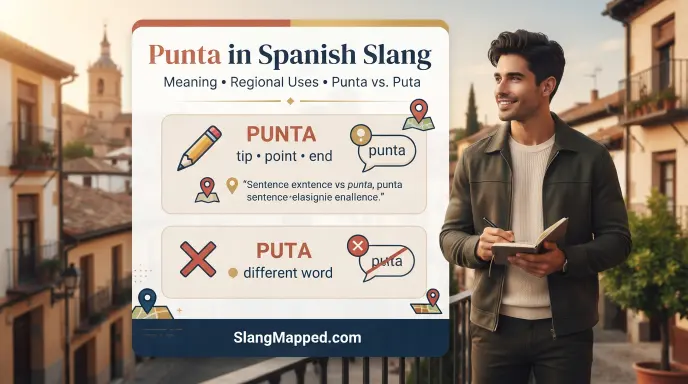
Punta in Spanish slang is not automatically a swear word. In standard Spanish, punta usually means “tip,” “point,” “end,” or “corner.”
It can also have several regional and colloquial meanings, so the exact meaning depends on the sentence and the country where the Spanish is spoken.
People often search for punta in Spanish slang because the word looks and sounds very similar to puta, a separate and vulgar Spanish word.
These two words should not be treated as the same. Punta has many ordinary uses, while puta has offensive meanings and uses.
This guide explains the standard meaning of punta, its documented regional uses, the difference between punta and puta, pronunciation, social-media context, and when it is safe or unwise to use the word.
Quick Answer: Punta in Spanish Slang
Punta usually means “tip,” “point,” “end,” or “corner” in Spanish. It is normally a neutral word, not a curse. However, dictionaries document several regional slang and colloquial meanings, including “a lot” in some areas and a derogatory meaning for a group of people in Mexico.
What Does Punta Mean in Spanish?
The basic meaning of punta is the pointed, narrow, outer, or ending part of something.
It is a normal Spanish noun and appears in everyday speech.
For example:
- la punta del lápiz = the tip of the pencil
- la punta del cuchillo = the tip of the knife
- la punta de la nariz = the tip of the nose
- la punta de la mesa = the corner of the table
- la punta de la isla = the tip or point of the island
Cambridge lists meanings such as “tip,” “point,” “corner,” and “headland,” while SpanishDictionary also gives meanings such as “side,” “corner,” and “pinch.”
Punta Is Not Automatically Slang
This distinction matters.
If someone says la punta del lápiz, they are simply talking about a pencil. There is no hidden slang meaning.
Likewise, punta can appear in geography, cooking, descriptions of objects, and common expressions without being offensive.
The slang meaning appears only in certain regional expressions or contexts.
Is Punta Actually Spanish Slang?
Sometimes, but not by default.
The word punta itself is standard Spanish. Some dictionaries also record colloquial or regional meanings. This means it is more accurate to describe punta as a standard Spanish word with additional regional slang uses, rather than calling the entire word slang.
SpanishDictionary, for example, records a colloquial Southern Cone use in which punta can mean “a lot,” “bunch,” or “loads.”
ASALE’s Diccionario de americanismos goes further and records country-specific meanings across Latin America.
Why This Distinction Matters
Calling every use of punta “slang” can confuse Spanish learners.
A better rule is:
Standard meaning first, regional meaning second.
That gives readers a much more accurate picture of how Spanish actually works.
Punta vs. Puta: Why People Get Them Confused
Punta and puta are different words.
This is probably the most important distinction for anyone searching for punta in Spanish slang.
| Word | Basic meaning | General tone |
| punta | tip, point, end | Usually neutral |
| puta | vulgar term and insult | Offensive |
SpanishDictionary lists punta as a feminine noun pronounced approximately “poon-tah.”
Does Punta Mean Puta?
No.
There is an n in punta. Removing that letter creates a different word with a very different meaning.
This is more than a spelling detail. If you are learning Spanish, confusing the two can create an embarrassing misunderstanding.
Why Do People Confuse Them?
Non-native speakers may hear Spanish quickly and miss the difference between the sounds.
Online discussions can make the problem worse because people sometimes write one word when they actually mean the other. Search results can also mix the two because both terms are commonly searched together.
So, if you see punta in a sentence, do not automatically replace it with puta.
Regional Slang Meanings of Punta
The regional meanings of punta are where the topic becomes more interesting.
ASALE’s Diccionario de americanismos documents different uses by country. This is strong evidence that punta does not have one universal slang definition across Spanish-speaking countries.
| Region | Documented use |
| Mexico | A group of people sharing a negatively viewed quality |
| Mexico, Peru, Chile, Argentina | A leading or first position in a competition or ranking |
| Venezuela | A taunt, indirect remark, or jab |
| Spain, Nicaragua, Uruguay | A large or indefinite amount |
| Chile | A small, occasional dose of a drug |
| Guatemala, Honduras, Nicaragua, Venezuela, Argentina | A group of cattle |
| Peru, Chile | A triangular neck scarf |
These are regional dictionary meanings, not meanings that every Spanish speaker uses.
The Mexican Derogatory Use
ASALE records a Mexican use of punta for a group of people who share a quality considered negative. The dictionary labels this use as derogatory.
This is an important example because it shows that punta can carry a negative tone without being equivalent to puta.
The “A Lot” Meaning
SpanishDictionary records a colloquial Southern Cone use where punta can mean “a lot,” “a bunch,” or “loads.”
This meaning is easy to miss if you only learn the basic translation “tip.”
What Spanish Dictionaries Say About Punta
A useful way to avoid misinformation is to compare reputable dictionaries rather than relying on a single slang website.
Cambridge Dictionary
Cambridge gives punta meanings including tip, point, corner, headland, and small amount, along with several common expressions.
SpanishDictionary
SpanishDictionary lists punta as a feminine noun and gives meanings including tip, side, corner, pinch, point, headland, and regional colloquial uses such as “a lot” and “bunch.”
ASALE
ASALE’s Diccionario de americanismos is particularly useful for slang and regional vocabulary. It identifies meanings by country rather than treating Latin American Spanish as one single variety.
This evidence supports a simple conclusion:
There is no single “punta slang meaning” that works everywhere.
Punta Meaning by Context
The sentence around punta can tell you which meaning is intended.
| Context | Likely meaning | Tone |
| Pencil or pen | Tip | Neutral |
| Knife or sharp object | Point/tip | Neutral |
| Table or cloth | Corner/end | Neutral |
| Geography | Point/headland | Neutral |
| “A punta de…” expression | Depends on expression | Contextual |
| Regional group reference | Group of people | Can be derogatory |
| Southern Cone colloquial use | A lot/bunch | Informal |
| Caribbean regional use | Taunt/indirect remark | Can be negative |
This is why translating one Spanish word without its sentence can produce a misleading answer.
How to Tell Which Meaning Someone Intended
If you encounter punta in a conversation, use these clues.
Look at the Words Around It
Compare:
La punta del lápiz.
This clearly refers to the tip of a pencil.
But a regional expression involving una punta de… may have a completely different meaning.
Consider the Country
A word can have a special meaning in Mexico that is not common in Argentina, Chile, Spain, or Puerto Rico.
ASALE specifically marks many punta meanings by country.
Check the Tone
Ask if the speaker is:
- Describing an object
- Talking about a place
- Joking
- Insulting someone
- Using regional slang
- Talking about a large amount
- Making an indirect remark
Tone can help distinguish ordinary Spanish from slang.
How Punta Is Used in Texting and Social Media
Seeing punta on TikTok, Instagram, Snapchat, Reddit, Discord, or in a text does not automatically mean you are looking at internet slang.
The person may simply be using the ordinary Spanish word.
For example, someone discussing travel might write about la punta de la isla. Someone talking about cooking might mention una punta de sal. Neither use is slang.
Why Social Media Causes Confusion
Social platforms often bring speakers from different Spanish-speaking countries together.
A Mexican speaker, Chilean speaker, and Spanish speaker from Spain may use the same word differently.
That means an online definition can be correct for one regional context but wrong if presented as a universal meaning.
Is Punta Rude or Offensive?
Usually, no.
The ordinary word punta is neutral.
However, some documented regional uses have a negative or derogatory tone. ASALE, for example, marks the Mexican use referring to a negatively viewed group as derogatory.
So the best answer is:
Punta itself is not generally a swear word, but particular regional uses can be informal, negative, or offensive.
That is very different from puta, which dictionaries explicitly classify as vulgar or offensive in its relevant uses.
Real-Life Examples of Punta
Here are examples that show how the word works in different contexts.
Talking About a Pencil
La punta del lápiz está rota.
English: “The tip of the pencil is broken.”
Tone: Neutral.
Talking About a Knife
Ten cuidado con la punta del cuchillo.
English: “Be careful with the tip of the knife.”
Tone: Neutral.
Talking About a Place
La casa está en la punta de la calle.
English: “The house is at the end of the street.”
Tone: Neutral.
Talking About the Tip of the Nose
Me duele la punta de la nariz.
English: “The tip of my nose hurts.”
Tone: Neutral.
A Regional Colloquial Use
In a Southern Cone context, punta can appear in expressions where it means a lot, a bunch, or loads. SpanishDictionary documents this colloquial usage.
The important point is that this meaning should not automatically be applied to Spanish everywhere.
Pronunciation of Punta
Punta is pronounced approximately:
POON-tah
SpanishDictionary gives the pronunciation as poon-tah.
The n is important because it separates punta from puta.
Punta vs. Puta Pronunciation
A simple learner-friendly comparison is:
- punta → approximately “POON-tah”
- puta → approximately “POO-tah”
The words are not identical, and native speakers distinguish them.
If you are speaking Spanish, pronounce the n clearly in punta.
Common Mistakes English Speakers Make
Assuming Punta Is Always Slang
It is not. The basic word is standard Spanish.
Assuming Punta Means Puta
It does not. These are separate words.
Applying One Country’s Slang Everywhere
Regional meanings should remain regional unless reliable evidence shows wider use.
Trusting a Single Online Slang Definition
Slang websites can be useful for discovering expressions, but dictionary evidence is better for deciding if a meaning is standard, colloquial, or regional.
Ignoring the Complete Sentence
A single word may have several meanings. Punta is a good example.
When Should You Avoid Using Punta?
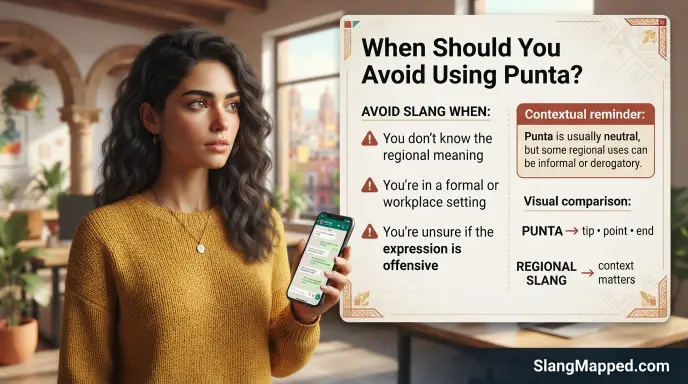
You do not need to avoid the normal Spanish word punta.
It is perfectly reasonable to use it when talking about a tip, point, end, or similar meaning.
Be more cautious when using an unfamiliar regional slang expression containing punta.
Avoid copying slang from social media when:
- You do not know what the full expression means.
- You do not know which country uses it.
- The phrase appears insulting.
- You are speaking in a workplace or formal setting.
- You are speaking with a teacher or someone you do not know well.
- You are unsure if you actually heard punta or puta.
When in doubt, use the standard meaning and avoid slang you cannot confidently explain.
Similar Spanish Words and Expressions
Several Spanish words can create confusion for learners.
| Word | Common meaning |
| punta | Tip, point, end |
| punto | Point, dot, period |
| pico | Beak, peak, pointed part; other regional meanings |
| puntero | Pointer; can have other meanings |
| puta | Vulgar term/insult |
The difference between punta and punto is also worth learning. They are related in some contexts but are not interchangeable.
Most importantly, do not treat punta and puta as spelling variations. They are different words.
Frequently Asked Questions
Q1. What does punta mean in Spanish slang?
Punta can have several regional slang or colloquial meanings, but its standard meaning is usually tip, point, end, or corner. Some regional uses mean “a lot,” refer to a group of people, or describe a taunt.
Q2. Is punta a bad word in Spanish?
No. Punta is normally a neutral Spanish word. Some regional uses can have a negative or derogatory tone, but the word is not automatically profanity.
Q3. Does punta mean puta?
No. Punta and puta are different Spanish words. Punta commonly means “tip” or “point,” while puta is a vulgar word with offensive uses.
Q4. What does punta mean in English?
The most common English translations are tip, point, end, corner, or headland, depending on context.
Q5. Can punta have a slang meaning?
Yes. Dictionaries document several regional and colloquial meanings. For example, SpanishDictionary records a Southern Cone use meaning “a lot” or “bunch,” while ASALE records several country-specific meanings.
Q6. Is punta offensive in Mexico?
The standard word is not offensive. However, ASALE records a Mexican derogatory use referring to a group of people who share a negatively viewed quality. That particular use can therefore be insulting.
Q7. How do you pronounce punta?
It is approximately pronounced “POON-tah.” The n is pronounced and helps distinguish it from puta.
Q8. Is punta used on TikTok and Instagram?
It can be, but seeing punta on social media does not mean it is automatically internet slang. Users may simply be using the normal Spanish word or a regional expression.
Q9. Can I use punta at work?
Yes, when you are using its normal meaning. For example, discussing la punta del lápiz or la punta de una herramienta is completely ordinary. Avoid unfamiliar regional slang expressions in formal settings.
Q10. Why do people confuse punta and puta?
They look and sound similar, especially to people who are new to Spanish. However, the n in punta changes the word, and the two terms have very different meanings.
Conclusion
Punta in Spanish slang is best understood as a standard Spanish word that also has several regional and colloquial meanings. Its most common meanings are tip, point, end, corner, or headland, and these uses are completely normal.
Some Spanish-speaking regions use punta in special expressions, including meanings related to large amounts, groups of people, taunts, and other local concepts. ASALE’s regional dictionary shows that these meanings vary by country.
The most important warning is not to confuse punta with puta. They are different words, and puta has vulgar and offensive uses.
So, if you see punta in a Spanish conversation, look at the full sentence and regional context before deciding that it is slang or offensive.
Explore More Reland Slang Terms
- Way Spanish Slang: Meaning of Güey and Wey
- Spaniard Slang: Common Spanish Slang Words Used in Spain
- Nombre Slang Meaning: What It Really Means in Spanish

Hi, I’m Rachel Simmons, a language writer specializing in American English and modern slang. I research regional expressions, everyday phrases, and evolving word meanings across the United States. I enjoy making complex language trends simple, practical, and easy for everyone to understand.