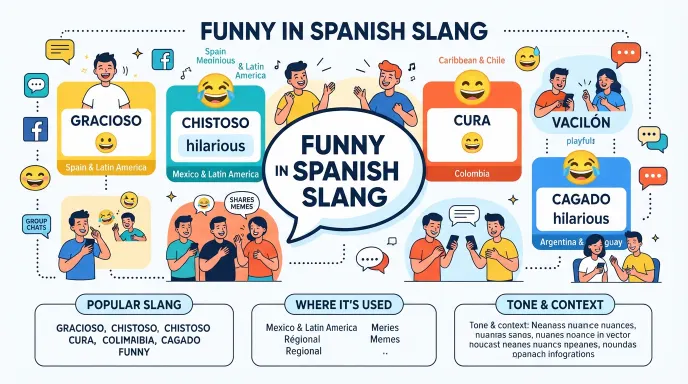
Funny in Spanish slang usually refers to informal Spanish words and expressions people use to describe something or someone as humorous, hilarious, amusing, or entertaining.
Instead of using the standard word gracioso, native Spanish speakers often choose slang that changes by country, region, and situation.
Many people search for funny in Spanish slang because they want to understand casual conversations, social media posts, memes, TV shows, or chats with Spanish-speaking friends. While some slang words are widely understood, others are only common in certain countries.
In this guide, you’ll learn the most popular slang words for “funny,” where they are used, when to avoid them, and how to use them naturally in real-life conversations.
Quick Answer: Funny in Spanish Slang
Funny in Spanish slang can be expressed with words like chistoso, cura, cagado, vacilón, and bacán, depending on the country. The safest and most widely understood word is gracioso, while slang alternatives vary across Spain and Latin America.
What Does Funny in Spanish Slang Mean?
In everyday Spanish, “funny” means something that makes people laugh or smile. The standard translation is gracioso, but in casual conversations, people often replace it with regional slang.
The exact slang word depends on where the speaker lives. A word that sounds natural in Mexico may sound unusual in Spain or Argentina.
Standard Meaning
The most common formal word is:
- Gracioso: Funny, amusing, or humorous.
- Divertido: Entertaining or enjoyable.
These words work in almost every Spanish-speaking country.
Slang Meaning
Slang words are more relaxed and often used among friends, classmates, coworkers, or online communities. Some expressions are playful, while others can be informal or even vulgar.
Is There a Full Form?
No. Funny in Spanish slang is not an abbreviation or acronym.
Instead, it refers to different slang words that Spanish speakers use instead of the standard word gracioso.
Different Ways to Say Funny in Spanish Slang
Spanish has many informal words for “funny.” Their meanings are similar, but the places where they are used are different.
Chistoso
Chistoso means funny or someone who enjoys telling jokes.
Example:
“Ese chico es muy chistoso.”
(“That guy is really funny.”)
This word is common across many Spanish-speaking countries and is usually polite.
Cagado (Mexico)
In Mexico, cagado can mean extremely funny or hilarious.
Example:
“¡Ese video está bien cagado!”
(“That video is so funny!”)
Although very common in casual speech, it comes from a vulgar root word, so avoid using it in professional settings or with people you do not know well.
Cura (Mexico)
In Mexican slang, cura refers to something funny or entertaining.
Example:
“Qué buena cura.”
(“That’s really funny.”)
It is commonly heard among younger speakers and friends.
Vacilón (Spain)
In Spain, vacilón describes someone who jokes around a lot or has a playful personality.
Example:
“Es muy vacilón.”
(“He’s really funny and playful.”)
It usually has a positive meaning but depends on the tone.
Bacán
In some Latin American countries, bacán mainly means cool or awesome. In casual conversation, it may also describe someone with an entertaining personality.
The exact meaning changes depending on the country.
Where Is Funny in Spanish Slang Commonly Used?
Different slang words appear in different places and conversations.
Everyday Conversations
Friends often use slang when talking about funny people, jokes, or amusing situations.
Example:
“Ese meme estuvo buenísimo.”
(“That meme was hilarious.”)
Social Media
Platforms like TikTok, Instagram, Facebook, and X are full of regional slang.
Users often comment on funny videos using local expressions instead of formal Spanish.
Text Messages
Friends usually shorten their messages and use informal vocabulary when chatting.
Example:
- “Ese video está cagado.”
- “Qué cura.”
- “Muy chistoso.”
Comedy Shows
Stand-up comedians and TV hosts often use regional slang to connect with local audiences.
Watching comedy from different countries is a great way to learn these expressions.
Is Funny in Spanish Slang Rude, Offensive, or Harmless?
Most words for funny in Spanish slang are harmless, but not all are appropriate in every situation.
| Slang Word | Tone | Safe for Everyone? |
| Gracioso | Neutral | ✅ Yes |
| Chistoso | Friendly | ✅ Yes |
| Cura | Casual | ✅ Usually |
| Vacilón | Informal | ✅ Usually |
| Cagado | Vulgar Casual | ❌ No |
When speaking with teachers, older adults, clients, or at work, choose gracioso or chistoso instead of stronger slang.
Real-Life Examples of Funny in Spanish Slang
Friends Talking
Carlos: ” Viste ese video?”
Luis: “Sí, está bien chistoso.”
Family Conversation
“Mi abuelo siempre cuenta historias muy graciosas.”
“My grandfather always tells funny stories.”
Social Media Comment
“JAJA, qué cura ese video.”
School
“Nuestro profesor también es muy gracioso.”
This sounds natural and respectful.
Workplace
Instead of slang, you might say:
“La presentación fue muy divertida.”
This is more professional than using regional slang.
Origin and History of Funny in Spanish Slang
Spanish has been spoken for centuries across Europe and the Americas. As the language spread, each country developed its own informal vocabulary.
Some slang words for “funny” come from local culture, while others grew popular through comedy, music, television, and everyday conversations.
Unlike formal Spanish, slang changes quickly. A word that is popular today may become outdated in a few years, while new expressions continue to appear through social media and youth culture.
There is no single slang word that represents every Spanish-speaking country. Instead, each region has developed its own way of describing something as funny, entertaining, or hilarious.
Similar Slang and Related Terms
Several Spanish words can describe something as funny, amusing, or entertaining. Some are standard Spanish, while others are regional slang.
| Word | Meaning | Commonly Used In |
| Gracioso | Funny, humorous | Most Spanish-speaking countries |
| Chistoso | Funny, good at telling jokes | Latin America |
| Divertido | Entertaining, enjoyable | All regions |
| Vacilón | Playful, likes joking around | Spain |
| Cura | Funny, amusing | Mexico |
| Cagado | Very funny or hilarious (informal) | Mexico |
| Buenísimo | Really good or hilarious (depending on context) | Many countries |
Funny vs. Gracioso
Although English uses one word “funny” Spanish speakers often choose different words depending on the situation.
- Gracioso focuses on humor.
- Divertido means entertaining.
- Chistoso often describes a person who enjoys making jokes.
- Regional slang adds a more casual and local feel.
When Should You Avoid Using It?
Not every slang word is suitable for every conversation. Think about who you are speaking with before choosing a slang expression.
At Work
Professional meetings, emails, and presentations are better suited to standard Spanish.
Instead of saying cagado, use gracioso or divertido.
At School
Teachers and school staff usually expect respectful language. Casual slang may sound too informal.
With Older People
Older adults may not recognize newer slang or may find some expressions inappropriate.
In Formal Writing
Avoid slang in:
- Business emails
- School assignments
- News articles
- Official documents
Standard Spanish is the better choice in these situations.
Polite Alternatives
If you want to say something is funny without using slang, these words are safe almost everywhere.
| Word | Meaning | Formality |
| Gracioso | Funny | Formal and informal |
| Divertido | Entertaining | Formal and informal |
| Humorístico | Humorous | Mostly formal |
| Entretenido | Enjoyable | Formal and informal |
| Ingenioso | Clever and witty | Formal |
These alternatives are suitable for conversations with teachers, coworkers, clients, and people you have just met.
Why Do People Use Funny in Spanish Slang?
Slang helps conversations sound more natural and expressive. Many native speakers use slang without even thinking about it.
It Sounds More Natural
Friends usually prefer casual words over formal vocabulary.
It Shows Local Identity
Many slang words are closely connected to a specific country or region. Using local expressions can make conversations feel more authentic.
It Adds Personality
Some slang words make a story sound more exciting or expressive than simply saying something is “funorous.”
It Fits Online Conversations
On platforms like TikTok, Instagram, Reddit, and messaging apps, people often choose slang because it feels shorter, more relaxed, and matches the casual tone of online communication.
Common Misunderstandings Of Funny in Spanish Slang
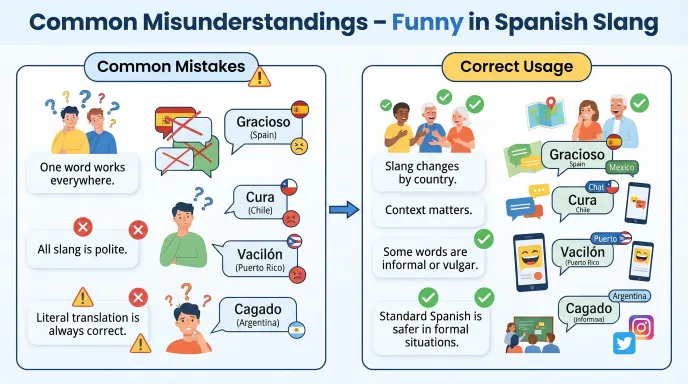
People learning Spanish sometimes assume there is only one slang word for “funny.” In reality, Spanish slang changes from country to country.
One Word Does Not Work Everywhere
A slang word that is common in Mexico may sound unfamiliar in Spain or Argentina.
Slang Is Not Always Appropriate
Some expressions are acceptable among close friends but may sound rude in formal settings.
Literal Translation Can Be Misleading
Certain slang words have literal meanings that are very different from how they are actually used in conversation.
For example, cagado literally comes from a vulgar word, but in Mexican slang it often means “very funny.” Because of its origin, it should still be used carefully.
Frequently Asked Questions
Q1. What is the most common way to say funny in Spanish?
The most common word is gracioso. It is widely understood across Spanish-speaking countries and is appropriate in most situations.
Q2. What is Mexican slang for funny?
Common Mexican slang includes cura and cagado. While both can describe something as funny, cagado is informal and comes from a vulgar expression.
Q3. Is gracioso slang?
No. Gracioso is standard Spanish, not slang. It is the safest and most widely accepted way to say “funny.”
Q4. Is cagado offensive?
It depends on the situation. Among close friends in Mexico, it often means “really funny.” However, because it has a vulgar origin, it is best avoided in professional or formal conversations.
Q5. Can I use Spanish slang at work?
It is generally better to use standard Spanish, such as gracioso or divertido, in workplaces, schools, and formal settings.
Q6. Does every Spanish-speaking country use the same slang?
No. Spanish slang varies widely by country and even by region. A word that is popular in Mexico may not be commonly used in Spain, Colombia, or Argentina.
Conclusion
Funny in Spanish slang does not have just one meaning or one correct word. While gracioso remains the safest and most widely understood choice, many countries use their own slang expressions such as chistoso, cura, vacilón, and cagado in casual conversations.
The best word depends on where you are, who you are talking to, and how formal the situation is.
If you are learning Spanish, start with gracioso and then explore regional slang as you become more familiar with different cultures.
Understanding these differences will help you communicate more naturally and avoid using informal expressions in the wrong context.
Discover More Articles:

Hi, I’m Rachel Simmons, a language writer specializing in American English and modern slang. I research regional expressions, everyday phrases, and evolving word meanings across the United States. I enjoy making complex language trends simple, practical, and easy for everyone to understand.