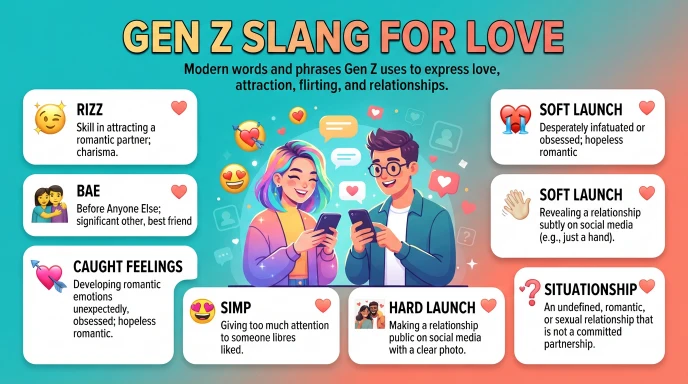
Gen Z slang for love includes modern words and phrases that young people use to express romantic feelings, attraction, affection, or emotional connection.
Instead of saying “I love you” directly, many people use trendy expressions like rizz, simp, caught feelings, or down bad to describe different stages of love and relationships.
People search for gen z slang for love because they often see these words on TikTok, Instagram, Snapchat, Discord, Reddit, or in text messages and want to know what they really mean.
Some of these expressions are playful, while others can be teasing or even slightly negative depending on the situation.
In this guide, you’ll learn the meanings of the most common Gen Z love slang, where these terms are used, when they’re appropriate, and how to understand them in everyday conversations.
Quick Answer: Gen Z Slang for Love
Gen Z slang for love refers to informal words and phrases that younger people use to talk about romance, attraction, crushes, flirting, dating, and emotional attachment. These expressions are popular on social media, messaging apps, and online communities, and their meanings often depend on the conversation and tone.
What Does Gen Z Slang for Love Mean?
The love slang meaning can vary by context. Gen Z slang for love is a collection of modern expressions that describe different romantic emotions and relationship experiences.
Unlike traditional love words, these slang terms are usually casual, humorous, or influenced by internet culture.
Some words describe having a crush, while others explain flirting, admiration, heartbreak, or strong attraction. Many of these expressions became popular through short-form videos, memes, and online conversations before spreading into everyday speech.
Instead of using one word for every romantic feeling, Gen Z often chooses different slang depending on the situation.
For example:
- Feeling attracted to someone
- Having a secret crush
- Flirting confidently
- Becoming emotionally attached
- Being obsessed with someone
- Falling in love unexpectedly
Because slang changes quickly, some expressions stay popular for years while others fade as new trends appear.
Different Meanings of Gen Z Slang for Love
Not every Gen Z love term means exactly the same thing. Some are positive, while others are funny, sarcastic, or slightly critical.
| Meaning | What It Refers To | Example |
| Romantic love | Deep affection for a partner | “They’re completely in love.” |
| Attraction | Liking someone’s appearance or personality | “She definitely has a crush on him.” |
| Flirting | Trying to impress someone romantically | “He’s using all his rizz today.” |
| Emotional attachment | Catching unexpected feelings | “I didn’t mean to catch feelings.” |
| Admiration | Really liking someone | “She’s totally obsessed with him.” |
| Heartbreak | Feeling sad after a relationship | “He’s still down bad after the breakup.” |
Understanding the context is important because the same expression can sound playful among friends but more serious in a romantic conversation.
Common Gen Z Slang for Crushing on Someone
Having a crush can be described in many casual ways online and in everyday conversations. People may use different expressions to talk about secretly liking someone, developing romantic feelings, or showing interest in a person.
- gen z slang for crushing on someone
- gen z slang for crush
- crush gen z slang
- slang for liking someone
- gen z love meaning
For example, someone might say, “I think I’m catching feelings,” when a casual friendship starts becoming romantic. Other expressions can describe attraction, flirting, or being strongly interested in someone.
How to Say “I Love You” in Gen Z Slang?
Wondering how to say I love you in Gen Z slang? You can use simple expressions such as ILY, ILYSM, LY, love you, bae, or you’re my person, depending on the relationship and tone.
| Expression | Meaning | Tone |
| ILY | I love you | Casual |
| ILYSM | I love you so much | Strong affection |
| LY | Love you | Short and casual |
| Love you | I love you | Natural and simple |
| You’re my person | You are very important to me | Sweet/romantic |
| Bae | Romantic partner or loved one | Playful |
If you’re looking for I love you in Gen Z language, texting abbreviations like ILY and ILYSM are among the easiest options. For a more personal message, phrases like “you’re my person” can sound warmer.
Where Is Gen Z Slang for Love Commonly Used?
Most Gen Z love slang appears in casual conversations rather than formal writing. These expressions are especially common where younger people communicate online.
Text Messages
Friends and couples often use love slang in everyday chats.
Example:
“Bro, I think I’m catching feelings.”
TikTok
Relationship videos, dating stories, memes, and trending sounds regularly introduce new love-related slang.
Captions, comments, reels, and story replies frequently include modern relationship expressions.
Snapchat
Quick chats and private conversations often use short slang words because they are fast and easy to type.
Discord
Gaming communities and friend groups sometimes use romantic slang jokingly or during casual conversations.
Relationship discussions, dating advice, and meme communities often explain or debate newer slang terms.
Everyday Conversations
Many Gen Z expressions have moved beyond the internet and are now spoken in schools, colleges, and among friends.
Where You’ll See These Terms Most
| Platform | How Love Slang Is Used | Popularity |
| TikTok | Dating videos, memes, trends | ⭐⭐⭐⭐⭐ |
| Captions, comments, DMs | ⭐⭐⭐⭐⭐ | |
| Snapchat | Personal chats | ⭐⭐⭐⭐☆ |
| Discord | Casual conversations, jokes | ⭐⭐⭐⭐☆ |
| Relationship discussions | ⭐⭐⭐⭐☆ | |
| Text Messages | Everyday chatting | ⭐⭐⭐⭐⭐ |
| Schools & Colleges | Face-to-face conversations | ⭐⭐⭐⭐☆ |
Common Gen Z Love Slang You’ll See
Here are some popular Gen Z romantic words and expressions related to love and dating.
| Slang | Meaning | Tone |
| Rizz | Natural charm or flirting ability | Positive |
| Caught Feelings | Started developing romantic emotions | Neutral |
| Crushing | Having a crush on someone | Positive |
| Down Bad | Extremely attracted or emotionally invested | Humorous |
| Simp | Someone who shows excessive attention to a person they like | Can be playful or teasing |
| Bae | Boyfriend, girlfriend, or loved one | Affectionate |
| Main Character | Someone acting confidently or romantically in their own story | Playful |
| Delulu | Unrealistically hopeful about a romantic situation | Humorous |
| Soft Launch | Hinting at a relationship online without revealing the partner | Neutral |
| Hard Launch | Publicly revealing a relationship on social media | Positive |
These Gen Z love terms don’t all mean “love” directly, but they are commonly used when talking about attraction, dating, and relationships.
Gen Z love words for a boyfriend or girlfriend can include affectionate terms such as bae and boo, depending on the relationship and tone.
Gen Z Love Words for Boyfriend and Girlfriend
The right term can depend on the relationship, personality, and tone of the conversation.
Some people use short affectionate expressions in texts, while others prefer playful nicknames or modern relationship terms.
You may come across phrases such as:
- gen z love words for boyfriend
- gen z love words for girlfriend
- gen z love words
- love gen z words
- gen z words for love you
- gen z term of endearment
- gen z terms of endearment
- my love in gen z language
- love terms gen z
- gen z slang for girlfriend
- gf z
For example, bae can be used as an affectionate name for a romantic partner. Other terms may be more personal or playful, so the relationship and context matter.
Is Gen Z Slang for Love Rude, Offensive, or Harmless?
Most Gen Z slang for love is harmless and playful. People use it to talk about dating, crushes, or relationships in a fun and casual way. However, a few terms can sound teasing or disrespectful if used in the wrong context.
Always consider your audience before using slang. A close friend may understand the joke, while a teacher, parent, or coworker may not.
| Slang | Offensive? | Notes |
| Rizz | No | A compliment about someone’s flirting skills. |
| Caught Feelings | No | A common way to say you’ve become emotionally attached. |
| Bae | No | A friendly nickname for a romantic partner. |
| Soft Launch | No | Refers to hinting at a relationship online. |
| Hard Launch | No | Publicly announcing a relationship. |
| Delulu | Sometimes | Usually a joke, but it can sound insulting if aimed at someone. |
| Simp | Sometimes | Often used playfully, but it can also mock someone for showing too much affection. |
| Down Bad | Sometimes | Usually humorous, though it can embarrass someone if used to make fun of them. |
Context Matters
The same slang word can have different meanings depending on the speaker’s tone.
Friendly
“You’re such a simp for your girlfriend.”
This might simply mean someone is very caring.
Mocking
“Stop being such a simp.”
Here, the speaker is making fun of someone.
Because tone changes the meaning, it’s best to use these terms with people who understand your sense of humor.
Why Do People Use Gen Z Slang for Love?
People use Gen Z love slang because it feels modern, expressive, and fun. These words often describe emotions in a way that traditional vocabulary cannot.
Common reasons include:
- Making conversations feel casual.
- Describing dating situations quickly.
- Joining online trends.
- Sharing jokes and memes.
- Expressing emotions with humor.
- Feeling connected to internet culture.
- Adding personality to text messages.
Many expressions also become popular because influencers, creators, and friends use them repeatedly on social media.
Gen Z Slang for Flirting and Dating
Flirting and dating have their own slang terms, especially in texting and social media conversations. These expressions can describe trying to attract someone, showing romantic interest, or navigating the early stages of a relationship.
Some searches related to this topic include:
- flirt in gen z slang
- gen z slang for flirting
- flirting in gen z slang
- gen z dating
- love gen z slang
- genz love terms
- slang love
For example, rizz is commonly associated with charm or the ability to attract someone. Other expressions can describe the talking stage, romantic interest, or developing feelings.
Because slang changes by community and platform, a term that sounds natural on social media may not be appropriate in a formal conversation.
Real-Life Examples of Gen Z Slang for Love
Here are realistic examples of how Gen Z love slang appears in everyday conversations.
Text Message
Alex: Did you talk to Emma today?
Ryan: Yeah… I think I’m catching feelings.
TikTok Comment
“Bro has unlimited rizz “
Instagram Caption
“Soft launching something special “
Snapchat Chat
Friend 1: Are you two dating?
Friend 2: Not officially… just vibing.
Discord Conversation
Player 1: You keep joining whenever she’s online.
Player 2: Don’t expose me
Reddit Post
“I’ve been talking to someone for two weeks, and now I’m catching feelings. Is that normal?”
School Conversation
Student A: Did Jake ask her out?
Student B: Yeah, his rizz finally worked.
Family Conversation
Teenagers usually avoid using newer slang with older family members because many parents may not recognize the terms.
Instead of saying:
“I’m down bad.”
They may simply say:
“I really like someone.”
Origin and History
Most Gen Z love slang did not appear all at once. Different words became popular at different times through music, online communities, and social media.
Many expressions spread rapidly after appearing in short videos, memes, or viral posts.
Early Internet Influence
Online forums and texting culture introduced many casual relationship expressions during the late 2000s and early 2010s.
Social Media Growth
Platforms like TikTok, Instagram, Snapchat, and Reddit helped new slang reach millions of users in a short time. A phrase could become popular worldwide within days if creators and influencers started using it.
Cultural Influence
Some modern slang has roots in specific communities before becoming mainstream. For example, several widely used internet expressions draw influence from African American Vernacular English (AAVE). As these words spread online, their meanings sometimes changed or broadened.
Understanding where a term comes from helps avoid using it incorrectly or taking it out of its original cultural context.
Slang Changes Quickly
Unlike dictionary words, internet slang evolves fast.Some expressions remain popular for years, while others disappear as new trends replace them. What sounds current today may feel outdated a few years later.Because of this, it’s always helpful to consider when and where a slang term is being used.
Similar Slang and Related Terms
If you’re learning Gen Z slang for love, you’ll probably come across these related expressions as well.
| Slang | Meaning | Common Use |
| Crush | Someone you like romantically | Everyday conversations |
| Rizz | Charm or flirting ability | Dating, TikTok |
| Bae | Romantic partner | Text messages |
| Simp | Someone showing lots of affection | Memes, jokes |
| Caught Feelings | Developed romantic emotions | Relationships |
| Down Bad | Extremely attracted to someone | Social media |
| Soft Launch | Hinting at a relationship online | Instagram, TikTok |
| Hard Launch | Publicly revealing a relationship | Social media |
| Ship | Wanting two people to become a couple | Fandoms, online communities |
| Situationship | A romantic connection without clear commitment | Dating discussions |
Gen Z slang for crush includes terms such as crushing, caught feelings, down bad, and delulu, depending on the context.
Gen Z Love Slang vs Traditional Expressions
| Traditional Phrase | Gen Z Slang |
| I like someone. | I’m catching feelings. |
| They’re a good flirt. | They’ve got rizz. |
| That’s my boyfriend/girlfriend. | That’s my bae. |
| I care about them a lot. | I’m down bad. |
| They announced their relationship. | They hard launched. |
These newer expressions often make conversations shorter, more playful, and more relatable among younger speakers.
When Should You Avoid Using Gen Z Slang for Love?
Gen Z love slang works best in casual conversations. In some situations, using these expressions may confuse people or sound unprofessional.
It’s usually better to avoid them in:
- Business emails
- Job interviews
- School assignments
- Academic writing
- Formal presentations
- Professional meetings
- Conversations with people who may not understand modern internet slang
For example, saying:
“Our manager has great rizz.”
may sound unprofessional in a workplace.
Instead, say:
“Our manager communicates confidently.”
Likewise, writing “I’m down bad” in a formal email is unlikely to be understood by everyone.
Can You Use Gen Z Love Slang at Work or School?
It depends on the setting and the people around you.
| Situation | Appropriate? | Why |
| Texting close friends | ✅ Yes | Very common in casual chats. |
| TikTok comments | ✅ Yes | Fits the platform’s informal style. |
| Instagram captions | ✅ Yes | Frequently used in social media posts. |
| Discord servers | ✅ Yes | Common in gaming and online communities. |
| Classroom discussions | ⚠️ Sometimes | Only if the teacher allows informal language. |
| Workplace chat | ⚠️ Sometimes | Use only with coworkers who understand the slang. |
| Job interviews | ❌ No | Professional language is a better choice. |
| Business emails | ❌ No | Slang may appear too casual or unclear. |
When you’re unsure, choose clear and standard English instead of slang.
Common Misunderstandings
People sometimes misunderstand Gen Z love slang because many words have meanings that depend on context.
“Rizz” Does Not Mean Love
Many people think rizz means being in love.
It actually refers to someone’s ability to attract or flirt with others, not love itself.
“Simp” Is Not Always an Insult
Some people use simp jokingly between friends.
Others use it to criticize someone for giving too much attention to a romantic interest.
The tone makes a big difference.
“Down Bad” Doesn’t Always Mean Heartbreak
Although it can describe emotional sadness after a breakup, it is more commonly used to mean someone is very attracted to another person.
Not Every Gen Z Uses the Same Slang
Gen Z is a large generation with different interests and backgrounds.
Some people use these expressions every day, while others prefer regular English or different regional slang.
Frequently Asked Questions
Q1. What is the most popular Gen Z slang for love?
There isn’t one single Gen Z word for love.” Popular relationship-related slang includes rizz, caught feelings, bae, down bad, soft launch, and situationship. Each describes a different part of dating or relationships.
Q2. Is Gen Z slang for love offensive?
Most terms are harmless and playful. However, words like simp or delulu may sound insulting if used to mock someone. Always consider your tone and audience.
Q3. What does “caught feelings” mean?
It means someone unexpectedly develops romantic emotions for another person after spending time together.
Example:
“We were just friends, but I caught feelings.”
Q4.What does “rizz” mean?
Rizz means charm or the ability to flirt successfully with someone. It does not mean love itself.
Q5. Is “bae” still popular?
Yes, although bae is still widely recognized, many Gen Z users now mix it with newer expressions depending on the platform and social group.
Q6. Which social media platforms use these terms the most?
You’ll commonly see Gen Z love slang on:
- TikTok
- Snapchat
- Discord
- X (formerly Twitter)
- Text messages
Q7. Can adults use Gen Z love slang?
Yes. Anyone can use these expressions if they understand the meaning and the situation. However, they are generally best suited to informal conversations.
Q8. Does Gen Z slang change often?
Yes. Internet slang evolves quickly. Some words stay popular for years, while others disappear as new trends emerge. If you’re unsure about a term, check how people are currently using it before adding it to your everyday vocabulary.
Q9. How to flirt in Gen Z Slang?
Gen Z slang for flirting commonly includes rizz, which refers to charm or the ability to attract someone romantically.
Conclusion
Gen Z slang for love is a fun and creative way to talk about attraction, dating, crushes, flirting, and relationships. Rather than relying on traditional phrases, Gen Z often uses expressions like rizz, caught feelings, bae, down bad, and soft launch to describe different romantic situations.
The key to understanding these terms is context. Some expressions are playful compliments, while others can be teasing or humorous depending on the conversation.
They’re most common on social media platforms and in text messages, but they aren’t always appropriate in professional or formal settings.
As online culture continues to evolve, new relationship slang will appear while older terms gradually fade.
Learning these expressions helps you better understand conversations on social media and communicate more naturally with people who use modern.
Explore More Articles:

Hi, I’m Rachel Simmons, a language writer specializing in American English and modern slang. I research regional expressions, everyday phrases, and evolving word meanings across the United States. I enjoy making complex language trends simple, practical, and easy for everyone to understand.