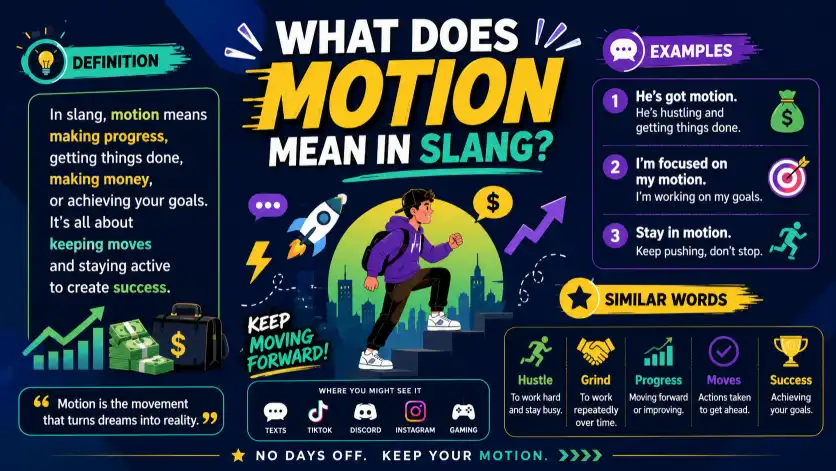
In slang, “motion” means money, success, or forward momentum in someone’s life. If a person says they “have motion” or “got motion,” they’re saying they’re doing well financially, making progress, or staying busy with things that are paying off.
People search what does motion mean slang after hearing it in a TikTok, a livestream, or from a younger family member, because the everyday meaning of “motion” (movement) doesn’t match how it’s actually being used. It sounds like a normal word, which makes the slang meaning easy to miss.
This guide breaks down exactly what “motion” means in slang, where it came from, how it’s used across different platforms and age groups, and how to tell it apart from the ordinary, non-slang use of the word.
Quick Answer:
“Motion” is slang for money, success, or momentum. Saying someone “has motion” means they’re doing well , earning money, gaining opportunities, or making visible progress in life. It’s most common in hip-hop culture, street slang, and, more recently, Gen Z and Gen Alpha TikTok trends.
What Does “Motion” Mean as Slang?
At its core, “motion” describes the feeling of things moving forward in someone’s favor. It’s not tied to one narrow definition , it stretches to cover money, opportunity, hustle, and general life progress, depending on how it’s used in a sentence.
Motion = Money or Financial Success
The most common modern use of “motion” is as a stand-in for money. “He’s got motion” usually means someone has cash, a steady income, or is clearly doing well financially.
Motion = Momentum or Progress
Beyond money specifically, “motion” can describe someone’s overall trajectory , new opportunities, a growing business, or visible upward movement in their career or social life.
Motion = Being Active and Busy (With Purpose)
Some uses of “motion” simply mean someone is staying productive and engaged, not sitting still, and putting in real effort toward a goal.
Different Meanings and Related Phrases
“Motion” on its own carries the general meaning above, but it also shows up in a few fixed phrases with their own shade of meaning. Treating each phrase separately avoids the confusion of assuming they all mean exactly the same thing.
“I got motion”
- Definition: A direct claim that the speaker has money, opportunities, or things going well for them right now.
- Tone: Confident, sometimes boastful, often said playfully rather than seriously.
- Example: “New shoes, new phone , I got motion right now.”
- Popularity: Very common in casual speech among students and became a widely recognized phrase through TikTok and livestreaming culture.
“Motion man” or “Motion god”
- Definition: A label for someone seen as especially successful, busy, and productive , a step up from just “having motion.”
- Tone: Complimentary, sometimes exaggerated for effect.
- Example: “Bro started a whole business this year, he’s a motion man now.”
- Popularity: Common in social media captions and comment sections, especially praising someone’s hustle.
“No motion” or “You ain’t got no motion”
- Definition: The opposite claim , that someone has no money, no momentum, or nothing going on for them.
- Tone: Teasing or dismissive, used in playful arguments between friends.
- Example: “Don’t talk, you ain’t got no motion right now.”
- Popularity: Common as a comeback line in casual banter.
Where Is “Motion” Commonly Used?
| Platform / Setting | How “Motion” Shows Up |
| TikTok / livestreams | “I got motion” as a confident brag, popularized through creator and gaming livestream culture |
| Texting between friends | Casual claims about money or good news, e.g. “got motion this week” |
| School / middle and high school slang | Common among Gen Alpha and younger Gen Z students as everyday bragging slang |
| Hip-hop lyrics and street talk | Longer-standing use describing hustle, momentum, and financial rise |
| Workplace chat | Rare and would sound out of place in professional communication |
The word spread quickly in 2025 and 2026 partly through popular livestreamers, which pushed it from hip-hop and street slang into much younger, broader online audiences.
Is “Motion” Rude, Offensive, or Harmless?
“Motion” is harmless slang. It’s used to brag, joke, or describe someone’s success, and it doesn’t target or insult any group of people.
- As a brag (“I got motion”): Playful, not offensive.
- As a compliment (“motion man/god”): A genuine compliment, sometimes with a joking exaggeration.
- As a tease (“no motion”): Light teasing between friends, not a serious insult, though tone and relationship matter, as with any friendly jab.
Real-Life Examples
Text message between friends:
“You coming out this weekend?” “Yeah I got motion, just got paid “
TikTok comment section:
“This guy dropped out and now runs his own detailing business, that’s real motion.”
School hallway conversation:
“New AirPods? You got motion or what?” “Nah my mom got them for my birthday “
Gaming livestream chat:
“Chat, I just hit a new PB and got a sponsorship offer, it’s motion season.”
Sibling teasing at home:
“You still asking mom for lunch money? No motion over here, huh?”
Each example shows “motion” being used to brag, compliment, or gently tease , always tied to the idea of things going well.
Origin and History of “Motion”
The slang use of “motion” traces back to hip-hop and street culture, where it was used to describe hustle, financial movement, and the general idea of “moving up” , building a brand, escaping a tough situation, or gaining traction in life. This usage grew alongside broader hustle and grind culture language in the late 2010s and early 2020s.
The word gained a second, much larger wave of popularity more recently, spreading rapidly through TikTok and livestreaming communities. Phrases like “I got motion” and “motion man” were pushed into mainstream youth slang partly through popular gaming livestreamers, which is why many parents and teachers only started hearing it from much younger students in 2025 and 2026, even though the underlying slang sense of the word is older.
Because the word has traveled between hip-hop culture, general street slang, and now Gen Alpha internet trends, its exact “first use” is hard to pin to one single moment , what’s clear is that the money/momentum meaning predates its recent viral spike by several years.
Similar Slang or Related Terms
| Term | Meaning |
| Bag / secured the bag | Made money or achieved a financial win |
| Grinding / hustling | Working hard toward success |
| On the come-up | Rising in success or status |
| Popping off | Doing very well or gaining sudden success |
| Moving different | Acting or living in a noticeably improved, more successful way |
When Should You Avoid Using “Motion”?
- In professional emails or workplace conversations , it’s casual slang and won’t read as clear or appropriate in formal writing.
- With teachers or in academic assignments , it will come across as too informal for schoolwork.
- When talking to someone unfamiliar with the slang , without context, “I got motion” can simply sound confusing, since the everyday meaning of “motion” (movement) doesn’t match.
- As a serious financial claim , since it’s often used loosely or jokingly, it isn’t the right word choice when you actually need to communicate real financial details.
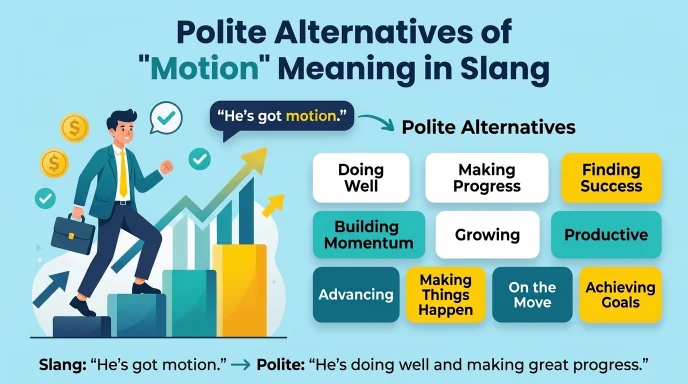
Polite Alternatives
Why Do People Use “Motion”?
People use “motion” because it’s short, upbeat, and instantly signals confidence without sounding like a plain brag. Saying “I got motion” feels more casual and clever than simply saying “I have money” or “things are going well for me.” It also ties into a bigger cultural theme , hustle culture and the idea of constantly moving forward , which makes the word feel aspirational as well as descriptive.
Common Misunderstandings
- Assuming “motion” always means literal movement. In slang, it almost never refers to physical motion , it’s about money, success, or momentum in someone’s life.
- Thinking it’s brand-new Gen Alpha slang. The core slang meaning comes from earlier hip-hop and street culture; it simply became far more visible recently through TikTok and livestreaming.
- Assuming it’s always a serious financial claim. Much of the time, “I got motion” is a lighthearted brag or joke rather than a literal statement about someone’s bank account.
Frequently Asked Questions
Q1: What does “motion” mean in slang?
It means money, success, or forward momentum. Saying someone “has motion” means they’re doing well or making visible progress in life.
Q2: Is “motion” rude or offensive?
No. It’s used to brag, compliment, or playfully tease, and it doesn’t carry any offensive or hateful meaning.
Q3: Where does the slang “motion” come from?
It originated in hip-hop and street culture as a way to describe hustle and financial movement, then spread widely through TikTok and livestreaming culture in more recent years.
Q4: Can I use “motion” at work?
It’s best avoided in professional settings. It works fine in casual conversation but reads as too informal for workplace or academic communication.
Q5: Is “motion” used on social media?
Yes, especially on TikTok, where phrases like “I got motion” and “motion man” are common as bragging or complimenting language.
Q6: What does “I got motion” mean?
It’s a direct, casual way of saying “things are going well for me right now,” usually about money, opportunities, or general success.
Q7. What does “motion man” mean in slang?
It’s a compliment for someone seen as very successful, busy, and productive , a step above just “having motion,” implying they’re always making moves and getting things done.
Q8. What do people mean when they say “motion”?
They usually mean money, success, or forward momentum in life , that someone is doing well or actively making progress.
Q9. What is “motion” slang in Urban Dictionary?
Urban Dictionary lists it mainly as having money and opportunities, and getting ahead of “haters” , though some entries also list other, unrelated crude meanings, since anyone can submit definitions.
Q10. What is “motion” slang for a girl?
Separately from the money meaning, some slang dictionaries use “having motion” to crudely describe a woman’s figure or the way she walks , this use is objectifying and isn’t the mainstream, everyday meaning of the word.
Q11. Why does Gen Z say “pookie”?
“Pookie” is a term of endearment, similar to “sweetie” or “honey,” used for partners, close friends, or pets. Its exact origin is unclear, but it’s an old affectionate nickname (dating back decades) that exploded in popularity through TikTok in 2023.
Conclusion
“Motion” in slang has nothing to do with literal movement , it’s shorthand for money, momentum, and success.
The word grew out of hip-hop and street culture and picked up a huge second wave of popularity through TikTok and livestreaming, especially among younger students who now use it as everyday bragging language.
It’s harmless, casual, and works well among friends, but it’s not the right word for formal writing or serious financial conversations.
Once you know the context, “motion” is simply a quick way of saying someone’s life is moving in a good direction.
Discover More Articles:

Hi, I’m Rachel Simmons, a language writer specializing in American English and modern slang. I research regional expressions, everyday phrases, and evolving word meanings across the United States. I enjoy making complex language trends simple, practical, and easy for everyone to understand.