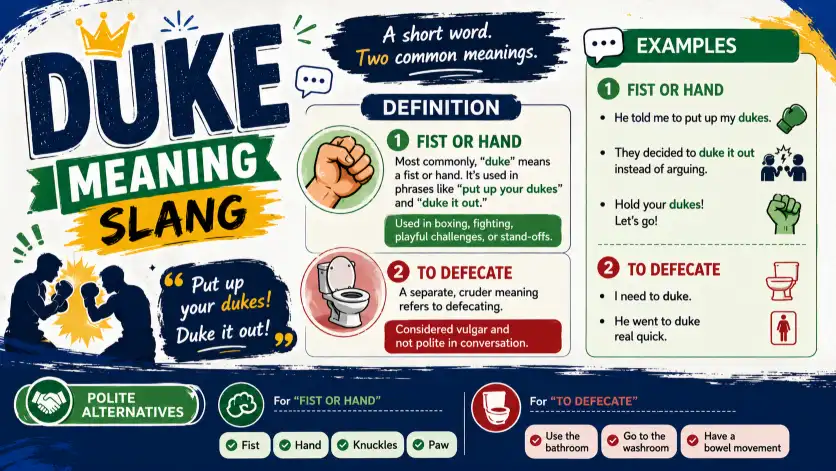
In slang, “duke” most often means a fist or hand, used in phrases like “put up your dukes” (get ready to fight) or “duke it out” (to fight or compete hard). It’s also used informally as a nickname and, in a cruder sense, as a word for going to the bathroom.
People search for duke meaning slang because they hear the word in a movie, a sports commentary, a text message, or a joke, and the meaning isn’t obvious from context.
It doesn’t look like typical internet slang, and it isn’t tied to one platform the way newer terms are.
This guide breaks down every common meaning of “duke,” where each one comes from, how people actually use it today, and when it’s safe (or not) to use it yourself.
Quick Answer:
“Duke” is mainly slang for a fist or hand. “Put up your dukes” means “get your fists ready to fight.” A related phrase, “duke it out,” means to fight or compete fiercely over something , physically or in an argument, a game, or a negotiation. A separate, cruder slang use of “duke” refers to defecating.
The Different Meanings of “Duke” in Slang
“Duke” isn’t a single-meaning slang word. It has three distinct uses, and mixing them up is where most confusion comes from.
Meaning 1: Duke = Fist or Hand
This is the original and most well-known slang meaning. “Dukes” (usually plural) refers to a person’s fists.
- Definition: Hands or fists, ready for a fight.
- Tone: Old-fashioned, tough-guy, often used jokingly rather than as a real threat today.
- Example: “Put your dukes up, let’s see what you got.”
- Popularity: Still recognized, but mostly heard in older movies, wrestling commentary, or as a playful challenge between friends rather than everyday conversation.
Meaning 2: Duke It Out = To Fight or Compete Hard
Built from meaning 1, “duke it out” expanded beyond literal fighting.
- Definition: To fight, argue, or compete intensely until there’s a winner.
- Tone: Can be literal (a physical fight) or figurative (a debate, a sports match, a business rivalry).
- Example: “The two teams duked it out until the final second.”
- Popularity: Common in sports journalism, news headlines, and everyday speech. This use is far more current than “put up your dukes.”
Meaning 3: Drop a Duke = Bathroom Slang (Crude)
This meaning is unrelated to the fist-related uses and is considered vulgar.
- Definition: A crude, informal way to say someone is defecating.
- Tone: Crass and juvenile. It’s toilet humor, not aggressive or dangerous, but it is impolite in most settings.
- Example: “He said he’d be right back , had to drop a duke.”
- Popularity: Used mainly among close friends or in casual, joking conversation. It’s not something you’d say to a teacher, parent, or coworker.
Meaning 4: Duke as a Nickname (Not Really Slang, but Related)
“Duke” is also a common nickname , most famously for actor John Wayne, who was called “The Duke.” Duke University and Duke Ellington also come up often in searches for this word.
These aren’t slang; they’re proper nouns, but they explain why some people search “duke” without meaning any of the slang definitions above.
Where Is “Duke” Commonly Used?
| Platform / Setting | How “Duke” Shows Up |
| Texting | Mostly “duke it out” in casual arguments or banter |
| Sports commentary | “The boxers duked it out for 12 rounds” |
| Gaming / Discord | Playful trash talk: “Let’s duke it out in the next match” |
| TikTok / Instagram | Rare as slang; more often a reference to “The Duke” or Duke University |
| Workplace chat | Almost never used, and “put up your dukes” or “drop a duke” would sound out of place |
| Face-to-face conversation | “Put up your dukes” as a joking challenge among friends |
The fist-related meaning shows up far more in spoken English, headlines, and older media than in modern texting or app-based slang. It’s not a term that originated on a specific social platform.
Is “Duke” Rude, Offensive, or Harmless?
It depends entirely on which meaning is being used, so this isn’t a single yes-or-no answer.
- “Put up your dukes” / “duke it out”: Harmless in almost every context. It’s playful or descriptive, not offensive, and doesn’t target any group.
- “Drop a duke”: Crude and impolite, but not offensive in the sense of being hateful or targeted. It’s the kind of phrase that’s fine among close friends and inappropriate almost everywhere else.
- No known offensive or hateful use: Unlike some slang terms, “duke” doesn’t carry a history of being used as a slur or coded insult.
Real-Life Examples
Text message between friends:
“You still mad about the game?” “Nah, we can duke it out in a rematch this weekend “
Gaming (Discord):
“Stop trash talking and just duke it out in ranked already.”
Sports commentary (TV or article):
“The two heavyweight champions are set to duke it out this Saturday night.”
Casual conversation:
“My brother and I used to put our dukes up over the last slice of pizza, never actually threw a punch though.”
Joking, informal text (crude meaning):
“Be back in 5, gotta drop a duke.”
Each example shows the same word carrying a completely different tone depending on which meaning is in play , which is exactly why understanding the context matters more than memorizing one definition.
Origin and History of “Duke”
The exact origin of “dukes” meaning fists is genuinely uncertain, and any source that states it with total confidence is oversimplifying.
The most repeated theory ties it to Cockney rhyming slang from working-class East London. In this theory, “Duke of Yorks” rhymed with “forks,” an old slang word for fingers, which eventually got shortened to “dukes.” This theory appears in print as far back as 1874, in John Camden Hotten’s dictionary of slang.
A second, less common theory suggests the word may come from Romani (Romany), where a word close to “dook” or “duke” is linked to the hand.
Language researchers who’ve studied the phrase say this Romani connection may have influenced or blended with the Cockney rhyming-slang theory, rather than one being definitively “correct” and the other wrong.
A third, more folkloric explanation connects the phrase to the Marquess of Queensberry, who created modern boxing rules , but most language historians consider this a coincidental, appealing story rather than a documented origin.
What is confirmed: the word “duke” meaning “fist” was already in common use in both the U.S. and England by the mid-1800s, showing up in an American soldier’s 1859 memoir.
“Duke it out” is a newer expansion of the older “dukes” slang, and became especially common in 20th-century American sports writing and everyday speech. It is not tied to any single generation , it predates Gen Z, Millennial, and even Baby Boomer slang by well over a century.
The “drop a duke” bathroom slang has a separate, much less documented history and appears mainly in informal slang dictionaries rather than historical print sources.
Similar Slang or Related Terms
| Term | Meaning |
| Throw down | To start a fight or challenge someone |
| Scrap | A fight, usually informal |
| Go toe-to-toe | To fight or compete very closely with someone |
| Fisticuffs | An old-fashioned, often joking word for fighting with fists |
| Drop a deuce | Another crude bathroom slang phrase, similar to “drop a duke” |
When Should You Avoid Using “Duke”?
- At work or in professional emails , “duke it out” can occasionally work in a light, informal team chat about a friendly competition, but “put up your dukes” and especially “drop a duke” should be avoided entirely.
- With teachers, elders, or in formal writing , none of these phrases fit a formal or academic tone.
- In any serious conflict , using “put up your dukes” to describe a real, non-joking fight can come across as minimizing something that’s actually serious.
- The crude meaning, in mixed or unfamiliar company , “drop a duke” is fine among close friends but can come across as immature or inappropriate elsewhere, including around children who may repeat it without understanding the context.
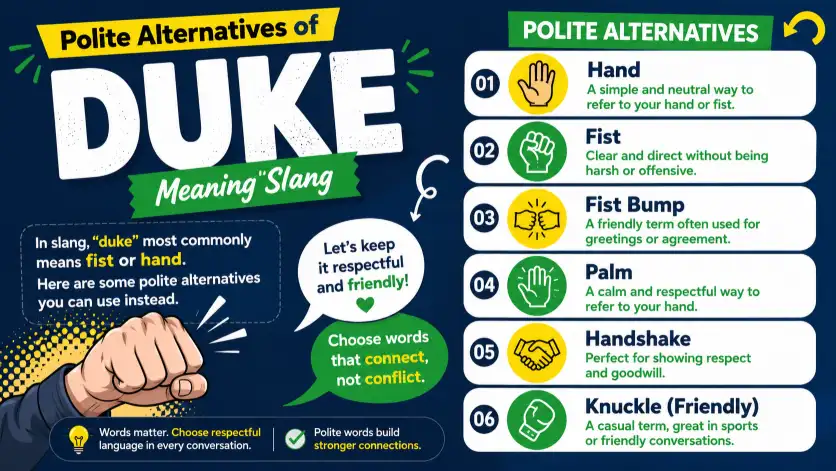
Polite Alternatives
Why Do People Use “Duke”?
People use “duke it out” because it’s short, vivid, and instantly understandable , it paints a clearer picture than saying “compete” or “argue.
” The fist-related meaning survives mostly because it sounds punchy (literally) and fits naturally into sports and competition talk.
The crude “drop a duke” meaning persists the way most toilet slang does: it’s silly, a little rebellious, and useful for avoiding a more blunt or clinical word in casual company.
Common Misunderstandings
Thinking “duke” only refers to a fight.
The bathroom-related meaning is completely separate and just as commonly searched.
Assuming it’s new internet slang.
“Duke” as slang for fists predates modern internet slang by more than 150 years it isn’t a TikTok or Gen Z invention.
Confusing it with “The Duke” nicknames.
References to John Wayne, Duke University, or Duke Ellington aren’t slang at all they’re proper names that happen to share the word.
Assuming one fixed origin story.
As shown above, historians and linguists don’t fully agree on where “dukes” (fists) came from, and it’s more honest to present it as a term with competing theories than a single confirmed fact.
Frequently Asked Questions
Q1: What does “duke” mean in slang?
Most commonly, it means a fist or hand, used in phrases like “put up your dukes” and “duke it out.” A separate, cruder meaning refers to defecating.
Q2: Is “duke it out” rude?
People commonly use it to describe a fight or intense competition. It is harmless and widely accepted in everyday speech and sports writing.
Q3: Is “drop a duke” offensive?
People generally see it as crude and juvenile rather than offensive. You can use it in casual conversations, but you should avoid it in formal or professional settings.
Q4: Where does the slang “duke” come from?
The most supported theory traces it to 19th-century Cockney rhyming slang (“Duke of Yorks” for “forks,” meaning fingers), though some linguists also point to a possible Romani-language influence.
Q5: Can I use “duke it out” at work?
In a light, informal context about friendly competition, it can work. It’s still casual language, so avoid it in formal reports, client-facing writing, or professional emails.
Q6: Is “duke” used on social media?
It shows up occasionally, mostly in the “duke it out” sense during sports or gaming banter, rather than as a trending or platform-specific term.
Q7. What does it mean to be called a duke?
Formally, “duke” refers to a high noble title just below a prince. Informally, people sometimes use “duke” or “dukes” as a casual, friendly nickname, similar to “dude” or “friend.”
Q8. What is a synonym for the word duke?
For the fist meaning: “fists” or “mitts.” For the noble title: “nobleman” or “peer.”
Q9. What does it mean to duke a girl?
Most standard slang dictionaries define “to duke” someone as to hit or punch them with your fist , so this would mean punching her, not a romantic term.
Q10. What does “duke it” mean?
It’s a short form of “duke it out” , to fight, argue, or compete hard until there’s a winner.
Q11. Is duke a slang term?
People recognize “duke” as established American slang when it means “fist” or appears in the phrase “duke it out.” However, people use “duke” as a formal, non-slang word when referring to a noble title.
Q12. What is a duke for a woman?
The female equivalent of the noble title “duke” is “duchess,” not “duke.”
Q13. Is “duke it out” considered slang?
Yes , it’s a widely recognized informal/colloquial phrase meaning to fight or compete intensely, listed as informal usage in standard dictionaries.
Conclusion
“Duke” carries three genuinely separate meanings: fists or hands (as in “put up your dukes”), a way of describing an intense fight or competition (“duke it out”), and a crude, informal word for using the bathroom.
The fist-related meaning has been around for well over 150 years, most likely rooted in Cockney rhyming slang, though its exact history isn’t fully agreed upon.
None of the meanings are hateful or targeted, but tone matters , “duke it out” is safe almost everywhere, while “drop a duke” is best kept to casual conversations with people who won’t mind the humor.
Knowing which meaning is in play is really the whole trick to understanding this word.
Discover More Articles:

Hi, I’m Tyler Brooks, a writer specializing in Gen Z culture and internet slang. I track trending terms across TikTok and social media to explain their real-world meanings. My goal is to provide clear, accurate, and up-to-date definitions that help readers understand modern online language.