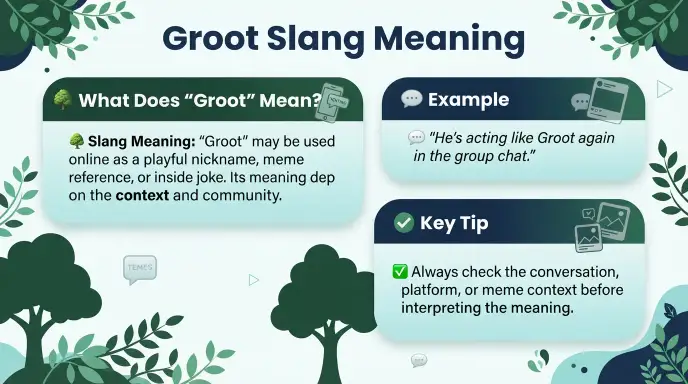
In slang, “Groot” is used mostly as a joking way to say something without really answering, based on a fictional tree character who can only speak one line.
People also use it as a playful compliment for someone big, quiet, and gently strong, or to describe someone being loud and hyper.
People search groot slang after seeing the word pop up in a meme, a comment section, or a group chat, and it doesn’t behave like a normal English word. That’s because it started as a movie catchphrase before it turned into everyday slang.
This guide covers every real meaning of “Groot” in slang, where each one is used, if it’s appropriate to say at work or school, and where the word actually comes from , including its surprising, non-slang origin.
Quick Answer: What Does “Groot” Mean in Slang?
“Groot” as slang mainly means giving a vague, one-line, non-answer to a question , copying a fictional character who can only say “I am Groot.” It’s also used as an affectionate label for someone who is big and quietly strong, or, less commonly, to describe someone acting hyper or over-excited.
Where Does the Slang Come From?
The slang use of “Groot” comes from a tree-like character in Marvel’s Guardians of the Galaxy films, who can only say one short line, over and over, no matter what he’s asked.
Fans and casual moviegoers picked up on how funny and strange that repetition sounded, and it turned into a real-world habit: repeating a fixed phrase instead of actually answering someone.
This is different from the word’s original meaning. Before it was a character name, “groot” is a real Dutch and Afrikaans word meaning “big” or “great” , it shows up in the Dutch surname “De Groot,” which translates roughly to “the big one” or “the tall one.”
The movie character’s name almost certainly nods to this meaning, since Groot is depicted as an unusually large, towering being. So the slang isn’t randomly invented , it grew out of an existing word, filtered through a pop-culture character, and then reshaped again by internet users.
The Different Meanings of “Groot” in Slang
“Groot” carries a few separate slang meanings today, and they don’t all mean the same thing, so it helps to look at them one at a time.
1: A Vague or Repeated Non-Answer
- Definition: Saying the same short, unhelpful phrase (often literally “I am Groot”) instead of giving a real answer.
- Context: Used when someone doesn’t want to answer directly, is joking around, or wants to dodge an awkward question.
- Tone: Playful and self-aware, rarely meant to be genuinely rude.
- Example: “Are you and Sara dating?” , “I am Groot.” , “That’s not an answer!”
- Popularity: This is the most common and widely recognized slang use, especially in comment sections and group chats where people quote the line as a joke.
2: Repeating It to Annoy or Confuse Someone
- Definition: Saying “I am Groot” over and over, on purpose, until the other person gives up or walks away.
- Context: A bit of harmless chaos between friends , it works because it’s confusing rather than because it’s mean.
- Tone: Silly, mock-annoying, meant as a joke rather than a real insult.
- Example: “Hey, are you okay?” , “I am Groot.” , “…Okay, what’s wrong?” , “I am Groot.” , “I’m leaving now.”
- Popularity: Common among younger internet users and gamers who enjoy the bit as a running joke.
3: An Affectionate Label for Someone Big and Gentle
- Definition: Calling someone “a Groot” or “being groot” as a warm, half-teasing compliment for being large, calm, and quietly protective.
- Context: Usually said about a friend, partner, or family member with a big, gentle presence.
- Tone: Sweet, sometimes teasing, never insulting.
- Example: “My boyfriend barely talks, but he’ll fight anyone who messes with me. Total Groot energy.”
- Popularity: Common in casual conversation and social media captions, less common in text abbreviations.
4: Acting Hyper, Loud, or Over-Excited
- Definition: Some slang dictionaries list “grooting” or “being groot” as acting overly hyper, wild, or a little unhinged with excitement.
- Context: Said about someone who’s clearly too excited or worked up.
- Tone: Joking, not offensive.
- Example: “Calm down, you’re being groot right now, it’s just a video game.”
- Popularity: Less common than the other meanings, mostly seen in informal slang-dictionary submissions rather than everyday speech.
A Note on Rare, Crude Usage
A small number of user-submitted slang dictionary entries also list “groot” as a crude, body-related insult. This use is uncommon, not widely recognized, and isn’t part of the mainstream slang meaning most people mean when they use the word. It’s worth knowing it exists so you aren’t caught off guard, but it’s not something you’ll typically run into in normal conversation.
Where Is “Groot” Commonly Used?
| Platform / Setting | How “Groot” Shows Up |
| Texting | Quoting “I am Groot” as a joke non-answer |
| TikTok / Instagram comments | Reaction-style replies, often just “I am Groot” |
| Discord / gaming chats | Repeating the line to be playfully annoying |
| Used as a one-line joke reply in threads | |
| Workplace chat | Rare, and would come across as unprofessional if used with clients or managers |
| Face-to-face conversation | Occasionally said as an inside joke between friends |
The slang is strongest wherever movie and meme references travel fastest , comment sections, group chats, and gaming voice calls , rather than in formal writing.
Is “Groot” Rude, Offensive, or Harmless?
In its common uses, “Groot” is harmless. It’s a joke reference, a playful compliment, or a way to describe someone being excitable , none of which are meant to insult or target anyone.
- As a non-answer or running joke: Completely harmless, used for humor.
- As an affectionate label (“total Groot energy”): A compliment, not an insult.
- As “grooting” (hyper/excited): Mildly teasing but not offensive.
- The rare crude slang-dictionary definition: This isn’t how most people use or understand the word, so it shouldn’t be assumed unless the context clearly points that way.
Real-Life Examples
Text message between friends:
“Did you eat my leftovers?” “I am Groot ” , “THAT’S A YES”
Discord voice chat:
“Bro why do you keep saying ‘I am Groot’ every time I ask something” “I am Groot.”
Instagram caption:
“He carried all our bags without complaining, total Groot energy today “
Reddit comment thread:
“OP, be honest, did you actually apologize first?” “I am Groot.”
Casual conversation with a sibling:
“You’ve been bouncing off the walls all morning, calm down, you’re being groot.”
Each example shows the same core idea , using “Groot” to dodge a direct answer, describe gentle strength, or point out excitable energy, depending entirely on context.
Similar Slang or Related Terms
| Term | Meaning |
| No comment | A formal way of avoiding a direct answer |
| Big teddy bear | Describes someone large but gentle, similar to the “affectionate” Groot meaning |
| Broken record | Repeating the same thing over and over, similar to the “non-answer” Groot meaning |
| Feral | Acting wild or over-excited, similar to the “grooting” meaning |
When Should You Avoid Using “Groot”?
- In professional emails or workplace messages , quoting a movie character isn’t appropriate in formal or client-facing communication.
- With teachers, professors, or in academic writing , it will come across as too casual and won’t be understood as a real answer.
- When someone is asking a serious question , using “I am Groot” as a joke non-answer can feel dismissive if the other person genuinely needs a real response.
- With people unfamiliar with the movie reference , if someone hasn’t seen Guardians of the Galaxy, the joke won’t land and may just come across as confusing.
Polite Alternatives
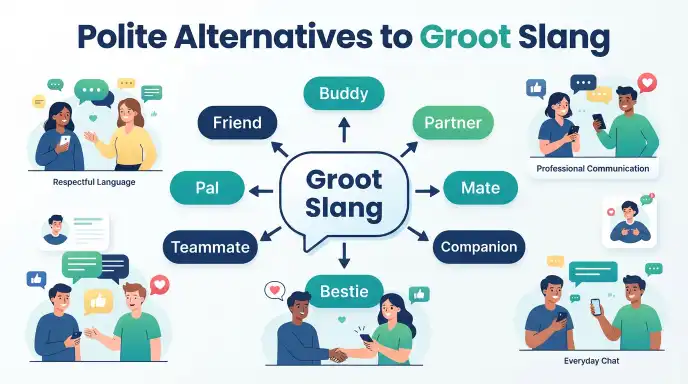
- Instead of “I am Groot” (as a dodge): “I’d rather not say” or “That’s between us.”
- Instead of “total Groot energy”: “He’s such a gentle giant” or “Quietly strong.”
- Instead of “you’re being groot” (hyper): “You’re a lot right now” or “Take a breath.”
Why Do People Use “Groot”?
People use “Groot” because it packs a whole personality into one word , the character is instantly recognizable, so referencing him communicates “gentle,” “big,” “loyal,” or “repetitive” without needing to explain further. Repeating “I am Groot” as a non-answer works because it’s genuinely funny: it mimics a beloved character while dodging a question in a way that feels playful rather than evasive. It’s a shortcut that only works because so many people already share the same movie reference.
Common Misunderstandings
- Assuming “Groot” only refers to the movie character. In slang, it’s been repurposed into several everyday meanings that go beyond simply naming the character.
- Thinking the word was invented for the movie. “Groot” is a real, older Dutch and Afrikaans word meaning “big” or “great,” and it also exists as a surname, long before the character was created.
- Treating every use as sarcastic or dismissive. The affectionate “gentle giant” meaning is sincere, not sarcastic, even though it’s still casual.
- Assuming the crude slang-dictionary definition is common knowledge. It isn’t the meaning most people intend, and leading with that assumption will usually be wrong.
Frequently Asked Questions
Q1: What does “Groot” mean in slang?
Most often, it means giving a joking, repeated non-answer to a question, based on a movie character who can only say one line. It can also mean calling someone a gentle giant, or describing someone acting hyper.
Q2: Is “Groot” rude or offensive?
No, not in its common uses. It’s a playful reference or compliment. A rare, uncommon crude definition exists in some user-submitted slang dictionaries, but it isn’t the standard meaning.
Q3: Where does the word “Groot” actually come from?
It’s originally a Dutch and Afrikaans word meaning “big” or “great,” also found in the surname “De Groot.” The Marvel character borrows this meaning, and internet slang later borrowed the character’s catchphrase.
Q4: Can I use “Groot” at work?
It’s best avoided in professional or formal communication , it only works in casual conversations where the movie reference will actually be understood.
Q5: Is “Groot” used on social media?
Yes, especially as a joking one-line reply in comments and captions, and as a way to describe someone as a “gentle giant.”
Q6: Is “I am Groot” the same as “Groot” slang?
They’re closely related. “I am Groot” is the exact catchphrase people quote, while “Groot” alone is used more loosely as a label or description.
Q7. What is Grootslang in South Africa?
It’s a legendary cryptid , a giant elephant-and-serpent hybrid said to live in caves and rivers in the Richtersveld region of South Africa’s Northern Cape.
Q8. What is the origin of the word Grootslang?
It comes from Afrikaans, where “groot” means “big/great” and “slang” means “snake,” so it literally translates to “big snake” or “great serpent.”
Conclusion
Groot slang grew out of a simple movie catchphrase and turned into several genuinely useful everyday meanings: a joking non-answer, an affectionate label for someone big and gently strong, and occasionally a way to describe hyper or excitable behavior.
The word itself is older than the character, rooted in a Dutch and Afrikaans term for “big,” which makes the slang feel a little less random once you know the backstory.
Keep it casual, keep it among people who’ll get the reference, and “Groot” works exactly the way it’s meant to , short, warm, and a little funny.
Explore More Articles:

Hi, I’m Rachel Simmons, a language writer specializing in American English and modern slang. I research regional expressions, everyday phrases, and evolving word meanings across the United States. I enjoy making complex language trends simple, practical, and easy for everyone to understand.