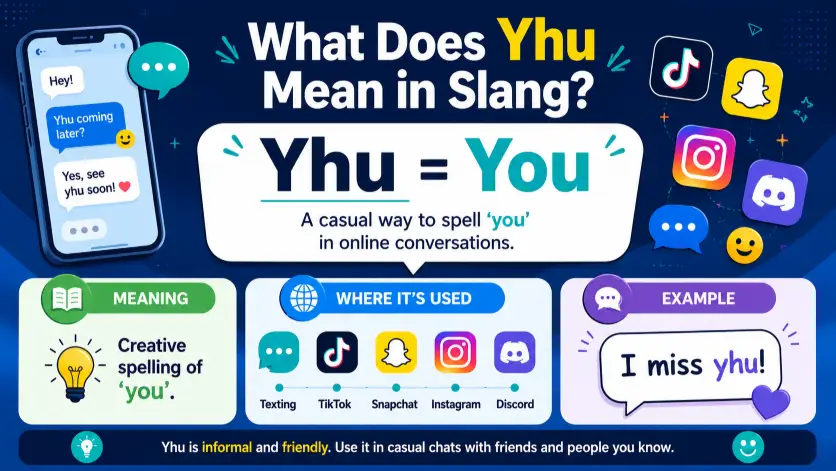
What does yhu mean in slang? Yhu is a stylized spelling of the word “you.” People use it in text messages, social media, and online chats to sound more expressive, playful, or unique.
Although it looks different, it has the same meaning as the standard word you.Many people search what does yhu mean in slang after seeing it on TikTok, Snapchat, Instagram, Discord, or in text messages.
At first glance, it can look like an abbreviation or a secret code, but it is simply another way to write “you.”
In this guide, you’ll learn what yhu means, where it came from, how people use it, if it’s appropriate in different situations, and see plenty of real-life examples.
Quick Answer: What Does Yhu Mean in Slang?
Yhu means “you.” It is an informal internet slang spelling used in texting and social media. People often write yhu instead of you to make messages feel more personal, stylish, or expressive. The meaning does not change ,it simply replaces the standard spelling.
What Does Yhu Mean in Slang?
Yhu is another way of spelling the word “you.” It is not an acronym or abbreviation with hidden meanings. Instead, it is a creative spelling that became popular in online conversations.
When someone writes:
- “Yhu are so funny.”
- “I miss yhu.”
- “Can yhu help me?”
they simply mean:
- “You are so funny.”
- “I miss you.”
- “Can you help me?”
The message stays exactly the same. Only the spelling changes.
People often use yhu because they like how it looks or because it gives their messages a more relaxed and personal style.
| Term | Meaning | Tone | Common Use |
| Yhu | You | Friendly, casual | Texting, social media, online chats |
Does Yhu Stand for Anything?
No. Yhu does not have a full form.
Unlike abbreviations such as:
- LOL = Laugh Out Loud
- BRB = Be Right Back
- IDK = I Don’t Know
Yhu is simply an alternative spelling of “you.”
Many people mistakenly think it is an acronym because of its unusual spelling, but that is incorrect.
Different Meanings of Yhu
For most conversations, yhu has only one meaning: “you.” However, the tone behind it can vary depending on the conversation.
1. A Friendly Way to Say “You”
This is the most common use.
Example
“Yhu always make me smile.”
Meaning:
“You always make me smile.”
2. A Stylish or Decorative Spelling
Some people enjoy changing the spelling of common words to make their messages stand out.
Examples include:
- yhu
- mah (my)
- dis (this)
- dat (that)
These spellings are often used for style rather than grammar.
3. A Casual Social Media Expression
On apps like TikTok or Instagram, users sometimes write yhu because it matches the informal tone of online conversations.
Example:
“Love yhu guys “
This simply means:
“Love you guys.”
Where Is Yhu Commonly Used?
You’ll mostly see yhu in informal conversations rather than formal writing.
| Platform | Is Yhu Common? | Notes |
| Text Messages | ✅ Very Common | Friends and family chats |
| Snapchat | ✅ Common | Casual conversations |
| TikTok Comments | ✅ Common | Friendly comments and captions |
| ✅ Common | DMs, captions, comments | |
| Discord | ✅ Sometimes | Casual servers and chats |
| ⚠️ Less Common | Depends on the community | |
| Gaming Chats | ✅ Sometimes | Informal team chats |
| School Essays | ❌ No | Use “you” instead |
| Workplace Emails | ❌ Never | Use proper spelling |
Who Uses the Word Yhu?
There is no single group that owns or created the term, but it is most often seen among:
- Teenagers
- Young adults
- Social media users
- Friends chatting online
- Mobile phone users
- People who enjoy creative texting styles
Although younger users tend to use it more often, anyone can write yhu in casual conversations.
Why Do People Spell “You” as “Yhu”?
People usually choose yhu for style rather than necessity.
Some common reasons include:
- To make messages look unique.
- To sound friendly or affectionate.
- To match texting trends.
- To give chats a playful tone.
- To personalize their writing.
Unlike abbreviations that save time, yhu actually has the same number of letters as you, so it is mostly about appearance rather than speed.
Is Yhu Popular on Social Media?
Yes. Yhu appears across many social media platforms, although it is not as common as standard spelling.
You may see it in:
- TikTok captions
- Instagram comments
- Snapchat chats
- Facebook posts
- WhatsApp messages
- Messenger conversations
- Discord chats
It is especially common in friendly conversations, compliments, and affectionate messages.
Examples:
- Miss yhu already.
- Thank yhu so much.
- Yhu did amazing!”
- Can’t wait to see yhu.
Because online language changes quickly, the popularity of creative spellings like yhu may vary over time. Some users still enjoy this style, while others prefer the standard spelling you for clarity.
Real-Life Examples of Yhu in Slang
Seeing yhu in context makes it much easier to understand. In every example below, yhu simply means “you.”
Friends Chatting
Friend 1: “Yhu coming tonight?”
Friend 2: “Yeah, I’ll be there around 7.”
Text Message
Alex: “Thank yhu for helping me today.”
Sam: “You’re welcome!”
TikTok Comment
“Yhu absolutely nailed this dance!”
Meaning:
“You absolutely nailed this dance!”
Instagram Caption
“Love yhu all “
Meaning:
“Love you all.”
Snapchat Message
“Miss yhu already.”
Meaning:
“Miss you already.”
Gaming Chat
“Yhu saved the whole team!”
Meaning:
“You saved the whole team!”
Family Chat
“Happy birthday! Love yhu so much.”
Meaning:
“Happy birthday! Love you so much.”
Origin and History of Yhu

The exact origin of yhu is uncertain, and there is no official record showing who first used it. It likely became popular through online messaging and social media during the late 2000s and early 2010s, when users began experimenting with creative spellings of everyday words.
Rather than being an abbreviation, yhu is a stylized spelling of you. Similar creative spellings appeared in text messages, chat rooms, and social networking sites where people wanted their writing to feel more personal or distinctive.
As smartphones and social media grew, spellings like yhu, mah, dis, and dat spread through online communities. Today, yhu is still recognized by many internet users, although it is less common than the standard spelling you.
Is Yhu Still Popular?
Yes, but not as much as before.
Creative spellings such as yhu were especially popular several years ago. Today, many people simply write you, while others continue using yhu in casual chats with friends.
Its popularity depends on:
- Friend groups
- Online communities
- Personal writing style
- Social media trends
Because internet slang changes quickly, some users may view yhu as a slightly older texting style, while others still use it regularly.
Is Yhu Rude, Offensive, or Harmless?
Yhu is generally harmless.
It is simply another way of writing you and does not carry an offensive meaning on its own.
| Situation | Appropriate? |
| Friends | ✅ Yes |
| Family | ✅ Yes |
| Text Messages | ✅ Yes |
| Social Media | ✅ Yes |
| School Assignments | ❌ No |
| Business Emails | ❌ No |
| Job Applications | ❌ No |
The word itself is not rude. However, the tone of the message matters. For example:
- “Thank yhu!” is friendly.
- “Yhu never listen!” may sound rude because of the sentence, not because of the word yhu.
Can You Use Yhu at Work or School?
Usually, no.
While most people will understand what yhu means, it is considered too informal for professional or academic writing.
Use you instead when writing:
- School essays
- Homework
- Research papers
- Business emails
- Job applications
- Professional messages
- Formal letters
Save yhu for casual conversations with people who are familiar with internet slang.
Similar Slang and Related Terms
Many internet users enjoy changing the spelling of common words. Here are a few examples.
| Slang | Standard Word | Meaning |
| Yhu | You | Refers to the person being spoken to |
| U | You | Shortened spelling of “you” |
| Ur | Your / You’re | Depends on the sentence |
| Mah | My | Creative spelling of “my” |
| Dis | This | Informal spelling |
| Dat | That | Informal spelling |
| Luv | Love | Casual spelling |
| Thx | Thanks | Shortened expression |
These spellings make conversations feel more relaxed but should be avoided in formal writing.
Why Do People Use Yhu?
People rarely use yhu because it is faster. Instead, they use it because it changes the style and tone of a message.
Common reasons include:
- It feels more personal.
- It looks creative.
- It matches casual texting habits.
- Friends may use the same style.
- It helps messages sound playful or affectionate.
For many users, it is simply a fun way to write.
When Should You Avoid Using Yhu?
Although yhu is harmless, there are times when using the standard spelling you is the better choice.
Avoid using yhu in:
- Academic assignments
- Exams
- Professional emails
- Business reports
- Workplace chats with clients
- College applications
- Official documents
- Customer service communication
Using proper spelling in these situations helps you appear clear, professional, and respectful.
Common Misunderstandings About Yhu
People often misunderstand yhu when they first see it. Here are some common myths and the facts.
| Myth | Fact |
| Yhu is an acronym. | ❌ No. It is simply another spelling of “you.” |
| Yhu has a secret meaning. | ❌ No. It usually means exactly the same as “you.” |
| Only teenagers use it. | ❌ Mostly younger users, but anyone can use it. |
| Yhu is rude. | ❌ No. The tone depends on the full message. |
| Yhu is correct for formal writing. | ❌ No. Use the standard spelling you in formal situations. |
Understanding these differences can help you interpret messages correctly and choose the right way.
Frequently Asked Questions
What does yhu mean in slang?
Yhu means “you.” It is a creative spelling used in texting, social media, and online chats. The meaning stays the same as the standard word you.
What does yhu stand for?
Yhu does not stand for anything. It is not an acronym like LOL or BRB. It is simply an alternative spelling of you.
Is yhu used in text messages?
Yes. Yhu is commonly used in text messages between friends, family members, and people chatting casually online.
Example:
“How are yhu today?”
This means:
“How are you today?”
What does yhu mean on Snapchat?
On Snapchat, yhu simply means “you.” Users often write it to make messages sound more friendly or expressive.
Example:
“Miss yhu “
Meaning:
“Miss you.”
What does yhu mean on TikTok?
On TikTok, yhu usually means “you.” You might see it in captions, comments, or replies.
Example:
“Yhu deserve more followers!”
Meaning:
“You deserve more followers!”
Is yhu grammatically correct?
No. Yhu is not standard English spelling. It is internet slang and should only be used in informal conversations.
For school, work, or professional writing, always use you.
Is yhu rude or offensive?
No. Yhu is generally harmless and not considered offensive. The tone depends on the rest of the message, not the word itself.
Who usually uses yhu?
You’ll most often see yhu used by:
- Teenagers
- Young adults
- Social media users
- Friends texting each other
- People in casual online communities
Anyone can use it, but it is much less common in formal settings.
Is yhu still popular?
Yes, but not as much as it once was. Many people now prefer the standard spelling you, while others still use yhu in casual conversations or as part of their personal texting style.
Can I use yhu in school or at work?
It is best not to use yhu in:
- School assignments
- Business emails
- Job applications
- Professional documents
- Formal presentations
Use the standard spelling you instead.
Conclusion
If you’ve been wondering what does yhu mean in slang, the answer is simple: yhu is a creative spelling of “you.” It is commonly used in text messages, social media posts, and online chats to give conversations a more casual, friendly, or expressive tone.
Unlike abbreviations such as LOL or IDK, yhu does not have a full form or hidden meaning. It simply replaces the standard spelling of you.
While it works well in informal conversations with friends, it is not appropriate for professional emails, school assignments, or other formal writing.
As with most internet slang, context matters. Knowing where and when to use yhu will help you communicate naturally while avoiding confusion. When in doubt, use you in formal situations and save yhu for relaxed, everyday chats.
Explore More:

Hi, I’m Rachel Simmons, a language writer specializing in American English and modern slang. I research regional expressions, everyday phrases, and evolving word meanings across the United States. I enjoy making complex language trends simple, practical, and easy for everyone to understand.