Rock climbing slang shows up everywhere climbers talk, in gym conversations, on Instagram captions, in Reddit threads, and in group chats after a big send.
If you have ever seen a friend post “sent my project after five whippers” and had no idea what that meant, you are not alone.
Climbing has built its own vocabulary over decades, and a lot of it can look like a secret code to anyone outside the sport.
This guide walks through the most common terms, what they actually mean in real conversation, and how to use them without sounding out of place.
Quick Answer:
Rock climbing slang refers to the informal words and phrases climbers use to describe moves, gear, difficulty, and experiences on the wall, such as beta (advice on how to climb a route), sending (successfully finishing a climb), and whipper (a big fall while roped in).
What does rock climbing slang mean in text?
When you see climbing slang in a text, caption, or comment, it almost always describes something that happened on a climb or gives advice about one. It is a shorthand that lets climbers communicate quickly without spelling out every detail.
For example, a text like “got the beta from a local, sending tomorrow” tells another climber that the person received route advice and plans to complete a difficult climb the next day. To someone unfamiliar with the sport, that sentence would be nearly meaningless.
Common rock climbing slang terms and what they mean
Below is a breakdown of the terms climbers use most, grouped by what they describe.
Terms about success and effort
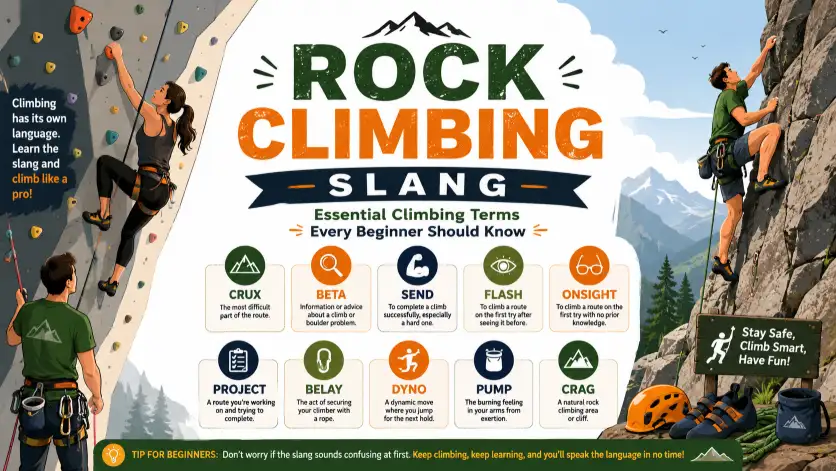
Send / Sending This means completing a climb cleanly, without falling or resting on the rope. “I finally sent that 5.11 today” is a moment worth celebrating in climbing circles.
Redpoint A redpoint is completing a route from bottom to top without falling, after having practiced it before. It is different from doing something on the very first try.
Onsight An onsight is completing a climb successfully on the first attempt, with no prior knowledge of the moves and no falls. It is considered one of the purest forms of a send.
Flash A flash is similar to an onsight, but the climber has received some information, or beta, about the route beforehand and still completes it on the first try.
Project A project is a route that a climber is actively working toward completing, often one that takes multiple sessions or weeks to finish.
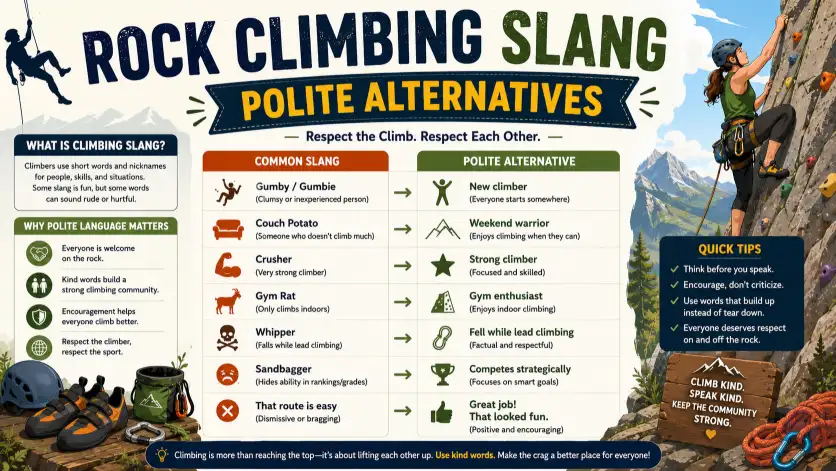
Sandbagging This describes a route that is harder than its stated grade suggests, or a person who understates how hard something is, sometimes as a joke among friends.
Terms about falling and safety
Whipper A whipper is a large, often dramatic fall while attached to a rope. Climbers sometimes share whipper videos as a badge of honor rather than something embarrassing.
Dab In bouldering, a dab happens when a climber touches the ground or a mat with a body part that is not supposed to touch, usually invalidating the attempt.
Catch This refers to how a belayer manages the rope when a climber falls, giving them a soft or controlled landing.
Terms about technique and gear
Beta Beta is information or advice about how to climb a specific route, including hand and foot placements. Climbers ask for beta constantly, and giving unsolicited beta is sometimes seen as poor etiquette.
Crux The crux is the hardest single move or section of a climb, the part most likely to cause a fall.
Crimp A crimp is a small, narrow hold that climbers grip with just their fingertips.
Jug A jug is a large, easy to hold grip, the opposite of a crimp.
Sloper A sloper is a rounded hold with no real edge, relying on friction and open hand grip strength rather than a strong finger grip.
Gaston A gaston is a move where a climber pushes outward on a hold with the elbow bent, rather than pulling inward.
Topping out This means reaching and climbing over the very top of a boulder or route, common in bouldering where there is no rope to lower off from.
Terms about people and community
Gumby A playful, and sometimes teasing, term for a new or inexperienced climber who may not yet know proper etiquette or technique.
Crusher Someone who climbs at a very high level, often used with admiration.
Beta spray Giving too much unwanted advice or information to someone climbing, often seen as annoying rather than helpful.
Is rock climbing slang rude, offensive, or neutral?
Most rock climbing slang is neutral and used casually within the community. A few terms, like sandbagging or gumby, can come across as teasing, so tone matters. Among friends these words are usually lighthearted, but used toward a stranger, they can sound condescending. Terms like crux, beta, send, and crimp are purely descriptive and carry no negative connotation at all.
Where is rock climbing slang commonly used?
This kind of language shows up most often in:
- Instagram captions and comments on climbing photos or videos
- Reddit communities focused on climbing and bouldering
- Discord servers for local climbing gyms or crews
- Group texts between climbing partners
- YouTube climbing vlogs and comment sections
- Conversations at the climbing gym or crag itself
Real life examples of usage
Friendly
“Nice send on that project, you crushed it today.”
Casual
“Can you give me the beta for the crux move, I keep falling there.”
Argumentative
“That is not a real onsight if someone already told you the beta.”
Gaming or social media context
“Posted my whipper video, worst catch of the year honestly.”
Origin and background of the slang
Much of climbing slang grew out of the sport’s small, tight knit communities in places like Yosemite and the sport climbing scenes of Europe during the 1970s and 1980s. Terms like redpoint trace back to European climbers marking unclimbed routes with a red dot until they were completed cleanly. As indoor climbing gyms grew rapidly in popularity over the last fifteen years, this vocabulary moved from a niche subculture into a much larger, more mainstream audience, especially online.
Comparison with similar terms
| Term | Meaning | Key difference |
| Onsight | First try, no prior beta | Purest form of a send |
| Flash | First try, with beta known | Slightly easier than onsight |
| Redpoint | Success after practice | Not a first attempt |
| Send | General success on a climb | Broad term covering any clean completion |
When to avoid using it
If you are talking with someone completely new to the sport, or writing for a general audience, heavy slang can confuse rather than connect. It is also worth toning it down in professional or safety related communication, where clear, precise language matters more than casual shorthand.
Polite alternatives
Why people use this slang
Climbing slang builds a sense of belonging. Using the right term at the right moment signals that you understand the sport and its culture, and it lets climbers describe fairly technical experiences in just a few words instead of long explanations.
Impact of using slang in communication
Within the climbing community, this shorthand speeds up communication and builds camaraderie. Outside that community, it can create distance or confusion if the listener does not share the same background, so reading your audience matters.
Is it safe for social media?
Yes, rock climbing slang is generally safe to use on social media. It carries no offensive meaning in the vast majority of cases and is widely understood across climbing focused platforms and hashtags. The only caution is that a few teasing terms could be misread by someone unfamiliar with climbing culture as more negative than intended.
FAQs
Q1. What does send mean in climbing slang?
It means completing a climb successfully, from start to finish, without falling.
Q2. What is the full form of beta in climbing?
Beta is not an abbreviation, it simply refers to advice or information about how to complete a route.
Q3. What does dab mean in bouldering slang?
A dab is touching the ground or mat with a body part during a bouldering attempt, which usually means the attempt does not count.
Q4. Is calling someone a gumby offensive?
It is usually a lighthearted, teasing term for a beginner among friends, though it can sound dismissive if used toward a stranger.
Q5. What does whipper mean in climbing?
A whipper is a large fall while roped in, often shared as an exciting story rather than something negative.
Q6. What does onsight mean compared to flash?
An onsight is a first try success with no prior information, while a flash is a first try success after receiving some beta beforehand.
Q7. What does rock climbing slang mean for beginners?
Rock climbing slang refers to the special words and phrases climbers use to describe climbing techniques, equipment, routes, and experiences.
Q8. What does “climber” mean in slang?
In climbing slang, a climber is simply someone who enjoys rock climbing, if indoors or outdoors. Friends may also casually call an enthusiastic climber a crusher if they’re especially skilled.
Q9. What do you call people who rock climb?
People who rock climb are commonly called climbers, rock climbers, or climbing partners. In climbing communities, experienced or strong climbers are sometimes nicknamed crushers, while beginners may jokingly be called newbies or gumbies.
Conclusion
Rock climbing slang is really just a fast, colorful way for climbers to describe their experiences on the wall. Terms like send, beta, crux, and whipper cover almost everything you will run into in a typical climbing conversation online or in person.
Most of it is casual and friendly, though a handful of teasing terms are best used with people you know well. Once you understand the context and tone behind each phrase, this language becomes an easy and natural part of talking about the sport.
Explore More:

Hi, I’m Tyler Brooks, a writer specializing in Gen Z culture and internet slang. I track trending terms across TikTok and social media to explain their real-world meanings. My goal is to provide clear, accurate, and up-to-date definitions that help readers understand modern online language.