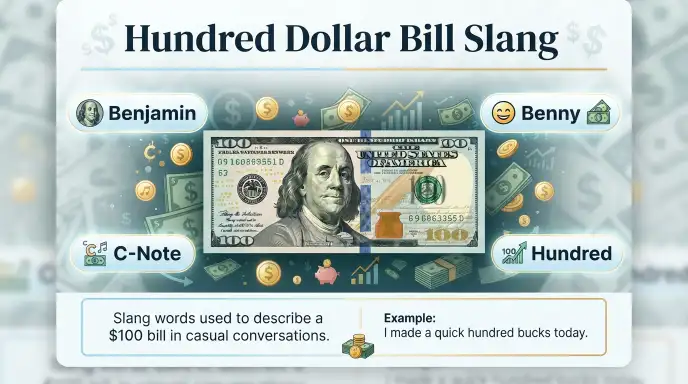
Hundred dollar bill slang refers to the informal names people use instead of saying “one hundred dollar bill” or “$100 bill.” Common slang terms include Benjamin, Benji, C-note, and Franklin.
These names are popular in everyday conversations, music, movies, and social media because they are shorter and more casual.
Many people search for hundred dollar bill slang after hearing these terms in songs, text messages, or online videos. Knowing what they mean helps you understand conversations without confusion.
In this guide, you’ll learn the most common slang names for a $100 bill, where they came from, when people use them, and if they are appropriate in different situations.
Quick Answer: Hundred Dollar Bill Slang
Hundred dollar bill slang includes informal names like Benjamin, Benji, Franklin, and C-note. Most of these names come from the fact that Benjamin Franklin’s portrait appears on the U.S. $100 bill. These slang terms are widely used in casual speech, music, pop culture, and online conversations.
What Does Hundred Dollar Bill Slang Mean?
Hundred dollar bill slang means any informal word or nickname used to describe a U.S. $100 banknote instead of saying “one hundred dollars.”
People use these nicknames to:
- Sound casual in conversation
- Shorten everyday speech
- Add style or humor
- Reference money in songs and movies
- Talk about cash in text messages or online posts
These slang words all refer to the same amount of money, but some are much more common than others.
| Slang Term | Meaning | Common Usage |
| Benjamin | $100 bill | Very common |
| Benji | $100 bill | Very common |
| Franklin | $100 bill | Common |
| C-note | $100 | Common |
| Hundred | $100 bill | Everyday speech |
Different Meanings of Hundred Dollar Bill Slang
Although most people use these terms to mean the same thing, each nickname has its own background and style.
Benjamin
Benjamin is the best-known slang term for a $100 bill.
The nickname comes from Benjamin Franklin, whose portrait has appeared on the front of the U.S. $100 bill for many years.
Examples:
- “I found two Benjamins in my old wallet.”
- “That jacket cost three Benjamins.”
Tone: Friendly and casual
Benji
Benji is simply a shorter version of Benjamin.
It has become especially popular in hip-hop music, social media, and everyday conversations among younger speakers.
Examples:
- “He paid me five Benjis.”
- “I’m saving every Benji I earn.”
Tone: Informal and modern
Franklin
Some people simply call a $100 bill a Franklin.
Like Benjamin, this nickname refers directly to Benjamin Franklin’s picture on the bill.
Although correct, it is slightly less common than Benjamin or Benji.
Examples:
- “She handed me a Franklin.”
- “I’ve only got one Franklin left.”
Tone: Casual
C-Note
C-note is another well-known slang term for one hundred dollars.
The “C” comes from the Roman numeral for 100, while “note” means a paper bill.
Unlike Benjamin or Franklin, C-note refers to the value of the money rather than the person shown on it.
Examples:
- “That repair cost a C-note.”
- “I made a quick C-note today.”
Tone: Informal but widely understood
Hundred
Sometimes people simply say “a hundred” when they clearly mean a $100 bill.
For example:
- “Can you break a hundred?”
- “I only have a hundred on me.”
In everyday conversation, the context usually makes the meaning clear.
Where Is Hundred Dollar Bill Slang Commonly Used?
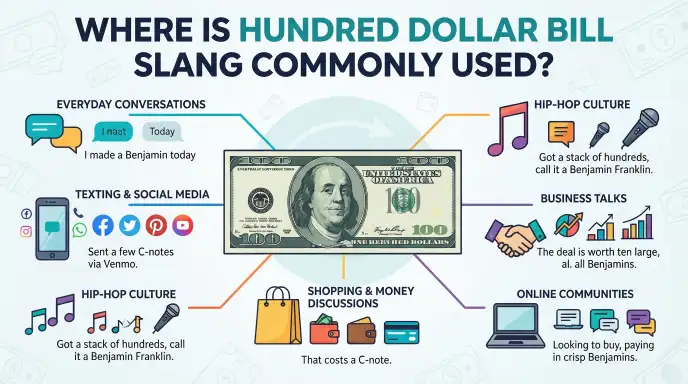
People use hundred dollar bill slang in many casual settings. The exact nickname often depends on the speaker, region, and situation.
Everyday Conversations
Friends and family often use slang instead of saying “$100 bill.”
Example:
“Can you lend me a Benjamin until Friday?”
Text Messages
Short nicknames are common because they are faster to type.
Example:
“I found a Benji in my jacket pocket!”
Social Media
On platforms like TikTok, Instagram, and X, users often mention Benjis or Franklins when talking about spending, saving, or earning money.
Example:
“Stacking Benjis all summer.”
Music and Pop Culture
Hip-hop, rap, and movies have helped make terms like Benjamin and Benji famous.
Lyrics often use these words because they are short, recognizable, and fit naturally into rhymes.
Casual Business Conversations
Some people jokingly use these slang terms with close coworkers or friends.
For example:
“That bonus was a few extra Benjamins.”
However, formal workplaces usually prefer saying “$100” or “one hundred dollars” instead of slang.
Is Hundred Dollar Bill Slang Rude, Offensive, or Harmless?
In most situations, hundred dollar bill slang is harmless. These nicknames simply refer to money and do not contain offensive language.
Here is a quick guide:
| Situation | Appropriate? |
| Talking with friends | ✅ Yes |
| Text messaging | ✅ Yes |
| Social media | ✅ Yes |
| Music lyrics | ✅ Yes |
| School essays | ❌ Usually no |
| Business reports | ❌ No |
| Legal or financial documents | ❌ Never |
While words like Benjamin and Benji are perfectly acceptable in casual conversation, they are not suitable for professional writing, contracts, or official financial records. In those situations, use the exact amount, such as “$100” or “one hundred dollars.”
Origin and History of Hundred Dollar Bill Slang
The most popular hundred dollar bill slang developed because Benjamin Franklin has appeared on the front of the U.S. $100 bill for more than a century. Over time, people began referring to the bill by Franklin’s first name instead of its value.
The nickname Benjamin became widely recognized in the late 20th century, especially through American pop culture, hip-hop music, movies, and television. As the term spread, shorter versions like Benji also became common in everyday speech.
Another long-standing slang term is C-note. Unlike Benjamin, it is based on the bill’s value rather than the person shown on it. The letter C represents the Roman numeral for 100, while note is an older word for a paper banknote.
Although these terms are popular, no single slang nickname is used everywhere. Different regions, age groups, and communities may prefer one term over another.
Timeline of Popular Usage
| Time Period | Development |
| Early 1900s | “C-note” begins appearing as slang for $100. |
| Mid-1900s | Benjamin Franklin becomes strongly associated with the $100 bill. |
| Late 1900s | “Benjamin” gains popularity in everyday American English. |
| 1990s–2000s | Hip-hop music helps make “Benji” and “Benjamin” widely recognized. |
| Today | Benjamin, Benji, Franklin, and C-note remain common casual terms. |
Real-Life Examples of Hundred Dollar Bill Slang
Seeing the slang used in real conversations makes it much easier to understand.
Friendly Conversation
Alex: “How much did the concert ticket cost?”
Jordan: “About two Benjamins.”
Text Message
Friend 1: “Did you get paid today?”
Friend 2: “Yep! A few extra Benjis this week.”
Shopping
Customer: “Can you break a Benjamin?”
Cashier: “Sure, no problem.”
Family Conversation
Dad: “Grandma gave you a Benjamin for graduation.”
Son: “That’s awesome! I’ll save it.”
Workplace Chat
Coworker: “The company gave everyone a Benjamin as a holiday bonus.”
This type of casual conversation is usually fine among coworkers, but official emails and reports should use the exact dollar amount instead.
Social Media Caption
“Saved my first ten Benjis this year! “
Music and Entertainment
Many rap songs and movies use Benjamin or Benji when talking about earning or spending money. These nicknames are popular because they sound natural and are easy to remember.
Similar Slang or Related Terms
Many U.S. currency denominations have their own nicknames. Learning them can help you understand conversations about money.
| Slang Term | Amount | Meaning |
| Buck | $1 | One dollar |
| Five | $5 | Five-dollar bill |
| Sawbuck | $10 | Ten-dollar bill |
| Twenty | $20 | Twenty-dollar bill |
| Fifty | $50 | Fifty-dollar bill |
| Benjamin | $100 | Hundred-dollar bill |
| Benji | $100 | Short form of Benjamin |
| Franklin | $100 | Named after Benjamin Franklin |
| C-note | $100 | One hundred dollars |
Remember that these are informal terms. Official financial documents always use the exact dollar amount.
Why Do People Use Hundred Dollar Bill Slang?
People often choose slang because it feels more natural than saying “one hundred dollar bill” every time.
Common reasons include:
- It makes conversations shorter.
- It sounds relaxed and friendly.
- It reflects American pop culture.
- It is common in music and movies.
- It adds personality to everyday speech.
- It helps people communicate casually with friends.
In many cases, the slang is simply part of everyday language rather than an attempt to sound fashionable.
Common Misunderstandings About Hundred Dollar Bill Slang
Some people become confused when they first hear these nicknames. Here are a few common misunderstandings.
“Benjamin” Is Not a Different Currency
Some people think a Benjamin is a special type of money.
It is not. It simply means a U.S. $100 bill.
“Benji” Does Not Always Mean Cash
In some conversations, Benji may be someone’s nickname or even the name of a pet.
Always look at the context before deciding what it means.
“Franklin” Usually Refers to the Person
Outside money-related conversations, Franklin often refers to Benjamin Franklin himself or to someone named Franklin.
Only use the money meaning when the discussion is clearly about cash.
Not Every Country Uses These Terms
These slang words are mainly associated with U.S. dollars.
People in other countries may use completely different slang for their own currencies.
When Should You Avoid Using Hundred Dollar Bill Slang?
Although these nicknames are common, they are not appropriate in every situation.
Avoid using them in:
- Legal documents
- Bank forms
- Tax records
- Business contracts
- Academic writing
- Professional presentations
- Official workplace emails
- Financial reports
Instead, write the exact amount, such as “$100” or “one hundred dollars.”
Using clear and formal language helps prevent misunderstandings in professional settings.
Polite Alternatives
If you want to sound more professional, use standard financial terms instead of slang.
| Slang | Professional Alternative |
| Benjamin | $100 |
| Benji | One hundred dollars |
| Franklin | A $100 bill |
| C-note | One hundred dollars |
These alternatives are better for workplaces, schools, banks, and official communication.
Frequently Asked Questions
Q1. What is the most common hundred dollar bill slang?
The most common hundred dollar bill slang is Benjamin. Many people also use Benji, especially in casual conversations, music, and social media.
Q2. Why is a $100 bill called a Benjamin?
A $100 bill is called a Benjamin because it features Benjamin Franklin on the front. The nickname comes directly from his first name.
Q3. Is “Benji” the same as “Benjamin”?
Yes. Benji is simply a shorter, more informal version of Benjamin. Both terms mean a $100 bill.
Q4. What does C-note mean?
C-note is slang for $100. The letter C represents the Roman numeral for 100, while note means a paper bill.
Q5. Is hundred dollar bill slang offensive?
No. Most hundred dollar bill slang terms are harmless and widely understood. They are informal expressions rather than offensive words.
Q6. Can I use hundred dollar bill slang at work?
You can use it in casual conversations with coworkers if the workplace culture is informal. However, avoid slang in business reports, contracts, emails, and other official documents.
Q7. Is “Franklin” another name for a $100 bill?
Yes. Franklin is another common nickname for a $100 bill because Benjamin Franklin appears on the note.
Q8. Is hundred dollar bill slang used on social media?
Yes. Terms like Benjamin and Benji often appear on platforms such as TikTok, Instagram, X, Reddit, and in text messages when people talk about earning, saving, or spending money.
Q9. Are these slang terms only used in the United States?
These nicknames are mainly associated with U.S. currency. Other countries often have different slang words for their own banknotes and coins.
Q10. Should I use hundred dollar bill slang in school assignments?
It is usually better to avoid slang in essays, research papers, and other academic work. Use formal terms such as “$100 bill” or “one hundred dollars” unless you are specifically writing about slang or popular culture.
Conclusion
Hundred dollar bill slang includes popular nicknames such as Benjamin, Benji, Franklin, and C-note. These informal terms all refer to a U.S. $100 bill, but each has a slightly different history and style of use.
While Benjamin and Benji are the most recognizable today, C-note remains a classic expression that has been used for many years.
Understanding these slang terms makes it easier to follow conversations, song lyrics, movies, and social media posts.
Although they are perfectly acceptable in casual settings, they should generally be avoided in formal writing, business communication, and legal documents. When in doubt, consider your audience and choose the term that best fits the situation.
Explore More Articles:

Hi, I’m Tyler Brooks, a writer specializing in Gen Z culture and internet slang. I track trending terms across TikTok and social media to explain their real-world meanings. My goal is to provide clear, accurate, and up-to-date definitions that help readers understand modern online language.