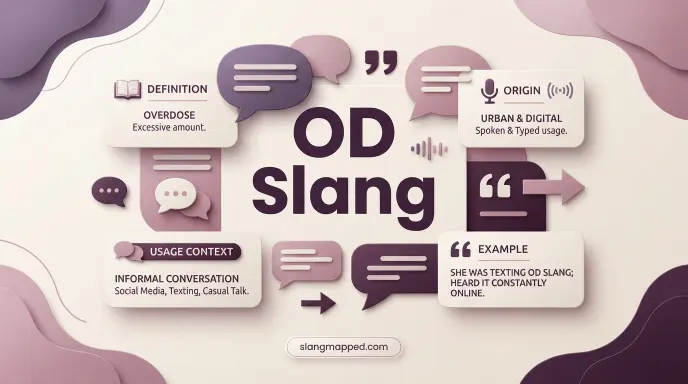
OD slang means “extremely” or “way too much” in casual texting and social media like saying “that pizza was OD good.”
The same short term, OD, is also an abbreviation for overdose, a serious word used in medical and drug-related situations.
People search for OD slang because the same two letters can mean something playful or something serious, depending entirely on the sentence around it.
This guide breaks down both meanings clearly, shows where each one is used, and explains how to tell them apart so you never misread a message.
Quick Answer: What Does OD Mean?
OD most commonly means “extremely” or “way too much” in casual slang (example: “that homework was OD hard”). It can also stand for overdose, referring to taking a harmful or excessive amount of a drug or medication. The correct meaning always depends on the sentence around it.
What Does OD Mean in Slang?
When people use OD in texts, on TikTok, or in everyday talk, they usually mean something is happening at an extreme level. It works like the words “really,” “super,” or “way too.”
For example:
- “This line is OD long.” (The line is extremely long.)
- “He was OD mad at me.” (He was very angry.)
- “That movie was OD good.” (The movie was excellent.)
In this slang sense, OD is not connected to drugs at all. It has simply become a shorthand way to add extra intensity to whatever comes after it.
Full Meaning: What Does OD Stand For?
Literally, OD is an abbreviation for overdose. In medical and health contexts, this is the only meaning that matters. An overdose happens when someone takes more of a substance a prescription drug, an over-the-counter medicine, or an illegal drug than their body can safely handle.
Outside of medical settings, that original meaning got stretched into slang. Saying someone is “OD-ing” on something no longer always means drugs. It can just mean they’re doing too much of an activity, like “she’s OD-ing on coffee” (drinking way more than usual).
Different Meanings of OD
OD carries two meanings that should never be blended together, because one is casual and the other is serious.
Meaning 1: OD as “Extremely” or “Too Much” (Slang)
- Definition: An intensifier meaning “very,” “extremely,” or “excessively.”
- Context: Casual conversation, texting, gaming chats, social media captions.
- Tone: Playful, exaggerated, informal.
- Example: “Bro, that test was OD easy.”
- Popularity: Very common among teens and young adults, especially on TikTok and in group chats.
Meaning 2: OD as “Overdose” (Serious/Medical)
- Definition: Taking a dangerous or excessive amount of a drug or medication.
- Context: Medical conversations, news reports, health warnings, discussions about substance use.
- Tone: Serious, urgent, never used as a joke in proper contexts.
- Example: “He was rushed to the hospital after an OD.”
- Popularity: Widely understood across all age groups because it’s used in healthcare and news media.
Important: If someone says a person “OD’d” without any extra context, this usually points to the overdose meaning, not the slang one. Always read the full sentence before assuming which meaning applies. This is the kind of term where context genuinely changes how serious it should be taken.
Where Is OD Commonly Used?
| Platform | How OD Is Usually Used |
| Texting | Slang intensifier (“that’s OD funny”) |
| TikTok comments | Slang intensifier, often exaggerated for humor |
| Discord chats | Slang intensifier among gaming groups |
| Both meanings, depending on the subreddit | |
| News articles/health content | Overdose (serious meaning only) |
| Workplace chat | Rarely used at all; avoid the slang version here |
The slang version of OD thrives in fast, informal chat spaces. The overdose meaning shows up in news, medical resources, and any conversation about drug or medication safety.
Is OD Rude, Offensive, or Harmless?
The slang meaning of OD (“extremely”) is harmless. It’s just a casual way to describe intensity and isn’t considered rude or offensive on its own.
The overdose meaning is a serious topic, not an offensive one — but it should be treated with care. Making jokes about overdoses, especially referencing a real person’s drug use, can come across as insensitive or hurtful. This is a case where tone matters more than the word itself.
Real-Life Examples
Friendly text message: “Guess what I got the job! I’m OD excited right now.”
Gaming/Discord chat: “That last round was OD close, we almost lost.”
TikTok comment: “This recipe is OD underrated, everyone needs to try it.”
School conversation: “The math homework tonight is OD long, I’m never finishing.”
News/health context: “Officials reported a rise in accidental OD cases linked to counterfeit pills.”
Workplace chat (why it doesn’t fit): “This deadline is OD tight” technically usable, but too casual for most professional settings.
Origin and History of OD Slang
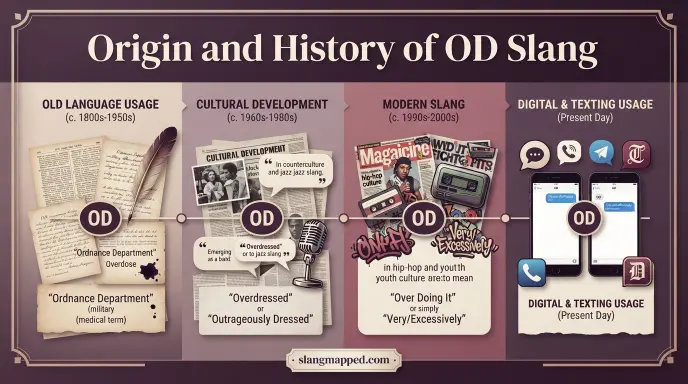
The slang use of OD (“extremely” or “over the top”) comes from African American Vernacular English (AAVE), with roots tracing back to New York slang.
Language researchers link the modern casual usage directly back to the medical term “overdose” the idea being that doing something “OD” is like doing it to an overdose-level extreme.
Documented early online use of the spelled-out version “odee” appeared on Twitter and Urban Dictionary as far back as 2008–2009, and it spread through hip-hop and rap lyrics before becoming common in everyday texting.
Because slang spreads informally through speech long before it’s written down, the exact first use is impossible to pin down with certainty what’s clear is that it grew out of Black American youth culture and hip-hop, not generic “internet slang” with no traceable origin.
The medical meaning of OD (overdose) has been standard English since long before the slang version existed and isn’t tied to any specific subculture.
Similar Slang or Related Terms
| Term | Meaning |
| Extra | Over the top, dramatic |
| Hella | Very, extremely (West Coast slang) |
| Mad | Very, a lot (also NYC-rooted intensifier) |
| Odee | Alternate spelling of OD (slang meaning) |
| Overkill | Doing more than necessary |
How to Use OD in a Sentence (Word Forms)
OD can change form depending on how it’s used in a sentence, and this is where a lot of people get confused about spelling.
- OD (adjective/intensifier): “That was OD funny.”
- OD’d (past tense): “I OD’d on candy last night.” (means “ate way too much”)
- OD’ing (present continuous): “She’s OD’ing on studying right now.”
- OD’s (used as a verb with “he/she/it”): “He OD’s on caffeine every morning.”
In the slang sense, the apostrophe (OD’d, OD’ing) is the most common way people write it, since OD is treated like an abbreviation rather than a regular word. You’ll also see “odd” used by mistake — that’s a spelling error, not a real form of the slang.
Other Meanings of OD (Outside Slang)
OD isn’t only used in slang or in the overdose sense. In a few professional fields, it stands for something completely different:
| Field | What OD Stands For |
| Eye care/optometry | Oculus dexter: Latin for “right eye” |
| Prescriptions | Omne in die: Latin for “once daily” |
| Engineering/manufacturing | Outside diameter (of a pipe or object) |
| Military | Officer of the Day |
These meanings show up on prescription labels, technical documents, and job titles — not in texting or on social media. If you see OD in one of these settings, it almost certainly isn’t slang or the overdose meaning.
Capitalization: OD vs. od vs. Od
Capitalization doesn’t change the meaning of the slang term, but it can affect how easy it is to read.
- OD (all caps): The standard way to write it, since it started as an abbreviation.
- od (lowercase): Common in fast texting or lowercase-style captions; still means the same thing.
- Od or Odee/Ode (spelled-out versions): Used to make the slang sound more like a spoken word, often in casual writing or captions.
None of these versions are “more correct” than another in casual chat the lowercase and spelled-out forms are just stylistic choices. In formal or medical writing, though, OD should always stay in capital letters, since that’s the standard abbreviation for overdose.
When Should You Avoid Using OD?
- In professional emails or workplace messages: it reads as too casual.
- When talking with teachers, employers, or unfamiliar adults: they may not know the slang meaning and could misread it as referencing drugs.
- Around topics of real overdoses or substance use: using the slang version nearby can accidentally sound insensitive.
- In formal writing, reports, or resumes: always out of place.
Polite Alternatives
If you want to keep the same meaning in a more formal setting, try:
- “extremely”
- “really”
- “very much”
- “quite” (for a lighter version)
Why Do People Use OD?
People use slang like OD because it’s short, expressive, and adds emphasis without needing extra words. It fits naturally into fast typing and voice-to-text conversations, and using current slang can also signal that someone is in touch with youth or online culture.
Common Misunderstandings
- Mistake: Assuming every use of “OD” refers to drugs. Reality: In most casual texts and comments, it simply means “extremely.”
- Mistake: Thinking OD is a brand-new word. Reality: The slang version has roots going back over a decade and connects to older AAVE and hip-hop language.
- Mistake: Using OD casually in serious health conversations. Reality: In those contexts, people will assume you mean an actual overdose.
Frequently Asked Questions
Q1. What does OD mean in texting?
In texting, OD almost always means “extremely” or “way too much.” For example, “that show was OD funny” means the show was extremely funny.
Q2. Does OD always mean overdose?
No. OD only means overdose when the context is about drugs, medication, or health. In casual chats and social media, it’s an intensifier meaning “very” or “excessively.”
Q3. Is OD offensive to use?
The slang meaning isn’t offensive. It becomes inappropriate only if used carelessly around serious topics like substance use or someone’s health struggles.
Q4. Can I use OD at work or with a teacher?
It’s best to avoid it. Since OD can also mean overdose, using it with people unfamiliar with the slang version could cause confusion or come across as unprofessional.
Q5. Where did the slang meaning of OD come from?
It comes from African American Vernacular English and New York hip-hop culture, where it grew out of the term “overdose” to describe anything taken to an extreme.
Q6. Is OD used on TikTok and Discord?
Yes. It’s a common intensifier in TikTok comments, Discord chats, and group texts, especially among teens and young adults.
Final Takeaways:
OD is a two-sided term. In everyday texting and social media, it’s a lighthearted way to say “extremely” or “way too much,” with no connection to drugs at all. In medical, health, or news contexts, it stands for a serious topic: overdose.
Knowing which meaning applies just takes a quick look at the surrounding words. Use the slang version freely with friends, but save the formal wording for school, work, or professional messages.
You May Also Like:
- From A to Z: The Complete Glass Slang Handbook
- What Does Fresh Slang Mean? Here’s the Answer
- Hundred Dollar Bill Slang: Meaning, Popular Terms and Usage

Hi, I’m Tyler Brooks, a writer specializing in Gen Z culture and internet slang. I track trending terms across TikTok and social media to explain their real-world meanings. My goal is to provide clear, accurate, and up-to-date definitions that help readers understand modern online language.