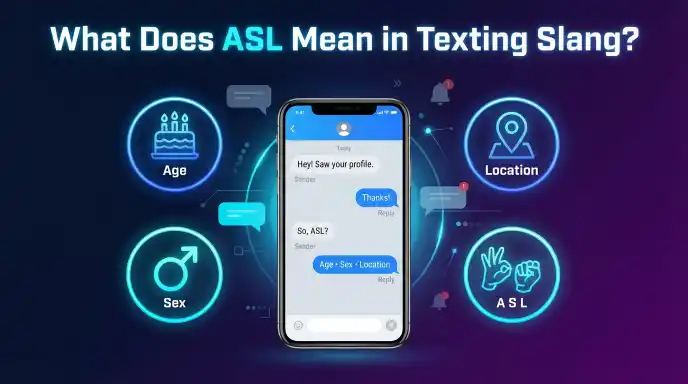
What does ASL mean in texting slang? In texting and online conversations, ASL usually means “Age, Sex, Location?” It is a short way to ask someone basic personal information when starting a chat.
However, depending on the conversation, ASL can also stand for American Sign Language. Understanding the context is the key to knowing which meaning is intended.
Many people search for this abbreviation after seeing it on Snapchat, Discord, Reddit, TikTok, Instagram, gaming chats, or text messages. Since ASL has more than one meaning, it can easily confuse new internet users.
This guide explains every common meaning, where people use it, if it is appropriate, and how to respond when someone sends “ASL?” in a conversation.
Quick Answer: ASL Slang Meaning
In texting slang, ASL most commonly stands for “Age, Sex, Location?” It is a quick way to ask someone’s basic details during an online conversation. In other contexts, ASL refers to American Sign Language, so the intended meaning depends on the topic.
Quick Table: What Does ASL Mean in Texting Slang?
| Feature | Details |
| Slang | ASL |
| Primary Meaning | Age, Sex, Location |
| Alternative Meaning | American Sign Language |
| ASL Full Form | Age, Sex, Location |
| Used In | Texting, Snapchat, Discord, Reddit, TikTok, Instagram, gaming chats, online forums |
| Purpose | To quickly ask someone’s basic personal information |
| Tone | Neutral and casual |
| Is It Offensive? | No, but it may feel too personal if asked by a stranger |
| Still Popular? | Yes, though less common than in the early internet days |
| Best Used | Casual online conversations with willing participants |
| Avoid Using | Professional settings, with strangers, or when privacy is a concern |
| Example | “ASL?” → “18, Female, USA.” |
What Does ASL Mean in Text?
The meaning of ASL changes depending on the conversation. While many people immediately think of the internet slang, others may recognize it as an abbreviation for American Sign Language.
In casual texting, social media chats, and online communities, ASL almost always means “Age, Sex, Location?” It is used as a conversation starter, especially when two people have just met online.
ASL Meaning as “Age, Sex, Location”
This is the original and most common slang meaning.
When someone sends:
ASL?
They are asking three questions at once:
- Age: How old are you?
- Sex: What is your gender? (Today, many people would simply ask “gender.”)
- Location: Where are you from?
Instead of typing three separate questions, users shorten everything into one simple abbreviation.
For example:
Person A: Hey! Nice to meet you.
Person B: ASL?
Person A: 22, Female, Texas.
The conversation continues from there.
Years ago, this was one of the first questions people asked when chatting with strangers online.
ASL Meaning as American Sign Language
Not every use of ASL refers to internet slang.
In conversations about education, accessibility, healthcare, or the Deaf community, ASL means American Sign Language.
For example:
- “I’m taking an ASL class this semester.”
- “The conference will have an ASL interpreter.”
- “She communicates using ASL.”
In these examples, ASL has nothing to do with texting slang.
The surrounding conversation almost always makes the correct meaning obvious.
How to Know Which Meaning Someone Means
If you’re unsure, look at the rest of the conversation.
| Conversation | Meaning of ASL |
| “Hi! ASL?” | Age, Sex, Location |
| “I’m learning ASL.” | American Sign Language |
| “Does this event provide ASL?” | American Sign Language |
| “ASL before we start chatting?” | Age, Sex, Location |
Context is the easiest way to understand the abbreviation.
ASL Full Form in Slang
The ASL full form in texting slang is:
Age + Sex + Location
It became popular because it allowed people to introduce themselves quickly without typing several separate questions.
Why Was ASL So Popular?
Before social media profiles displayed personal information automatically, people often chatted anonymously.
If you entered an online chat room in the late 1990s or early 2000s, other users usually knew nothing about you.
Instead of asking:
- How old are you?
- Are you male or female?
- Where do you live?
They simply typed:
ASL?
It saved time and became one of the internet’s most recognizable abbreviations.
Is the Full Form Still Relevant Today?
The abbreviation is still understood, but it is not nearly as common as it once was.
Modern apps already show information like:
- Profile pictures
- Usernames
- Age (sometimes)
- Country
- Interests
Because of this, fewer people need to ask “ASL?” at the beginning of every conversation.
However, you may still see it in:
- Anonymous chat apps
- Online gaming
- Older internet communities
- Nostalgic memes
- Casual texting
Is ASL Rude, Offensive, or Neutral?
ASL is generally considered neutral, but if it feels appropriate depends on how and when it is used.
Usually Neutral
Among friends or people who are comfortable chatting online, asking “ASL?” is simply a quick way to learn basic information.
Most people do not view the abbreviation itself as offensive.
It Can Feel Too Personal
Some users are uncomfortable sharing:
- Their age
- Their gender
- Their location
especially with someone they have just met online.
If a stranger immediately sends:
“ASL?”
Some people may choose not to respond.
Others may answer only one part of the question or ignore it completely.
Respect Privacy
Everyone has different comfort levels online.
If someone does not want to answer an ASL question:
- Don’t pressure them.
- Don’t repeatedly ask.
- Respect their privacy.
Good online communication always values consent and personal boundaries.
Where Is ASL Slang Commonly Used?
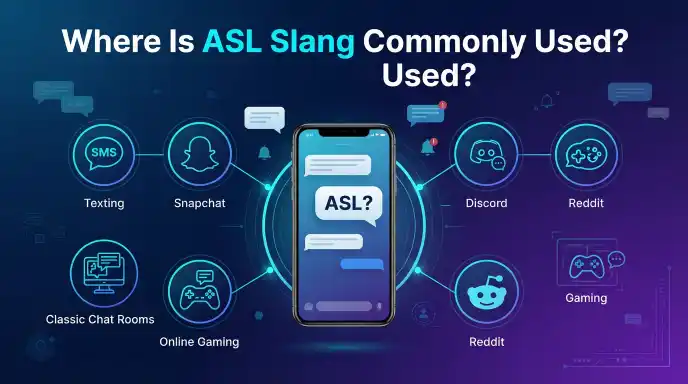
Although ASL is less popular than it was years ago, it still appears in several online spaces.
Text Messages
Friends sometimes use ASL jokingly or when getting to know someone.
Example:
“Hey! ASL?”
Snapchat
On Snapchat, someone may send “ASL?” after adding a new friend. They are usually trying to learn basic information before continuing the conversation.
However, because Snapchat is widely used by younger audiences, many users now prefer asking questions naturally instead of using the abbreviation.
Discord
Discord communities, especially public servers and gaming groups, occasionally use ASL when members are introducing themselves.
For example:
“New here. ASL?”
This is simply a quick way to ask for basic details before chatting.
On Reddit, ASL appears mostly in discussion threads, nostalgia posts, or communities where people interact anonymously.
Many Reddit users recognize it as an old-school internet abbreviation rather than a modern slang term.
Gaming Communities
Online multiplayer games sometimes include ASL in chat rooms or voice-chat communities.
A player might ask:
“ASL before we squad up?”
Although this still happens, many gamers skip the abbreviation and simply ask where someone is from or what language they speak.
Older Chat Rooms
ASL became famous through early internet chat platforms such as:
- AOL Instant Messenger (AIM)
- Yahoo Chat
- MSN Messenger
- IRC Chat Rooms
It was often the very first message exchanged between strangers.
Real-Life Examples of ASL Usage
The tone of ASL depends on the situation. Here are examples showing how it appears in different conversations.
Friendly Conversation
Emma: Hi! Nice to meet you.
Ryan: ASL?
Emma: 20, Female, Australia.
Ryan: Cool! I’m 22 from Canada.
The question is simply used to start a friendly conversation.
Casual Texting
Alex: You seem interesting.
Jordan: Thanks!
Alex: ASL?
Here, the abbreviation replaces three separate introductory questions.
Social Media Example
Comment:
“ASL? You seem cool.”
The commenter wants to know more about the person before continuing the conversation.
Gaming Example
Player 1: Looking for teammates.
Player 2: ASL? 19, Male, UK.
Although still understood, many gaming communities now ask more specific questions instead.
Argumentative Example
Person A: Why do you need my ASL? We’ve just met.
Person B: Sorry, I was only trying to introduce myself.
This example shows that not everyone feels comfortable sharing personal information immediately.
Origin and Background of the Slang
The slang meaning of ASL dates back to the early days of the public internet.
During the 1990s and early 2000s, online chat rooms were one of the main ways people met strangers from around the world. Unlike today’s social media platforms, these chat rooms rarely included personal profiles or photos.
As a result, users needed a fast way to learn basic information about each other.
Typing:
ASL?
became the quickest solution.
Why Did It Become So Popular?
The abbreviation spread rapidly because it:
- Saved typing time.
- Worked across different chat platforms.
- Was easy to remember.
- Quickly started conversations.
Soon, almost every major chat platform had users asking “ASL?” within the first few messages.
Why Is It Less Common Today?
Today’s apps already display information such as:
- Names
- Photos
- Locations
- Interests
- User bios
Because much of this information is already available, fewer people need to ask “ASL?”
Instead, people often begin conversations with more natural questions.
Comparison with Similar Slang
Many internet abbreviations make conversations faster, but each serves a different purpose.
| Slang | Full Form | Meaning | Common Use |
| ASL | Age, Sex, Location | Asking basic personal details | Introductions |
| BRB | Be Right Back | Leaving temporarily | Chatting |
| IDK | I Don’t Know | Expressing uncertainty | Texting |
| IMO | In My Opinion | Sharing an opinion | Discussions |
| TTYL | Talk To You Later | Ending a conversation | Messaging |
| DM | Direct Message | Private conversation | Social media |
Unlike abbreviations such as BRB or IDK, ASL is mainly used at the beginning of conversations rather than throughout them.
ASL vs A/S/L
You may also see:
A/S/L
This means exactly the same thing.
The slashes simply separate the three words:
- Age
- Sex
- Location
Both versions are correct, although ASL without slashes is more common today.
Why People Use This Slang
Even though ASL is older internet slang, people continue using it for several reasons.
It Saves Time
Instead of typing three separate questions, one abbreviation communicates the same idea.
It Starts Conversations
When chatting with someone new, ASL provides a simple icebreaker.
It Is Part of Internet Culture
Many long-time internet users continue using ASL because it reminds them of classic chat rooms and early online communities.
It Is Widely Recognized
Although younger users may not use it often, millions of internet users still understand what it means.
Impact of Using Slang in Communication
Internet slang like ASL changes how people communicate online.
Positive Effects
Using ASL can:
- Make conversations faster.
- Reduce typing.
- Create a casual atmosphere.
- Help people connect quickly.
- Reflect online culture and internet history.
Possible Drawbacks
There are also some disadvantages.
- New users may not recognize the abbreviation.
- Multiple meanings can cause confusion.
- Some people may see the question as too personal.
- It may appear outdated in modern conversations.
Choosing the right audience and context makes communication much clearer.
When Should You Avoid Using ASL?
Although ASL is generally a neutral abbreviation, there are situations where it is better not to use it.
Professional Conversations
Avoid using ASL in workplace chats, business emails, or professional networking platforms. It can seem too informal and unrelated to the conversation.
Instead, ask only for information that is necessary and appropriate.
When Talking to Strangers
If you’ve just met someone online, asking for their age, gender, and location immediately may make them uncomfortable.
Many people prefer to build trust before sharing personal details.
Conversations with Minors
Be especially careful when chatting with younger users online. Asking for personal information can easily be misunderstood and may violate community guidelines on some platforms.
Privacy-Focused Communities
Some online forums and communities encourage users to stay anonymous. In these spaces, asking “ASL?” may not be welcomed.
When in doubt, respect the other person’s privacy and let them decide what they want to share.
Polite Alternatives to ASL
If you want to get to know someone without asking “ASL?”, try more natural questions.
Friendly Alternatives
- Where are you from?
- What should I call you?
- Tell me a little about yourself.
- How did you find this community?
- What are your interests?
More Respectful Questions
If age or location is relevant, ask politely:
- “If you don’t mind me asking, how old are you?”
- “Which country are you from?”
- “Would you like to introduce yourself?”
These questions sound more conversational and give the other person the choice to answer.
Is It Safe for Social Media?
Yes, ASL itself is safe to use on social media. The abbreviation is not harmful or offensive.
However, sharing personal information publicly should always be done carefully.
Stay Safe Online
Keep these tips in mind:
- Avoid sharing your exact address or personal details with strangers.
- Think carefully before revealing your age or location in public comments.
- Use privacy settings on social media platforms.
- Never feel pressured to answer personal questions.
If someone asks for information that makes you uncomfortable, you are free to ignore the message or end the conversation.
Common Misunderstandings About ASL
Because ASL has more than one meaning, people sometimes misunderstand it.
ASL Always Means “Age, Sex, Location”
This is false.
In discussions about education, accessibility, or the Deaf community, ASL means American Sign Language.
Everyone Still Uses ASL
Not exactly.
The abbreviation is much less common today than it was in the early days of the internet. Many people now ask questions directly instead of using ASL.
ASL Is Offensive
No.
The abbreviation itself is neutral. If it feels appropriate depends on the context and the relationship between the people chatting.
Frequently Asked Questions
Q1. What does ASL mean in texting slang?
In texting slang, ASL usually stands for Age, Sex, Location. It is a quick way to ask someone basic personal information when starting an online conversation.
Q2. What does ASL stand for?
The ASL full form in internet slang is Age, Sex, Location. In other contexts, such as education or accessibility, ASL stands for American Sign Language.
Q3. Is ASL still used today?
Yes, but it is less common than it was during the late 1990s and early 2000s. You may still see it in gaming communities, anonymous chat platforms, and nostalgic online discussions.
Q4. Is ASL rude?
No. ASL is generally considered neutral. However, asking for someone’s age, gender, or location too early in a conversation may make some people uncomfortable.
Q5. Does ASL always mean Age, Sex, Location?
No. The meaning depends on the context. In many conversations, ASL refers to American Sign Language instead of the texting abbreviation.
Q6. Can I use ASL on Snapchat or Discord?
Yes. Some users still understand and use ASL on platforms like Snapchat and Discord. However, many people today prefer asking questions in full sentences rather than using the abbreviation.
Conclusion
Understanding what does ASL mean in texting slang helps you communicate more confidently online. In most text messages and online chats, ASL stands for Age, Sex, Location, making it a quick way to ask someone’s basic details.
However, in conversations about accessibility, education, or the Deaf community, ASL refers to American Sign Language.
Before using ASL, always consider the context and your audience. While the abbreviation is generally neutral, some people may prefer not to share personal information with strangers.
By understanding its different meanings and using it respectfully, you can avoid confusion and communicate more effectively across texting, social media, and online communities.
Discover Related Texting Slangs:
- WYA Meaning: The Texting Slang Everyone’s Using in 2026
- What Does TS Mean in Text Slang? Definition, Usage & Examples
- ATP Slang Meaning in Text: How People Use it on Social Media

Hi, I’m Rachel Simmons, a language writer specializing in American English and modern slang. I research regional expressions, everyday phrases, and evolving word meanings across the United States. I enjoy making complex language trends simple, practical, and easy for everyone to understand.