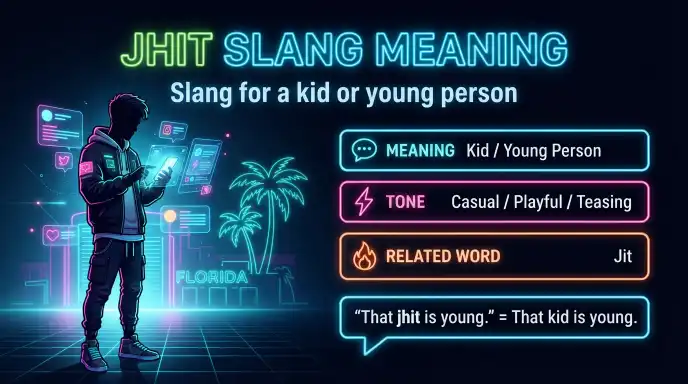
Jhit slang meaning usually refers to a kid, young person, or someone younger than the speaker. It is closely related to the slang word “jit,” which is strongly associated with Florida, especially South Florida.
If you have seen jhit in TikTok comments, texts, gaming chats, or social media posts, you may wonder if it is an abbreviation or an insult.
In most cases, it is simply a casual slang term for a younger person. However, its tone can change depending on the situation. It may sound playful between friends but dismissive when used toward someone you do not know.
In this guide, you will learn the jhit slang meaning, where the term comes from, how people use it online, if it is rude, and how jhit differs from similar words such as jit, kid, and youngin.
Quick Answer: What Does Jhit Slang Meaning Refer To?
Jhit means “kid,” “young person,” or someone who is younger than the speaker. It can also describe someone who is smaller, inexperienced, or acting young. The word is closely related to jit, a Florida-associated slang term.
For example:
“That jhit is only 12.”
Here, jhit simply means that kid.
The tone matters. Among friends, it can sound playful or affectionate. In other situations, it can sound dismissive or insulting, especially when used to talk down to someone.
What Does Jhit Slang Mean?
The most common jhit slang meaning is a young person or kid.
It can describe someone who is:
- Younger than you
- Smaller or younger-looking
- Inexperienced
- Acting immature
- A younger friend, sibling, or acquaintance
The word does not always have a negative meaning. Someone might call a younger family member a jhit in a joking or familiar way.
Jhit vs. Jit
The spelling can cause confusion.
| Term | Common meaning | Notes |
| Jit | Kid or young person | More established spelling |
| Jhit | Kid or young person | Alternative online spelling |
| Jitt | Kid or young person | Another spelling sometimes seen online |
Wiktionary lists jhit as an alternative form of jit, while Merriam-Webster defines jit as a young person or kid.
So if someone writes “that jhit”, they usually mean the same basic thing as “that jit.”
Does Jhit Stand for Anything?
No. Jhit usually does not stand for a longer phrase.
Unlike texting abbreviations such as LOL or BRB, jhit is normally a slang word rather than an acronym. Claims that it officially stands for phrases such as “Juvenile in Training” should not be treated as the established definition.
The better-supported explanation is that jhit is an alternative spelling of jit, with jit documented as a Florida-associated slang term for a young person.
Different Meanings of Jhit Slang
Although the basic meaning stays around the idea of youth, the exact sense can change with context.
1. Jhit Means “Kid”
This is the most common meaning.
Someone may say:
“That jhit is always running around.”
Meaning:
“That kid is always running around.”
This can be neutral or playful.
2. Jhit Means Someone Younger
A speaker can use jhit to point out an age difference.
For example:
“I was already working when that jhit was still in school.”
Here, the speaker is emphasizing that the other person is younger.
3. Jhit Can Suggest Inexperience
The word can sometimes carry the idea of being inexperienced or immature. Merriam-Webster notes that jit may refer to someone who is new to something or inexperienced, and its tone can become slightly negative depending on context.
For example:
“Let the older players handle it. You’re still a jhit.”
In this sentence, jhit has a dismissive meaning closer to “young/inexperienced kid.”
4. Jhit Can Be Used Playfully
Friends may also use it without serious insult:
“What’s up, jhit?”
Here, it can work like:
“What’s up, kid?”
The relationship between the speakers and their tone helps determine if it sounds friendly or disrespectful.
Where Is Jhit Slang Commonly Used?
Jhit is strongly connected to Florida slang, particularly South Florida. The related form jit has been documented in Florida for decades and later spread more widely through music and online culture.
You may encounter jhit/jit in:
- Text messages
- TikTok comments
- Instagram comments
- Discord chats
- Reddit discussions
- Gaming communities
- Rap and hip-hop culture
- Casual conversations
The spelling jhit is especially useful to recognize when reading online because different communities may spell the same slang term differently.
Jhit on TikTok
On TikTok, jhit may appear in comments about younger people, children, or someone acting immature.
For example:
“Why that jhit walking like that ”
The writer is likely referring to the person as a kid or young person, often in a joking way.
Jhit in Gaming
In gaming chats, someone might call a younger or inexperienced player a jhit.
“That jhit just joined the lobby.”
The meaning is informal and depends heavily on the community.
Jhit in Workplace Chat
This is different.
Even though the word can be harmless among friends, jhit is not suitable for most professional communication. A coworker may not understand the regional slang, and it can sound disrespectful.
Use “younger player,” “new player,” “kid,” or another clear term instead when the situation requires professionalism.
Is Jhit Slang Meaning Rude or Offensive?
Jhit is not automatically offensive, but it can sound disrespectful or condescending.
Its tone depends on who says it, who they are talking about, and how they say it.
| Situation | Likely tone |
| Close friends joking | Playful |
| Older person talking to a child | Casual |
| Talking about a younger sibling | Familiar |
| Calling a stranger a jhit | Potentially disrespectful |
| Using it to dismiss an adult | Condescending |
| Professional workplace | Not recommended |
The related word jit is generally neutral but can take on a negative edge when it suggests that someone is foolish, immature, or inexperienced.
So context matters more than the word alone.
Real-Life Examples of Jhit Slang Meaning
Example 1: Talking About a Younger Person
Alex: “Who’s that jhit with your brother?”
Sam: “That’s his little cousin.”
Here, jhit means young person/kid.
Example 2: Friendly Teasing
Mike: “You really missed that easy shot.”
Jay: “Relax, jhit. I’m warming up.”
Here, the word is being used as playful teasing.
Example 3: Gaming
Player 1: “Who invited that jhit?”
Player 2: “He’s my little brother. Give him a chance.”
Here, jhit refers to a younger player.
Example 4: Talking About Inexperience
“That jhit just started playing yesterday.”
In this context, jhit can suggest that the person is young or inexperienced.
Example 5: Social Media Comment
“Jhit really thought nobody would notice ”
Here, the word is probably being used jokingly to refer to someone who made a silly mistake.
Origin and History of Jhit Slang
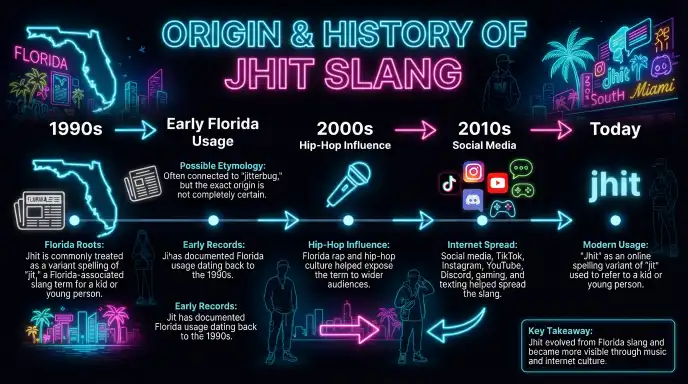
The origin of jhit needs some care because the spelling is less established than jit, and online sources sometimes give conflicting explanations.
The strongest dictionary evidence connects jit with Florida and African American English. Merriam-Webster says online use dates to the early 2000s but notes that the term itself is much older. It cites a 1993 St. Petersburg Times example and a 1994 South Florida Sun-Sentinel example.
A commonly reported explanation is that jit developed as a shortening of “jitterbug.” Merriam-Webster specifically records a 1994 example explaining “Jit” as short for “Jitterbug.” Wiktionary also lists jitterbug as an etymology for jit.
The spelling jhit is best treated as a variant rather than a completely separate slang word. Wiktionary lists jhit among alternative forms of jit.
How Did It Spread Online?
The term became more visible outside Florida through Florida hip-hop and rap culture. Merriam-Webster points to artists such as YNW Melly, Smokepurpp, and Kodak Black as part of the word’s wider exposure.
Later, social media helped regional slang reach people who had never heard it locally.
Jhit vs. Similar Slang
Several words can replace jhit, but they are not exact matches.
| Slang | Basic meaning | Tone |
| Jhit/Jit | Young person or kid | Casual |
| Kid | Young person | Neutral |
| Youngin | Young person | Informal |
| Rookie | Inexperienced person | Casual |
| Little bro | Younger male/friend | Friendly |
| Youngster | Young person | Casual/old-fashioned |
Jhit is more regional and culturally specific than ordinary words such as kid.
When Should You Avoid Using Jhit Slang Meaning?
Avoid jhit when the listener may not understand regional slang or when a respectful tone is expected.
You should especially avoid it:
- In formal emails
- In job interviews
- In academic writing
- When speaking to someone you do not know
- When addressing a teacher or supervisor
- When talking about someone in a serious situation
- When the word could make someone feel belittled
If you are unsure about the person’s reaction, “kid,” “young person,” or “younger person” is clearer.
Polite Alternatives to Jhit Slang
If you want the same basic meaning without slang, try:
- Kid
- Young person
- Younger person
- Youngster
- Child
- Younger guy
- Younger player
- Newcomer : when you mean inexperienced rather than young
Choose the alternative based on what you actually mean. Jhit can refer to youth, while rookie refers more specifically to lack of experience.
Why Do People Use Jhit?
People use jhit because it is short, casual, and strongly associated with a particular regional style of speech.
It can help speakers:
- Refer to someone younger
- Tease a friend
- Show familiarity
- Point out someone’s inexperience
- Use Florida-influenced slang
- Sound casual in online conversations
Its meaning often depends on the relationship between the speakers.
Common Misunderstandings About Jhit
Jhit is not usually an acronym
You do not normally need to expand it into a phrase. It is slang, not standard texting shorthand.
Jhit does not always mean “insult”
Some uses are playful or neutral. Calling someone a jhit does not automatically mean the speaker dislikes them.
Jhit and jit are closely related
The h does not necessarily create a new meaning. Jhit is commonly treated as a spelling variant of jit.
It is not simply a Gen Z invention
Although younger internet users may use the word today, the related jit has documented Florida usage going back decades.
Frequently Asked Questions
Q1. What does jhit mean in slang?
Jhit usually means a kid or young person. It can also describe someone who is younger, smaller, or inexperienced.
Q2. Is jhit the same as jit?
Yes. Jhit is commonly used as an alternative spelling of jit, a Florida-associated slang term for a young person.
Q3. What does jhit mean on TikTok?
On TikTok, jhit usually refers to a young person or kid, often in a joking or teasing way.
Q4. Does jhit stand for “Juvenile in Training”?
There is no strong evidence that this is the established meaning of jhit. It is better understood as a spelling variant of jit rather than a confirmed acronym.
Q5. Is jhit a bad word?
Not necessarily. It can be friendly, neutral, teasing, or dismissive depending on the context.
Q6. Is jhit Florida slang?
Yes. Jhit/jit is strongly associated with Florida slang, especially South Florida.
Q7. Can I use jhit at work?
It is better to avoid it in professional settings. Use kid, younger person, colleague, or newcomer depending on what you mean.
Q8. What is the difference between jhit and kid?
Both can refer to a young person, but jhit is informal regional slang, while kid is widely understood in everyday English.
Conclusion: Jhit Slang Meaning
Jhit slang meaning is usually “kid,” “young person,” or someone younger than the speaker. It is closely related to jit, a Florida-associated slang term that has been used for decades and later spread through music and online culture.
The word is not automatically rude. Among friends, it can be playful or familiar, while calling a stranger a jhit may sound dismissive. The safest approach is to look at the speaker’s tone and the surrounding conversation.If you need a neutral word, kid or young person is usually the better choice.
Explore More Articles:
- What Does “Rib” Mean in Slang? Definition & Examples
- What’s a “Lark” in Slang? The Answer Might Surprise You
- What Does Low Key Slang Mean? Texting and Social Media Usage

Hi, I’m Rachel Simmons, a language writer specializing in American English and modern slang. I research regional expressions, everyday phrases, and evolving word meanings across the United States. I enjoy making complex language trends simple, practical, and easy for everyone to understand.