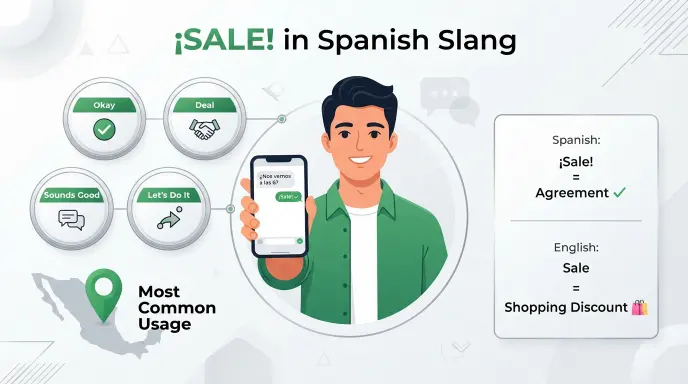
Sale in Spanish slang is a casual way to say “okay,” “deal,” “sounds good,” “let’s do it,” or “I’m in.”
It comes from the Spanish verb salir (“to go out” or “to come out”), but in everyday conversation, sale has become a friendly expression of agreement, especially in Mexico and some other Spanish-speaking countries.
Many people search for sale in Spanish slang after seeing it in a text message, on TikTok, or in a chat with Spanish-speaking friends. At first, it can look like the English word “sale,” which means a discount. However, in Spanish slang, it has a completely different meaning.
In this guide, you’ll learn what sale in Spanish slang means, where people use it, when it’s appropriate, and how to understand it in real conversations.
Quick Answer
Sale in Spanish slang means “okay,” “deal,” “sounds good,” or “let’s do it.” It is an informal expression used to agree with someone or accept a suggestion. It is especially common in Mexican Spanish and is often seen in texting, social media, and everyday conversations.
What Does Sale in Spanish Slang Mean?
Sale is an informal Spanish expression that shows agreement. Instead of giving a long reply, people simply say sale to let others know they accept an idea or plan.
Depending on the conversation, it can mean:
| Expression | Meaning in English | Tone |
| Sale | Okay | Friendly |
| Sale | Sounds good | Casual |
| Sale | Deal | Positive |
| Sale | Let’s do it | Enthusiastic |
| Sale | I’m okay with that | Relaxed |
Unlike the English word sale, which refers to shopping discounts, the Spanish slang sale is about agreeing with someone.
A Simple Definition
When someone says sale, they are usually saying:
- “Okay.”
- “That works for me.”
- “Let’s go.”
- “I’m in.”
- “Deal.”
It is short, natural, and easy to use.
Why Do People Say “Sale”?
People use sale because it is quicker and friendlier than giving a longer answer.
For example:
Friend: “Vamos por tacos a las ocho.”
You: “¡Sale!”
Meaning:
Friend: “Let’s get tacos at eight.”
You: “Sounds good!”
Does “Sale” Always Mean Slang?
No. Context is important.
The word sale also has its normal Spanish grammar meaning. It is the third-person form of the verb salir, meaning “he/she/it goes out” or “comes out.”
For example:
- El sol sale temprano.
“The sun rises early.”
This is not slang.
When people reply with only “Sale!”, they are usually using the slang meaning.
Full Meaning of “Sale”
The word sale does not stand for anything. It is not an abbreviation or acronym.
It comes from the Spanish verb salir, but over time, speakers especially in Mexico began using sale as a quick way to agree with someone.
Today, many native speakers use it naturally without thinking about its original grammatical form.
Literal Meaning
The literal meaning of sale is related to the verb salir.
Examples:
- Ella sale de la escuela.
“She leaves school.” - El tren sale a las seis.
“The train leaves at six.”
These examples use standard Spanish, not slang.
Slang Meaning
As slang, sale expresses agreement or acceptance.
Examples:
- “¿Nos vemos mañana?”
“Sale.” - “Vamos al cine.”
“¡Sale!”
Here, sale simply means:
- Okay.
- Sure.
- Sounds good.
- Deal.
Different Meanings of Sale in Spanish Slang
Although sale usually means “okay,” its exact meaning changes slightly depending on the situation.
Agreement
This is the most common use.
Example
A: “Let’s study after class.”
B: “Sale.”
Meaning:
“I agree.”
Accepting an Invitation
Someone invites you somewhere, and you accept.
Example
A: “Want to grab coffee?”
B: “Sale.”
Meaning:
“Sure!”
Confirming a Plan
People also use sale when confirming plans.
Example
A: “I’ll pick you up at seven.”
B: “Sale.”
Meaning:
“That works.”
Ending a Conversation Positively
Sometimes sale is simply a friendly way to finish planning something.
Example
A: “See you tomorrow.”
B: “Sale.”
Meaning:
“See you then.”
Where Is Sale in Spanish Slang Commonly Used?
Sale is most commonly heard in Mexico, where it has become a natural part of everyday informal speech. It may also be understood in some nearby Spanish-speaking communities, although other countries often prefer different expressions.
Everyday Conversations
Friends and family frequently use sale when making plans.
Example:
- “Sale, nos vemos más tarde.”
- “Okay, see you later.”
Text Messages
Because it is short, sale is popular in texting.
Example:
Friend: “I’ll send the photos tonight.”
Reply: “Sale “
Social Media
You may notice sale in comments or direct messages on platforms like:
- TikTok
People often use it to accept invitations, confirm plans, or reply casually.
School and College
Students commonly use sale when talking with classmates.
Example:
“Let’s meet in the library.”
“Sale.”
Workplace Chats
Some coworkers who know each other well may also use sale in informal workplace messages.
However, in professional emails or formal business communication, people usually choose more formal expressions instead of sale.
Is Sale in Spanish Slang Rude, Offensive, or Harmless?
Sale is generally harmless and polite in casual conversations. It is not considered a rude or offensive slang term. Instead, it is a friendly way to show that you agree with someone or accept a suggestion.
However, like many informal expressions, it fits some situations better than others.
Casual Conversations
Among friends, classmates, siblings, or family members, sale sounds natural and friendly.
Example
Friend: “Let’s order pizza tonight.”
You: “¡Sale!”
This sounds relaxed and positive.
Professional Situations
In a workplace or formal setting, sale may sound too casual.
Instead, people often use more formal expressions such as:
- De acuerdo. (Agreed.)
- Está bien. (That’s fine.)
- Perfecto. (Perfect.)
These choices sound more professional in emails, meetings, or business messages.
Can Children Use It?
Yes. Since sale is not offensive, children and teenagers may hear and use it in everyday conversations. It simply expresses agreement and does not carry a negative meaning.
Quick Guide
| Situation | Is “Sale” Appropriate? |
| Friends | ✅ Yes |
| Family | ✅ Yes |
| School friends | ✅ Yes |
| Text messages | ✅ Yes |
| Social media | ✅ Yes |
| Workplace chat | ✅ Usually, if informal |
| Business email | ❌ Better to use formal Spanish |
Real-Life Examples of Sale in Spanish Slang
The easiest way to understand sale is to see how native speakers use it in everyday conversations.
Friends Making Plans
Carlos: “Vamos al cine esta noche?”
Ana: “¡Sale!”
Meaning: “Let’s go to the movies tonight. Sounds good!”
Text Message
Message:
Friend: “I’ll call you after dinner.”
Reply: “Sale “
Meaning: “Okay.”
Family Conversation
Mom: “We’ll leave at nine tomorrow.”
Son: “Sale.”
Meaning: “Okay.”
School
Student 1: “Let’s finish the project after class.”
Student 2: “Sale.”
Meaning: “Deal.”
WhatsApp Group
Friend: “Everyone meet at the café at 5.”
Several replies:
- Sale.
- Sale
- Sale, ahí estaré.
These responses all confirm the plan.
Social Media
Someone comments:
“Live stream tonight at 8!”
Replies may include:
- Sale.
- Sale, nos vemos.
- Sale
These replies show excitement and agreement.
Origin and History of Sale in Spanish Slang
The slang use of sale comes from the Spanish verb salir, which means “to leave,” “to go out,” or “to come out.”
How Did It Become Slang?
Language experts generally agree that the slang meaning developed naturally in everyday Mexican Spanish.
Over time, people began using sale as a short way of saying that an idea or plan was accepted.
Instead of giving a full sentence like:
“Está bien, hagámoslo.”
(“Okay, let’s do it.”)
People simply replied:
“Sale.”
This shorter response became popular because it is quick, friendly, and easy to understand.
Where Did It Become Popular?
The slang meaning is most strongly associated with Mexico, where it has been used in spoken conversations for many years before becoming common in text messages and social media.
Today, it also appears in:
- WhatsApp chats
- TikTok comments
- Facebook conversations
- Instagram messages
- Online gaming chats among Spanish speakers
Although many Spanish speakers understand it, it is much more common in Mexican Spanish than in Spain or several South American countries.
Is the Exact Origin Known?
No. There is no single confirmed date or event marking when sale became slang. Like many everyday expressions, it spread gradually through spoken language before becoming popular online.
Similar Slang or Related Terms
Several Spanish expressions have meanings close to sale, although each has its own tone and regional preference.
| Expression | Meaning | Common Region |
| Sale | Okay / Deal | Mexico |
| Va | Okay / Sounds good | Mexico |
| Dale | Go ahead / Okay | Argentina, Uruguay, parts of Latin America |
| Órale | Come on / Okay / Wow | Mexico |
| Está bien | That’s fine | Most Spanish-speaking countries |
| Perfecto | Perfect | Universal Spanish |
Sale vs. Va
Both expressions can mean “okay.”
Example
“Nos vemos mañana.”
“Va.”
or
“Sale.”
In many Mexican conversations, both responses sound natural.
Sale vs. Dale Slang
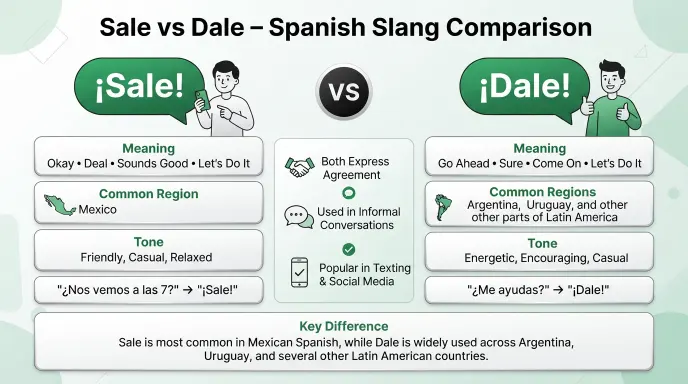
People learning Spanish often confuse these expressions.
- Sale is especially common in Mexico.
- Dale is more common in Argentina, Uruguay, and several other Latin American countries.
Both often express agreement, but their regional use is different.
Why Do People Use Sale?
People use sale because it is simple, friendly, and saves time.
Instead of typing or saying a complete sentence, they can quickly show agreement with one word.
It Makes Conversations Faster
Instead of saying:
“Yes, that sounds like a good idea.”
People simply say:
“Sale.”
It Sounds Friendly
The word has a warm, relaxed tone that fits conversations with friends and family.
It Works Well in Texting
Because it is short, sale is popular on messaging apps.
Examples include:
- Instagram Direct Messages
- Facebook Messenger
- TikTok messages
It Helps Confirm Plans
People often use sale when everyone has agreed on a time or activity.
For example:
- Meeting friends
- Planning dinner
- Organizing school work
- Confirming travel plans
Using sale tells others that the plan is settled.
Common Misunderstandings
People who are new to Spanish often misunderstand sale because it looks exactly like the English word sale.
Mistaking It for Shopping
English speakers may think sale refers to discounts or lower prices.
In Spanish slang, it usually has nothing to do with shopping.
Thinking It Is an Acronym
Some people assume sale is short for another phrase.
It is not.
It is simply a Spanish word that developed an informal meaning through everyday use.
Assuming It Is Used Everywhere
Many learners believe every Spanish-speaking country uses sale the same way.
In reality, it is most common in Mexico. Other countries may prefer expressions like dale, vale, or está bien, depending on the region.
When Should You Avoid Using It?
Although sale is friendly and harmless, it is not suitable for every situation.
Formal Business Emails
Use more professional expressions when writing to:
- Clients
- Managers
- Government offices
- Universities
Academic Writing
Do not use slang in essays, reports, or research papers.
Formal Spanish is a better choice.
Speaking With Someone Who Doesn’t Know Mexican Slang
If you are talking with someone from another Spanish-speaking region, they may understand sale, but a more universal expression such as está bien may avoid confusion.
Serious Professional Meetings
Business meetings usually require more formal language than casual chats.
Using professional expressions shows respect and clarity.
Frequently Asked Questions
Q1. What does sale mean in Spanish slang?
Sale in Spanish slang means “okay,” “deal,” “sounds good,” or “let’s do it.” It is a casual way to agree with someone and is especially common in Mexico.
Q2. Is sale an abbreviation?
No. Sale is not an abbreviation or acronym. It comes from the Spanish verb salir, but as slang, it is simply used to express agreement.
Q3. Is sale used only in Mexico?
It is most common in Mexico, where it is a very popular informal expression. Some Spanish speakers in other countries may understand it, but they often use different words such as vale, dale, or está bien.
Q4. Is sale rude or offensive?
No. Sale is a friendly and harmless expression. It is widely used among friends, family, classmates, and in casual online conversations.
Q5. Can I use sale in a business email?
It is better not to. Sale is informal, so formal expressions like de acuerdo, está bien, or perfecto are more appropriate in professional communication.
Q6. Does sale mean the same as the English word “sale”?
No. Although they are spelled the same, they have different meanings. The English word sale refers to discounted prices or shopping promotions, while the Spanish slang sale means “okay,” “deal,” or “sounds good.”
Q7. Is sale commonly used in texting?
Yes. Sale is very common in text messages, WhatsApp chats, and social media because it is short, easy to type, and quickly shows agreement.
Q8. What are some alternatives to sale in Spanish?
Depending on the country, people may use:
- Vale
- Dale
- Va
- Está bien
- Perfecto
Each has a similar meaning, but regional preferences vary.
Conclusion
Sale in Spanish slang is a simple and friendly expression that usually means “okay,” “deal,” “sounds good,” or “let’s do it.” While it comes from the Spanish verb salir, its slang meaning has become especially popular in Mexico for showing agreement in everyday conversations.
If you see sale in a WhatsApp message, a TikTok comment, or hear it from a Spanish-speaking friend, understanding the context makes its meaning clear. It is safe, informal, and widely accepted in casual settings, but it is best to choose more formal expressions in professional or academic situations.
Learning words like sale not only improves your Spanish vocabulary but also helps you communicate more naturally with native speakers.
Read More Articles:

Hi, I’m Tyler Brooks, a writer specializing in Gen Z culture and internet slang. I track trending terms across TikTok and social media to explain their real-world meanings. My goal is to provide clear, accurate, and up-to-date definitions that help readers understand modern online language.