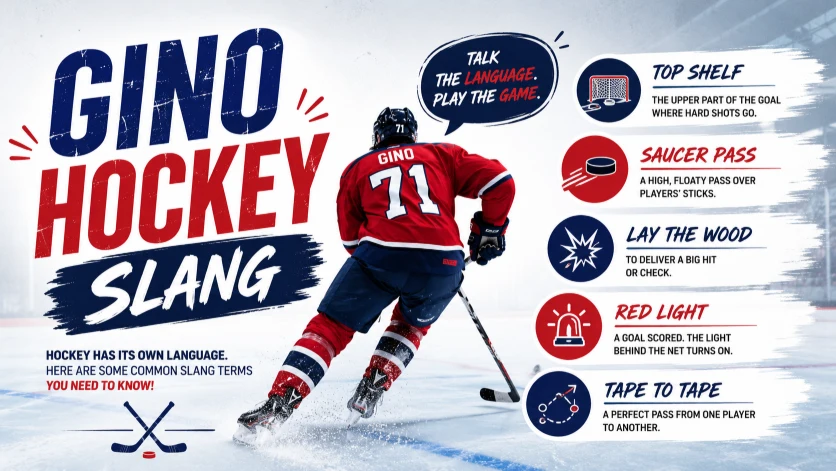
Gino is hockey slang for a goal, often used to celebrate when a player scores.It’s a fun, informal term commonly heard among players, commentators, and hockey fans.
If you’ve ever sat near the glass at a rink or scrolled through hockey highlights online, you’ve probably heard someone shout “gino!” the second the puck crosses the line.
Gino hockey slang is one of those terms that sounds like an inside joke until someone explains it and once you know it, you start noticing it everywhere, from beer-league benches to NHL locker room interviews.
People search for this term because it pops up in commentary, social clips, and team chats, and it’s not always obvious from context if it’s a compliment, an insult, or just hockey shorthand.
Quick Answer:
In hockey slang, a “gino” simply means a goal that’s been scored. If someone says “he scored a gino,” it just means he put the puck in the net nothing more, nothing less.
Read more: Gen Z Slang for Love: Meanings, Examples & Popular Terms
What Does Gino Mean in Hockey Slang?
At its core, gino is just another word for a goal. When a player scores, teammates or commentators might say “nice gino” or “he ripped a gino top shelf.” It’s used the exact same way you’d use the word “goal” it just carries more rink personality.
The term shows up most in casual, spoken hockey culture rather than in official broadcasts or written rulebooks. You’re far more likely to hear it in a locker room, at a pickup game, or in a hockey meme than in a formal recap.
Full Form and Definition
Gino doesn’t stand for anything , it’s not an acronym or abbreviation. It’s simply slang, the same way “biscuit” means puck or “twig” means stick. The plural form can be spelled a couple of different ways, most commonly “ginos” or “genos,” depending on the region or the group using it.
A simple working definition: Gino (noun) hockey slang for a goal scored during a game.
Is It Rude, Offensive, or Neutral?
Gino is completely neutral. It doesn’t insult anyone, and there’s no negative connotation attached to it. Unlike chirp-heavy hockey slang such as “bender” or “hoser,” which are meant to needle an opponent, gino is purely celebratory.
Saying someone scored a gino is just a fun, casual way of saying they scored , you could say it about your favorite NHL sniper or your kid’s peewee team and it would land the same way.
Where Is It Commonly Used?
Gino is mostly a spoken-word term that lives in hockey culture rather than mainstream slang. You’ll typically hear or see it in:
- Locker rooms and benches: players hyping up a teammate right after he scores
- Beer leagues and pickup hockey: casual games where slang flows freely
- Hockey social media and highlight clips: captions like “GINO for the boys!”
- Video game and streaming communities: especially around games like EA Sports NHL, where players narrate their own goals
- Sports podcasts and hockey YouTube channels: often used for comedic effect
It’s less common in professional broadcasts, though color commentators occasionally slip it in for a relatable, “insider” feel.
Real-Life Examples of Usage
| Situation | Real-Life Example | Meaning |
|---|---|---|
| During a game | “What a snipe! That’s another Gino for Jake tonight.” | Jake scored another goal. |
| Coach after the game | “We needed more Ginos if we wanted to win.” | The team needed more goals. |
| Locker room | “Nice Gino, buddy! That shot was unstoppable.” | Great goal. |
| Sports commentator | “He buries his second Gino of the period!” | He scores his second goal. |
| Fan conversation | “Did you see that overtime Gino? What a finish!” | Did you see the overtime goal? |
| Practice session | “Let’s work on creating more chances for Ginos.” | Practice creating scoring opportunities. |
| Player interview | “My teammates set me up perfectly for that Gino.” | My teammates helped me score the goal. |
| Team celebration | “Three Ginos in the third period turned the game around.” | Three goals changed the game. |
| Hockey text message | “Smith had two Ginos and an apple tonight!” | Smith scored two goals and one assist (“apple” = assist). |
| Social media post | “Big win tonight! Four Ginos and a shutout! 🏒” | The team scored four goals and allowed none. |
Origin and Background
The exact origin of gino as hockey slang is a bit murky, and different sources describe it slightly differently, but it’s widely accepted as one of many playful nicknames hockey culture has invented over the decades for common actions ,right alongside terms like “apple” for an assist or “biscuit” for the puck.
Some fans have also tied the word loosely to Pittsburgh Penguins star Evgeni Malkin, whose nickname “Geno” sounds nearly identical, though most hockey slang guides treat “gino” (the goal term) and “Geno” (the nickname) as separate things that just happen to sound alike.
Because hockey slang tends to spread through locker rooms and word of mouth rather than official channels, it’s hard to pin down one single inventor or exact year it started.
Comparison With Similar Slang
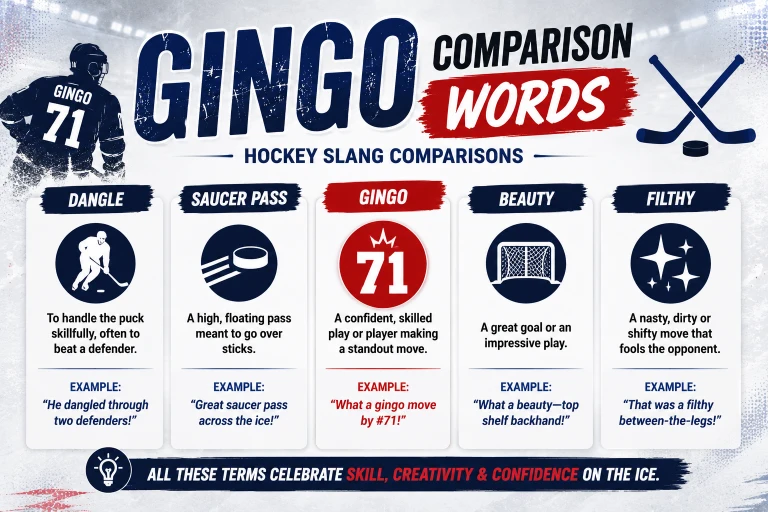
Hockey has no shortage of colorful words for scoring, and gino is just one entry in a much bigger list. Here’s how it stacks up against similar terms:
| Slang Term | Meaning | Tone |
| Gino | A goal that’s been scored | Casual, celebratory |
| Snipe | A precise, well-placed shot that scores | Impressed, admiring |
| Bar down | A shot that hits the crossbar and drops into the net | Excited, highlight-worthy |
| Light the lamp | To score a goal (referencing the red goal light) | Classic, broadcast-friendly |
| Hatty | Three or more goals by one player in a game | Achievement-focused |
The main difference is that gino is a general, all-purpose word for any goal, while terms like “snipe” or “bar down” describe the style of the shot itself.
When to Avoid Using It
There’s really no situation where gino would be considered inappropriate, since it’s a neutral, positive term. That said, it’s still slang, so it’s worth skipping in:
- Formal writing, like a game recap for a school newspaper or official team report
- Conversations with people unfamiliar with hockey culture, where it might just cause confusion
- Professional or corporate settings, simply because it reads as overly casual
Polite Alternatives
Since gino isn’t rude to begin with, there’s no need for a “polite” substitute it but if you want a more formal or universally understood word, “goal” works perfectly in any context where slang might not fit.
Why People Use This Slang
Hockey culture runs on shorthand and inside language. Using words like gino instead of “goal” signals that you’re part of the community , it’s a small way players and fans bond over a shared vocabulary.
It also just makes talking about the game more fun. Shouting “gino!” carries more energy in the moment than a flat “goal,” which is part of why slang like this sticks around from locker room to locker room, generation to generation.
Impact of Using Slang in Communication
Slang like gino strengthens group identity and makes conversations feel more natural among people who already know the game.
The flip side is that it can create a small barrier for newcomers , someone new to hockey might hear “he scored a gino” and have no idea what just happened.
Understanding terms like this helps close that gap and makes it easier to follow along with commentary, social posts, and casual rink talk.
Is It Safe for Social Media?
Yes. Gino is completely safe to use on any platform. There’s nothing offensive, sensitive, or age-restricted about it.
It’s commonly used in captions, comments, and highlight clips across Instagram, TikTok, and X (formerly Twitter) without any issue.
Examples in Different Tones
Friendly: “Great gino out there today, man that shot was filthy.”
Casual: “Scored a gino in the third, nothing wild, just happy to help the team.”
Argumentative (trash talk during a game): “That was barely a gino, your goalie fell over , I could’ve scored that blindfolded.”
Gaming or social media context: “GINO first goal of the season let’s gooo”
FAQs
Q1. What does gino mean in hockey?
It means a goal has been scored , it’s used exactly like the word “goal.”
Q2. Is gino an offensive term?
No, it’s completely neutral and used in a positive, celebratory way.
Q3. Where did the term gino come from?
Its exact origin isn’t fully documented, but it’s part of a long tradition of hockey locker-room slang; some fans also loosely associate it with NHL player Evgeni “Geno” Malkin, though the slang term and the nickname are generally considered separate.
Q4. Is gino the same as Geno (Evgeni Malkin’s nickname)?
Not officially they’re spelled and used differently, though the similar sound has led to some playful overlap among fans.
Q4. Can I use gino outside of hockey?
It’s specific to hockey culture, so using it elsewhere probably won’t be understood — it’s best kept to hockey conversations.
Q5. Is “gino” the correct spelling, or is it “geno”?
Both spellings show up across hockey slang guides and communities; “gino” tends to be more common, but you may see “geno” used interchangeably.
Conclusion
Gino hockey slang is a simple, upbeat term that means exactly one thing: a goal has been scored. It’s neutral, safe to use anywhere, and mostly lives in the casual, spoken side of hockey culture ,locker rooms, pickup games, and social clips rather than formal broadcasts.
If you’re chirping with teammates or captioning a highlight online, dropping “gino” instead of “goal” is an easy way to sound like you know the game. Just remember the context: it’s a fun, insider word, so save it for hockey talk where the audience will actually get the reference.
Explore More Articles:

Hi, I’m Tyler Brooks, a writer specializing in Gen Z culture and internet slang. I track trending terms across TikTok and social media to explain their real-world meanings. My goal is to provide clear, accurate, and up-to-date definitions that help readers understand modern online language.