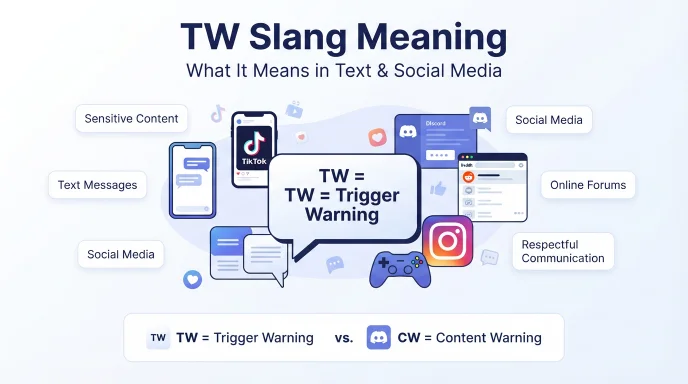
TW slang meaning usually stands for “Trigger Warning.” People search for this abbreviation because they often see it before sensitive posts on TikTok, Reddit, X, Instagram, Discord, or other online platforms. If you’re new to internet slang, seeing “TW” at the beginning of a post can be confusing.
Unlike many slang terms that are used for humor or texting shortcuts, TW is meant to help readers prepare for potentially upsetting content.
It gives people the choice to continue reading or skip the content if it may affect them emotionally.
Quick Answer:
TW means “Trigger Warning.” It is a short notice placed before content that may include sensitive topics such as violence, abuse, self-harm, or other potentially distressing subjects.
What Does TW Mean in Text?
In texting and online conversations, TW most commonly means Trigger Warning.
A trigger warning is a brief alert that tells readers the following message, image, or video may contain sensitive or emotionally difficult content. It allows people to decide if they want to continue.
Examples include:
- TW: Graphic injury
- TW: Violence
- TW: Eating disorders
- TW: Self-harm discussion
The goal is not to censor content but to give readers a chance to prepare or avoid topics they may find upsetting.
TW Full Form
| Abbreviation | Full Form | Most Common Meaning |
| TW | Trigger Warning | Alert before sensitive content |
Although Trigger Warning is the most common meaning, TW can have different meanings depending on the context.
Other possible meanings include:
| Meaning | Where You May See It |
| Trigger Warning | Social media, forums, blogs |
| Twitter (older abbreviation) | Older online discussions |
| Taiwan | News or geography |
| Team Win | Gaming communities (less common) |
When chatting online, Trigger Warning is almost always the intended meaning unless the conversation clearly suggests otherwise.
What Does TW Stand For in Slang?
In modern internet slang, TW stands for Trigger Warning.
Unlike playful abbreviations such as LOL or BRB, TW serves an informational purpose. It helps make online spaces more considerate by warning users about potentially distressing material.
You’ll often see it before discussions involving:
- Violence
- Abuse
- Trauma
- Death
- Serious accidents
- Mental health struggles
- Graphic medical content
Is TW Rude, Offensive, or Neutral?
TW is generally neutral.
The abbreviation itself is not offensive. Instead, it is used respectfully to help others.
People usually appreciate trigger warnings because they allow users to choose if they want to view sensitive content.
However, problems can arise if someone:
- Uses TW sarcastically.
- Places unnecessary trigger warnings on harmless content.
- Uses it to mock serious issues.
Using TW sincerely is considered polite and respectful.
Where Is TW Commonly Used?
Social Media
People often add TW before:
- Instagram captions
- TikTok videos
- X posts
- Facebook posts
Example:
TW: Discussion of grief.
Many Reddit users begin posts with a trigger warning before discussing sensitive experiences.
Example:
TW: Domestic violence.
Discord
Community servers frequently encourage members to include TW before posting upsetting images or discussions.
Text Messages
Friends sometimes send a trigger warning before discussing difficult news.
Example:
TW: Hospital discussion. I wanted to update you about what happened today.
Blogs and Online Articles
Writers may place a trigger warning before articles discussing traumatic events or graphic details.
Real-Life Examples of TW Usage
Here are examples showing how TW is used naturally.
Friendly
TW: Pet loss. I wanted to share something emotional today.
Casual
TW: Blood in the next photo.
Social Media
TW: Eating disorder discussion.
Mental Health Discussion
TW: Anxiety and panic attacks.
Gaming Community
TW: Loud flashing effects in this gameplay clip.
Educational Content
TW: Historical violence discussed below.
Origin and Background of TW
The phrase Trigger Warning became widely used on internet forums during the early 2000s.
It was first popular in online support communities where people discussed traumatic experiences. Members used warnings to help others avoid unexpected emotional distress.
Over time, the practice spread to:
- Tumblr
- Twitter (now X)
- TikTok
- Discord
- Online news articles
Today, trigger warnings are commonly used across many internet communities, although opinions about their use sometimes differ.
Do You Know:
TW slang usually stands for Trigger Warning, a brief notice that alerts readers to sensitive or potentially upsetting content.It is commonly used on social media, online forums, and in text messages to help people decide if they want to continue viewing the content. This makes online communication more thoughtful and respectful.
Why Do People Use TW?
People use TW for several reasons.
1. To Respect Others
Sensitive topics affect people differently.
A warning gives readers the opportunity to decide ifthey wish to continue.
2. To Prevent Unexpected Distress
Some people may find discussions of trauma emotionally overwhelming.
A simple warning helps reduce surprise.
3. To Create Safer Online Spaces
Many online communities encourage thoughtful communication.
Trigger warnings support respectful conversations.
4. To Give Context
Readers immediately understand that sensitive material follows.
This improves clarity before difficult discussions.
Comparison with Similar Slang
| Term | Meaning | Purpose |
| TW | Trigger Warning | Warns about sensitive content |
| CW | Content Warning | Warns about potentially upsetting material, often broader than TW |
| NSFW | Not Safe For Work | Warns about explicit or inappropriate content |
| FYI | For Your Information | Shares useful information |
| PSA | Public Service Announcement | Gives important public information |
TW vs CW
Many people use TW and CW interchangeably.
However:
- TW usually refers to emotionally triggering topics.
- CW may cover a wider range of sensitive material, including spoilers, flashing lights, or disturbing images.
When Should You Avoid Using TW?
Although TW is useful, there are situations where it isn’t necessary.
Avoid using it:
- Before ordinary conversations.
- As a joke about serious topics.
- To exaggerate harmless situations.
- To mock people who use trigger warnings.
Using TW appropriately helps maintain its purpose.
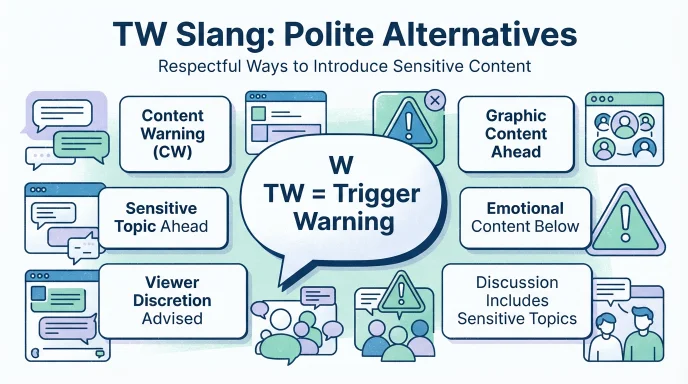
Polite Alternatives
Why Has TW Become So Popular?
Several reasons explain its popularity.
- Social media reaches large audiences.
- Mental health awareness has increased.
- Online communities encourage respectful communication.
- Platforms often discuss sensitive real-world events.
- Creators want viewers to make informed choices.
TW has become part of everyday internet culture rather than simply internet slang.
Impact of Using TW in Communication
Using trigger warnings can have both positive and negative effects.
Positive Effects
- Shows consideration for others.
- Gives readers informed choices.
- Encourages respectful discussions.
- Helps people prepare emotionally.
- Improves community guidelines.
Possible Drawbacks
- Some people overuse trigger warnings.
- Different communities have different expectations.
- Not everyone agrees on what requires a warning.
The key is using TW thoughtfully and only when appropriate.
Is TW Safe for Social Media?
Yes.
TW is considered safe across most social media platforms.
Many creators use it before discussing:
- True crime
- Medical conditions
- Mental health
- Violence
- Abuse
- Serious accidents
Adding a trigger warning often improves clarity and demonstrates respect for your audience.
Real-Life Examples in Different Situations
Friendly Conversation
TW: I want to talk about something emotional today.
Casual Text
TW: This story includes a car accident.
Argumentative Discussion
TW: Abuse discussion before continuing this thread.
Gaming
TW: Flashing lights appear during the next boss fight.
Instagram Caption
TW: Mental health discussion.
Reddit Post
TW: Grief and family loss.
Frequently Asked Questions
Q1. What does TW mean in texting?
TW usually means Trigger Warning, letting readers know sensitive content follows.
Q2. Is TW always short for Trigger Warning?
No. It can also mean Twitter, Taiwan, or other phrases depending on context, but Trigger Warning is the most common online meaning.
Q3. Is TW offensive?
No. It is generally considered respectful because it helps prepare readers for potentially upsetting content.
Q4. What is the difference between TW and CW?
TW focuses on emotionally triggering material, while CW (Content Warning) can apply to a broader range of sensitive or disturbing content.
Q5. Should I use TW on social media?
Yes, if your post contains graphic, traumatic, or emotionally sensitive topics. It helps readers decide if they want to continue.
Q6. Can TW be used in text messages?
Yes. People sometimes use it before discussing difficult news or personal experiences with friends or family.
Q7. What is a TW girl?
A TW girl usually refers to a girl who adds Trigger Warnings (TW) before sharing sensitive content online. It is not an official slang term and its meaning can vary by context.
Q8. What does TW mean?
TW most commonly stands for Trigger Warning. It alerts readers that the following content may contain sensitive or potentially upsetting topics.
Q9. What is TW in TikTok?
On TikTok, TW means Trigger Warning. Creators use it before videos about topics like violence, grief, or mental health to inform viewers in advance.
Q10. What does TW abuse mean?
TW: Abuse means “Trigger Warning: Abuse.” It tells readers or viewers that the content includes discussions or depictions of abuse and may be distressing to some people.
Conclusion
TW slang meaning is Trigger Warning, a short notice that alerts readers to potentially sensitive or distressing content.
Rather than being casual slang, it serves as a respectful communication tool across texting, social media, forums, and online communities.
Understanding what TW stands for, when to use it, and how it differs from similar terms like CW can help you communicate more thoughtfully online.
When used appropriately, TW gives readers the freedom to decide if they are ready to engage with sensitive material, making digital conversations more considerate and inclusive.
Read More:

Hi, I’m Rachel Simmons, a language writer specializing in American English and modern slang. I research regional expressions, everyday phrases, and evolving word meanings across the United States. I enjoy making complex language trends simple, practical, and easy for everyone to understand.