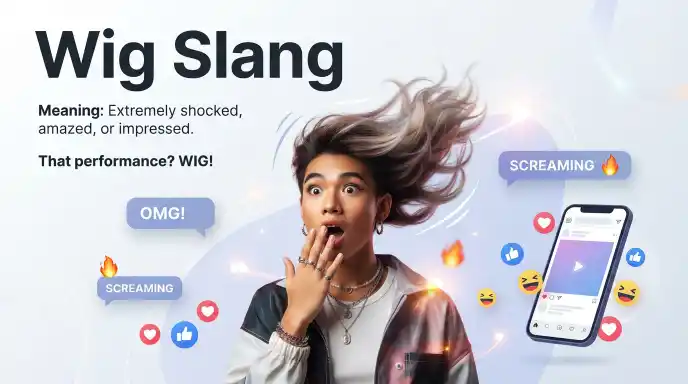
Wig slang means being extremely shocked, impressed, or excited by something, often because it is so amazing or unexpected. In online conversations, people may simply say “wig!” as a dramatic way to show that something has blown them away.
If you have seen wig slang on TikTok, Instagram, X, or in text messages, you may wonder why people are talking about hair. In its slang use, “wig” is not usually about a real hairpiece.
It is a playful reaction that suggests something was so powerful that it metaphorically knocked your wig off.
This slang is often seen in fandoms, entertainment discussions, social media comments, and casual chats. Its meaning can change slightly with the situation, so context matters.
In this guide, you will learn what wig slang means, how people use it, where the expression comes from, and when it is appropriate to use.
Quick Answer: What Does Wig Slang Mean?
Wig slang means “I’m extremely impressed, shocked, or amazed.” It comes from the humorous idea that something was so surprising or powerful that it metaphorically knocked a person’s wig off.
Example:
“That performance was incredible. Wig!”
It is usually a playful and positive reaction.
What Does Wig Slang Mean?
In internet conversations, wig is used as a short reaction to something that creates a strong emotional response.
It can communicate:
- Shock: “I can’t believe that happened.”
- Amazement: “That is incredible.”
- Excitement: “This is so good!”
- Admiration: “You look amazing.”
- Surprise: “I did not see that coming.”
The slang is based on exaggeration. The idea is that something was so powerful that it metaphorically made your wig fly off.
For example:
“She looked amazing at the event. Wig!”
The person is not saying that someone’s actual wig came off. They are saying the appearance was extremely impressive.
You may also see longer versions such as:
“My wig is gone.”
“You just snatched my wig.”
“Wig snatched.”
All of these expressions are built around the same basic idea: something left the speaker stunned or impressed.
Is Wig an Acronym or Abbreviation?
No. Wig is not an acronym or abbreviation in this slang meaning.
It is the regular English word “wig”, which normally means a hairpiece. Internet users gave the word a figurative meaning as a dramatic reaction.
This is different from slang terms that come from initials or shortened phrases. For example, “LOL” comes from “laughing out loud,” while “wig” does not stand for a longer phrase.
| Term | Meaning |
| Wig | Extremely impressed, shocked, or amazed |
| Wig snatched | Completely stunned or impressed |
| My wig is gone | I am extremely shocked or impressed |
| Snatched | Looking excellent or impressing someone |
So, if someone comments “WIG!”, there is no hidden full form you need to decode.
Different Meanings of Wig Slang
The main slang meaning stays connected to a strong reaction, but the exact emotion can change depending on the context.
Wig Meaning: Extremely Impressed
The most common use is to show that something is very impressive.
Someone might comment:
“That dance was perfect. Wig!”
Here, the speaker means:
“That was so impressive!”
This use is common when reacting to music, dancing, fashion, makeup, performances, or other creative work.
Wig Meaning: Shocked or Surprised
“Wig” can also express strong surprise.
For example:
“Wait, she actually won? Wig.”
The speaker is showing that they did not expect the result.
In this situation, “wig” is closer to “I can’t believe it” than simply “that was good.”
Wig Meaning: Overwhelmed by Something Amazing
Sometimes people use the term when something feels so dramatic or exciting that they do not know how else to react.
For example:
“That plot twist took me completely by surprise. Wig.”
The speaker may not literally be praising the plot twist. They are emphasizing how strongly it affected them.
Wig as a Dramatic Reaction
Online slang often uses exaggeration for humor. “Wig” works well because it turns a normal reaction into a funny mental image.
Instead of saying:
“I am very impressed.”
someone can simply write:
“Wig.”
The shorter version feels more dramatic and more suited to casual internet conversation.
Wig vs. Wig Snatched
Although these expressions are closely related, they are not exactly identical.
| Expression | Basic meaning | Tone |
| Wig | I am amazed or impressed | Short and dramatic |
| Wig snatched | I am completely stunned | More dramatic |
| My wig is gone | I am extremely shocked | Humorous |
| Snatched | Excellent, attractive, or impressive | Positive |
For example:
“That outfit is amazing. Wig!”
This is a short reaction.
A more dramatic version would be:
“That outfit completely snatched my wig.”
Both express a strong reaction, but the second one makes the exaggeration more obvious.
Where Is Wig Slang Commonly Used?
Wig slang is mainly used in casual online spaces where people share quick, emotional reactions. You may see it in social media comments, fan communities, text messages, and conversations about music, fashion, celebrities, or entertainment.
It is especially useful when someone wants to show a strong reaction without writing a long sentence.
Wig Slang on TikTok
On TikTok, people may use “wig” after watching an impressive performance, transformation, reveal, or funny moment.
For example:
“That transition was so clean. Wig!”
Here, the commenter means that the transition was extremely impressive.
Wig Slang on Instagram
Instagram users may use “wig” in comments under photos, videos, beauty posts, fashion content, or celebrity posts.
For example:
“The whole look is perfect. WIG.”
The comment shows strong admiration.
Wig Slang in Text Messages
In texting, “wig” can be used as a quick emotional reaction between friends.
Friend 1: “I got tickets to the concert!”
Friend 2: “WIG! No way!”
In this case, the word shows excitement and surprise.
Wig Slang on Discord
On Discord, the expression can appear in casual gaming, fandom, or community chats.
For example:
Player 1: “I beat the boss without taking damage.”
Player 2: “Wig. That was confusing.”
The speaker is reacting to an impressive achievement.
Wig Slang on X and Other Online Communities
The term can also appear in posts and replies about celebrities, music releases, television shows, movies, and other entertainment topics.
A person might write:
“That final scene? Wig.”
The short reaction tells other users that the scene caused a strong emotional response.
Is Wig Slang Rude, Offensive, or Harmless?
Wig slang is usually harmless and playful when used in the right setting. It normally expresses excitement, admiration, surprise, or amazement rather than insulting someone.
However, its cultural background is worth understanding.
The slang sense of “wig” is commonly associated with AAVE (African American Vernacular English) and Black queer and drag culture. It later became widely used in online fandom and stan communities. Because of this history, it is better to understand the expression as part of a broader cultural path rather than describing it simply as a random “Gen Z invention.”
The word itself is not normally offensive. Still, context matters.
Is Wig Appropriate for Everyone?
There is no rule that only one group can use the word. However, people should understand where expressions come from before using them casually.
It is also possible for a slang term to sound natural among friends but strange in a formal setting.
For example:
“Wig! Your performance was amazing!”
may sound fun among friends.
But in a formal school or workplace setting, this would be clearer:
“Your performance was excellent.”
Knowing the audience is more important than forcing slang into every conversation.
Real-Life Examples of Wig Slang
The best way to understand wig slang is to see how people actually use it.
Example 1: Amazing Performance
Mia: “Did you watch her live performance?”
Sara: “Yes! Wig. Her vocals were incredible.”
Here, “wig” means “I was extremely impressed.”
Example 2: Unexpected News
Alex: “Guess what? We got tickets for the final.”
Sam: “WIG! Seriously?”
Here, “wig” expresses excitement and surprise.
Example 3: Fashion
“That jacket looks amazing on you. Wig!”
The speaker is strongly complimenting the person’s appearance.
Example 4: Makeup
“The makeup artist really nailed this look. Wig.”
Here, “wig” shows admiration for the finished look.
Example 5: A Plot Twist
Friend 1: “Did you see who was behind everything?”
Friend 2: “No! That ending was shocking. Wig.”
The speaker is reacting to an unexpected plot twist.
Example 6: Gaming
Player 1: “I won the match with one point left.”
Player 2: “Wig. That was way too close.”
Here, “wig” shows surprise and excitement about the result.
Example 7: Social Media Comment
“The transformation at the end. WIG ”
The commenter is saying that the final reveal was extremely impressive or surprising.
What Does “My Wig Is Gone” Mean?
“My wig is gone” is a more dramatic way of saying “I am completely shocked or impressed.”
The expression uses the same metaphor as “wig snatched.” The speaker is joking that something was so powerful that their imaginary wig has disappeared.
For example:
“She just announced a surprise album. My wig is gone.”
The person is not talking about a real wig. They are saying the announcement surprised them greatly.
This phrase is usually playful and works best in informal conversations.
What Does “Wig Snatched” Mean?
“Wig snatched” means that something was so impressive, surprising, or powerful that it metaphorically knocked your wig off.
It is often used as a strong reaction to:
- A great performance
- An impressive outfit
- A dramatic reveal
- A surprising announcement
- A major plot twist
- A celebrity moment
- An unexpected achievement
For example:
“That final performance snatched my wig.”
The speaker means that the performance left them extremely impressed.
“Wig snatched” can overlap with “snatched,” but the two expressions do not always have the same use. “Snatched” can describe someone’s appearance or style, while “wig snatched” focuses more directly on the viewer’s reaction.
How the Tone Changes With Context
The same word can sound different depending on the conversation.
| Context | Example | Intended feeling |
| Compliment | “Wig! That outfit looks amazing.” | Admiration |
| Surprise | “Wig, I didn’t expect that.” | Shock |
| Excitement | “WIG! We got tickets!” | Excitement |
| Entertainment | “That ending? Wig.” | Amazement |
| Gaming | “Wig, how did you win?” | Surprise |
| Formal work chat | “Wig! Great presentation.” | Too casual |
The important point is that “wig” is highly informal. Its meaning is usually easy to understand when the surrounding conversation is casual.
Wig Slang in Casual vs. Professional Communication
Casual Communication
“Wig” can work well when talking with:
- Close friends
- Online friends
- Fandom communities
- Social media followers
- Gaming groups
- People who regularly use internet slang
The dramatic tone is part of its appeal.
Professional Communication
It is usually better to avoid “wig” in:
- Business emails
- Job applications
- Formal reports
- Academic writing
- Official messages
- Professional presentations
Use a clear phrase instead.
For example:
Informal:
“Wig! Your presentation was amazing.”
Professional:
“Your presentation was excellent and very well organized.”
The second version communicates the same positive idea without relying on slang.
Origin and History of Wig Slang
Wig slang is linked to AAVE, Black queer and drag culture, and later online fandom communities. The expression uses the image of a wig flying or being removed to show that someone was so shocked or impressed that they were metaphorically “knocked out” by what they saw.
The exact first use of wig as slang is difficult to pin down to one person or date. It is more accurate to describe its development through related expressions and communities than to claim a single confirmed inventor.
From Hair and Performance Culture to Slang
Wigs have long been an important part of drag and performance culture. A dramatic wig reveal or change can be part of a performance, making hair a natural part of expressions about appearance and transformation.
Related phrases such as “wig snatched” developed the idea further. If someone’s wig is metaphorically “snatched,” the person has seen something so impressive or shocking that they are left stunned.
The expression later spread through wider internet communities, especially fandom and stan culture.
Wig Slang in the 2010s
The term became much more visible online during the 2010s. It appeared in conversations about celebrities, music, television, fashion, beauty, and performances.
Online fandom communities helped popularize short reaction phrases because users could communicate strong emotions with just a few words.
Know Your Meme records a slang definition for “wig” from November 2017 and connects the expression with related phrases such as “wig snatched” and “snatched bald.”
A notable mainstream pop-culture moment happened during American Idol in 2018, when contestant Noah Davis used the expression during his audition. The exchange helped introduce the term to viewers who may not have encountered it online before.
Did Gen Z Invent Wig Slang?
No, it is not accurate to say that Gen Z invented wig slang.
Although younger internet users helped spread and popularize the expression, its history reaches into earlier cultural and online communities. Describing it only as “Gen Z slang” removes important context about its development.
The term’s history also shows why internet slang can move from a specific cultural community into much wider online use.
Is Wig Slang Still Popular?
Wig is still recognizable as internet slang, but its popularity depends on the online community.
People familiar with older stan culture, fandom language, and social-media slang may understand it immediately. Others may recognize the word but use it less often themselves.
Slang has a natural lifecycle. A phrase can remain understandable even after it becomes less trendy.
Today, “wig” may feel more natural in:
- Fandom communities
- Celebrity discussions
- Meme pages
- Casual social media comments
- Older internet slang conversations
- Informal chats
It may sound less natural in formal communication or among people who do not use internet slang.
That does not make the expression wrong. It simply means audience and context matter.
Similar Slang to Wig
Several slang expressions communicate a similar feeling of amazement, admiration, or surprise.
| Slang | Meaning | Main difference |
| Wig | Extremely impressed or shocked | Focuses on the speaker’s reaction |
| Wig snatched | Completely stunned or impressed | More dramatic version |
| Slay | Do something extremely well | Praises the person or action |
| Ate | Did something very well | Strong praise for performance or appearance |
| Shook | Very surprised or shocked | Focuses more on surprise |
| Mind blown | Extremely amazed | More general expression |
| Snatched | Looking excellent or stylish | Often describes appearance |
For example:
“She slayed that performance.”
focuses on how well she performed.
“Wig!”
focuses more on the speaker’s reaction to the performance.
“I was shook.”
focuses mainly on being surprised or shocked.
These terms can overlap, but they are not exact synonyms in every situation.
Wig vs. Slay
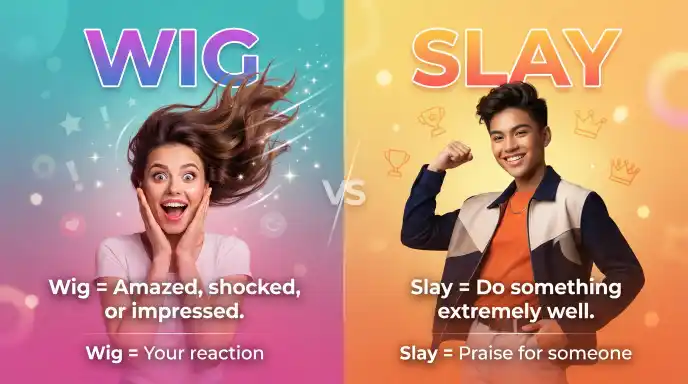
Wig and slay can both appear as positive reactions, but they serve different purposes.
“Slay” usually praises a person’s action, appearance, or performance.
“She slayed that dance.”
The speaker is praising the dancer.
“Wig” describes the speaker’s strong reaction.
“That dance? Wig!”
The speaker is saying that the performance left them amazed.
Wig vs. Shook
Wig and shook can both express surprise, but “shook” is more directly connected to being shocked or unsettled.
For example:
“I was shook when I saw the ending.”
This means the ending surprised the person.
“That ending? Wig!”
This can show surprise, but it can also suggest admiration or excitement.
The surrounding context tells you which emotion is strongest.
When Should You Avoid Using Wig Slang?
You should avoid wig slang when the situation requires formal, clear, or professional language.
Avoid It in Formal Writing
Do not normally use “wig” in:
- School essays
- Academic research
- Formal reports
- Business proposals
- Job applications
- Professional documents
Use standard words such as amazing, impressive, surprising, excellent, or remarkable instead.
Avoid It When the Audience May Not Understand
If you are speaking with someone who rarely uses internet slang, “wig” may confuse them.
For example, a parent, teacher, client, or older relative may understand the literal meaning of “wig” but not the slang meaning.
In those cases, saying:
“That was amazing!”
is clearer than:
“Wig!”
Avoid It in Serious Conversations
“Wig” is designed to be playful and dramatic. It may sound inappropriate when discussing serious or sensitive subjects.
Choose language that matches the seriousness of the conversation.
Polite Alternatives to Wig Slang
If you want to express the same basic idea without slang, there are many simple alternatives.
| Instead of “Wig” | You can say |
| Wig! | That was amazing! |
| Wig! | I’m impressed! |
| Wig, seriously! | I can’t believe it! |
| My wig is gone. | I’m completely shocked! |
| You snatched my wig. | You really surprised me! |
| Wig! That looks good. | That looks fantastic! |
These alternatives are easier to use with teachers, parents, coworkers, clients, and other formal audiences.
Why Do People Use Wig Slang?
People use wig because it delivers a strong reaction in a very short form.
Instead of writing:
“I am extremely impressed by what I just saw.”
someone can simply write:
“Wig!”
The slang also adds humor and exaggeration. The imaginary picture of a wig flying off makes the reaction more expressive than a simple “wow.”
It can also help users signal that they understand a particular online style or fandom community.
Common Misunderstandings About Wig Slang
Does Wig Always Mean a Hairpiece?
No.
The normal dictionary meaning is a hairpiece, but in an online conversation, “wig” may be a reaction meaning “I am shocked, amazed, or impressed.”
Look at the surrounding words to determine which meaning is intended.
Does Wig Have a Full Form?
No. Wig does not have a standard full form in this slang use.
It is not an abbreviation like LOL or IDK.
Does Wig Mean the Same as Slay?
Not exactly.
“Slay” usually praises someone’s performance, appearance, or success. “Wig” describes the speaker’s dramatic reaction to something impressive or surprising.
Is Wig Only Used by Young People?
No.
It is strongly associated with online culture and younger internet communities, but anyone familiar with the expression can understand or use it.
Is Wig Always Positive?
Usually, it expresses a positive or excited reaction, but it can also simply show shock or surprise.
For example:
“Wig, I did not expect that.”
The speaker may be surprised rather than praising something.
Frequently Asked Questions
Q1. What does wig mean in slang?
Wig means that someone is extremely impressed, shocked, amazed, or excited by something. It is often used as a short and dramatic online reaction.
Q2. What does “wig snatched” mean?
“Wig snatched” means that something was so impressive or shocking that it metaphorically knocked someone’s wig off. It is a more dramatic version of “wig.”
Q3. Is wig a Gen Z slang word?
Wig is commonly associated with modern internet culture, but it did not originate simply as a Gen Z invention. Its history is connected to AAVE, Black queer and drag culture, and later online fandom communities.
Q4. Is wig slang offensive?
Usually, no. It is generally used as a playful reaction. However, its cultural history should be understood rather than ignored.
Q5. Can I use wig slang at work?
It is best to avoid it in formal workplace communication. In a very casual team chat, it may be understood, but professional wording is safer.
Q6. What does “my wig is gone” mean?
It means “I am extremely shocked, surprised, or impressed.” It is a humorous extension of the “wig snatched” idea.
Q7. Is wig still used on social media?
Yes, the slang remains recognizable online, especially in fandom and entertainment communities. However, its popularity varies by platform and audience.
Q8. What is another word for wig slang?
Depending on the context, similar expressions include shook, mind blown, wow, slay, ate, and wig snatched. They are related but do not have exactly the same meaning.
Conclusion: What Does Wig Slang Mean?
Wig slang means being extremely impressed, shocked, amazed, or surprised by something. The expression turns the ordinary word “wig” into a playful reaction, based on the idea that something was so powerful that it metaphorically knocked your wig off.
You are most likely to see it in casual social media posts, fandom communities, texting, and entertainment discussions. It can be positive, dramatic, and humorous, but it is not a good choice for formal writing or professional communication.
The expression also has a cultural history connected to AAVE and Black queer and drag communities, so understanding that background gives the term more context.
The simple takeaway: when someone says “Wig!” online, they are usually saying “Wow, that was amazing!” or “I can’t believe what I just saw!”
Read More Articles:
- Vibing Meaning Slang: Origins,Uses, and Real-Life Examples
- Gen Z Slang for Love: Meanings, Examples & Popular Terms

Hi, I’m Rachel Simmons, a language writer specializing in American English and modern slang. I research regional expressions, everyday phrases, and evolving word meanings across the United States. I enjoy making complex language trends simple, practical, and easy for everyone to understand.