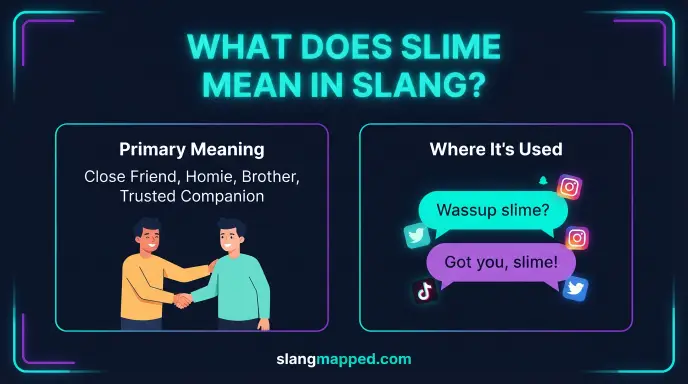
What does slime mean in slang? Simply put, slime is a casual term of endearment for a close friend, brother, or highly trusted homie.
While the word brings up images of something sticky and gross, in modern internet culture and texting, calling someone “my slime” means they are your day-one ally who always has your back.
Originating in Harlem and Atlanta hip-hop communities, the phrase has migrated to TikTok, Discord, and texting as a staple of youth culture.
If you are deciphering a text from a teenager or catching up on modern internet lingo, this guide covers its true meaning, roots, and proper usage.
Quick Answer: What Does Slime Mean in Slang?
Slime means a close friend, brother, or highly trusted companion. When someone calls you “slime,” they are acknowledging a strong bond of loyalty and friendship. It is an affectionate term primarily used in casual settings and youth subcultures.
- Primary Meaning: Close friend, homie, or brother.
- Tone: Informal, affectionate, highly casual.
- Popularized By: Hip-hop culture (Young Thug, YSL record label, Vado).
- Safety: Harmless in casual conversations; inappropriate for professional or school settings.
Detailed Breakdown: What Does Slime Mean?
While the literal definition of slime refers to a thick, slippery substance, its slang meaning is entirely about interpersonal trust and connection.
When used as a noun, calling someone “my slime” is equivalent to saying “my day-one friend” or “my brother.” It signifies that the person has your back through thick and thin.
“That’s my slime right there — we’ve known each other since grade school.”
Is it an Acronym?
In recent years, internet users created a backronym (an acronym fitted to an existing word) to explain the term:
- S Street
- L Life
- I Intelligence
- M Motivating
- E Educational
While this acronym circulates widely on social media graphics, it was created after the word was already popular in street culture and hip-hop. You do not need to memorize the acronym to understand or use the slang naturally.
The 3 Different Meanings of Slime in Modern Slang
Depending on who you are talking to and where you are reading it, the word can shift meanings slightly.
| Slang Meaning | Definition | Context / Tone | Example |
| 1. Close Friend / Homie (Most Common) | A trusted companion or brother. | Affectionate, street-smart, casual. | “What’s good, slime?” |
| 2. To Deceive or Snake Someone (Verb) | To betray, trick, or take advantage of a friend. | Negative, warning, critical. | “I can’t believe he slimed his own crew out of that deal.” |
| 3. Nickelodeon Toy / Trend (Literal Slang) | Actual gooey slime popular among younger kids and DIY creators. | Lighthearted, playful, youth culture. | “We spent all afternoon making ASMR slime videos.” |
Where is Slime Commonly Used?
You will encounter this term across specific digital platforms and subcultures:
- Text Messages & DMs: Used as a greeting between close friends (“Wassup slime”).
- TikTok & Instagram: Appears in comment sections, video captions, and hip-hop music edits.
- Discord & Gaming Communities: Used in casual voice chats and gaming servers, particularly within rap, streetwear, or competitive gaming groups.
- Hip-Hop & Rap Culture: Frequently heard in song lyrics, rap interviews, and social posts from Atlanta and East Coast rap artists.
Origin and History of Slime as Slang
To truly understand this term, it helps to look at its evolution within American hip-hop culture.
Early Beginnings and Evolution
- Harlem Origins (Late 2000s): Harlem rapper Vado, alongside Dipset members like Cam’ron and Jim Jones, began heavily using “slime” as street slang for a brother or close associate in New York City.
- Atlanta Expansion (2010s): Atlanta rapper Young Thug adopted the word, elevating it from regional slang to a global brand. He named multiple mixtapes after it (e.g., Slime Season) and founded the record label YSL (Young Stoner Life / Young Slime Life).
- Mainstream Internet Culture: As hip-hop solidified its place as dominant youth culture, terms like “slime” migrated off music tracks and onto platforms like Twitter (X), Instagram, and TikTok.
Regional and Cultural Nuances to Slime
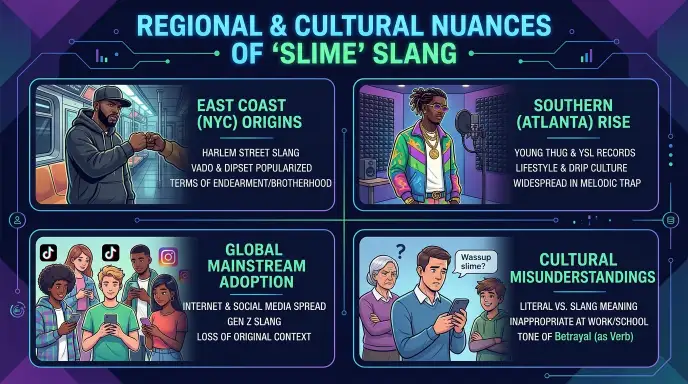
Slang dictionary competitors often overlook how regional dialects shape a word’s tone. “Slime” carries distinct cultural flavors depending on geographic region:
East Coast (NYC) Context
In New York City, particularly in Harlem and the Bronx, “slime” carries a rugged, street-authentic tone. It is frequently paired with words like “free” when shouting out incarcerated friends or used in drill rap subgenres.
Southern (Atlanta) Context
In Atlanta, the term transitioned into a broader lifestyle brand centered around drip, luxury fashion, and melodic trap music. Here, calling someone “slime” feels more artistic, smooth, and heavily connected to YSL culture.
Global Internet Context
Outside the US (such as in UK drill communities or Australian gaming hubs), youth adopt “slime” strictly through internet immersion. In these spaces, it functions purely as generic peer-to-peer slang without deep street roots.
Real-Life Conversation Examples
Here is how the word sounds in natural, everyday conversations across different settings:
Friendly Text Message
- Jordan: Yo, you pullin’ up to the game tonight?
- Malik: Yeah already on the way, slime. Save me a seat.
In a Gaming Voice Chat (Discord)
- Player 1: Nice clutch! You saved the whole round!
- Player 2: You already know, slime. I got you.
Warning About Betrayal (Verb Form)
- Sam: Why don’t you hang out with Chris anymore?
- Taylor: Man, he tried to slime me out of my share of the reselling profits. We’re done.
Is Slime Rude, Offensive, or Harmless?
Safety and Severity Check
- Is it a slur? No.
- Is it offensive? No, not when used as a noun meaning “friend.”
- Is it aggressive? When used as a verb (“to slime someone”), it implies betrayal, which carries a negative tone.
However, calling someone “slime” without having a close relationship can sound unnatural or overly familiar. It relies heavily on existing rapport.
When Should You Avoid Using It?
While harmless among peers, there are distinct environments where using this word will hurt your communication:
Workplace and Professional Settings
Never use “slime” in emails, Slack channels, or professional meetings. Stick to polite professional alternatives like “colleague” or “team.”
Academic Settings
Avoid using slang terms in essays, tests, or when speaking to teachers, professors, or school administrators.
Casual Acquaintances
Using it with someone you barely know might cause confusion or discomfort, as the word literally refers to something slippery and gross.
Polite Alternatives and Related Slang
If you want to express closeness without using this specific word, consider these popular alternatives:
| Term | Meaning | Tone / Setting |
| Bro / Brother | Close male friend. | Universal, universally understood. |
| Homie | Close friend from childhood or neighborhood. | Casual, classic hip-hop slang. |
| Twin | Someone who thinks or acts just like you. | Modern Gen Z slang, very popular on TikTok. |
| Fam | Friend treated like family. | Casual, widely accepted across age groups. |
| Bestie | Best friend. | Lighthearted, very common among Gen Z/Millennials. |
Common Misunderstandings
Misunderstanding 1: Thinking it’s an insult
Older adults or parents often assume calling a child “slime” is a put-down because of the literal definition. In modern youth slang, it is a compliment signifying loyalty.
Misunderstanding 2: Confusing it with “Snake”
A “snake” is a deceitful person. While “sliming” someone means snaking them, calling someone “my slime” means the exact opposite it means they are trustworthy.
Misunderstanding 3: Thinking it originated on TikTok
While TikTok helped spread the term to younger generations, the slang predates TikTok by over a decade, originating in New York and Atlanta hip-hop communities.
Non-Verbal Cues: Hand Gestures & Tone
Most slang guides miss the physical cues associated with the term. When spoken in real life, “slime” is rarely said in a flat tone:
Tone of Voice
It is usually delivered with a relaxed, warm tone or an upbeat cadence (often drawn out as “sliiiime” when greeting someone).
Accompanying Gestures
It is frequently accompanied by a dap (a casual hand-shake/fist-bump combo), a chest-bump, or a head nod.
Frequently Asked Questions
Q1. What does “slime” mean on TikTok?
On TikTok, “slime” usually means a close friend or brother. You will often see it in video captions, rap music edits, or comment sections where creators shout out their best friends.
Q2. What does “my slime” mean from a boy to a girl?
When a boy calls a girl “my slime,” he is typically placing her in the “friend zone” as a close, trusted buddy, or expressing genuine platonic loyalty. Occasionally, it is used endearingly in casual relationships.
Q3. Is “slime” AAVE?
Yes. The slang term originated within African American Vernacular English (AAVE) and hip-hop subcultures in Harlem, NYC, and Atlanta, Georgia, before entering broader mainstream internet slang.
Q4. What does it mean to “slime someone out”?
To “slime someone out” means to betray, trick, or take advantage of a person—often for personal gain, money, or social clout.
Q5. Is the term “slime” becoming outdated or cringe?
While still widely understood, its popularity peaked in mainstream internet culture around 2020–2022. Today, overuse by people outside the hip-hop or streetwear communities can sometimes be viewed as “cringe” or forced, though it remains a staple in authentic subcultures.
Conclusion: Understanding the Language of Modern Loyalty
Slang language evolves rapidly, but slime has sustained a remarkably strong presence in youth culture and modern communication for over fifteen years.
While the literal word brings up imagery of a sticky, unpleasant substance, its slang definition represents the exact oppositea badge of trust, mutual respect, and genuine brotherhood rooted deeply in Harlem and Atlanta hip-hop heritage.
If you encounter the term in a fast-moving TikTok comment section, a Discord gaming server, or a casual text message from a friend, calling someone your “slime” is one of the highest compliments of loyalty in modern internet culture.
Key Takeaway for Everyday Use:
- Keep it Casual: Use “slime” exclusively with close peers, friends, and within digital communities where informal speech is accepted.
- Know the Context: Avoid using the term in professional emails, academic essays, job interviews, or when speaking with teachers and authority figures.
By understanding the tone, origin, and social nuances behind the term, you can navigate modern online slang with confidence and clarity!
Read Related Slang Articles:
- What Does Totes Mean in Slang? Complete Guide
- Borg Meaning Slang: Origin, Recipe, and Why It’s Controversial
- Chuzz Meaning Slang: TikTok’s Controversial Slang Explained

Hi, I’m Rachel Simmons, a language writer specializing in American English and modern slang. I research regional expressions, everyday phrases, and evolving word meanings across the United States. I enjoy making complex language trends simple, practical, and easy for everyone to understand.