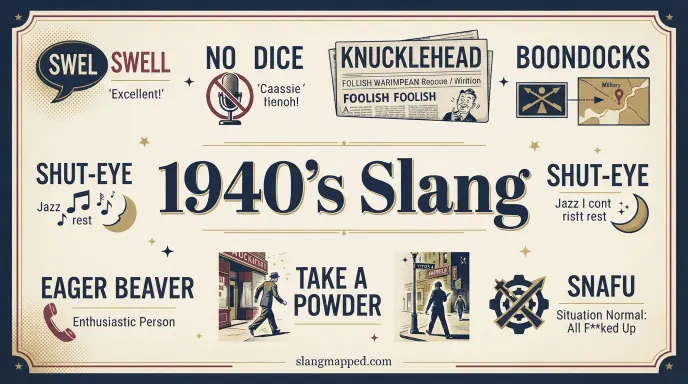
1940’s slang refers to the informal words and phrases used in American speech during the 1940s, especially around World War II, jazz and swing culture, movies, and everyday life.
Some terms disappeared, while others such as boondocks, swell, knucklehead, and SNAFU survived into modern English.
If you are searching for 1940’s slang, you may want to understand how people talked during this period or find authentic expressions for a story, history project, character, or conversation.
This guide explains common 1940s slang, what the words meant at the time, where they came from, and which ones are still understood today.
Quick Answer: What Is 1940’s Slang?
1940’s slang means informal American words and phrases associated with the 1940s. Much of this language was shaped by World War II, military life, jazz and swing culture, movies, and everyday American speech. Examples include “swell” for excellent, “take a powder” for leave, and “boondocks” for a remote place.
What Does 1940’s Slang Mean?
The phrase 1940’s slang does not describe one single type of slang. It is a broad label for informal expressions that were popular or recorded during the decade.
The 1940s were unusual because several different influences met at once:
- World War II and military life
- Jazz, swing, and dance culture
- Hollywood movies and radio
- Teen and young-adult culture
- American regional speech
- Working-class and urban expressions
- New military abbreviations and nicknames
Some expressions were genuinely new in the 1940s. Others were older words that became especially popular during the decade.
That distinction matters. A word appearing in a list of “1940s slang” does not necessarily mean it was invented in the 1940s.
For example, swell had already been used as slang meaning “excellent” by the 1930s, although it remained strongly associated with older American popular culture.
50+ Popular 1940’s Slang Words and Phrases
Here are some of the most useful examples of 1940s-era American slang.
| Slang | Meaning |
| Ace | Someone highly skilled |
| Ameche | To make a telephone call |
| Applesauce | Nonsense or an exclamation |
| Beat | Tired or exhausted |
| Bender | A drinking spree |
| Bop | To dance to jazz or swing music |
| Boondocks | A remote or rural place |
| Bupkis | Nothing |
| Broad | A woman; dated and often offensive |
| Brush-off | A rejection or snub |
| Cheesy | Cheap or poor quality |
| Chicken | A coward |
| Clams | Money |
| Cook with gas | Do something successfully |
| Cop | Police officer |
| Dame | Woman; now dated |
| Dead hoofer | Poor dancer |
| Doll | Girl or woman |
| Ducky | Good or excellent |
| Eager beaver | An enthusiastic person |
| Fuddy-duddy | An old-fashioned person |
| Gas | Something fun or funny |
| Greenbacks | Paper money |
| Gumshoe | Private detective |
| Heebie-jeebies | Nervousness or uneasiness |
| Hep | Fashionable or knowledgeable about current culture |
| Hitched | Married |
| Honcho | Person in charge |
| In the sticks | In an isolated rural area |
| Knucklehead | Foolish person |
| Lettuce | Paper money |
| No dice | No; refusal or rejection |
| Nuts | Aggressive |
| Peanuts | A small amount of money |
| Peepers | Eyes |
| Ragging | Teasing or making fun of someone |
| Schnook | Gullible or easily fooled person |
| Shuteye | Sleep |
| Snap your cap | Become angry |
| Sauced | Drunk |
| Stompers | Shoes |
| Swell | Excellent or wonderful |
| Take a powder | Leave |
| The sticks | A remote rural area |
| Tough cookie | Strong or difficult person |
| Two cents’ worth | One’s opinion |
| Unmentionables | Women’s underwear |
| Whammy | A spell or force causing bad luck |
| What’s cooking? | What’s happening? |
| What’s buzzin’, cousin? | What’s going on? |
| Zooty | Flashy or stylish |
Many of these meanings are documented in historical slang collections and reference works.
1940’s Slang for People
The 1940s had plenty of colorful terms for describing people.
Ace
An ace was someone who was especially skilled or successful at something.
Example:
“He’s an ace mechanic.”
The word is still common today, although it no longer feels strongly tied to the 1940s.
Eager Beaver
An eager beaver described someone enthusiastic and willing to work hard.
Example:
“Tom’s an eager beaver. He’s already finished the whole job.”
This expression remains understandable today.
Knucklehead
A knucklehead was a foolish or ignorant person.
Example:
“Don’t be such a knucklehead.”
It was generally a mild insult rather than an extremely offensive one.
Fuddy-Duddy
A fuddy-duddy was an old-fashioned person who disliked newer ideas, styles, or behavior.
Example:
“My uncle thinks dancing is improper. What a fuddy-duddy!”
This word still exists, but it sounds distinctly old-fashioned today.
Dame and Broad
Dame and broad could both refer to a woman in period slang.
However, these terms should not automatically be treated as friendly equivalents of woman today. Broad, in particular, is marked as offensive in historical slang references.
1940’s Slang for Money and Everyday Life
Money had plenty of informal names.
- Clams: money
- Greenbacks: paper dollars
- Lettuce: paper money
- Peanuts: a small amount of money
- Wad: a large amount of money carried together
For example:
“He only paid me peanuts for the job.”
Some of these expressions survived well beyond the 1940s.
Other everyday expressions included:
- Ameche: make a phone call
- Shuteye: sleep
- Peepers: eyes
- Stompers: shoes
- Specs: eyeglasses
- Hen fruit: eggs
These terms show how slang was not limited to dramatic or humorous expressions. People also used slang for ordinary objects and activities.
1940’s Military Slang
World War II had a major effect on American slang. Military personnel developed shortened expressions, nicknames, and acronyms that sometimes spread into civilian speech.
SNAFU
SNAFU is one of the best-known expressions connected with World War II military slang.
It was an acronym describing a situation that was badly disorganized or going wrong. Public explanations often softened the final word to “fouled” rather than using the original profanity. The expression was recorded in U.S. military slang by 1941.
The U.S. military also used Private Snafu as the name of a fictional, accident-prone soldier in training cartoons created during World War II. The cartoons were made to teach soldiers military lessons and improve morale.
Dogface
A dogface referred specifically to an infantry soldier.
GI
GI became strongly associated with American servicemen and the term Government Issue.
Ack-Ack
Ack-ack referred to anti-aircraft fire or anti-aircraft guns.
Flak
Flak referred to anti-aircraft fire. Its later use for criticism developed into a broader modern meaning.
These examples show how military life contributed a distinct layer of 1940s vocabulary.
1940’s Slang From Jazz and Popular Culture
Music and entertainment also influenced the language of the period.
Bop
Bop could mean dancing energetically to jazz or big-band music.
Gas
Calling something a gas meant it was fun or very funny.
Example:
“That party was a gas!”
Ducky Shincracker
A ducky shincracker was a good dancer.
Dead Hoofer
A dead hoofer was a poor dancer.
Expressions like these reflect how important dancing and popular music were to social life in the era.
What Does “Boondocks” Mean?
Boondocks means a remote area far away from cities or towns.
Today, you might hear:
“They live way out in the boondocks.”
The interesting part is its history. The word comes from Tagalog bundok, meaning “mountain.” It entered American English through U.S. military use in the Philippines and was reinforced during World War II.
So although boondocks is often listed among 1940s slang words, it did not originate in the 1940s. Its history goes back earlier.
This is an important example of why “slang from the 1940s” and “slang invented in the 1940s” are not the same thing.
What Did “Swell” Mean in the 1940s?
Swell meant excellent, wonderful, or very good in American slang.
For example:
“That’s a swell idea.”
The slang sense was already popular before the 1940s, particularly in the 1930s, but it remained recognizable during the 1940s.
Today, this meaning sounds dated or nostalgic. Someone saying “That’s swell!” may sound deliberately old-fashioned rather than like a typical modern speaker.
Where Was 1940’s Slang Used?
1940s slang appeared in many parts of American culture, but usage varied by group and setting.
| Setting | Common influence |
| Military | War terms, acronyms, soldier nicknames |
| Jazz clubs | Music and dance expressions |
| Movies | Hollywood and gangster-style language |
| Radio | Popular catchphrases and informal speech |
| Everyday conversation | Money, people, food, and activities |
| Teen culture | Music, fashion, and social expressions |
| Newspapers and magazines | Slang that had entered wider public awareness |
Not every American used every expression. Slang could vary by region, age, occupation, and social group.
That is why it is better to describe these as documented 1940s-era American expressions rather than claiming that everyone in the 1940s used them.
Is 1940’s Slang Rude or Offensive?
Some 1940s slang is harmless, while other terms can sound insulting or offensive today.
For example:
- Swell: harmless
- Eager beaver: generally harmless
- Knucklehead: mild insult
- Fuddy-duddy: teasing or mildly insulting
- Dame: dated
- Broad: potentially offensive
- SNAFU: contains an obscene original expansion
Historical context matters. A word can appear in an old movie or book without being appropriate for modern everyday conversation.
If you are writing historical fiction, the social setting and character matter. If you are speaking to someone today, modern neutral wording is usually safer.
Are 1940’s Slang Words Still Used Today?
Yes. Some survived almost unchanged, while others became dated.
Still familiar today
- Boondocks
- Knucklehead
- Eager beaver
- No dice
- What’s cooking?
- What’s up?
- Greenbacks
- SNAFU
- Two cents’ worth
- Hitched
Mostly dated or nostalgic
- Ameche
- Ducky shincracker
- Dead hoofer
- Dame
- Zooty
- Take a powder
- Snap your cap
- Doll, in some contexts
Some expressions may sound natural in a historical movie but unusual in a modern text message.
1940’s Slang vs. Modern Slang
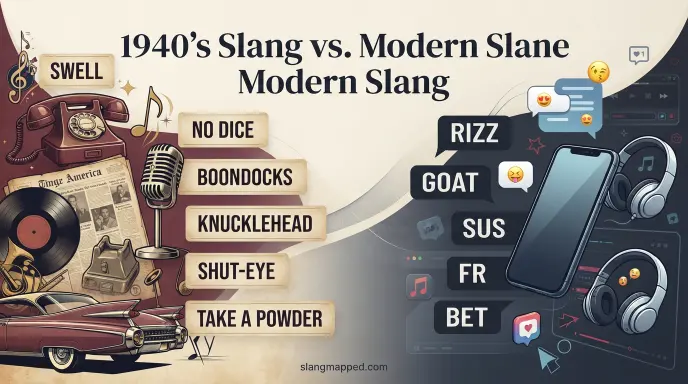
The biggest difference is not simply the vocabulary. It is where the slang comes from.
1940s slang was heavily influenced by:
- War and military service
- Radio
- Movies
- Jazz and swing
- Regional speech
- Face-to-face social life
Modern slang spreads much faster through:
- TikTok
- Discord
- Snapchat
- Text messaging
- Gaming communities
A 1940s speaker might ask:
“What’s cooking?”
A modern speaker could say:
“What’s up?”
Both can ask what is happening, but they belong to very different cultural periods.
Real-Life Examples of 1940’s Slang
Here are natural examples based on historical meanings:
1. “That new record is swell.”
Meaning: The record is excellent.
2. “I need some shuteye.”
Meaning: I need some sleep.
3. “Quit being a knucklehead.”
Meaning: Stop acting foolish.
4. “He’s way out in the boondocks.”
Meaning: He lives in a remote area.
5. “No dice. I’m not going.”
Meaning: No; I’m refusing.
6. “What’s cooking, cousin?”
Meaning: What’s happening?
7. “That fellow is an eager beaver.”
Meaning: He is very enthusiastic and hardworking.
8. “We were paid peanuts.”
Meaning: We received very little money.
Why Do People Search for 1940’s Slang?
People often look up 1940’s slang for more than simple curiosity.
Common reasons include:
- Writing historical fiction
- Understanding old movies
- Studying American history
- Researching family history
- Creating period-style dialogue
- Learning about World War II culture
- Understanding old songs or books
- Finding vintage names and expressions
- School projects
- Comparing older slang with modern slang
The key is to use historical expressions carefully. A list of old words can be useful, but knowing who used a term, when they used it, and what it meant at the time gives you a much more accurate picture.
When Should You Avoid Using 1940’s Slang?
You should avoid using historical slang when it could confuse people or sound disrespectful.
Be especially careful with terms that describe:
- Women in dated ways
- Ethnic or racial groups
- People based on appearance
- Sexual behavior
- Military or wartime situations
- Alcohol or drugs
You should also avoid forcing 1940s slang into modern professional communication. Writing “Take a powder!” to your manager, for example, could sound strange rather than clever.
For historical writing, however, dated expressions can make dialogue feel more authentic when they fit the character and time period.
Common Misunderstandings About 1940’s Slang
Was all 1940s slang invented during the 1940s?
No. Some expressions were older but remained popular during the decade.
Boondocks, for example, has roots going back to Tagalog bundok and earlier U.S. military use.
Did everyone in the 1940s use these words?
No. Slang differed by region, age, occupation, and social group.
Is every word on a “1940s slang” list authentic?
Not necessarily. Some online lists mix words from nearby decades or present older expressions as if they were invented in the 1940s.
That is why historical dating should be treated carefully.
Is 1940s slang the same as World War II slang?
Not exactly. World War II military slang is an important part of 1940s language, but civilian slang also included expressions about money, dancing, relationships, food, clothing, and everyday life.
Frequently Asked Questions
Q1. What are some popular 1940’s slang words?
Popular examples include swell, boondocks, knucklehead, eager beaver, no dice, take a powder, shuteye, greenbacks, dame, bupkis, and SNAFU.
Q2. What did “swell” mean in the 1940s?
Swell meant excellent, wonderful, or very good. The slang meaning existed before the 1940s, but people continued to use it widely during that period.
Q3. What did “boondocks” mean?
Boondocks meant a remote or rural place far away from cities. Its history is connected to the Tagalog word bundok, meaning “mountain.”
Q4. What did “take a powder” mean?
Take a powder meant to leave, often quickly or abruptly.
Q5. What did “SNAFU” mean?
SNAFU was World War II military slang for a situation that went badly wrong or became disorganized. Soldiers originally used a profane expansion of the acronym, while public sources often softened it to “Situation Normal: All Fouled Up.”
Q6. Is 1940s slang still used today?
Some terms remain common or recognizable, while others sound old-fashioned. Boondocks, knucklehead, eager beaver, and SNAFU are examples that survived in some form.
Q7. Was 1940s slang only used by soldiers?
No. Soldiers created and popularized many expressions, especially during World War II, but civilians also used slang connected with music, movies, money, relationships, and daily life.
Q8. Is 1940s slang appropriate today?
Some expressions are harmless, but others are dated, insulting, or offensive. If you use them today, context matters.
Conclusion
1940’s slang gives us a useful look at American life during a major period of history. The language of the decade was shaped by World War II, military culture, jazz, movies, radio, and everyday conversation.
Words such as swell, knucklehead, shuteye, boondocks, no dice, and eager beaver show the playful side of the era, while terms such as SNAFU reveal how strongly military life influenced American vocabulary.
The most important point is that not every expression labeled “1940s slang” was invented during the 1940s. Some were older terms that were popular at the time. Others came directly from wartime culture.
If you want to use these expressions in modern writing, check their historical meaning and tone first. That small step can make vintage dialogue feel much more believable.
You May also Like:
- IMA Slang Meaning: More Than Just Texting Shorthand
- Rico Meaning Slang: Full Definition, Examples & Usage Explained
- FOH Slang Meaning: The Internet’s Favorite Comeback

Hi, I’m Rachel Simmons, a language writer specializing in American English and modern slang. I research regional expressions, everyday phrases, and evolving word meanings across the United States. I enjoy making complex language trends simple, practical, and easy for everyone to understand.