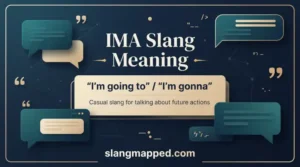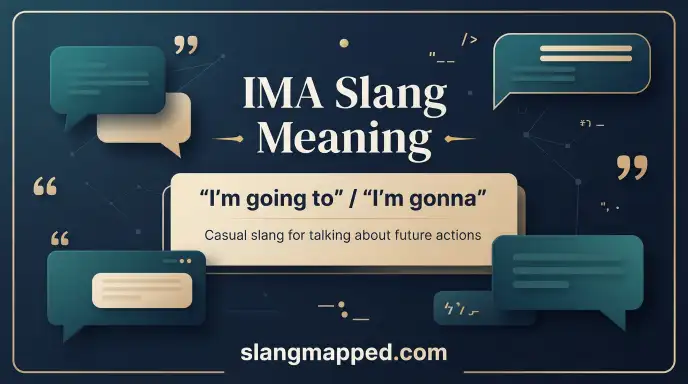
“Ima” is casual slang that usually means “I’m going to” or “I’m gonna.” People use it in texts, chats, comments, and other informal conversations to talk about something they plan or intend to do.
If you have seen messages like “ima call you later” or “ima go home,” you may wonder if ima slang is a typo, an abbreviation, or something else.
In most casual online conversations, it simply refers to an upcoming action. You may also see it written as imma, I’ma, or I’mma.
This guide explains the ima slang meaning, how people use it, where it comes from, if it is rude, and when you should avoid using it.
It also covers other possible meanings of “IMA,” because context can sometimes change what the term means.
Quick Answer
IMA slang usually means “I’m going to” or “I’m gonna.” It is an informal way to talk about an action someone plans or intends to do.
Example: “Ima call you tonight.”
Meaning: “I’m going to call you tonight.”
What Does IMA Slang Mean?
The most common ima slang meaning is “I’m going to.”
It is a casual, spoken-style form of the phrase. Instead of writing:
“I’m going to get some food.”
Someone may write:
“Ima get some food.”
The meaning stays the same. The spelling simply makes the sentence sound more relaxed and conversational.
“Ima” often appears before an action:
- Ima go = I’m going to go
- Ima call you = I’m going to call you
- Ima eat = I’m going to eat
- Ima check = I’m going to check
- Ima tell you = I’m going to tell you
The words that come after “ima” can help you understand the intended meaning quickly.
A Simple Way to Remember IMA
You can think of the expression as a casual progression:
I’m going to → I’m gonna → imma / ima
So, “ima” is better understood as an informal representation of casual speech rather than a traditional acronym.
Is IMA an Abbreviation?
Not exactly.
In its common slang use, ima is not an acronym in which each letter represents a separate word. It is a casual form that developed from spoken expressions such as “I’m gonna,” which itself comes from “I’m going to.”
This is why you may see several spellings:
| Form | Meaning | Typical Use |
| ima | I’m going to | Casual texting |
| imma | I’m going to | Casual speech and online writing |
| I’ma | I’m going to | Informal writing |
| I’mma | I’m going to | Informal writing |
| I’m gonna | I’m going to | Casual speech and texting |
These forms are closely related, although different speakers may prefer different spellings.
Why Are There Different Spellings?
Slang often tries to represent the way people actually speak.
When “I’m going to” is said quickly, it can sound much closer to “I’m gonna” or “I’ma.” Online users then spell the sound in different ways.
As a result, there is no single spelling that everyone must use.
Different Meanings of IMA
Although “I’m going to” is the main meaning of “ima” in casual conversation, IMA can have other meanings in certain contexts.
IMA Meaning “I’m Going To”
This is the most common slang meaning.
Example:
“Ima finish this homework first.”
Meaning:
“I’m going to finish this homework first.”
This meaning is especially likely when “ima” comes directly before a verb or action.
IMA Meaning “I Must Admit”
In some texting and slang references, IMA can also mean “I must admit.”
For example:
“IMA, that movie was better than I expected.”
Here, the writer is introducing an admission or personal opinion.
This meaning is much less common than “I’m going to,” so context is important. You should not automatically interpret every “IMA” as “I must admit.”
IMA as a Professional or Other Abbreviation
Outside slang, IMA can stand for different names, organizations, or technical terms.
For example, it can refer to the Institute of Management Accountants in a professional context.
This is why capitalization alone is not enough to determine the meaning. The words around IMA matter.
If someone writes:
“Ima call you later.”
they are almost certainly using slang.
If you see IMA in a business document, academic paper, or organization name, it may have nothing to do with slang.
Where Is IMA Slang Commonly Used?
“Ima” is mainly used in informal communication.
You may see it in:
- Text messages
- Group chats
- Instagram comments
- TikTok comments
- Snapchat messages
- Discord chats
- Gaming conversations
- Online forums
- Casual social media posts
It can also appear in spoken language because the form reflects casual pronunciation.
The platform does not decide the meaning by itself. The surrounding words and conversation give you the strongest clue.
IMA in Texting
“ima text you when I get there”
This means:
“I’m going to text you when I get there.”
IMA on TikTok and Instagram
“ima try this later”
This means:
“I’m going to try this later.”
It can appear in captions, comments, or direct messages when someone is talking casually.
IMA on Discord
“ima hop off for a while”
This means:
“I’m going to leave for a while.”
IMA in Gaming
“ima join after this match”
This means:
“I’m going to join after this match.”
Gaming chats often use short, informal language, so “ima” fits naturally in that setting.
Is IMA Slang Rude or Offensive?
No. “Ima” is not rude or offensive by itself.
It is simply an informal way to express an intention or future action.
The rest of the sentence can affect the tone, though.
For example:
“Ima grab some food.”
sounds neutral and casual.
But:
“Ima tell you exactly what I think.”
could sound serious or confrontational depending on the conversation.
So, the word “ima” itself is generally harmless. The tone comes from the complete sentence, the relationship between the speakers, and the situation.
Cultural and Linguistic Background of IMA Slang
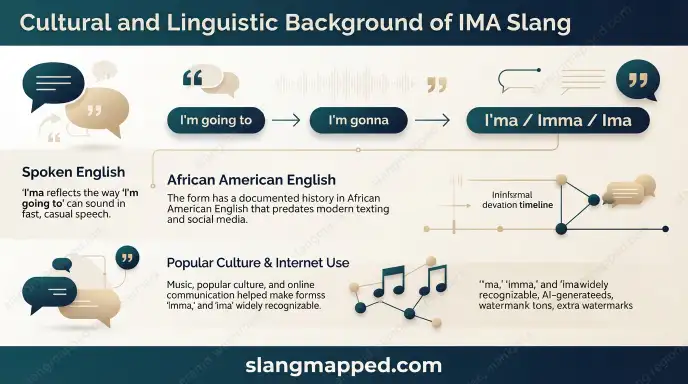
It is also worth understanding that forms such as “I’ma” and “imma” have a history that goes beyond modern texting.
The form has been associated with African American English and has also appeared widely in music and popular culture. It is therefore more accurate to describe it as part of a longer history of spoken English varieties rather than saying that the internet invented it.
This distinction matters because slang and informal speech can spread across communities and platforms while still having roots in particular speech communities.
Is IMA Appropriate at Work or School?
Usually, no.
“Ima” is strongly casual. It is suitable for relaxed conversations, but standard English is safer in formal communication.
| Situation | Is “ima” appropriate? |
| Texting a friend | Yes |
| Casual group chat | Yes |
| Gaming chat | Yes |
| Social media comment | Usually |
| Message to a close classmate | Usually |
| School assignment | No |
| Academic essay | No |
| Professional email | No |
| Formal report | No |
| Job application | No |
For example, avoid writing:
“Ima send the report tomorrow.”
in a professional email.
A better choice is:
“I’m going to send the report tomorrow.”
The same applies when writing to a teacher, employer, customer, or another person in a formal role.
Formal Alternatives
If you want to express the same idea in standard English, use:
- I’m going to
- I am going to
- I plan to
- I intend to
- I will, when the context calls for it
For example:
Casual:
“Ima check it and let you know.”
Formal:
“I’m going to check it and let you know.”
More professional:
“I’ll check it and let you know.”
Real-Life Examples of IMA Slang
“Ima” becomes easier to understand when you see it in natural conversations.
Example 1: Making Plans
Text:
“Ima meet you at 7.”
Meaning:
“I’m going to meet you at 7.”
Example 2: Leaving
Text:
“Ima head home now.”
Meaning:
“I’m going to head home now.”
Example 3: Calling Someone
Text:
“Ima call you after dinner.”
Meaning:
“I’m going to call you after dinner.”
Example 4: Gaming
Chat:
“Ima switch servers.”
Meaning:
“I’m going to switch servers.”
Example 5: Making a Decision
Text:
“Ima just buy it.”
Meaning:
“I’m going to buy it.”
Example 6: Social Media
Comment:
“Ima try this tomorrow.”
Meaning:
“I’m going to try this tomorrow.”
Example 7: Friendly Conversation
Text:
“Ima tell you something funny.”
Meaning:
“I’m going to tell you something funny.”
These examples show the main pattern: ima usually comes before an action that the speaker plans to take.
Origin and History of IMA Slang
The history of ima slang goes beyond modern texting and social media. The expression reflects the way “I’m going to” can change when people speak quickly and casually.
The form is closely related to “I’m gonna,” which is an informal spoken form of “I’m going to.” Over time, different speakers began representing these spoken forms in writing as “I’ma,” “imma,” “I’mma,” and “ima.”
Roots in Spoken English
“I’ma” has a documented history in African American English (AAE) that predates social media and modern internet slang. The form has also been widely used in music and popular culture, helping it become familiar to a much wider audience.
This means it is not accurate to say that teenagers or the internet invented “ima.” Its modern online use is part of a longer history of informal spoken English.
How IMA Became Common Online
Texting and social media made informal spellings much more visible.
People began writing the way they speak in:
- Text messages
- Online forums
- Social media posts
- Music-related discussions
- Gaming chats
- Messaging apps
As these platforms grew, spellings such as ima and imma became easy for readers to recognize.
There is no single confirmed date when “ima” suddenly became slang. Different spellings developed and spread over time, so it is better to describe its history as gradual rather than assigning it to one exact year.
IMA vs. IMMA vs. I’MA
The forms ima, imma, I’ma, and I’mma usually express the same basic idea: “I’m going to.”
| Form | Meaning | Example |
| ima | I’m going to | “Ima call her.” |
| imma | I’m going to | “Imma check it.” |
| I’ma | I’m going to | “I’ma leave soon.” |
| I’mma | I’m going to | “I’mma tell him.” |
| I’m gonna | I’m going to | “I’m gonna call him.” |
Does the Spelling Change the Meaning?
Usually, no.
The spelling may reflect a person’s preferred writing style, pronunciation, or online community. One person may write “ima”, while another writes “imma.”
For example:
“Ima go now.”
and
“Imma go now.”
normally communicate the same message.
There is no universal rule saying that one spelling is always correct.
Why Do People Use IMA?
People use “ima” because it makes communication feel shorter, more casual, and more conversational.
It Is Quick to Type
“Ima” is shorter than “I’m going to.”
When people are chatting quickly, they often choose shorter forms.
It Sounds Like Casual Speech
The spelling reflects how the phrase may sound when spoken naturally.
For example:
“I’m going to call you.”
can sound more like:
“I’m gonna call you.”
In even more casual speech, forms represented as “I’ma” or “imma” may appear.
It Creates a Relaxed Tone
Using “ima” can make a message sound less formal.
Compare:
“I’m going to watch a movie.”
with:
“Ima watch a movie.”
The second version feels more like a casual text between friends.
It Fits Online Communication
Online conversations often favor short, natural expressions. This is especially true in:
- Group chats
- Gaming
- Discord
- TikTok comments
- Instagram comments
- Snapchat
- Casual texting
Common Misunderstandings About IMA
Because “IMA” can have more than one meaning, readers sometimes misunderstand it.
“Is IMA Always an Acronym?”
No.
In its common slang use, ima is not an acronym in which each letter stands for a separate word.
It is an informal spelling connected to “I’m going to” and “I’m gonna.”
“Is IMA Just a Typo?”
Usually not.
If someone writes:
“ima call you later”
they are most likely using slang.
The unusual spelling is intentional and communicates a casual tone.
“Does IMA Mean ‘I Am’?”
Not usually.
The most common slang meaning is “I’m going to.”
For example:
“Ima get some food.”
means:
“I’m going to get some food.”
It does not simply mean “I am.”
“Does IMA Mean ‘I Must Admit’?”
It can in some contexts.
If someone writes:
“IMA, that was actually good.”
they may mean:
“I must admit, that was actually good.”
However, this use is much less common than “I’m going to.”
Always look at the surrounding sentence before deciding what IMA means.
“Is IMA a Gen Z Word?”
Not exactly.
Young people may use “ima” online, but the expression has a history that predates Gen Z and modern social media.
Calling it exclusively a Gen Z word would oversimplify its history and usage.
When Should You Avoid Using IMA?
You should avoid ima when standard or formal English is expected.
This includes:
- Job applications
- Professional emails
- Academic assignments
- School essays
- Formal reports
- Official documents
- Business proposals
- Formal presentations
In Professional Communication
Instead of:
“Ima send the file today.”
write:
“I’m going to send the file today.”
This sounds clearer and more professional.
In School Writing
Instead of:
“Ima explain the answer.”
write:
“I’m going to explain the answer.”
Even if your teacher understands the slang, standard English is usually expected in academic writing.
With People You Do Not Know Well
If you are unsure about someone’s communication style, standard English is the safer option.
You can always use slang in a relaxed conversation once you know that the other person is comfortable with it.
Polite Alternatives to IMA Slang
There is nothing offensive about “ima,” but you may want a more neutral expression in some situations.
Casual Alternatives
- I’m gonna
- I’m going to
- I’ll
- I plan to
Formal Alternatives
- I am going to
- I plan to
- I intend to
- I will
- I am planning to
How IMA Is Used Across Different Platforms
The meaning usually stays the same, but the tone and frequency of use can vary.
| Platform | Typical use of IMA | Tone |
| Texting | Talking about plans | Very casual |
| Snapchat | Quick messages | Casual |
| TikTok | Comments and captions | Casual |
| Comments and DMs | Casual | |
| Discord | Chat and gaming | Very casual |
| Informal discussion | Casual | |
| Workplace chat | Possible but not ideal | Informal |
| School work | Usually avoid | Formal |
IMA in Text Messages
Texting is one of the most natural places to see “ima.”
“ima be there soon”
The writer is simply saying:
“I’m going to be there soon.”
IMA on TikTok
TikTok comments often use informal spelling and conversational language.
“ima try this recipe”
means:
“I’m going to try this recipe.”
IMA on Discord
Discord conversations are usually relaxed, especially in gaming communities.
“ima hop on later”
means:
“I’m going to get online later.”
IMA in Workplace Chat
You may understand a coworker’s message such as:
“ima send it in a few minutes”
but it is still quite casual.
For professional communication, “I’ll send it in a few minutes” or “I’m going to send it in a few minutes” is usually better.
Similar Slang and Related Expressions
Several expressions are close to “ima,” but they are not always identical.
I’m Gonna
The closest everyday alternative is “I’m gonna” .
“I’m gonna call you.”
Meaning:
“I’m going to call you.”
It is casual but often feels slightly more standard in writing than “ima.”
Gonna
“Gonna” is an informal form of “going to.”
“I’m gonna leave.”
It is common in speech and casual writing.
I’ll
“I’ll” is a contraction of “I will.”
It can work in both casual and professional communication, depending on the sentence.
I Plan To
“I plan to” is more neutral.
This is useful when you want to sound clear without using slang.
Why Context Matters With IMA
Context is especially important because IMA can have different meanings.
Consider these two examples:
“Ima call you later.”
Here, “ima” clearly means “I’m going to.”
Now consider:
“IMA, that was a great movie.”
Here, the intended meaning could be “I must admit.”
The sentence structure gives you the clue.
A useful rule is:
If IMA comes before an action verb, “I’m going to” is usually the likely meaning.
For example:
- Ima go
- Ima call
- Ima eat
- Ima check
- Ima leave
- Ima tell
If it introduces an admission or opinion, another interpretation may be possible.
Is IMA Still Common?
“Ima” remains recognizable in informal speech and online communication, but slang does not have one fixed level of popularity everywhere.
Its use can vary by:
- Age
- Region
- Community
- Platform
- Personal writing style
- Cultural background
Some people strongly prefer “imma,” while others use “ima” or “I’ma.”
It is therefore better to describe “ima” as a well-established informal expression rather than claiming that everyone uses it or that it is exclusively associated with one generation.
Frequently Asked Questions
Q1. What does IMA mean in slang?
IMA usually means “I’m going to” or “I’m gonna.” It is an informal expression used in texts, chats, social media, and other casual conversations.
Q2. What does IMA mean in texting?
In texting, IMA most commonly means “I’m going to.”
For example:
“ima call you later”
means:
“I’m going to call you later.”
Q3. Is IMA the same as IMMA?
Usually, yes. Ima and imma are commonly used to express the same idea: “I’m going to.”
The difference is mainly spelling and personal preference.
Q4. Is IMA rude?
No. “Ima” is not inherently rude or offensive.
It is simply informal slang. The rest of the sentence determines if the overall message sounds friendly, serious, or rude.
Q5. Can I use IMA in a formal email?
It is better to avoid it.
Use “I’m going to,” “I plan to,” or “I will” instead.
Q6. What does “ima go” mean?
“Ima go” usually means “I’m going to go.”
Depending on the context, it can also mean that someone is about to leave.
Q7. Can IMA have another meaning?
Yes. In some contexts, IMA can mean “I must admit.” It can also represent professional or organizational names outside slang.
Context is the best way to determine the intended meaning.
Final Thoughts
The most common ima slang meaning is “I’m going to” or “I’m gonna.” It is a casual way to talk about an action someone plans to take.
You may see ima, imma, I’ma, or I’mma in texting, gaming chats, social media, and other informal conversations. These forms generally communicate the same idea.
The expression is not rude or offensive by itself. However, it is too casual for most academic and professional writing, where “I’m going to,” “I plan to,” or “I will” is a better choice.
The key takeaway is simple:
IMA usually means “I’m going to.” Check the context when another meaning could fit.
You May Also Like:
- CIP Meaning Slang: The Term Everyone’s Searching For
- What Is Deuce Slang for Drug? 2026 Updated Guide
- Twinnem Slang Meaning: A Breakdown of This Viral Slang Term

Hi, I’m Rachel Simmons, a language writer specializing in American English and modern slang. I research regional expressions, everyday phrases, and evolving word meanings across the United States. I enjoy making complex language trends simple, practical, and easy for everyone to understand.