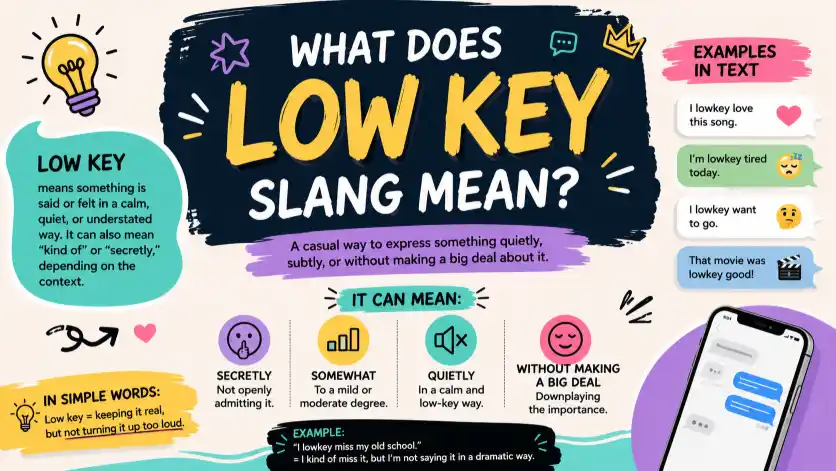
What does low key slang mean? Low key slang means expressing something quietly, subtly, or without making a big deal about it.
If you have seen phrases like “I low-key love this song” or “I’m low-key tired” in texts, TikTok comments, or social media posts, you may wonder what the speaker really means.
The phrase is common in casual online conversations because it can make a statement sound more relaxed or understated.
Depending on the context, low-key can mean “somewhat,” “secretly,” “quietly,” or “without much attention.” For example, “I low-key want to go” may mean that someone wants to go but is not openly expressing that feeling.
Understanding the context is important because the meaning can change slightly from one sentence to another.
Quick Answer
Low key slang means something is true, felt, or happening quietly, mildly, or without drawing much attention to it. In texting, “I low-key like it” can mean “I actually like it, but I’m not making a big deal about it.”
What Does Low Key Slang Mean in Text?
In text messages, low-key is usually used to make a statement sound more casual, understated, or private.
For example:
“I low-key want to leave early.”
This does not necessarily mean the person strongly wants to leave. It suggests they kind of want to leave or quietly feel like leaving without making a big announcement about it.
Another example is:
“I low-key love this movie.”
Here, the speaker may be admitting that they really enjoy the movie while presenting the opinion in a relaxed or understated way.
The exact meaning depends on context. Low-key can describe a feeling, opinion, desire, plan, or reaction.
Common meanings include:
- Somewhat: “I’m low-key nervous.”
- Secretly: “I low-key want to try it.”
- Quietly: “They celebrated low-key.”
- Without making a big deal: “Let’s keep it low-key tonight.”
This flexibility is one reason the phrase is so common in casual online communication.
Low-Key Slang Full Form and Definition
Unlike abbreviations such as “LOL” or “IDK,” low-key does not have a full form.
It is a phrase made from the words low and key. In slang, however, the phrase has developed a broader conversational meaning.
What Does Low-Key Stand For?
Low-key does not stand for another phrase. It is not an acronym or shortened form.
In modern casual speech, it can suggest:
- A hidden or less openly expressed feeling
- A mild degree of something
- An understated opinion
- Something done quietly
- A desire to avoid attention
For example:
“I low-key miss school.”
The speaker is expressing that they miss school but may be saying it in a casual or slightly understated way.
Is Low-Key Rude, Offensive, or Neutral?
Low-key is generally neutral and is not considered an offensive slang term.
It is commonly used between friends, family members, classmates, coworkers in informal settings, and online communities.
However, tone still matters.
Consider:
“You’re low-key annoying me.”
The phrase itself is not offensive, but the overall sentence can sound critical or rude.
Likewise:
“I low-key appreciate you.”
This sounds positive and friendly.
So, low-key is neutral slang, but the sentence around it determines if the message sounds friendly, serious, sarcastic, or negative.
For formal writing, it is usually better to replace it with clearer standard English.
Where Is Low-Key Slang Commonly Used?
Low-key appears frequently in informal digital communication.
Texting
Friends may use it to describe feelings or opinions:
“I low-key want pizza.”
“I’m low-key stressed about tomorrow.”
TikTok and Instagram
Social media users often use low-key in captions and comments to make opinions sound casual or understated.
Examples:
“Low-key the best outfit.”
“I low-key need this.”
Snapchat
The phrase can appear in short messages and stories when people share quick reactions.
“Low-key having a great day.”
Reddit users may use low-key when giving an opinion without presenting it too strongly:
“This game is low-key underrated.”
Discord and Gaming
Gamers may use the term when discussing games, strategies, characters, or reactions.
“I low-key forgot the objective.”
The phrase is especially natural in casual conversations where short, expressive language is common.
Different Meanings of Low-Key Slang
One important point is that low-key does not always mean exactly the same thing.
Low-Key Meaning “Somewhat”
Sometimes it simply means to a small or moderate degree.
Example:
“I’m low-key tired.”
Meaning:
“I’m somewhat tired.”
The speaker is not necessarily hiding the feeling. They are simply describing it as mild.
Low-Key Meaning “Secretly”
It can also suggest that someone has a feeling they are not openly admitting.
Example:
“I low-key have a crush on him.”
This can imply:
“I kind of have a crush on him, but I don’t openly talk about it.”
The idea of secrecy is stronger in this use.
Low-Key Meaning “Quietly”
The phrase can also describe an activity that happens without much attention.
Example:
“We had a low-key birthday party.”
Here, low-key means the party was simple, relaxed, and not very elaborate.
Low-Key Meaning “Without Making a Big Deal”
This use focuses on keeping something relaxed.
Example:
“Let’s have a low-key weekend.”
This means the person wants a calm weekend without a lot of plans, excitement, or social activity.
Real-Life Examples of Low-Key Slang
The best way to understand this slang is to see how it changes with context.
Friendly Example
Friend 1: Did you like the new café?
Friend 2: Yeah, I low-key loved it.
Here, low-key makes the statement sound casual and relaxed.
Casual Example
“I’m low-key hungry.”
This usually means the person is somewhat hungry or has started feeling hungry.
Secretive Example
“I low-key want to go to the concert.”
The speaker may want to attend but is not strongly announcing the desire.
Positive Example
“This is low-key one of my favorite songs.”
The speaker is expressing strong appreciation in an understated way.
Negative Example
“That comment was low-key rude.”
Here, low-key softens the criticism slightly. The speaker is saying the comment was somewhat rude without making the statement extremely harsh.
Argumentative Context
Person 1: Why are you upset?
Person 2: Because you were low-key ignoring me all night.
Here, low-key suggests that the ignoring may not have been obvious or direct, but the speaker noticed it.
Gaming Example
“That weapon is low-key overpowered.”
The gamer is saying the weapon may be stronger than expected.
Social Media Example
“Low-key obsessed with this trend.”
This means the person really likes the trend, but the wording keeps the statement playful and casual.
Low-Key vs. High-Key
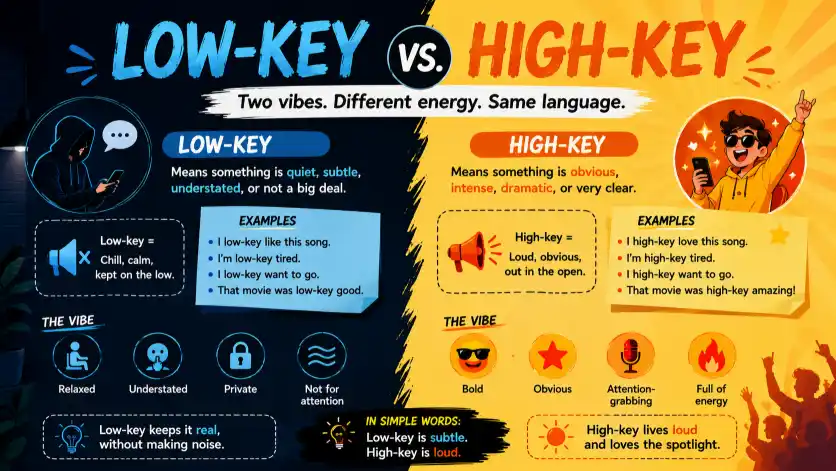
Low-key is often compared with high-key because the two expressions can suggest opposite levels of openness or intensity.
| Term | Common Meaning | Example |
| Low-key | Quietly, somewhat, secretly, or without emphasis | “I low-key like it.” |
| High-key | Openly, strongly, or very clearly | “I high-key love it.” |
For example:
“I low-key want to go.”
This sounds understated.
“I high-key want to go.”
This sounds much more direct and emphatic.
However, high-key is less universal than low-key, and people may use the two expressions differently depending on their online community or personal style.
Low-Key vs. Kind of
In many sentences, low-key can be similar to kind of.
“I’m low-key nervous.”
“I’m kind of nervous.”
Both can communicate a mild feeling.
However, low-key can add an extra sense of understatement or quiet admission.
For example:
“I low-key want to quit.”
This can sound like the speaker is revealing a thought they have not been saying openly.
Low-Key vs. Secretly
These terms can overlap, but they are not always identical.
Secretly strongly suggests that something is hidden.
“She secretly likes him.”
This clearly suggests she does not openly reveal her feelings.
Low-key is softer:
“She low-key likes him.”
This could mean she likes him quietly, somewhat, or without making it obvious.
So, context is important.
Origin and Background of Low-Key Slang
The expression low-key existed in English before its modern internet-slang use. Its older meaning was connected to keeping something restrained, quiet, or not highly noticeable.
Over time, the phrase became common in informal speech as a way to describe something that was understated or kept quiet.
Its use expanded online as social media, texting, and other forms of digital communication became more conversational.
Today, people can use low-key both as an adjective and as an informal adverb-like modifier.
For example:
“It was a low-key event.”
and:
“I low-key enjoyed it.”
These sentences use the phrase in slightly different ways.
The slang meaning is not limited to one website or one generation. It appears across many forms of casual communication, although the exact tone can vary between speakers.
Why Do People Use Low-Key Slang?
People often use low-key because it makes a statement feel less intense and more conversational.
It Softens Opinions
Compare:
“I hate this.”
with:
“I low-key hate this.”
The second statement can sound less blunt, although it can still express a strong negative opinion.
It Shows Understatement
Someone may genuinely feel strongly but choose to express the feeling casually.
“I low-key love this.”
This can communicate enthusiasm without sounding overly serious.
It Can Suggest Privacy
The phrase can hint that the speaker is revealing something they do not normally say openly.
“I low-key miss them.”
It Fits Online Communication
Short, informal expressions work well in texts, captions, comments, chats, and gaming conversations. Low-key adds personality without requiring a long explanation.
When Should You Avoid Using Low-Key?
Low-key is fine for most casual conversations, but it may not fit formal communication.
Avoid using it when writing:
- Academic assignments
- Formal reports
- Business proposals
- Official applications
- Professional documentation
- Formal workplace emails
For example, instead of writing:
“I’m low-key concerned about the results.”
a formal version could be:
“I have some concerns about the results.”
The meaning is clearer and more professional.
You should also avoid relying on slang when communicating with someone who may not understand online expressions.
Polite and Formal Alternatives to Low-Key
Depending on the context, you can replace low-key with:
- Somewhat
- Slightly
- Quietly
- Privately
- Mildly
- Rather
- A little
- To some extent
- Without drawing attention
- In a subtle way
For example:
Casual:
“I’m low-key worried.”
More formal:
“I’m somewhat worried.”
Another example:
Casual:
“We had a low-key celebration.”
Neutral:
“We had a simple celebration.”
Is Low-Key Safe for Social Media?
Yes. Low-key is generally safe and non-offensive for social media.
It is commonly used in everyday online conversations, captions, comments, and messages.
Still, safety is different from appropriateness. A harmless slang term can still make a post sound too casual for a professional audience.
Before using it, consider:
- Who will read the post?
- Is the platform casual or professional?
- Could the statement be misunderstood?
- Does the conversation require formal language?
For personal posts and casual chats, low-key is usually completely normal.
The Impact of Low-Key on Communication
Using low-key can change how a message feels.
Without it:
“I like this song.”
With it:
“I low-key like this song.”
The second version can sound more relaxed, playful, or understated.
It can also create ambiguity. Someone reading “I low-key want to go” may not know if the speaker slightly wants to go or strongly wants to go but is trying to hide it.
That is why context and tone matter.
If your message needs to be precise, simply state what you mean.
Common Sentence Patterns With Low-Key
Here are some natural patterns you may see online:
“I low-key…”
Used to express a feeling, opinion, or desire.
“I low-key want to stay home.”
“That’s low-key…”
Used to describe something in an understated way.
“That’s low-key impressive.”
“Low-key the…”
Often used in social media captions.
“Low-key the best part of the trip.”
“Keep it low-key.”
Used when someone wants something simple, quiet, or relaxed.
“Let’s keep the party low-key.”
These patterns can help you recognize the intended meaning when reading online conversations.
Low-Key Meaning in Different Contexts
| Context | Likely Meaning | Example |
| Feelings | Quiet or somewhat | “I’m low-key nervous.” |
| Attraction | Secret or understated | “I low-key like her.” |
| Opinion | Mildly or casually | “That movie was low-key good.” |
| Plans | Simple or relaxed | “Let’s keep it low-key.” |
| Gaming | Understated observation | “That character is low-key strong.” |
| Social media | Casual emphasis | “Low-key obsessed!” |
| Conversation | Without making a big deal | “I low-key forgot.” |
The same phrase can therefore have different shades of meaning.
FAQs About Low-Key Slang
Q1. What does low-key mean in texting?
In texting, low-key usually means somewhat, secretly, quietly, or without making a big deal about something. The exact meaning depends on context.
Q2. What does low-key mean on social media?
On social media, low-key often makes a statement sound casual or understated. For example, “low-key obsessed” means someone really likes something but expresses it playfully.
Q3. Is low-key a bad word?
No. Low-key is generally neutral slang and is not considered a swear word or offensive expression.
Q4. Does low-key mean secretly?
Sometimes. In a sentence such as “I low-key like him,” it can suggest a feeling that the speaker is not openly admitting. However, low-key can also simply mean “somewhat” or “quietly.”
Q5. What is the opposite of low-key slang?
High-key is commonly used as an informal opposite. It can suggest being open, obvious, or strongly expressive about something.
Q6. Can I use low-key in formal writing?
It is better to avoid it in formal writing. Use words such as somewhat, slightly, quietly, privately, or subtly, depending on what you mean.
Q7. What does Gen Z mean by lowkey?
Gen Z uses “lowkey” to mean “kind of,” “secretly,” or “quietly,” often to express a feeling or opinion in a casual, understated way.
Q8. Why do teenagers say “low key”?
Teenagers use “low key” to make their thoughts sound more relaxed, subtle, or less serious, such as “I lowkey love this song.”
Conclusion
So, what does low key slang mean? In texting and online conversations, low-key usually describes something that is quiet, understated, somewhat true, or not openly emphasized. It can also suggest a private feeling or a desire to avoid making something seem like a big deal.
For example, “I low-key love this song” can mean that the speaker really likes the song but is expressing that feeling casually. In “Let’s keep it low-key,” the phrase instead means simple, relaxed, or without much attention.
Because low-key can carry slightly different meanings, always consider the sentence and the speaker’s tone. It works well in texts, social media, gaming chats, and other informal settings, but clearer alternatives are better for formal communication.
Discover Related Slang Terms:
- Groofinator Slang: Meaning, Definition, Origin & How to Use It
- Awesome Slang Meaning: Complete Guide with Examples
- NFT Slang Meaning: Decode These 3 Mysterious Letters

Hi, I’m Tyler Brooks, a writer specializing in Gen Z culture and internet slang. I track trending terms across TikTok and social media to explain their real-world meanings. My goal is to provide clear, accurate, and up-to-date definitions that help readers understand modern online language.